Downloaded from hlayiso.com
NATIONAL SENIOR CERTIFICATE EXAMINATION
NOVEMBER 2017
NAUTICAL SCIENCE: PAPER II
Time: 3 hours 150 marks
PLEASE READ THE FOLLOWING INSTRUCTIONS CAREFULLY
1. This question paper consists of 6 pages. Please check that your question paper is
complete.
2. Answer ALL the questions in Sections A, B and C.
3. Begin the answer to each new question on a new page.
4. The use of scientific calculators is permitted.
5. Alphanumeric calculators and dictionaries are NOT permitted.
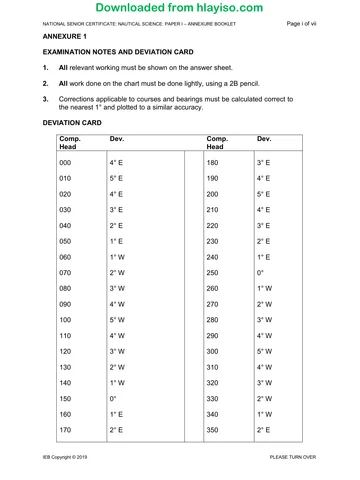
6. Nautical tables may be used.
7. It is in your own interest to write legibly and to present your work neatly.
REQUIREMENTS
Drawing Instruments
Radar Plotting Sheet
ANNEXURES – Nil
IEB Copyright © 2017 PLEASE TURN OVER
You're offline
Skip to contentQuestion paper 
View all
Nautical Science P2 2017 hlayiso.com
Nautical Science · Grade 12 · 2017. Question paper, 6 pages. Read online or download the PDF.
- Subject
- Nautical Science
- Grade
- Grade 12
- Document type
- Question paper
- Year
- 2017
- Paper
- 2
- Publisher
- IEB
- Pages
- 6
- File size
- 179.8 KB
Loading document…
Loading document…
1 of 6
Document textSearch extracted text and jump to a page.
Downloaded from hlayiso.com
NATIONAL SENIOR CERTIFICATE: NAUTICAL SCIENCE: PAPER II Page 2 of 6
SECTION A SEAMANSHIP
QUESTION 1
In compliance with the Convention on the International Regulations for Preventing
Collisions at Sea, 1972 as amended (hereinafter referred to as the COLREGs),
answer the following questions:
1.1 How should the Officer of the Watch ascertain whether a risk of collision
exists between two vessels approaching one another? (5)
1.2 From the bridge you sight a vessel ahead on a steady bearing displaying
the following day signal:
(a) What do these signals tell you about the operation of this vessel? (2)
(b) What is your course of action if this vessel is seen right ahead? (4)
1.3 When approaching the harbour you see a sailing vessel outbound. The
vessel displays a day signal of a "black cone" apex down, in the forepart
where it can best be seen.
(a) What does this signal mean? (3)
(b) What fog signal will this vessel sound? (4)
1.4 Two vessels are proceeding down a channel, the one overtaking the other.
In terms of the COLREGs, the overtaking vessel is to "give-way", and the
other is to "stand-on". What do you understand by the terms:
(a) "Give-way vessel"? (4)
(b) "Stand-on vessel"? (4)
IEB Copyright © 2017
Downloaded from hlayiso.com
NATIONAL SENIOR CERTIFICATE: NAUTICAL SCIENCE: PAPER II Page 3 of 6
1.5 State which vessels must comply with the COLREGs. (4)
1.6 A vessel over 50 metres in length is stopped and not making way through
the water due to a machinery breakdown and is therefore "not under
command".
(a) State what lights and day shapes are required to be displayed by
this vessel, and support your answer with a sketch for each (night
and day). (7)
(b) What fog signal would this vessel sound? (3)
[40]
QUESTION 2
2.1 List six action points in preparing to abandon ship (fitted with gravity davits). (6)
2.2 Name four action points that should be completed with the boats and life
rafts immediately after they have been launched in the water. (4)
[10]
QUESTION 3
Explain the effect on a vessel's stability and draught when a mass of weight is
shifted within the vessel if:
3.1 bunker fuel is transferred aft from No. 1 double bottom tanks port and
starboard to the engine room service tanks centre. (3)
3.2 ballast water is transferred from No. 4 upper wing tank port to No. 4 double
bottom tank starboard. (6)
3.3 ten containers are shifted from No. 4 lower hold starboard to No. 4 hatch
top port side. (6)
[15]
IEB Copyright © 2017 PLEASE TURN OVER
Downloaded from hlayiso.com
NATIONAL SENIOR CERTIFICATE: NAUTICAL SCIENCE: PAPER II Page 4 of 6
QUESTION 4
Your vessel is navigating in restricted visibility on a course of 030° (T), speed 6 kt.
A target is detected on the 12-mile radar range. The following bearings and ranges
were recorded:
TIME BEARING RANGE
10h00 324° (T) 11,4 m
10h03 325° (T) 10,5 m
10h06 325½° (T) 9,6 m
4.1 Plot the target on the plotting sheet provided. (7)
4.2 Prepare a full target report. (6)
4.3 Explain what action you would take to avoid a close quarter situation with
the target. (7)
[20]
QUESTION 5
General cargo vessels are also referred to as break-bulk vessels. What is the
difference between a break-bulk ship and a container ship?
[5]
90 marks
IEB Copyright © 2017
Downloaded from hlayiso.com
NATIONAL SENIOR CERTIFICATE: NAUTICAL SCIENCE: PAPER II Page 5 of 6
SECTION B COMMUNICATIONS AND METEOROLOGY
QUESTION 6
Describe in one or two paragraphs what the Global Maritime Distress and Safety
System (GMDSS) is.
[15]
QUESTION 7
7.1 There are two basic types of clouds – cumulus and stratus. Describe the
formation of each of these two types of clouds. (16)
7.2 List the main features of the north-east and south-east trade winds. (4)
[20]
35 marks
IEB Copyright © 2017 PLEASE TURN OVER
Downloaded from hlayiso.com
NATIONAL SENIOR CERTIFICATE: NAUTICAL SCIENCE: PAPER II Page 6 of 6
SECTION C SAILINGS
QUESTION 8
A vessel is preparing a passage from Vigo, Spain to Recife, Brazil.
8.1 Calculate the course and distance by Mercator sailing from the following
waypoints:
Vigo W.P. 42° 00' N 009° 30' W
Recife W.P. 08° 00' S 034° 40' W (20)
8.2 What is the steaming time at 18 knots to reach Recife? (5)
25 marks
Total: 150 marks
IEB Copyright © 2017
Recommended for this subject
Published documents with matching subject and grade metadata.
Question paper
Nautical Science P1 2019 hlayiso.com
Question paper
Nautical Science P1 Annexure Booklet 2019 hlayiso.com
Question paper
Nautical Science P2 2019 hlayiso.com
Question paper
Nautical Science P1 2018 hlayiso.com
Question paper
Nautical Science P1 Annexure booklet 2018 hlayiso.com
Question paper
Nautical Science P2 2018 hlayiso.com
Related documents
Matched using subject, grade, language, document type and exam metadata.
Memorandum
Nautical Science P2 MG 2017 hlayiso.com
Question paper
Nautical Science P1 2017 hlayiso.com
Question paper
Nautical Science P1 Annexure Booklet 2017 hlayiso.com
Memorandum
Nautical Science P1 MG 2017 hlayiso.com
Memorandum
Nautical Science P2 Memo 2019 hlayiso.com
Memorandum
Nautical Science P2 Memo 2018 hlayiso.com
More from Grade 12 Nautical Science
Explore more published documents in this catalogue.