Downloaded from hlayiso.com
NATIONAL SENIOR CERTIFICATE EXAMINATION
NOVEMBER 2019
NAUTICAL SCIENCE: PAPER II
MARKING GUIDELINES
Time: 3 hours Marks: 150
These marking guidelines are prepared for use by examiners and sub-examiners,
all of whom are required to attend a standardisation meeting to ensure that the
guidelines are consistently interpreted and applied in the marking of candidates'
scripts.
The IEB will not enter into any discussions or correspondence about any marking
guidelines. It is acknowledged that there may be different views about some
matters of emphasis or detail in the guidelines. It is also recognised that,
without the benefit of attendance at a standardisation meeting, there may be
different interpretations of the application of the marking guidelines.
IEB Copyright © 2019 PLEASE TURN OVER
You're offline
Skip to contentMemorandum 
View all
Nautical Science P2 Memo 2019 hlayiso.com
Nautical Science · Grade 12 · 2019. Memorandum, 8 pages. Read online or download the PDF.
- Subject
- Nautical Science
- Grade
- Grade 12
- Document type
- Memorandum
- Year
- 2019
- Paper
- 2
- Publisher
- IEB
- Pages
- 8
- File size
- 767.7 KB
Loading document…
Loading document…
1 of 8
Document textSearch extracted text and jump to a page.
Downloaded from hlayiso.com
NATIONAL SENIOR CERTIFICATE: NAUTICAL SCIENCE: PAPER II – MARKING GUIDELINES Page 2 of 8
SECTION A SEAMANSHIP
QUESTION 1
1.1 1.1.1 The two cones, apexes pointing towards each other, indicate a
vessel engaged in fishing or trawling.
The single cone, with apex pointing upwards, indicates that the
outlying fishing gear extends more than 150 metres horizontally
astern or on the side of the vessel to which the gear extends.
The diamond shape indicates a vessel towing where the length of
the tow is longer than 200 metres, and diamonds are displayed on
both the towing vessel and the vessel being towed.
1.1.2 Responsibility of the towing vessel:
• In respect of the trawler, the tug must keep clear of the vessel
engaged in fishing [Rule 18(a) (iii)].
• The tug should, if possible, reduce speed, if not, make a bold
alteration to starboard to allow the trawler to pass ahead.
Responsibility of the power-driven vessel:
• As an overtaking vessel, she must keep well clear of the tug and
tow (Rule 13).
• In respect of the trawler, the "stand-on vessel," the power-driven
vessel must keep out of the way [Rule 18(a) (iii)].
• The power-driven vessel should make a bold alteration to
starboard astern of the tow, and pass well ahead of the trawler.
Responsibility of the trawler (engaged in fishing):
• Maintain her course and speed (Rule 17a), but she may take
action to avoid collision by her manoeuvre alone as soon as it
becomes apparent to her that either one or both of the other
vessels are not taking appropriate action in compliance with the
rules [Rule 17(a)(ii), (b) & (c)]. In which case she should give five
short and rapid blasts on the whistle (Rule 34 (d).
1.2 1.2.1 Tug – sound, at intervals of not more than two minutes, three blasts
in succession, namely one prolonged followed by two short blasts
[Rule 35 (c)].
Vessel towed – the last vessel in the tow, if manned, shall, at
intervals of not more than two minutes, sound four blasts in
succession, namely one prolonged followed by three short blasts.
Where practical, this signal shall be made immediately after the
signal made by the towing vessel [Rule 35(d)].
1.2.2 A power-driven vessel making way through the water shall sound, at
intervals of not more than two minutes, one prolonged blast [Rule
35(a)].
IEB Copyright © 2019 PLEASE TURN OVER
Downloaded from hlayiso.com
NATIONAL SENIOR CERTIFICATE: NAUTICAL SCIENCE: PAPER II – MARKING GUIDELINES Page 3 of 8
1.2.3 A vessel engaged in fishing shall sound at intervals of not more than
two minutes three blasts in succession, namely one prolonged
followed by two short blasts [Rule 35 (c)].
1.3 Vessel constrained by her draught viewed from astern –
3 Red all-round lights
White stern light
1.4 • One short blast – alter course to starboard;
• Two short blasts – alter course to port;
• Three short blasts – going astern;
• Five short and rapid blasts – if a vessel fails to understand the intentions
of the other vessel, or is in doubt of the other's actions, then she shall
immediately sound five short and rapid blasts on the whistle
(Rule 34(d)].
QUESTION 2
Person overboard (MOB) procedure:
1. Release the lifebuoy with light and smoke signal;
2. Put wheel over towards the side the person went overboard;
3. Sound the alarm;
4. Call Master;
5. Activate the MOB button on the GPS;
6. Engines on stand-by and reduce speed;
7. Post lookouts;
8. Hoist signal flag "O";
9. Engage hand steering;
10. Note vessel position, the time, and the wind direction and speed;
11. Complete "Single Turn" or "Williamson Turn" manoeuvre;
12. Muster rescue boat crew;
13. Prepare to launch boat;
14. Prepare recovery of personnel;
15. Inform other shipping and local authority, "SECURITE" message or
Navigation Warning;
16. Inform the owners, operators and/or charterers.
17. Keep accurate records.
Any or all of the above. Marks awarded for prioritising the most immediate or
urgent actions.
IEB Copyright © 2019 PLEASE TURN OVER
Downloaded from hlayiso.com
NATIONAL SENIOR CERTIFICATE: NAUTICAL SCIENCE: PAPER II – MARKING GUIDELINES Page 4 of 8
QUESTION 3
3.1 3.1.1 Stable (+ GM)
3.1.2 Unstable (– GM)
3.1.3 Neutral (Ø)
Legend: K = keel;
B = centre of buoyancy;
B¹ = shift of centre of buoyancy when heeled;
G = centre of gravity of vessel;
GZ = righting lever;
ZG = capsizing lever;
M = metacentre;
W/L = water line.
3.2 A vessel "heels" to starboard due to external forces such as wind, waves, etc.
3.3 A vessel "lists" due to internal forces such as the shifting of weight off the
centre line to port or starboard, or the imbalance of weights on either side of
the centre line, etc.
3.4 Gross tonnage is the internal volume of the ship below the tonnage deck
plus the tween deck tonnage which includes the volume of any closed-in
spaces on or above the tonnage deck.
IEB Copyright © 2019 PLEASE TURN OVER
Downloaded from hlayiso.com
NATIONAL SENIOR CERTIFICATE: NAUTICAL SCIENCE: PAPER II – MARKING GUIDELINES Page 5 of 8
QUESTION 4
4.1
4.2 Time initial plot 20:00
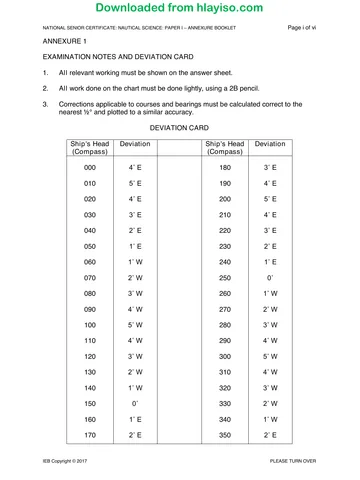
Initial range and bearing 255° (T) × 10,0 miles 1
CPA 0 miles, collision 1
Time of CPA 20:50 2
Target's true course 097° 3
Target's speed 13,0 knots 3
4.3 Make a bold alteration of 90° to port, course 073° and continue to monitor
the target till the danger has passed.
IEB Copyright © 2019 PLEASE TURN OVER
Downloaded from hlayiso.com
NATIONAL SENIOR CERTIFICATE: NAUTICAL SCIENCE: PAPER II – MARKING GUIDELINES Page 6 of 8
QUESTION 5
5.1 Design features of a Ro-Ro ship:
• Has a ramp on the stern or quarter for driving cargo on and off the
vessel. On some vessels the ramps are on the side.
• Internal fixed and/or closing ramps to access different deck levels.
• Equipped with a set of mobile cargo-handling equipment such as
forklifts, container stackers, low-bed trailers and mechanical horse or
tractors for towing the trailers.
• Multi-decked interlinked by ramps. In some cases there may be lifts or
hoists to move from one deck to the next.
• The vessels are normally self-supporting and not reliant on equipment or
infrastructure from ashore.
• Capable of handling large or small parcels of cargo including containers
and heavy lifts for abnormal-size cargo.
Any five of the above, or other pertinent information specifically about Ro-
Ro ships.
5.2 Reefer vessel:
• A vessel designed to carry refrigerated cargo such as perishable fruit
and meat.
• It is a multi-hatch/hold (usually 4 or 5) and multi-deck vessel designed
for palletised cargoes.
• May also carry refrigerated containers.
• Fitted out with cranes with capacity of up to 25 tons.
• Holds are insulated. Each deck and each hold temperature-controlled
from –20° C to ambient temperature.
• A central refrigerant plant normally situated in the engine room will
supply air pre-cooled to the required temperature to individual
compartments.
Any five of the above, or other pertinent information specifically about
Reefer ships.
IEB Copyright © 2019 PLEASE TURN OVER
Downloaded from hlayiso.com
NATIONAL SENIOR CERTIFICATE: NAUTICAL SCIENCE: PAPER II – MARKING GUIDELINES Page 7 of 8
SECTION B COMMUNICATIONS AND METEOROLOGY
QUESTION 6
6.1 Sea Area A1 is within radio telephone coverage of at least one VHF coast
station from which continuous DSC (digital selective calling) alerting is
available. It extends up to 50 nautical miles from the coast station.
6.2 Distress call:
MAYDAY, MAYDAY, MAYDAY
THIS IS ASTOR, ASTOR, ASTOR
Followed by distress message:
MAYDAY
ASTOR, CALL SIGN Zulu Siera Alpha Romeo
POSITION NORTH WEST COAST OF DASSEN ISLAND
MY VESSEL IS AGROUND
REQUIRE IMMEDIATE ASSISTANCE
WEATHER – WIND NW FORCE 7, POOR VISIBILITY
OVER.
QUESTION 7
7.1
7.2
7.3
7.4
IEB Copyright © 2019 PLEASE TURN OVER
Downloaded from hlayiso.com
NATIONAL SENIOR CERTIFICATE: NAUTICAL SCIENCE: PAPER II – MARKING GUIDELINES Page 8 of 8
SECTION C SAILINGS
QUESTION 8
LAT Meridional Parts LONG
Noon 13 Feb 31° 06' S 1952.93 S 013° 35' E
WP 18° 55' N 1148.62 N 063° 25' W
D.Lat/DMP/D.Long 50° 01' N 3101.55 77° 00' W
3001 4620
8.1 Tan Co. = D.Long / DMP
= 4620 / 3101.55
= N 56° W
Course = 304° (T)
8.2 Distance = D.Lat / Cos Co.
= 3001 / Cos 56°
Distance = 5 384.1 miles
8.3 St time @ 18 knots = 5384.1 / 18 Date 13 d 12 h 00 m
= 299.117 hrs @ 18kts 12 11 07
= 12 d 11 h 7 m ETA (GMT + 1) 25 23 07
Time dif. 05 – 00
ETA 25 th 18 h 07 m
Total: 150 marks
IEB Copyright © 2019
Recommended for this subject
Published documents with matching subject and grade metadata.
Memorandum
Nautical Science P1 Memo 2019 hlayiso.com
Memorandum
Nautical Science P1 Memo 2018 hlayiso.com
Memorandum
Nautical Science P2 Memo 2018 hlayiso.com
Memorandum
Nautical Science P1 MG 2017 hlayiso.com
Memorandum
Nautical Science P2 MG 2017 hlayiso.com
Question paper
Nautical Science P1 2019 hlayiso.com
Related documents
Matched using subject, grade, language, document type and exam metadata.
Question paper
Nautical Science P2 2019 hlayiso.com
Question paper
Nautical Science P1 Annexure Booklet 2019 hlayiso.com
Question paper
Nautical Science P2 2018 hlayiso.com
Question paper
Nautical Science P2 2017 hlayiso.com
Question paper
Nautical Science P1 2018 hlayiso.com
Question paper
Nautical Science P1 Annexure booklet 2018 hlayiso.com
More from Grade 12 Nautical Science
Explore more published documents in this catalogue.