
education
MPUMALANGA PROVINCE
REPUBLIC OF SOUTH AFRICA
NATIONAL
SENIOR CERTIFICATE
GRADE 12
PHYSICAL SCIENCES: CHEMISTRY P2
JUNE 2025
MARKS: 150
TIME: 3 hours
This question paper consists of 14 pages and 4 data sheets.
Copyright reserved Please turn over
Skip to contentAll 2025 papers 


View all


Physical Sciences Grade 12 P2 Mpumalanga June 2025 QP
Grade 12 Physical Sciences Paper 2 question paper from the Mpumalanga June Exam 2025, 18 pages. Read online or download the free PDF.
Physical Sciences · Grade 12 · Mpumalanga June Exam · 2025. Question paper, 18 pages. Read online or download the PDF.
- Subject
- Physical Sciences
- Grade
- Grade 12
- Document type
- Question paper
- Year
- 2025
- Exam period
- Mpumalanga June Exam
- Paper
- 2
- Curriculum
- CAPS
- Pages
- 18
- File size
- 3.3 MB
Free to read online, no sign-up needed
Loading document…
Loading document…
1 of 18
This exam
Mpumalanga June Exam 2025
- Paper 1Question paperMemo
- Paper 2Question paperMemo
Questions in this paper
- Question 1Organic Compounds and Macromolecules14 marks
- Question 2Organic Compounds and Macromolecules28 marks
- Question 3Organic Compounds and Macromolecules17 marks
- Question 4Organic Compounds and Macromolecules18 marks
- Question 5Rate and Extent of Reactions21 marks
- Question 6Chemical Equilibrium25 marks
Show all 7 questions
Document textSearch extracted text and jump to a page.
MDE/June 2025
INSTRUCTIONS AND INFORMATION
10.
i
12.
Write your name in the appropriate space on the ANSWER BOOK.
This question paper consists of SEVEN questions. Answer ALL the questions in the
ANSWER BOOK.
Start EACH question on a NEW page in the ANSWER BOOK.
Number the answers correctly according to the numbering system used in this
question paper.
Leave ONE line between two sub questions, for example between QUESTION 2.1
and QUESTION 2.2.
You may use a non-programmable calculator.
You may use appropriate mathematical instruments.
You are advised to use the attached DATA SHEETS.
Show ALL formulae and substitutions in ALL calculations.
Round off your final numerical answers to a MINIMUM of TWO decimal places.
Give brief motivations, discussions, et cetera where required.
Write neatly and legibly.
Copyright reserved Please turn over
MDE/June 2025
QUESTION 1 : MULTIPLE-CHOICE QUESTIONS
Four options are provided as possible answers to the following questions. Each
question has only ONE correct answer. Choose the answer and write only the
letter (A — D) next to the question number (1.1 — 1.10) in the ANSWER BOOK, for
example, 1.11 E.
1.1. Which ONE of the following compounds is an alkyne?
A CeHi2
B CaHe
Cc CroH22
D C4HsO (2)
1.2 Which ONE of the following is a functional isomer of ethyl propanoate?
A 4 H it i H
|
in a an nan
H H H H
B ie)
cE TY
H—C—C—C—C—C—O—H
} | ot
H H HH
° LiiLiia
See peon
H H H H H (2)
Copyright reserved Please turn over
MDE/June 2025
4.3. For which ONE of the following pairs of compounds will X have a higher
boiling point than ¥?
X Y
A CH3CH(CHs)CH3 | CHsCH2CH2CHs
B CHsCHs3 CH3CH2CH3
Cc CHsCH2CH2CH3 =| CH3CHsCOCH3
D CH3COOH CH3sCH2CH20H
1.4 Ethanol can be converted into other carbon-containing compounds using
the reactants as shown in the flow chart below.
Ethanol Ee Compound P Her
reaction 1 reaction 2
Compounds P and Q are, respectively:
P Q
A Ethene Bromoethane
B Ethanoic acid Ethanol
Cc Ethene Bromoethene
D Ethanol Ethanoic acid
1.5
to the following equation:
Compound Q
A piece of magnesium ribbon reacts with excess hydrochloric acid according
Mg(s) + 2HC&(aq) + MgCfo(aq) + Ha(g)
Which ONE of the following changes will NOT affect the reaction rate?
A
B
Cc
D
Putting the reaction mixture in a hot water bath
Using the same mass of powdered magnesium
Increasing the volume of the hydrochloric acid
Increasing the concentration of the hydrochloric acid.
Copyright reserved
(2)
(2)
(2)
Please turn over
MDE/June 2025
1.6 | Which ONE of the reaction rate versus time graphs below best represents
the reaction between magnesium and EXCESS dilute hydrochloric acid?
A
B
2 2
g &
c c
£ gS
oO oO
oO o
Do oO
& a
———
Time Time
D
2 2
© i
sf £
i=] =
2 Re]
oO aa]
oO g
®D o
a [W4
Time Tim
° (2)
1.7 Which ONE of the following will NOT affect the equilibrium position of
reversible chemical reactions?
A
B
Cc
D
Temperature
Catalyst
Pressure
Concentration (2)
1.8 The reaction given below reaches equilibrium in a closed container. The Ke
value is 0,04 at a certain temperature.
2S02(g) + O2(g) = 2SOs(g) AH <0
Which ONE of the following factors will change the Ke value to 0,4?
A
B
Cc
D
Increase in pressure
Decrease in pressure
Increase in temperature
Decrease in temperature (2)
Copyright reserved Please turn over
MDE/June 2025
1.9 During a titration to determine the concentration of an acid using a standard
solution of a base, a learner pipettes the base into a conical flask. The
learner then uses a small amount of water to rinse the inside of the flask so
that ail the base is part of the solution in the flask.
How will the extra water added to the flask affect the results of this titration?
The concentration of the acid ...
A cannot be determined.
will be lower than expected.
B
Cc will be higher than expected.
D
will be the same as expected. (2)
1.10 Which ONE of the following statements is ALWAYS true for monoprotic
acids?
A The lower the concentration of the acid solution, the weaker the
acid.
B There will be more H30* ions in 100 cm of a strong acid solution
than in 100 cm° of a weak acid solution.
Cc The pH of a strong acid is lower than the pH of a weak acid.
D One mole of a strong acid will produce more H30* ions in water than
one mole of a weak acid. (2)
[20]
Copyright reserved Please turn over
MDE/June 2025
QUESTION 2 (Start on a new page)
The letters A tot H in the table below represent EIGHT organic compounds.
H,C—CH,
A| 2,4-dichloro-3-ethyl-6-methyloctane | B He — th — 0 — By
CH, CHg
Viti
nh a a ek D | CH3CH2CHOHCH3
|
HH H O =
E fe)
II F | CsHi2
H3C—C—OH
—-
G} CHsCOCH2CH3 H | Butan-1-ol
2.1 Write down the LETTER(S) that represents the following
2.1.1. A functional isomer of compound G.
2.1.2 Ahaloalkane
2.1.3. Belongs to the same homologous series as compound H.
2.2 Write down the:
2.2.1 IUPAC name of compound B.
2.2.2 Structural formula of compound A.
2.2.3. Name of the homologous series to which compound C belongs.
2.2.4 Structural formula of the FUNCTIONAL GROUP of compound G.
2.3. Consider compound D
2.3.1 Define the term positional isomer.
2.3.2 Write down the STRUCTURAL FORMULA of the positional isomer
of compound D.
2.3.3. Is compound D a PRIMARY, SECONDARY or TERTIARY alcohol?
Give a reason for the answer.
(1)
(1)
(1)
(3)
(3)
(1)
(1)
(2)
(2)
(2)
Copyright reserved Please turn over
MDE/June 2025
2.4 Compound E and H are heated together in the presence of a catalyst in a
test tube to produce an ESTER.
Write down the:
2.4.1 Name of the reaction that takes place. (1)
2.4.2 NAME or FORMULA of the catalyst used. (1)
2.4.3. STRUCTURAL FORMULA of the ester that is produced. (2)
2.4.4 IUPAC name of the ester that is produced. (2)
2.5 The reaction below illustrates the complete combustion of compound F in
EXCESS oxygen.
CsHi2 + 802 — 5CO2 + 6H2O0
45 g of compound F reacts completely with oxygen at standard temperature
and pressure (STP). If the percentage yield of carbon dioxide (CO2z) is 76%,
calculate the volume of carbon dioxide formed. (5)
[28]
Copyright reserved Please turn over
QUESTION 3 (Start on a new page.)
MDE/June 2025
Students use alcohols A to C to investigate a factor that affects the boiling point of
alcohols.
They use equal volumes of each alcohol and heat them separately in a water bath.
3.1
3.2
3.3
3.4
3.5
3.6
3.7
Compounds Alcohols
A CH3OH
B CHsCH20H
| c CH3CH2CH20H
Define the term boiling point. (2)
What property of alcohols makes it necessary for them to be heated in a
water bath? (1)
What structural requirements must the alcohols meet to make this a fair
comparison? (2)
Write down the:
3.4.1 Independent variable. (1)
3.4.2 Name of the FUNCTIONAL GROUP of these compounds. (1)
3.4.3. IUPAC name of compound B (1)
Which ONE of the three compounds has the HIGHEST boiling point? (1)
Explain the answer to QUESTION 3.85 in full. (3)
The boiling point of compound C is now compared with that of compound X.
~ GOMPOUND BOILING POINT
(°c)
Cc CH3CH2CH20H 98
px ; CHsCOOH 118
3.7.1. Besides the conditions used to determine boiling points, give a
reason why this is a fair comparison. (1)
3.7.2 Fully explain the difference in the boiling points of compounds C and
X. (4)
[17]
Copyright reserved
Please turn over
QUESTION 4 (Start on a new page.)
MDE/June 2025
The flow chart below shows how alkenes can be used to prepare other organic
compounds. The letters A to G represent different organic reactions.
4.1
4.2
4.3
4.4
4.5
Compound 5
G
Bra
(es ese)
c Bute —xX Compound 4
Compound 1 a ut-t-ene | __| (Main product)
D
B | HCce
%
Compound 2 E | Compound 3
(Main product) (Main product)
+ NaCt +
Write down the type of reaction represented by:
41.1 C
4.1.2 F
413 D
For reaction A write down the:
4.2.1. IUPAC name of compound 4.
(1)
(1)
(1)
(2)
4.2.2.NAME or FORMULA of the inorganic reactant needed for this
reaction.
4.2.3 Type of addition reaction.
For reaction G, bromine water is added to compound 1.
(1)
(1)
4.3.1 Is compound 1 a saturated or unsaturated? Give a reason for the
answer.
4.3.2 Write down the reaction condition for this reaction.
Write down a_ balanced chemical
FORMULAE for reaction E.
(2)
(1)
equation using STRUCTURAL
(6)
For reaction B write down two reaction conditions required for this reaction (2)
Copyright reserved
[18]
Please turn over
MDE/June 2025
QUESTION 5 (Start on a new page.)
A student is asked to design an industrial process to produce sulphuric acid.
5.1. One of the reactions in the production of sulphuric acid is the roasting
(heating in oxygen) of a metal ore that contains lead(II) sulphide:
2PbS(s) + 302(g) > 2PbO(s) + 2SO2(g)
The student does a test experiment in which 36,8 g of O2 gas completely
reacts with 800 g of the metal ore. All of the PbS in the ore reacts, and ONLY
the PbS in the ore reacts wiih the oxygen.
5.1.1. Calculate the amount (in moles) of O2 that reacted. (3)
5.1.2 Calculate the mass of pure PbS in the metal ore. (3)
5.1.3. Calculate the percentage mass of the PbS in the metal ore. (2)
5.2 In another experiment, 50 g of sulphur trioxide reacts with water:
SOa(g) + H2O(£) + H2SOa(e)
The amount of sulphur trioxide present in the container is monitored over
time.
The following graph is plotted:
a
Mass of SO3 (g)
Time (min}
5.2.1. Write down the formula of the limiting reactant. (1)
5.2.2 At what time on the graph was the reaction rate the fastest. (1)
5.2.3. What happened at 6 minutes. (1)
5.2.4 Define the term reaction rate. (2)
Copyright reserved Please turn over
5.2.5
6.2.6
5.2.7
MDE/June 2025
Calculate the rate of the reaction in (g:s') during the first 2 minutes.
Copy the above graph in your answer book. On the same set of
axes, use a DOTTED LINE to show the curve that will be obtained
when the temperature increases. No numerical values are required.
In terms of the COLLISION THEORY, explain why the rate of a
chemical reaction increases with increasing temperature.
QUESTION 6 (Start on a new page)
6.1
6.2
Copyright reserved
Nitrosyl chloride (NOC) is a yellow gas that decomposes into colourless
nitrogen monoxide gas (NO) and green chlorine gas (Cfz2) at temperatures
above 100 °C.
2NOCU(g) = ZNO(g) + Cfa(g)
Yellow Green
Consider an equilibrium mixture of NOC, NO, and Cfz, which is initially
yellow-green, in a sealed container.
6.1.1
6.1.2
6.1.3
6.1.4
Explain the term closed system.
NO(g) is added to the container at constant volume. What colour
change will be observed in the container. Explain the answer
State Le Chatelier's principle.
When the pressure in the container is changed, the colour becomes
green. Use Le Chatelier's principle to explain whether the pressure
was INCREASED or DECREASED.
The Haber process uses nitrogen and hydrogen gases to produce ammonia
gas, represented in the reversible reaction below.
Na(g) + 3H2(g) = 2NHs(g)
(3)
(2)
(3)
[23]
(1)
(4)
(2)
(4)
Please turn over
MDE/June 2025
The Haber process was researched. The graph (below) shows how
the percentage yield of ammonia is affected by changes in
temperature and pressure.
120
\
\\
\\\
\
80 \
\V AN
60 - \ AL
40 \
“J
\ \ IN “™ 400 atmosphere
NX NTS 200 atmosphere
20 : Fs; 100 atmosphere
N ~ 1 50 atmosphere
100 200 300 400
Temperature (°C)
OY,
100
Amount ammonia produced (%)
In industry, the Haber process is typically operated at a temperature of
250 °C and a pressure of 200 atmospheres (200 atm).
6.2.1 Is the forward reaction in the Haber process EXOTHERMIC or
ENDOTHERMIC? (1)
6.2.2 Explain the answer to Question 6.2.1 in terms of Le Chatelier's
principle by referring to the graph. (4)
6.2.3. What is the percentage yield of ammonia at 250 °C and
200 atmosphere? (1)
6.3 Asolution is prepared by dissolving 4 mol of CuC£3-_ completely in water to
make a solution of volume 2 dm°. When equilibrium is established, there are
2,2 mol of Cu(H20)2" ions present at 25 °C.
Cu(H:0)2"(aq) + 4Ct-(aq) = CuCe?-(aq) + 6H20(t)
Determine the value of the equilibrium constant, Ke, for this reaction at
25 °C. (8)
[25]
Copyright reserved Please turn over
MDE/June 2025
QUESTION 7 (Start on a new page.)
Consider the following balanced chemical equations showing some acid-base
reactions.
A HNO3 + KOH — KNO3 + H2O0
B H2SO3 + H20 = HSO3 + H30*
7.1. Define an acid according to the Lowry- Bronsted theory. (2)
7.2 Consider the chemical equations (A and B) above.
7.2.1. Describe the term amphoteric substance. (2)
7.2.2 Write down the formula of an amphoteric chemical substance (other
than H20). (1)
7.2.3. Write down the formulae of the conjugate acid-base pairs in
reaction B. (2)
7.3. Which indicator must be used in reaction A. Choose from METHYL
ORANGE, BROMOTHYMOL BLUE or PHENOLPHTHALEIN. Give a
reason for the answer (3)
7.4 Consider reactions A and C, shown below.
A: HNO3 + KOH — KNOs3 + H20
C: 2HNO3 + Na2zCOz3 — 2NaNOs + CO2 + H20
A 13 g, impure sample of KOH is initially dissolved in 200 cm® of a
1,2 mol-dm’ nitric acid solution. The nitric acid was in EXCESS. Assume
that the volume remains constant.
-
a
HNO;
| 4 a
50 cm* of the resulting solution was then titrated to neutralisation using
23,67 cm® of a standard 0,85 mol-dm~? sodium carbonate solution.
7.4.1. Determine the amount (in mol) of nitric acid that was added to the
KOH. (2)
7.4.2 Calculate the percentage purity of the KOH sample. (9)
[21]
TOTAL [150]
Copyright reserved Please turn over
MDE/June 2025
DATA FOR PHYSICAL SCIENCES GRADE 12
PAPER 2 (CHEMISTRY)
GEGEWENS VIR FISIESE WETENSKAPPE GRAAD 12
VRAESTEL 2 (CHEMIE)
TABLE 1: PHYSICAL CONSTANTS/TABEL 1: FISIESE KONSTANTES
NAME/NAAM SYMBOL/SIMBOOL _ | VALUE/WAARDE
Standard pressure 8 5
Standaarddruk _ P sameeren
Molar gas volume at STP 3amart
Molére gasvolume by STD Ve ane mae
Standard temperature 6
Standaardtemperatuur T 273K
Avogadro's constant Na 6,023 x 1023 mot"
TABLE 2: FORMULAE/TABEL 2: FORMULES
n= m n= uJ
M Ny
N oor ¢ = nin
7 MV Vn
My _ Sa Ve pH = -log[Hs0*]
ny cy, Ve
Kw = [Hs0*][OH’] = 1 x 10° at/ by 298 K
Ect = FSatode “ aca / = a Eatode ~ Ee os
OR/OF
Ey = Ereduatin ~ Er idion i =a = Ecko ~ F esciae
OR/OF
Ee = Biers agent — =e agent / Ey sal CE Raaarariiat ms = ee
Copyright reserved
Please turn over
MDE/June 2025
87 zez
47 | ON | PW |} W4] sa) 30] Ya} WO] wy] ng | dN] A | ed | UW
cob | zob | vor | oor | 66 | 86 | 26 | 96 | G6 | w | c6 | z6 | 16 | 06
SLL | c2b | 69b | 29b | SOL | ¢9b | 6Sb | 2st | zSL | osE tL | WL | ov
n7/} 9A | WL | 4a | OH | AQ} aL | pd | ng | ws | wd] PN] Jd | 89 Nz
w | oc | 6 | 899 | 2 | 99 | so | v9 | 9 | 7 | 19 | 09 | 6S | 85 oy jew 2l44 2
68__|es |ze8
602 |zoz [voz [roe [26+ |s6t [zr [ocr Jos [ver jrer [est [ech [zc leer
Uy |WSOd 8) !a Sldds] LW SHH [ny J3d | 4l [SO fed |M JEL |SHZleT |ea Sisos
os _|se |vs |ce |ze |re [os [oe [ez |u |oe [oe |oe |e |w lus |g |g
ver [aev lect leet [ene [Sey |e |eor |90r [cor |vor 9 [% [ue [es [es [98
eX | 1 Sat Sigs slug S| ul S]pos|By ipa Sua Sina ROL SOW SIGN [475 B4S 3/4y &
vs |es |zs [ts |05 |6r |er | wy | or | or |e ler | zp | |or joc |e ae
ve [os [ez Joe |e joe [so sto [es [es [os ss [zs Jis [ar [sv jor |ec
Ye | 4g £) 9S Rsv $]99 B/e9D SUZ iND =) IN S/00 S) 84 SUUWAIO SI A SIU SIS GeO S| MS
gc _|se |ve |ec |ze [se loc {oz |ez_ |az |oz _|sz [or |e [aw |i loz |e
op |sce [ze [te le faz ve | &
WW /1D8)S dd S/S Bs] Wa esseuuoole ananejas apsapeuag BW =| eN S
gL ly 9L SL tl cb SSLW IWO}e sAnejas ayewIxaddy Z Lb
a a 6 Z
2 > Ed 2 By By = Psi
_ a . =| " = 2 * 4 ° Jooquiy yaymneGeuanyalz yy a _
? joquiks AyageGau0s9213 i
3H t H 3
2 | jeraBuroony THINFISIAIN jt
(C777, Ve (7,9 YY) Joquinu NWO (ww) (0)
ce | 2 aS 4 | |) 8 Z 9 S ¥ £ z L
SLN3W313 JO 318VL DIGOM3d FHL: FTGVL
SLN3W313 40 F18VL DIGOM3d FHL *€ ITAVL
Please turn over
Copyright reserved
Increasing strength of oxidising agents/ Toenemende sterkte van oksideermiddels
Copyright reserved
TABLE 4A: STANDARD REDUCTION POTENSTIALS
TABEL 4A: STANDAARD-REDUKSIEPOTENSIALE
Half-reactions/Halfreaksies E® (V)
Fog)+2e = 2F + 2,87
Co*¥+e = Co* + 1,81
H202+2H*+2e = 2H20 +1,77
MnO;+ 8H*+5e = Mn*+4H20 +1,51
Ch(g)+2e = 2C¢ + 1,36
Cr,03 +14H*+4e = Cr+ +7 H2O + 1,33
O2(g)+4H*+4e° = 2H20 + 1,23
MnOz+ 4H* + 2e = Mn** +2H2O0 + 1,23
Pt+2e = Pt + 1,20
Bro(fy+2e = 2Br + 1,07
NO; +4H*+3e° = NO(g)+2H2O —-+0,96
Hg +2e = Hg(t) + 0,85
Ag'te = Ag + 0,80
NO; +2H*+e = NO2(g)+H2O +0,80
Fe*+e = Fe* +0,77
O2(g)+ 2H* + 2e° = H202 + 0,68
k+2e = 2b + 0,54
Cut+e = Cu + 0,52
SO2+4H*+4e = S+2H20 + 0,45
2H20+O2+4e = 40H + 0,40
Cu*+2e = Cu + 0,34
$02 +4H'+2e = SO2(g)+2H20 + 0,17
Cu*+e = Cut + 0,16
Sn**+2e = Sn* +0,15
S+2H'+2e = H2S(g) +0,14
2H*+2e = H2(g) 0,00
Fe*+3e = Fe — 0,06
Pb**+2e = Pb - 0,13
Sn**+2e = Sn -0,14
Ni?*+2e = Ni - 0,27
Co*+2e = Co — 0,28
Cd**+2e = Cd — 0,40
Cet+e = Cr -0,41
Fe*+2e = Fe — 0,44
Cre++3e = Cr -— 0,74
Zn*+2e = Zn — 0,76
2H20 + 2e° == Ha(g) + 20H” — 0,83
Cr*+2e = Cr - 0,91
Mn?*+2e = Mn — 1,18
At®* + 3e = At — 1,66
Mg**+2e = Mg — 2,36
Nat +e = Na —2,71
Ca**+2e = Ca — 2,87
Srt+2e = Sr — 2,89
Ba**+2e = Ba — 2,90
Cs*t+e = Cs - 2,92
Ktte = K - 2,93
Lite = Li — 3,05
MDE/June 2025
Increasing strength of reducing agents/Toenemende sterkte van reduseermiddels
Please turn over
Increasing strength of oxidising agents/Toenemende sterkte van oksideermiddels
Lopyright reservea
TABLE 4B: STANDARD REDUCTION POTENSTIALS
TABEL 4B: STANDAARD-REDUKSIEPOTENSIALE
Half-reactions/Halfreaksies E® (Vv)
lite = Li — 3,05
K'te = K — 2,93
Cst+e = Cs - 2,92
Ba**+2e = Ba — 2,90
Srt+2e = Sr — 2,89
Ca**+2e = Ca — 2,87
Na*+e = Na -2,71
Mg**+2e = Mg — 2,36
AS +3e 2 AL — 1,66
Mn=" + 26 = Mn — 1,18
Crt+2e = Cr -0,91
2H20 +2e = H2{g) + 20H” — 0,83
Zn*+2e = Zn — 0,76
Crt++3e = Cr — 0,74
Fe’+2e = Fe - 0,44
Cr++e = Crt —0,41
Cd*4+2e = Cd - 0,40
Co*+2e = Co — 0,28
N?*+2e = Ni —0,27
Sn**+2e = Sn —0,14
Pb**+2e° = Pb —0,13
Fe*+3e = Fe — 0,06
2H*+2e = Hag) 0,00
S+2H*+2e = HS(g) + 0,14
Sn*+2e = Sn* + 0,15
Cu? +e = Cut + 0,16
S02 +4Ht+2e = $O2(g)+2H20 +0,17
Cu +2e = Cu + 0,34
2H20 +O2+4e = 40H + 0,40
SO2+4H*+4e = S+2H20 + 0,45
Cu’+e = Cu + 0,52
k+2e = 2 + 0,54
O2(g) + 2H*+2e = H202 + 0,68
Fe*+e = Fe* +0,77
NO;+2H'+e = NO2(g)+H2O —- + 0,80
Ag'te = Ag + 0,80
Hg**+2e = Hg(t) + 0,85
NO, +4H*+3e = NO(g)+2H20 + 0,96
Br(t)+2e = 2Br + 1,07
Pi +2e = Pt + 1,20
MnO2+ 4H*+2e = = Mn* +220 + 1,23
O2(g) + 4H" + 4e = 2H20 + 1,23
Cr,O2 +14H'+4e° = -2CP*+7H2O = + 1,33
Ch(g)+2e = 2C8 + 1,36
MnO;+ 8H*+5e = Mn**+4H20 1,51
H202+2H*+2e = 2H20 477
Co*¥+e = Co* + 1,81
Fo(g)+2e = 2F + 2,87
MDE/June 2025
Increasing strength of reducing agents/Toenemende sterkte van reduseermiddels
riedse turt over
Study this subject
Recommended for this subject
Question paper
Physical Sciences Grade 12 P1 Mpumalanga June 2025 QP
Question paper
Physical Sciences Grade 12 P2 North West Mock 2025 QP
Question paper
Physical Sciences Grade 12 P2 NSC June 2025 QP (Eng)
Memorandum
Physical Sciences Grade 12 P2 Eastern Cape June 2025 Memo
Memorandum
Physical Sciences Grade 12 Paper 2 Limpopo June 2025 Memo
Question paper
Physical Sciences Grade 12 Mpumalanga March Test 2025 QP
More from Grade 12 Physical Sciences
Memorandum
Physical Sciences Grade 12 P1 Eastern Cape Mock 2025 Memo
Memorandum
Physical Sciences Grade 12 Paper 1 Limpopo June 2025 Memo
Memorandum
Physical Sciences Grade 12 Paper 1 Limpopo Mock 2025 Memo
Memorandum
Physical Sciences Grade 12 Mpumalanga March Test 2025 Memo
Errata
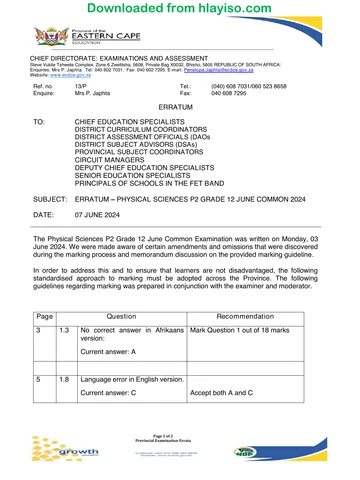
Physical Sciences Grade 12 P2 Eastern Cape June 2024 Errata
Question paper