
Downloaded from hlayiso.com
ALEXANDER ROAD HIGH SCHOOL
NOVEMBER 2021 2 HOURS
PHYSICAL SCIENCES Paper 1 Physics
PE TOTAL = 100
GRADE 10
______________________________________________________________________________
Instructions
• The question paper consists of 8 questions.
• Answer all the questions.
• Answer section A on the answer sheet provided.
• A non-programmable calculator may be used.
• Number the answers correctly according to the numbering system.
• Round off to two (2) decimal places where necessary.
• A formula sheet has been provided on the back of the answer sheet.
• A list of physical constants has been provided at the end of the question paper.
_________________________________________________________________________
SECTION A
- Answer on the answer sheet -
QUESTION 1: Multiple choice
Four possible options are provided as answers to the following questions. Each question has
only 1 correct answer. Choose the correct answer and write the letter (A – D) next to the
relevant question number (1.1 – 1.7) on the answer sheet.
1.1 Which of the lists below consists of only vector quantities?
A. Weight, mass, velocity
B. Force, weight, displacement
C. Acceleration, velocity, distance
D. Force, direction, pressure
1
Skip to content
View all
Physical Sciences Grade 10 P1 Eastern Cape June 2021 Memo
Grade 10 Physical Sciences Paper 1 memorandum from the Eastern Cape June 2021, 11 pages. Read online or download the free PDF.
Physical Sciences · Grade 10 · Eastern Cape June · 2021. Memorandum, 11 pages. Read online or download the PDF.
- Subject
- Physical Sciences
- Grade
- Grade 10
- Document type
- Memorandum
- Year
- 2021
- Exam period
- Eastern Cape June
- Paper
- 1
- Curriculum
- CAPS
- Pages
- 11
- File size
- 215.6 KB
Free to read online, no sign-up needed
Loading document…
Loading document…
1 of 11
Document textSearch extracted text and jump to a page.
Downloaded from hlayiso.com
The graph alongside shows the 81
x
displacement vs time graph for an object
(m)
moving in a straight line in the positive 54
direction.
0
Use this graph to answer the next two 0 3 6 9 12
t (s)
questions.
1.2 The object is travelling ….
A. forwards for the first 6 seconds and backwards for the next 3 seconds.
B. speeding up for the first 6 seconds and slowing down for the next 3 seconds.
C. is stationary after 9 seconds.
D. both B & C correct.
1.3 The corresponding velocity time graph is
B.
A.
v 10
v 18 (m.s-1)
(m.s-1) 3 6 9 12 t (s)
0
0
0 3 6 9 12 -18
t (s)
C. D.
v 18
(m.s-1) v 10
(m.s-1)
0 3 6 9 12 t (s)
0
-18
3 6 9 12
t (s)
1.4 Consider a pendulum swinging in a vacuum.
At which position is the mechanical energy maximum?
A.at A
B. at B
C. at C
D. At all positions. A
C
B
2
1.5
Downloaded from hlayiso.com
The correct order for increasing wavelength of electromagnetic waves is
A. radio waves, infrared, blue light, gamma rays.
B. x-rays, Ultraviolet, Infrared, microwaves.
C. gamma rays, microwaves, ultraviolet, radio waves.
D. TV waves, red light, green light, blue light.
1.6 The equivalent unit for a volt is:
A. joule per coulomb
B. ampere per ohm
C. joule per ampere
D. coulomb per second
1.7 All light bulbs are the same in the following circuits. In which circuit will the ammeter
reading be biggest
A B C D
A A A A
[14]
QUESTION 2 (Vectors):
north
Sipho walks (from A) around the
north side of a lake to meet a friend
with his boat (at B).
He walks 300 m north then 300 m A
east & then 600 m on a bearing of
1350 in 10 minutes. B
2.1 Define resultant vector.
(2)
2.2 Determine by accurate scaled
diagram what his final displacement
is from A to B. (Use scale 1cm : 10m) (4)
2.3 On what bearing must they paddle back to where Sipho started if they
decided to go in the boat? (1)
2.4 Calculate Sipho’s average speed when walking around the lake from A to B. (3)
[10]
3
Downloaded from hlayiso.com
QUESTION 3 (Motion):
Two vehicles P and Q are approaching a traffic light intersection at 20 m.s -1 The light turns
orange when they are 30 m from the intersection.
Vehicle P puts on its brakes and slows down to stop at the intersection.
Vehicle Q accelerates at 4 m.s-2 through the intersection for 3 seconds before continuing at
a constant velocity.
3.1 Define velocity. (2)
3.2 Convert 20 m.s-1 to km.h-1 (1)
3.3 Calculate the acceleration of vehicle P. (3)
3.4 Calculate the final velocity of vehicle Q. (3)
3.5 Sketch the velocity-time graphs for both vehicles on the same set of axes.
Label the relevant velocity and time values. (5)
[14]
QUESTION 4 (Energy):
A cyclist travels at 6 m.s-1 just before
going down a dip in the road. She free
wheels down the dip and up the other
side until she stops. Her mass and bicycle
combined are 60 kg.
Assume there is no friction. 3m
Use energy principles to calculate the
answers in 4.2 and 4.3
4.1 Define gravitational potential energy. (2)
4.2 What is the fastest speed she reaches at the bottom of the dip? (4)
4.3 Calculate the height she will reach on the other side when she stops. (4)
4.4 What is the name of the principle used in the calculation above? (1)
[11]
4
QUESTION 5 (Waves):
Downloaded from hlayiso.com
5.1 The speed of sound is 320 m.s-1. A person counts 5 seconds between
seeing lighting and hearing the thunder. How far away is the storm? (3)
5.2 Given the snapshot of a transverse wave below, answer the following
questions. Use the diagram on the answer sheet to answer 5.2.2.
20
X Y
Displacement (cm)
10
0
-10
-20
0 2 4 6 8 10 12 14 16
distance wave travelled (m)
(2)
5.2.1 Define the term wavelength.
5.2.2 On top of the diagram draw a wave with twice the amplitude and twice the
period. Use the diagram on the answer sheet. (2)
5.2.3 If it takes the crest at X 6 seconds to move to position Y calculate:
a) the frequency of the wave. (3)
b) The speed of the wave. (3)
5.3 A fishing boat uses
echolocation to detect schools
of fish.
If the speed of sound in water
is 1200 m.s-1 and it takes 0,4
seconds for the echo to be
heard, how deep is the school
of fish below the boat? (3)
[16]
5
Downloaded from hlayiso.com
QUESTION 6 (Light):
The wavelength of red light is 300 nm.
6.1 Calculate its frequency. (3)
6.2 What is the name of the “package of energy” which red light is made of? (1)
6.3 Calculate the energy of one of these ‘packages of energy’. (3)
[7]
QUESTION 7 (Electrostatics): +3 nC -5 nC
M N
Two spheres of identical size, and on insulated stands,
have the charges QM = +3 nC and QN = -5 nC
respectively. They are a short distance apart.
7.1.1 State the principle of “conservation of charge”. (2)
7.1.2 How many electrons are in excess or shortage on sphere M? (4)
7.1.3 State whether they were transferred TO or FROM sphere M. (1)
7.2.1 The two spheres are now brought together so that they touch and then are
separated again. What is the final charge on sphere N? (2)
7.2.2 In which direction did the charges move between the spheres, from M to N
or from N to M? (1)
[10]
6
Downloaded from hlayiso.com
V3
QUESTION 8 (Circuits):
In the circuit alongside: R1 = 4 and R2 = 2 . V1 A3
S1
R1
When both switches, S1 and S2, are closed, V2 = 4 V. A1
S2 R2
A2
8.1 Define the term current strength. (2)
V2
8.2 Calculate the effective parallel resistance. (3)
8.3 Calculate the reading on ammeter A2 when both switches are closed. (3)
8.4 Calculate the current through the light bulb when both switches are closed. (2)
8.5.1 What happens to the brightness of the bulb when switch S 2 is opened?
Write only: INCREASES, DECREASES, STAYS THE SAME or GOES OUT. (1)
8.5.2 Explain your choice in 8.5.1 above. (2)
8.6 In an experiment the following circuit was
used. The data measured is shown in the
table and plotted on the graph.
A
2 R
V
V
(V)
Current Voltage
1 (A) (V)
0,12 0,6
0,26 1,3
0,34 1,7
0 0,40 2,0
0 0,1 0,2 0,3 0,4
I (A)
8.6.1 Write an investigative question for this experiment. (2)
8.6.2 Determine the gradient of the graph. (2)
8.6.3 What does the gradient of the graph represent? (1)
[18]
TOTAL: 100
7
Downloaded from hlayiso.com
List of Physical Constants
Name Symbol Value
Acceleration due to gravity g 9,8 m.s-2
Speed of light in a vacuum c 3,0 × 10⁸ m.s-1
Planck’s constant h 6,63 × 10⁻³⁴ J.s
Charge on electron e -1,6 × 10⁻¹⁹ C
Electron mass me 9,11 × 10⁻³¹ kg
8
Downloaded from hlayiso.com
MEMO Gr10 Nov 2021
1.1 B 1.2 D 1.3 A 1.4 D 1.5 B 1.6 A 1.7 D
2.1 Resultant – is a single vector that has the same effect of two or more vectors.
300 424,3
✓ 45 0
2.2 R = 735 5m
300
✓
bearing 1000 20
424,3
99,70 724,3
9,70
124,3
✓
2.3 Back bearing = 90 + 9,7 + 180 = 279,70✓ 2800 20
2.4 Speed = dist/time ✓= 1200/(10x60)✓ = 2m.s-1 ✓
3.1 Vel = rate of change✓ of position ✓
3.2 20 x 3,6 = 72 km.h-1 ✓
3.3 vf2 = vi2 + 2ax ✓
0 = 202 + 2.a.30 ✓
a= 400/60 = -6,67 m.s-2 ✓ slowing down / deceleration / positive in reverse
3.4 vf = vi + at ✓ = 20 +4x3✓ = 32m.s-1 ✓
3.5
40 Axes correctly labelled with units (-1 if missing)
32 Values 32, 20 & t=3✓✓✓
30 Q Shape Q ✓
v Shape P ✓ does NOT have to cut t-axis at 3 s.
20 This was not a required calc.
(m.s-1)
10 P
0
0 3
t (s)
9
Downloaded from hlayiso.com
4.1 Ep = is the energy of an object due to its position✓ in a gravitational field✓
4.2 E mech top = E mech bottom ✓
Top: Ep + Ek = mgh + ½mv2 = 60x9,8x3 + ½ x60x62 = 1764 + 1080 = 2844 J ✓✓
Bottom Ep + Ek = 0 + ½ x60x v2 = 2844
v2 = 2844/30 = 94,8
v = 94,8 = 9,74 m.s-1 ✓✓
Ep + Ek top other side = 2844 = mgh + 0 ✓
60 x 9,8 x h = 2844 ✓ h= 2844/(69 x 9,8) = 4,84 ✓
4.4 Conservation of mechanical energy✓
5.1 Dist = Speed x time✓ = 320 x 5✓ = 1600 m ✓
5.2.1 Wavelength = shortest distance between two points in phase ✓✓ (2 or 0)
5.2.2 2xAmp ✓ 2x Period✓
5.2.3 a) 3 waves in 6 sec therefore 1 wave every 2 s f=1/T ✓= ½ = 0,5 Hz ✓✓
b) 3 wavelengths = 12m in 6 s = 2m.s-1 OR Dist/time✓ = 12/6✓ = 2 m.s-1✓
5.3 Dist = speed x time ✓= 1200 x 0.2 ✓= 240m✓ deep
(or use 0,4 sec & halve total distance)
6.1 c=f f=c/ ✓= 3x10⁸/ 300x10-9 ✓=1x10¹⁵ Hz✓
6.2 Photon✓
6.3 E=hf ✓= 6,6x10-34 x 1015 ✓= 6,6x10⁻¹⁹ J✓
7.1.1 Conservation charge – total charge in an isolated system remain constant✓✓
7.1.2 n = Q/qe ✓ = 3x10⁻⁹/1,6x10-19 ✓= 1,875x1010 ✓electrons
7.1.3 electrons rubbed FROM sphere M✓
7.2.1 Q = (Q1 + Q2)/2 ✓= (+3-5)/2 ✓= -1 nC✓
7.2.2 electrons transferred from N to M✓
10
Downloaded from hlayiso.com
8.1 Current strength: rate of flow of charge ✓✓ (2 or 0)
8.2 1/Rp = 1/r1 + 1/r2 ✓= ¼ + ½ = ¾ ✓
Rp = 4/3 = 1,333 ✓
8.3 V=IR ✓ 4=Ix2✓ I=4/2 = 2 A✓
8.4 I1 = V/R = 4/4 = 1 A✓ (or )
Ibub = 2 + 1 = 3A✓
8.5.1 DIMMER✓
8.5.2 Resistance increases ✓ ( removing a pathway) current decreases✓ DIMMER
8.6.1 How does the changing current✓ affect the voltage✓ across the resistor? (must be a
question that contains the 2 variables)
8.6.2 V/I = 2/0,4✓ = 5✓ 5.6.3 Resistance✓ in ohms
11
Study this subject
Recommended for this subject
Question paper
Physical Sciences Grade 10 P1 Eastern Cape November 2021 QP
Memorandum
Physical Sciences Grade 10 Paper 1 KZN June 2023 Memo
Memorandum
Physical Sciences Grade 10 Paper 1 KZN November 2023 Memo
Memorandum
Physical Sciences Grade 10 P1 2022 Memo
Memorandum
Physical Sciences Grade 10 P1 Gauteng November 2022 Memo
Memorandum
Physical Sciences Grade 10 P1 Gauteng November 2022 Memo
More from Grade 10 Physical Sciences
Question paper
Physical Sciences Grade 10 P2 November Mock Exam 2 2026 QP
Annual teaching plan
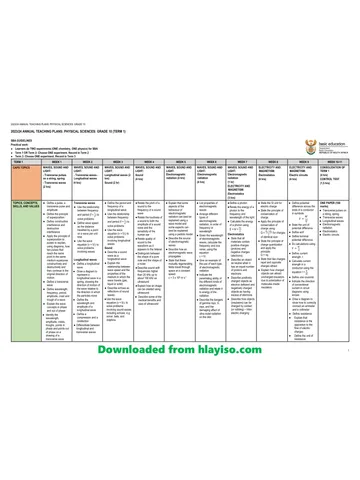
Gr 10 Phys Sci ATP 2023 24
Question paper and memo
Physical Sciences Grade 10 Eastern Cape June 2025 QP & Memo
Question paper
Physical Sciences Grade 10 Eastern Cape March Test 2025 QP
Question paper and memo
Physical Sciences Grade 10 Free State June 2025 Paper & Memo
Question paper and memo