
Downloaded from hlayiso.com
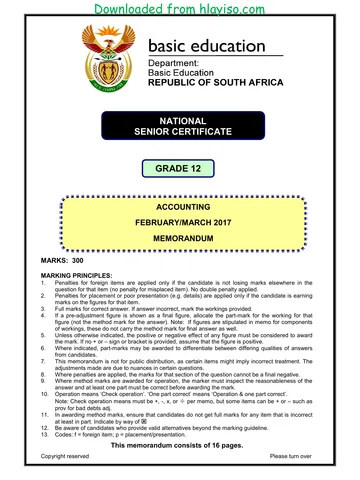
NATIONAL
SENIOR CERTIFICATE
GRADE 12
ACCOUNTING
MARCH 2018
MARKING GUIDELINES
MARKS: 300
MARKING PRINCIPLES:
1. Unless otherwise stated in the marking guideline, penalties for foreign items are applied only if the
candidate is not losing marks elsewhere in the question for that item (no penalty for misplaced item).
No double penalty applied.
2. Penalties for placement or poor presentation (e.g. details) are applied only if the candidate is earning
marks on the figures for that item.
3. Full marks for correct answer. If answer incorrect, mark the workings provided.
4. If a pre-adjustment figure is shown as a final figure, allocate the part-mark for the working for that
figure (not the method mark for the answer). Note: if figures are stipulated in memo for components of
workings, these do not carry the method mark for final answer as well.
5. Unless otherwise indicated, the positive or negative effect of any figure must be considered to award
the mark. If no + or – sign or bracket is provided, assume that the figure is positive.
6. Where indicated, part-marks may be awarded to differentiate between differing qualities of answers
from candidates.
7. This memorandum is not for public distribution, as certain items might imply incorrect treatment. The
adjustments made are due to nuances in certain questions.
8. Where penalties are applied, the marks for that section of the question cannot be a final negative.
9. Where method marks are awarded for operation, the marker must inspect the reasonableness of the
answer and at least one part must be correct before awarding the mark.
10. Operation means 'check operation'. 'One part correct' means operation and one part correct. Note:
check operation must be +, -, x, ÷, or per memo.
11. In calculations, do not award marks for workings if numerator & denominator are swapped – this also
applies to ratios.
12. In awarding method marks, ensure that candidates do not get full marks for any item that is incorrect
at least in part. Indicate with a .
13. Be aware of candidates who provide valid alternatives beyond the marking guideline.
14. Codes: f = foreign item; p = placement/presentation.
These marking guidelines consist of 16 pages.
Copyright reserved Please turn over
Skip to contentAll 2018 papers 

View all
Accounting Grade 12 NSC Supplementary 2018 Memo (English)
Grade 12 Accounting memorandum from the NSC Supplementary Exam 2018 (English), 16 pages. Read online or download the free PDF.
Accounting · Grade 12 · NSC Supplementary Exam · 2018. Memorandum, 16 pages. Read online or download the PDF.
- Subject
- Accounting
- Grade
- Grade 12
- Document type
- Memorandum
- Year
- 2018
- Exam period
- NSC Supplementary Exam
- Curriculum
- CAPS
- Pages
- 16
- File size
- 593.2 KB
Free to read online, no sign-up needed
Loading document…
Loading document…
1 of 16
This exam
NSC Supplementary Exam 2018
Document textSearch extracted text and jump to a page.
Downloaded from hlayiso.com
Accounting 2 DBE/Feb.–Mar. 2018
NSC – Marking Guidelines
QUESTION 1
1.1 DEBTORS' AGE ANALYSIS
1.1.1 Explain why the debtors' age analysis is considered to be an effective
internal control measure. State ONE point.
Valid explanation part-mark for unclear / incomplete answer
Helps identify slow or defaulting debtors (not abiding to the credit terms)
so that action can be taken.
Highlights debtors in good standing so their credit ratings can be reviewed.
It can expose the problem of allowing debtors to exceed their credit limits.
It can assist with planning/corrective measures such as sending
reminders, writing off debtors etc.
2
1.1.2 Explain TWO different problems highlighted by the debtors' age
analysis. In EACH case, provide the name of a debtor and figure(s).
Give marks for debtor & figures even if problem incorrectly identified
PROBLEM DEBTOR AND FIGURE(S)
Debtor Figure
Debtors exceeding credit limits P. Botha (by R700)
Or: balance of 4 200 is above his limit of 3 500
Overdue accounts/not complying with S. Walker (R8 500 overdue)
credit terms/slow payers O. Klein (R1 100 overdue);
M. Valley (R950 overdue)
Poor control of granting credit / M. Valley (R950)
Continue selling to debtors whose S. Walker (R8 500)
accounts are overdue O. Klein (R1 100) 6
1.2 DEBTORS' RECONCILIATION
1.2.1 CORRECTIONS TO THE DEBTORS' CONTROL ACCOUNT ON
30 NOVEMBER 2017
Balance before errors and omissions 25 700
(i) +2 700
(ii) +350
(iii) no part-marks – 1 800
(iv) No change
(v) +1 500
Correct Debtors' Control balance 28 450
one part correct
7
accept brackets for -ve amounts; no sign indicates +ve
accept “0 or –“ for “no change”
Copyright reserved Please turn over
Downloaded from hlayiso.com
Accounting 3 DBE/Feb.–Mar. 2018
NSC – Marking Guidelines
1.2.2 DEBTORS' LIST ON 30 NOVEMBER 2017
L Nkosi (5 700 – 1 800 ) 3 900
S Muller (11 100 + 350 ) 11 450
M Welthagen (– 1 900 + 1 500) (400)
B Sandleni (15 900 – 1 200 – 1 200 ) 13 500
2 400 two marks must be < 15 900
Correct total of Debtors' List operation one part correct 28 450
10
1.3.1 Calculate the VAT amount that is either receivable from or payable to
SARS on 31 July 2017.
MARK ONE LINE ONLY (DO NOT MIX LINES) VAT CONTROL CALCULATION
VAT INPUT VAT OUTPUT
27 200 *69 300
27 200 – 69 300 + 22 260 + 2 100
#22 260 #1 260
+ 4 200 – 1 260 – 4 130 = – 18 930
One part correct *2 100 4 130
OR 4 200
–67 200 two marks +21 000 two marks 18 930
27 200 – 69 300 + 2 100 + 22 260 – 1 260 + 4 200 74 690 74 690
– 4 130 = – 18 930
* Sales less returns
OR +67 200 two marks –21 000 two marks 69 300 – 2 100 = 67 200 two marks
– 27 200 + 69 300 – 2 100 – 22 260 + 1 260 – 4 200
+ 4 130 = 18 930 # Purchases less drawings
22 260 – 1 260 = 21 000 two marks
11
1.3.2 Nomvula has ordered goods with a marked price of R35 000 from Beta
Suppliers.
The sales director of Beta Suppliers, Jim Frow, has offered to sell these
goods to Nomvula for R15 000, provided that they do not have to issue
an invoice.
Comment on the offer made by Jim. State TWO points.
TWO valid points part-mark for unclear / incomplete answer
Tax evasion / buying stolen goods is illegal / unethical
The issuing of documents is important for internal control purposes / It is
fraudulent not to issue an invoice
Unethical/illegal activity will tarnish the image of the business.
Discount limits must be formalised by management (otherwise fraudulent)
4
TOTAL MARKS
40
Copyright reserved Please turn over
Downloaded from hlayiso.com
Accounting 4 DBE/Feb.–Mar. 2018
NSC – Marking Guidelines
QUESTION 2
2.1
2.1.1 Asset
2.1.2 Specific identification
2.1.3 Periodic
3
2.2.1 Calculate the value of the closing stock according to the FIFO method
on 31 December 2017.
300 x R430 = R129 000
140 x R375 = R52 500 one part correct
(440–300) (350+25) = R181 500 one part correct
6
2.2.2 Calculate the cost of sales.
(840 500 + 58 100) both for one mark
189 000 + 898 600 – 19 000 – 181 500 = 887 100
see 2.2.1 one part correct
OR: Using units sold:
540 189 000
one mark
550 217 250
900 – 50 = 850 345 850 one mark
500 – 140 = 360 135 000 two marks
887 100 one method mark
Calculate the gross profit.
1 380 000 – 887 100 = 492 900 one part correct
see above 8
2.2.3 Calculate the value of the closing stock on 31 December 2017 by using
the weighted-average method.
1 068 600 one part correct
189 000 + 898 600 – 19 000 x 440 = 171 600 one part correct (must be x 440)
540 + 2 250 – 50
2 740 one part correct
390 (WA) four marks
6
What will be the effect on the gross profit if the owner changes to this
valuation method? Provide figures.
If candidate indicates increase then inspect workings above
Award accuracy mark if workings indicate increase
Gross profit will decrease / be less * by 9 900 (181 500 – 171 600)
see 2.2.1 see 2.2.3
OR 492 900 – 483 000
FIFO WA 3
Copyright reserved Please turn over
Downloaded from hlayiso.com
Accounting 5 DBE/Feb.–Mar. 2018
NSC – Marking Guidelines
2.3 You are provided with information relating to Leno Furnishers. They sell
tables, chairs and beds for cash only. The owner is concerned that the
figures provided reflect poor internal control and decision-making.
Identify ONE problem for each product. Quote figures. In EACH case,
give advice on how to solve the problem.
Product Problem Advice
Figures
Comparison figures not necessary but may
enhance identification of problem
If figures correct award marks even if
explanation wrong
Stolen tables: 30 which Improve physical security
Tables leads to loss of income of Regular stock counts
R45 000 Check at doors.
Missing money Division of duties (banking)
Total sales: R1 920 000 but Documentation
Chairs
only R1 800 000 banked Request bank notification for
(R120 000) transactions (sms).
Reduce the selling price to
Too much stock on hand increase sales
200 whilst sales is only 480 More effective advertising
for the year. Consider discontinuing the
Beds 200/480 = 5 months; slow product
moving goods Purchase these goods
only 70% of available stock
according to order.
sold i.e. 480/680
9
TOTAL MARKS
35
Copyright reserved Please turn over
Downloaded from hlayiso.com
Accounting 6 DBE/Feb.–Mar. 2018
NSC – Marking Guidelines
QUESTION 3
3.1 GLAMOUR DRESS CREATIONS
3.1.1 PRODUCTION COST STATEMENT FOR THE YEAR ENDED 28 FEBRUARY
2017.
Raw/Direct materials cost (918 550 + 5 250 ) 923 800 *
Direct labour cost ( 810 000 three marks )
(753 300 + 48 600 + 8 100 + 8 100 )
OR: Solve for Y y = 753 300 + 48 600 + (0,01y) 818 100 *
y = 810 000 DLC = 810 000 + 8 100
OR 753 300+48 600+801 900 = 99% DLC = 101% 801 900 x 101/99
Prime cost DMC + DLC 1 741 900
Factory overhead cost (227 240 + 63 960 )
[(87 100 one mark – 7 150 two marks) x 80% one mark] 291 200 *
79 950 three marks
Total manufacturing cost operation 2 033 100
Work-in-process (1 March 2016) 76 000
2 109 100
Work-in-process (28 February 2017) operation (169 100)
Cost of production of finished goods 1 940 000 *
(1 860 000 + 190 000 – 110 000) 21
-1 foreign items (max -2) *one part correct
3.1.2 Calculate the net profit for the year ended 28 February 2017.
79 950 X 20%
Gross Profit = 1 310 000 (3 marks) 79 950 – adjustment in FOHC (3.1.1)
3 170 000 – 1 860 000 – 410 000 – (259 010 + 15 990 )
or – 259 010 – 15 990
275 000 two marks
= 625 000 one part correct
7
3.2 LIGHTING SOLUTIONS
3.2.1 Calculate the factory overhead cost per unit for the year ended
31 December 2017.
395 000 /50 000 = R7,90 2
3.2.2 Explain why George would not be concerned about the 28,1% increase in
total variable cost from R936 600 to R1 200 000.
Any valid comment compared to inflation rate figures not necessary
The variable cost per unit increased up by 7,6% which is less than inflation
rate
An additional 8 000 units were produced (19% increase in production)
There was an increase in units produced and therefore greater profits.
3
Copyright reserved Please turn over
Downloaded from hlayiso.com
Accounting 7 DBE/Feb.–Mar. 2018
NSC – Marking Guidelines
3.2.3 Give TWO reasons for the increase in the selling and distribution cost
per unit.
TWO valid reasons
Advertising costs may have increased
Increase in fuel price
Commission to sales staff increased
Due to inflation
Do not accept increased sales / increased delivery expenses 2
3.2.4 Calculate the break-even point for the year ended 31 December 2017.
575 000
45 – 24
21 two marks
= 27 381 units one part correct (accept 27 380,9)
4
Comment on the production level for 2017. State TWO points. Quote
figures.
Comparison figures not necessary but may enhance answer
Explanation must compare BEP with level of production figures see 3.2.3
The business produced and sold 50 000 units. This is 8 000 units more
than the production achieved in the previous financial year (42 000 units).
The business produced 22 619 (50 000 – 27 381) units more than the BEP.
There is an increase of (22 619 – 19 687) 2 932 units over the BEP when
compared to the previous financial year.
4
3.2.5 Lighting Solutions are considering importing raw materials because it is
cheaper and of a higher quality. Name TWO aspects that they must
consider before finalising their decision.
Any TWO relevant aspects
Fluctuation in exchange rates (impact on cost/selling price)
Additional / increasing import costs (transportation and custom duties)
Time delays (availability and/or delivery)
Support for local suppliers (impact on the local economy)
Not easy to return damaged goods
2
TOTAL MARKS
45
Copyright reserved Please turn over
Downloaded from hlayiso.com
Accounting 8 DBE/Feb.–Mar. 2018
NSC – Marking Guidelines
QUESTION 4
4.1
4.1.1 C
4.1.2 E
4.1.3 D
4.1.4 A
4.1.5 B 5
4.2 ORBIT LTD
4.2.1
(a) ORDINARY SHARE CAPITAL
Authorised
6 000 000 shares
Issued
Ordinary shares in issue at beginning of
4 200 000 3 150 000
year
(60 000) Shares repurchased during the year at *(45 000) *
Ignore brackets R0,75 (ASP) one part correct Ignore brackets
4 140 000 Ordinary shares in issue at end of year 3 105 000
one part correct must subtract repurchase 8
*Do not accept: R210 000 or 60 000 x R3,50
(b) RETAINED INCOME
Balance on 1 July 2016 874 000
Net profit after income tax (408 800 x 72/28 ) 1 051 200 *
OR: 1 460 000 – 408 800
Shares repurchased (60 000 x R2,75 ) 3,50 – ASP above **(165 000) *
OR: 210 000 – figure for repurchase in (a) Ignore brackets
Ordinary share dividends (1 540 800) *
Ignore brackets
Interim (paid) 630 000
Final (recommended) (4 140 000 x 22 cents or 0,22 / 22% 910 800 *
Balance on 30 June 2017 *one part correct &
219 400 *
repurchase and OSD must be subtracted 11
*One part correct
** do not accept 210 000 or 0;
Copyright reserved Please turn over
Downloaded from hlayiso.com
Accounting 9 DBE/Feb.–Mar. 2018
NSC – Marking Guidelines
4.2.2 ORBIT LTD
BALANCE SHEET ON 30 JUNE 2017.
ASSETS
NON-CURRENT ASSETS TA – CA 3 822 600
Fixed/Tangible Assets balancing figure 3 442 600
Fixed deposit 2 380 000
CURRENT ASSETS operation 1 037 800
Inventory 478 000
Trade and other receivables 309 100
317 000 – 15 850 + 7 950 one part correct
Cash and cash equivalents 250 700
TOTAL ASSETS see Total Equity and Liabilities 9 4 860 400
EQUITY AND LIABILITIES
SHAREHOLDERS' EQUITY operation 3 324 400
Ordinary share capital see 4.2.1 3 3 105 000
Retained income see 4.2.1 219 400
NON-CURRENT LIABILITIES 320 000
Loan: Helping Bank
(360 000 – 40 000) one part correct 4 320 000
302 400 one mark + 57 600 one mark – 40 000 one mark
CURRENT LIABILITIES operation 1 216 000
Award all marks if all items included in T&OP
Trade and other payables one part correct 246 400
(239 800 + 6 600 )
Shareholders for dividends see 4.2.1 910 800
SARS: Income tax (408 800 – 390 000) 18 800
one part correct
Current portion of loan see loan 40 000
TOTAL EQUITY AND LIABILITIES operation 10 4 860 400 28
Misplaced items mark figures but-1 each time (as per Nov 2017)
Foreign entries -1 (max -2)
Presentation / Incorrect or incomplete details -1 (max -2)
SARS may not be shown as a current asset
Copyright reserved Please turn over
Downloaded from hlayiso.com
Accounting 10 DBE/Feb.–Mar. 2018
NSC – Marking Guidelines
4.2.3 As a shareholder, explain your concern regarding the proposed
buy-back of shares. Provide calculations to support your concern.
Explanation part-mark for unclear / incomplete answer
Barry wants to increase his % shareholding (without investing in more shares)
He will become the majority shareholder which will enable him to influence all
decisions taken.
% shareholding of Barry after the share buyback:
1 904 400 / 3 740 000 x 100 = 50,9%. one part correct; accept 51%
(4 140 000 – 400 000)
6
4.3 AUDIT REPORT: DF ENTERPRISES LTD
4.3.1
(a) External
(b) Directors
2
4.3.2 (a) The audit report below indicates a/an (qualified/unqualified) opinion.
Qualified 1
(b) Explain why the shareholders should be concerned about this audit
report. State TWO points.
TWO valid points part-mark for unclear / incomplete answer
There is possible fraud/mismanagement occurring in the business.
There is a lack of internal control processes (poor recording)
The qualified audit report could affect the price of shares / reputation of the
company
Unaccounted expenditure impacted on their return/profits
Dividends could have been negatively affected by this problem
4
TOTAL MARKS
65
Copyright reserved Please turn over
Downloaded from hlayiso.com
Accounting 11 DBE/Feb.–Mar. 2018
NSC – Marking Guidelines
QUESTION 5
5.1 NO. WORKINGS AMOUNT
(a) Additions to buildings
4 934 450 – 1 058 520 – 2 866 990
OR (b) below (c) below 1 008 940
[3 993 390 + 300 000 – 270 280 – 97 600] – 4 934 450 one part correct
two marks one mark
OR
4 934 450 – 300 000 + 97 600 + 270 280 – 3 993 390
4
(b) Total depreciation on equipment
Old: 1 126 400 x 20% = 225 280 one part correct
270 280
one part correct
New: 300 000 x 20% x 9/12 = 45 000
one part correct
6
(c) Disposal of equipment at carrying value
97 600
1 126 400 + 300 000 – 270 280 – 1 058 520 one part correct
See (ii) above
5 15
5.2.1 WORKINGS ANSWER
Calculate the Income tax paid. Accept reversed signs 124 940
(422 500 – 295 750) two or nothing one part correct
3 390 + 126 750 – 5 200
Accept -ve or
brackets 5
5.2.2 Calculate the dividends paid. Accept reversed signs
120 000
50 000 + 70 000 one part correct
must be +ve
OR: 50 000 + 168 000 – 98 000 Accept -ve or
brackets 3
5.2.3 Calculate the net change in cash and cash equivalents.
– 25 000 – 245 000 Signs are important here
(2 500 – 27 500) – 270 000
4 marks (270 000)
1 mark (245 000)
2 marks (25 000) 4
5.3 CASH EFFECTS OF FINANCING ACTIVITIES one part correct 562 500
Proceeds from shares issued
1 270 000
4 117 500 + 152 500 – 3 000 000 One part correct
25 000 x R6,10
Funds used to repurchase shares 25 000 x R6,30
(157 500)
157 500 with no
Final figure must be correct to get 1 or 2 marks
brackets award 1 mark
Change in loan 1 300 000 – 750 000
(550 000)
550 000 with no
Final figure must be correct to get 1 or 2 marks
brackets award 1 mark 10
Copyright reserved Please turn over
Downloaded from hlayiso.com
Accounting 12 DBE/Feb.–Mar. 2018
NSC – Marking Guidelines
5.4.1 Calculate the debt-equity ratio.
750 000 : 4 375 250 = 0,2 : 1 one part correct (accept 0,17 : 1)
3
5.4.2 Calculate the earnings per share (in cents).
295 750 / 700 000 x 100 = 42,3 cents one part correct (accept 42 cents)
Note: Cannot accept 675 000 shares (as 25 000 shares repurchased on last day of fin year) 3
5.4.3 Calculate the return on average shareholders' equity (ROSHE).
one part correct; must be shown as %
295 750 x 100 = 7,9% one part correct (Accept 7,88%)
½ (3 135 000 + 4 375 250 )
7 510 250 two marks
3 755 125 three marks
5
5.5 Explain why the directors felt that the 630 cents offered on the shares
repurchased was a fair price. Quote TWO financial indicators with
figures.
Comparison to market price Figures
Comparison to NAV Figures
The price offered benefits the company as it is less than the market price of
640 cents (by 10 cents)
Less than the Net Asset Value of 648 cents (by 18 cents)
4
5.6.1 The directors revised the dividend pay-out policy for the current
financial year.
Calculate the percentage of earnings distributed as dividends for each
year to show this change.
2016: 20/23 x 100 = 87%
2017: 24/42,3 x 100 = 56,7% (refer 5.4.2)
4
Copyright reserved Please turn over
Downloaded from hlayiso.com
Accounting 13 DBE/Feb.–Mar. 2018
NSC – Marking Guidelines
5.6.2 Give ONE reason why the directors took this decision.
Any ONE valid explanation part-mark for unclear / incomplete answer
They decided to retain funds for future developments in the business.
They wanted to minimise their cash flow problems / They foresaw that the
company bank balance is going into an overdraft.
2
5.6.3 Explain why the shareholders may not be satisfied with the return they
earned. Quote a financial indicator or figure(s).
part-mark for unclear / incomplete answer
Explanation Figure/financial indicator
ROSHE is 7,9% (see 5.4.3) is less than what she would receive on an alternative
investment. (Fixed deposits offer 8% in 2016 and 9% in 2017).
3
5.7 Apart from the dividends, identify THREE good decisions. Explain the
effect of each decision on the company. Quote figures.
GOOD DECISION EFFECT ON COMPANY
(with figures ) Figures not required
Reducing or paying a large portion Reduced financial risk / Improved the debt
of the loan by R550 000 equity ratio from 0,4 :1 to 0,2 : 1
see 5.4.1
OR: OR
Decreased loan from R1 300 000 to The ROTCE improved from 6,4% to 11,4%;
R750 000 closer to the interest rate of 12% (still
negatively geared).
Issue new shares; R1 270 000* Lightened the cash flow burden
Used to reduce the loan
Purchase of fixed assets; Leads to capital growth (future productivity)
R1 308 930 (1 008 940 + 300 000) More assets in the company
see 5.1(a) 9
*Also:
Spent R157 500 to repurchase shares (not so significant but would show an improvement to
certain financial indicators).
TOTAL MARKS
70
Copyright reserved Please turn over
Downloaded from hlayiso.com
Accounting 14 DBE/Feb.–Mar. 2018
NSC – Marking Guidelines
QUESTION 6
6.1.1 Calculate the mark-up percentage on spare parts used in the Projected
Income Statement for March 2018.
22 875 / 30 500 x 100 = 75% one part correct
3
6.1.2 Calculate % decrease in service fee income expected in April 2018.
13 500 / 150 000 x 100 = 9% one part correct
(150 000 – 136 500) one mark
3
6.1.3 Calculate the additional space (in square metres) the business will rent
from April 2018.
6 000 / 75 = R80
9 200 / R80 = 115 sqm
Additional space = 115 – 75 = 40 square metres one part correct
OR
3 200 one mark 4
(9 200 – 6000) = 40 sqm one method mark
80 two marks
6.1.4 Calculate the interest rate on the fixed deposit.
5 700 – 2 700
3 000 x 12 x 100 = 8% one part correct
450 000
5
6.2 Comment on the control of stock and explain how Vusi intends to
correct this. Quote figures.
Each item Figures Comparison figures not essential
Trading stock deficit reduced to R2 000 (was high at R14 000)
Increase in security expenses by R4 200 / from R5 000 to R9 200 / by 84%.
4
Copyright reserved Please turn over
Downloaded from hlayiso.com
Accounting 15 DBE/Feb.–Mar. 2018
NSC – Marking Guidelines
6.3.1 Vusi is thinking of purchasing the business premises rather than renting
it. State ONE advantage and ONE disadvantage of this option.
Advantage part-mark for unclear / incomplete answer
Will not have to pay rent in future.
Business will acquire a fixed asset. This increases the value of the
business.
Extra space can be rented out to receive additional income.
Disadvantage part-mark for unclear / incomplete answer
Rates on property must be paid.
Additional maintenance costs will be incurred.
Large initial cash outlay or an additional monthly instalment, including
interest.
Not easy to relocate quickly
Costs and time involved in selling a building.
4
6.3.2 Vusi offers a free delivery service of spare parts to customers, but plans
to discontinue this service on 31 March 2018.
State TWO points to support this decision.
Any TWO relevant points: part-marks for unclear / incomplete answer
Customers will be forced to have the spare parts fitted as part of the
service offered by the business.
The business will be saving on the running cost of the delivery vehicle
The main line of business is the repairing of vehicles – the sale of spare
parts supports this
The profit on sale of spare parts is considerably lower than the fee income
for the repair service.
4
6.3.3 Calculate the cost of the new vehicle that he plans to purchase on
1 April 2018.
9 000 x 12 = R720 000 one part correct
0,15 or 15%
4
Copyright reserved Please turn over
Downloaded from hlayiso.com
Accounting 16 DBE/Feb.–Mar. 2018
NSC – Marking Guidelines
6.4.1 Explain whether Water and electricity has been well controlled, or not.
Comment on control Figures
Part-mark for unclear / incomplete answer Comparison figures not necessary but may enhance explanation
This expense has been well-controlled. If the projected amount of R4 500
considered the increase, it would have been R5 175. Only R5 000 was spent
(R175 less than the adjusted projected amount.
OR
The projected amount (R4 500) has not taken in account the tariff increase of
15% affected on 1 February 2018, which would have led to an adjusted
projected amount of R5 175.
3
6.4.2 Explain whether you agree with Vusi's decision not to use the full
budget for Advertising.
Comment on decision Figures
Part-mark for unclear / incomplete answer Comparison figures not necessary but may enhance explanation
The actual amount spent is R2 900 less than the budgeted/projected. / The
amount spent (R1 800) is lower than the projected amount (R4 700). This was
a poor decision and the full amount should have been used (considering that
that mark-up on cost was also adjusted from the projected 65% to 80%).
This had a negative effect on fee income (R22 500 less than projected)
and sales of spares (R31 500 less than projected)
3
6.4.3 Explain whether Consumable stores have been well controlled, or not.
Comparison of fee income and consumable stores Figures
Part-mark for unclear / incomplete answer Comparison figures not necessary but may enhance explanation
Fee income was less than budgeted by R22 500 (15%) whilst servicing
expenses was over the budget by R6 450 (21,5%). An actual decrease in fee
income should see a proportional decrease in consumable stores used. This
indicates a lack of control.
4
6.4.4 Explain how Vusi's decision about the mark-up percentage on spare
parts has affected the business.
Comparison of mark-up% and sales Figures
Part-mark for unclear / incomplete answer Comparison figures not necessary but may enhance explanation
The increase in the mark-up percentage (65% to 80%) negatively
impacted in spare-part sales.
Sales was less than projected by R31 500 (R128 700 to R97 200).
Profit on sales was less than projected by R7 500 (R50 700 to R43 200). 4
TOTAL MARKS
45
TOTAL: 300
Copyright reserved
Study this subject
Recommended for this subject
Memorandum
Accounting Grade 12 Eastern Cape Mock 2018 Memo (English)
Memorandum
Accounting Grade 12 KZN March 2018 Memo
Memorandum
Accounting Grade 12 NSC June 2018 Memo (Afrikaans)
Memorandum
Accounting Grade 12 NSC Supplementary 2017 Memo (Afrikaans)
Memorandum
Accounting Grade 12 NSC Supplementary 2017 Memo (English)
Question paper
Accounting Grade 12 Eastern Cape Mock 2018 QP (Afr)
More from Grade 12 Accounting
Study guide
Accounting
Addendum
Accounting Grade 12 P1 Eastern Cape June 2025 Addendum (Eng)
Question paper
Accounting Grade 12 P1 Eastern Cape June 2025 QP (Afr)
Question paper
Accounting Grade 12 P1 Eastern Cape June 2025 QP (Eng)
Question paper
Accounting Grade 12 P2 Eastern Cape June 2025 QP (Eng)
Addendum