
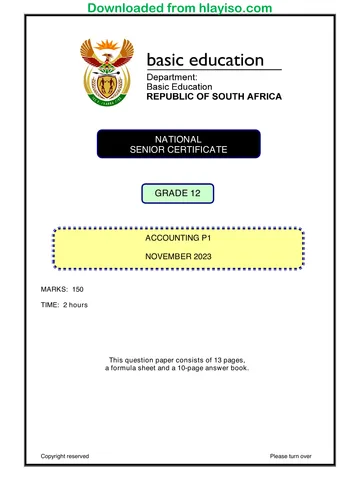
NATIONAL
SENIOR CERTIFICATE
GRADE 12
SEPTEMBER 2023
ACCOUNTING P1
MARKS: 150
TIME: 2 hours
This question paper consists of 11 pages, including
a formula sheet and an 11-page answer book.
Skip to contentAll 2023 papers 

View all
Accounting Grade 12 P1 Eastern Cape Mock 2023 QP (Eng)
Grade 12 Accounting Paper 1 question paper from the Eastern Cape Mock Exam 2023 (English), 11 pages. Read online or download the free PDF.
Accounting · Grade 12 · Eastern Cape Mock Exam · 2023 · English. Question paper, 11 pages. Read online or download the PDF.
- Subject
- Accounting
- Grade
- Grade 12
- Language
- English
- Document type
- Question paper
- Year
- 2023
- Exam period
- Eastern Cape Mock Exam
- Paper
- 1
- Curriculum
- CAPS
- Pages
- 11
- File size
- 565.4 KB
Free to read online, no sign-up needed
Loading document…
Loading document…
1 of 11
This exam
Eastern Cape Mock Exam 2023
Questions in this paper
Document textSearch extracted text and jump to a page.
2 ACCOUNTING P1 (EC/SEPTEMBER 2023)
INSTRUCTIONS AND INFORMATION
Read the following instructions carefully and follow them precisely.
1. Answer ALL the questions.
2. A special ANSWER BOOK is provided in which to answer ALL questions.
3. A Financial Indicator Formula Sheet is attached at the end of this question
paper.
4. Show ALL workings to earn part-marks.
5. You may use a non-programmable calculator.
6. You may use a dark pencil or blue/black ink to answer questions.
7. Where applicable, show ALL calculations to ONE decimal point.
8. Write neatly and legibly.
9. Use the information in the table below as a guide when answering the question
paper. Try NOT to deviate from it.
TIME
QUESTION TOPIC MARKS
(minutes)
Calculation of correct net profit and
1 60 45
Statement of Financial Position
Notes to Financial Statements, Cash
2 Flow Statement and Financial 40 30
Indicators
3 Interpretation of Financial Statements 35 30
4 Corporate Governance 15 15
TOTAL 150 120
Copyright reserved Please turn over
(EC/SEPTEMBER 2023) ACCOUNTING P1 3
QUESTION 1: CALCULATION OF NET PROFIT AND STATEMENT OF FINANCIAL
POSITION (60 marks; 45 minutes)
1.1 Indicate whether the following statements are true or false.
1.1.1 Shareholders are responsible for the running of the company.
1.1.2 The Statement of Financial Position shows the financial position of a
company at a specific date.
1.1.3 The Statement of Comprehensive Income shows the profit or loss for the
financial year.
(3 x 1) (3)
1.2 LUX LTD
The information relates to the financial year ended on 30 June 2023.
REQUIRED:
1.2.1 Refer to Information B (i).
Calculate the value of closing stock using the FIFO-method. (4)
1.2.2 Refer to Information A and B:
Use the table provided to calculate the correct net profit after tax for the
year ended 30 June 2023.
Indicate ‘+’ for increase and ‘–’ for decrease at each adjusted amount. (21)
1.2.3 Complete the Statement of Financial Position on 30 June 2023. (32)
NOTE:
• Adjustments from Information B must be considered when
completing the Statement of Financial Position.
• Show workings.
• Some amounts have been entered in the ANSWER BOOK.
Copyright reserved Please turn over
4 ACCOUNTING P1 (EC/SEPTEMBER 2023)
INFORMATION:
A. Extract from Pre-adjustment Trial Balance on 30 June.
2023 2022
(R) (R)
Ordinary share capital ? 6 800 000
Retained income 895 000
Mortgage loan: Govee Bank ? 3 985 000
Fixed assets (carrying value) 7 711 501
Fixed deposit ?
Trading stock 2 024 500
Debtors control 942 460
Bank (favourable) 53 440
Creditors control 1 962 260
SARS: Income tax (provisional payments) 914 600
Shareholders for dividends 616 500
Provision for bad debts ? 25 300
Insurance 128 400
Rent income 168 000
B. The net profit before tax, R3 551 841, was calculated before taking the
following into account:
(i) The stock-sheet below was omitted when the final stock figures were
calculated.
NOTE: The FIFO stock valuation method was used.
Units Unit price Total
Opening stock 850 R60 R51 000
Purchases:
November 2022 640 R90 R57 600
April 2023 350 R100 R35 000
Closing stock 400
(ii) Equipment bought on 1 January 2017, cost R360 000, was sold for cash
for R43 000 on 29 June 2023. No entries were made for the sale of the
equipment.
The equipment’s value depreciated at a fixed amount over six (6) years.
(iii) Provision for bad debts should be adjusted to R28 500.
(iv) Insurance includes an amount of R40 800 paid for the period
1 January 2023 to 31 December 2023.
(v) Rent is received for the period 1 July 2022 up to 30 September 2023. This
takes into account an increase of R800 per month from 1 April 2023.
Copyright reserved Please turn over
(EC/SEPTEMBER 2023) ACCOUNTING P1 5
(vi) A creditor with a debit balance of R11 000 must be transferred to the
debtors ledger.
(vii) Information from the loan statement received from Govee Bank:
• Monthly repayments, including interest of R45 000.
Interest on the loan is capitalised.
• Balance on 30 June 2023, R3 755 000.
NOTE: The current portion of the loan will be increased by R70 000 in
the next financial year.
C. After taking the above omissions into account, it was determined that R65 500
was due to SARS.
D. A final dividend of 45c per share was declared.
E. The following financial indicator was calculated on 30 June 2023:
• Net asset value per share (NAV): 420 cents
F. A fixed deposit was made at Best Bank on 25 June 2023.
60
Copyright reserved Please turn over
6 ACCOUNTING P1 (EC/SEPTEMBER 2023)
QUESTION 2: CASH FLOW STATEMENT AND FINANCIAL INDICATORS
(40 marks; 30 minutes)
2.1 Choose the correct word from the list below which best suits each statement
below. Write only the word next to the question numbers (2.1.1 to 2.1.3) in the
ANSWER BOOK.
Liquidity; Gearing; Profitability; Solvency
2.1.1 Use of borrowed capital (loans) to finance the business.
2.1.2 Ability of the business to pay short-term debts.
2.1.3 Ability to settle all debts using the assets of the business.
(3 x 1) (3)
2.2 TUMBA LTD
The information relates to the financial year ended 30 April 2023.
REQUIRED:
2.2.1 Complete the Ordinary Share Capital note. (6)
2.2.2 Calculate the following amounts for the Cash Flow Statement:
• Income tax paid (5)
• Dividends paid (3)
2.2.3 Complete the following sections of the Cash Flow Statement.
• Cash effects from investing activities (7)
• Net change in cash and cash equivalents (4)
2.2.4 Calculate the following financial indicators on 30 April 2023.
• Acid-test ratio (4)
• % return on average shareholders’ equity (ROSHE) (4)
• Interim dividends per share (4)
NOTE: Some amounts have been entered in the ANSWER BOOK.
Copyright reserved Please turn over
(EC/SEPTEMBER 2023) ACCOUNTING P1 7
INFORMATION:
A. Extract from the Statement of Comprehensive Income on 30 April 2023
Sales 3 188 150
Depreciation 413 000
Interest expense 78 000
Net profit after tax 637 630
NOTE: The income tax rate is 30%.
B. Extract from the Statement of Financial Position on 30 April:
2023 2022
Fixed assets (carrying value) 4 094 900 3 830 000
Financial assets 190 000
Inventories 720 800 520 000
Trade and other receivables 240 000 356 000
Cash and cash equivalents 56 600 6 500
Shareholders’ equity 6 062 000 5 124 800
Ordinary share capital 5 852 000 4 704 000
Retained income 210 000 420 800
Trade and other payables 90 440
SARS: Income tax Dr 21 270 Cr 36 600
Shareholders for dividends ? 265 000
Bank overdraft 0 38 400
Current liabilities 360 700 430 440
C. Fixed assets:
• Extensions to land and buildings were completed during the year at a cost
of R830 400.
• Equipment was sold during the year at carrying value.
D. Share capital and dividends:
• The authorised share capital consisted of 2 100 000 shares.
• On 1 May 2022, 70% of the authorised shares were in issue.
• On 30 June 2022, 300 000 additional shares were issued.
• On 30 September 2022 an interim dividend was paid, R318 600.
• 230 000 shares were repurchased on 31 January 2023.
40
Copyright reserved Please turn over
8 ACCOUNTING P1 (EC/SEPTEMBER 2023)
QUESTION 3: INTERPRETATION OF FINANCIAL INFORMATION
(35 marks; 30 minutes)
JMP LTD
The information relates to the financial year ended on 28 February 2023.
REQUIRED:
NOTE: Provide figures, trends, financial indicators or calculations in EACH case to
support your comments and explanations.
3.1 The company’s total sales increased from 2022 to 2023 and the operating
activities have been better controlled in 2023.
• Quote and explain TWO financial indicators, which indicate better control
over operating activities. (4)
• Quote and explain ONE relevant indicator, which directly contributed to the
increase in sales. (2)
3.2 Identify TWO financial indicators, which indicate an improvement in the liquidity
of the company. (2)
3.3 The directors decided to increase the loan at the beginning of 2023. Explain
why you agree with their decision. Quote TWO financial indicators with trends. (8)
3.4 Shareholders buy shares in companies as a short-term investment while others
do it as a long-term investment.
Explain how the change in the dividend pay-out policy affects the investment
choices of each type of shareholder. Provide comparative figures. (6)
3.5 Shareholders are divided on the price paid for the re-purchase of shares.
Provide ONE point in support of and ONE point against the price paid for
shares. Quote ONE financial indicator for each point. (4)
3.6 Refer to Information C
The directors of the company decided to issue an additional 50 000 shares in
the new financial year.
• Calculate the minimum number of shares S. Lucus must buy to become a
majority shareholder. (5)
• Mention TWO points why S. Lucus wants to become a majority shareholder. (4)
Copyright reserved Please turn over
(EC/SEPTEMBER 2023) ACCOUNTING P1 9
INFORMATION:
A. Financial indicators calculated on 28 February:
2023 2022
Mark-up % achieved 55% 70%
% operating expenses on sales 17,3% 21,2%
% operating profit on sales 22,1% 16,5%
% net profit on sales 17,2% 13,9%
Debtors collection period 31 days 44 days
Stock holding period 65 days 62 days
Creditors payment period 62 days 45 days
% return on shareholders’ equity (ROSHE) 19,5% 17,6%
Dividend pay-out rate 40% 80%
Debt-equity ratio 0,4 : 1 0,3 : 1
% return on total capital employed (ROTCE) 12% 11,5%
Net asset value per share (NAV) 1 200 cents 900 cents
B. Additional information on 28 February:
2023 2022
Market price of shares 1 320 cents 1 150 cents
Repurchase price of shares 1 420 cents
Interest on loans 10% 10%
Interest on alternative investments 6% 6%
C. Shares and percentage shareholding on 28 February 2023
Number of shares in issue 650 000
% shareholding of S. Lucus 48%
35
Copyright reserved Please turn over
10 ACCOUNTING P1 (EC/SEPTEMBER 2023)
QUESTION 4: CORPORATE GOVERNANCE (15 marks; 15 minutes)
4.1 The following are three types of reports which can be issued after the financial
statements of a company had been audited.
Qualified report Disclaimer of opinion Unqualified report
• Which type of audit report will discourage shareholders to buy shares in a
company? (1)
• Provide TWO reasons why shareholders will not be interested to buy shares
in such a company. (4)
4.2 Explain why a company’s financial statements have to be audited by
independent auditors. Provide TWO points. (4)
4.3 The following was reported to the company.
One of the directors, the Chief Financial Officer (CFO) and the Independent
Auditor of the company seems to be good friends as they meet socially every
second week.
As a shareholder, why would you be concerned by this kind of relationship?
Explain THREE points (one for each person involved as indicated in the
ANSWER BOOK). (6)
15
TOTAL: 150
Copyright reserved Please turn over
(EC/SEPTEMBER 2023) ACCOUNTING P1 11
GRADE 12 ACCOUNTING FINANCIAL INDICATOR FORMULA SHEET
Gross profit x 100 Gross profit x 100
Sales 1 Cost of sales 1
Net profit before tax x 100 Net profit after tax x 100
Sales 1 Sales 1
Operating expenses x 100 Operating profit x 100
Sales 1 Sales 1
Total assets : Total liabilities Current assets : Current liabilities
(Current assets – Inventories) : Current liabilities Non-current liabilities : Shareholders' equity
(Trade and other receivables + Cash and cash equivalents) : Current liabilities
Average trading stock x 365 Cost of sales .
Cost of sales 1 Average trading stock
Average debtors x 365 Average creditors x 365
Credit sales 1 Cost of sales 1
Net income after tax x 100
Net income after tax x 100 Number of issued shares 1
Average shareholders' equity 1 (*See note below)
Net income before tax + Interest on loans x 100
Average shareholders' equity + Average non-current liabilities 1
Shareholders' equity x 100 Dividends for the year x 100
Number of issued shares 1 Number of issued shares 1
Interim dividends x 100 Final dividends x 100
Number of issued shares 1 Number of issued shares 1
Dividends per share x 100 Dividends for the year x 100
Earnings per share 1 Net income after tax 1
Total fixed costs .
Selling price per unit – Variable costs per unit
NOTE:
* In this case, if there is a change in the number of issued shares during a financial year, the
weighted average number of shares is used in practice.
Copyright reserved Please turn over
Study this subject
Recommended for this subject
Question paper
Accounting Grade 12 P2 Eastern Cape Mock 2023 QP (Eng)
Question paper
Accounting Grade 12 P1 Eastern Cape June 2023 QP (Eng)
Question paper
Accounting Grade 12 P1 Eastern Cape Mock 2021 QP (Eng)
Memorandum
Accounting Grade 12 P1 Eastern Cape June 2023 Memo (English)
Question paper
Accounting Grade 12 P2 Eastern Cape Mock 2020 QP (Eng)
Question paper
Accounting Grade 12 P1 NSC November 2023 QP (Eng)
More from Grade 12 Accounting
Study guide
Accounting
Addendum
Accounting Grade 12 P1 Eastern Cape June 2025 Addendum (Eng)
Memorandum
Accounting Grade 12 P2 Eastern Cape June 2025 Memo (English)
Addendum
Accounting Grade 12 P1 Gauteng June 2025 Addendum (English)
Addendum
Accounting Grade 12 P2 Gauteng June 2025 Addendum (English)
Memorandum