
Downloaded from hlayiso.com
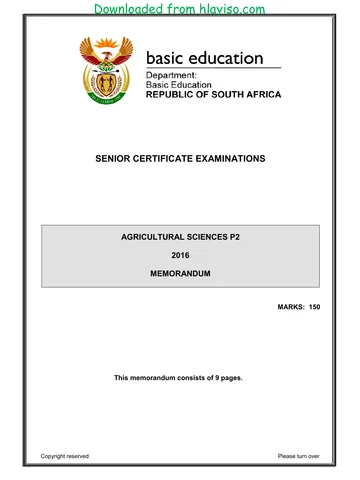
SENIOR CERTIFICATE EXAMINATIONS
AGRICULTURAL SCIENCES P1
2016
MEMORANDUM
MARKS: 150
This memorandum consists of 10 pages.
Copyright reserved Please turn over
Skip to contentMemorandum 

View all
Agricultural Sciences Grade 12 Paper 1 NSC June 2016 Memo
Grade 12 Agricultural Sciences Paper 1 memorandum from the NSC June Exam 2016, 10 pages. Read online or get the free PDF download, question paper linked when available.
Agricultural Sciences · Grade 12 · NSC June Exam · 2016. Memorandum, 10 pages. Read online or download the PDF.
- Subject
- Agricultural Sciences
- Grade
- Grade 12
- Document type
- Memorandum
- Year
- 2016
- Exam period
- NSC June Exam
- Paper
- 1
- Curriculum
- CAPS
- Pages
- 10
- File size
- 307.8 KB
Loading document…
Loading document…
1 of 10
Document textSearch extracted text and jump to a page.
Downloaded from hlayiso.com
Agricultural Sciences/P1 2 DBE/2016
SCE – Memorandum
SECTION A
QUESTION 1
1.1 1.1.1 B
1.1.2 A
1.1.3 A/B/C/D
1.1.4 D
1.1.5 B
1.1.6 B
1.1.7 A
1.1.8 C
1.1.9 A
1.1.10 D (10 x 2) (20)
1.2 1.2.1 B only
1.2.2 A only
1.2.3 Both A and B
1.2.4 B only
1.2.5 None (5 x 2) (10)
1.3 1.3.1 Ammonia
1.3.2 Backyard/free range system
1.3.3 Placenta retention
1.3.4 Spermatogenesis
1.3.5 Flushing/harvesting (5 x 2) (10)
1.4 1.4.1 Mineral licks
1.4.2 Antibodies
1.4.3 Progesterone
1.4.4 Mummification
1.4.5 Pistolette (5 x 1) (5)
TOTAL SECTION A: 45
Copyright reserved Please turn over
Downloaded from hlayiso.com
Agricultural Sciences/P1 3 DBE/2016
SCE – Memorandum
SECTION B
QUESTION 2: ANIMAL NUTRITION
2.1 Alimentary canal of poultry
2.1.1 Identification of the parts
A - Crop (1)
B - Proventriculus/glandular stomach (1)
C - Ventriculus/gizzard/muscular stomach (1)
2.1.2 Letter of the part that contains small stones
C (1)
2.1.3 Reason for the presence of stones
Helps with mechanical digestion/grinding of the food (1)
2.1.4 Parts of the alimentary canal of poultry that will not be found
in sheep
• Crop/A
• Proventriculus/B
• Gizzard/ventriculus/C
• Cloaca/vent/uro-genital opening/E
• Caeca/D (Any 2) (2)
2.2 Composition of feed intake and excreted by a calf consuming 5kg
2.2.1 Feed component with lowest absorption rate
Crude fibre (1)
2.2.2 TWO reasons for the answer
• Has the highest rate of excretion
• Fore stomachs/rumen not well developed/not functional
• Absence/limited quantities of rumen micro flora (Any 2) (2)
2.2.3 ONE reason for not recommending it for dairy cows
• Crude protein concentration is too low/5%
• Crude fibre concentration is too high/78% (Any 1) (1)
2.2.4 Calculate dry material (DM) in the feed (kg)
• (15% moisture) 0,15 x 5kg = 0,75kg moisture
• 5kg – 0,75 = 4,25kg DM
OR
• (85% DM) 0,85 x 5kg
• = 4,25kg DM (2)
Copyright reserved Please turn over
Downloaded from hlayiso.com
Agricultural Sciences/P1 4 DBE/2016
SCE – Memorandum
2.3 Pearson square method (Information on two feeds)
2.3 2.3.1 Calculate percentage
(a) Maize meal
31 x 100
33
= 93,93% (2)
(b) Soybean meal
2 x 100
33
= 6,06% (2)
2.3.2 Cost of soybean in the ration
• 0,0606 (6,06%) x 285kg = 17,27kg
• 17,27kg x R4,58 per kg
• = R79,10 (3)
2.4 Biological value (BV) data
2.4.1 Explanation of biological value
• BV is an index of the % of nitrogen in a certain feed
• It reflects the quality of protein in the feed
• It is determined by the amino acid composition
• and the ratio of amino acids in the protein (Any 2) (2)
2.4.2 Relation between the BV and the quality of a feed
• The higher the BV
• The better the quality of a feed
OR
• The lower the BV
• The lower the quality of a feed (2)
2.4.3 Identification of feed with the lowest BV
Maize meal (1)
2.4.4 Determination of suitability of maize meal
• Suitable for energy/fattening
• Not suitable for production/growth/reproduction (Any 1) (1)
2.4.5 Importance of feeding pigs feed with high BV
• They are not able to produce their own amino acids
• They need to be fed protein directly (2)
Copyright reserved Please turn over
Downloaded from hlayiso.com
Agricultural Sciences/P1 5 DBE/2016
SCE – Memorandum
2.5 Fodder flow planning
2.5.1 Calculate the:
(a) Quantity of Fescue (t DM/Ha)
• 210 t/year ÷ 15 Ha = 14t DM/Ha (2)
(b) Ha planted with maize for silage
• 100 t/year ÷ 10 t/Ha = 10 Ha (2)
2.5.2 Fodder crop best utilized for:
(a) Summer grazing
• Kikuyu (pasture)
(b) Succulent crop during the winter
• Maize/silage/kikuyu/fescue/ryegrass (winter rain area)
(c) Most economic hay
• Fescue (3)
[35]
QUESTION 3:ANIMAL PRODUCTION, PROTECTION AND CONTROL
3.1 Behaviour of farm animals
3.1.1 Area indicated
• C - Blind spot
• D - Balancing point (2)
3.1.2 Position where the handler is safe
Outside the flight zone/any area outside the circle/around A (1)
Reason
In that position the handler is not a threat to the animal (1)
3.1.3 THREE guidelines important when handling cattle
• Have knowledge/understanding of their behaviour
• Correct handling techniques
• Correct handling facilities
• Animal behaviour must be anticipated
• Be careful/watchful/prepared when working with animals
• Work calmly and quiet/no noise/no whips/sticks/dogs
• Be aware of their flight/safety zone (Any 3) (3)
3.2 Scenario on animal production systems
3.2.1 Farming systems practised
• Farmer A - Commercial farming (1)
• Farmer B - Subsistence farming (1)
3.2.2 Justification
• Farmer A - Produces on a large scale/sells the produce for
profit (1)
• Farmer B - Produce to sustain his family (1)
Copyright reserved Please turn over
Downloaded from hlayiso.com
Agricultural Sciences/P1 6 DBE/2016
SCE – Memorandum
3.2.3 Farmer with the highest contribution to environmental decline/
deterioration (1)
Farmer A
3.2.4 TWO environmental effects
• Farmer A produces 1440 tons of manure per year
• Produce methane as a by-product or ruminant digestion (2)
3.3 Apparatus used in sheep production process
3.3.1 Identification of apparatus
Electrical hot knife/pliers (1)
3.3.2 Function of apparatus in sheep
Tail docking/castration (1)
3.3.3 TWO reasons why apparatus is preferred
• Easy to use/fast
• Cheap
• Bloodless method
• Hygienic method (Any 2) (2)
3.3.4 Age at administering
• Young as possible/before day 7 after birth (1)
Reason
• Animals are easier to handle/smaller
• Less tissue damage/blood/stress to animals (Any 1) (1)
3.3.5 ONE other apparatus that can be used
• Knife/Scalpel
• Rubber/elastrator ring/castrator
• Burdizzo (Any 1) (1)
3.4 Diseases in farm animals
3.4.1 Complete table
A - Bacteria/Bacterium
B - Cattle/Sheep/Goat
C - Protozoa/Protozoan
D - Lumpy wool (4)
3.4.2 Disease affecting only dairy cows
Mastitis (1)
3.4.3 A management practice used that will prevent red water
• Inoculation/vaccination/immunisation
• Dipping to control ticks
• Move animals/veld management/rotational grazing/
burning of the veld (Any 1) (1)
3.4.4 Farm animal susceptible to mastitis
Lactating dairy cattle/cow/female animal (1)
Copyright reserved Please turn over
Downloaded from hlayiso.com
Agricultural Sciences/P1 7 DBE/2016
SCE – Memorandum
3.5 Poisonous plants
3.5.1 Phrase describing plants
Poisonous/toxic plants (1)
3.5.2 Farm animal mainly affected by poison leaf
Cattle (1)
3.5.3 TWO other poisonous plants
• Maize fungus
• Thorn apple
• Poisonous bulb (2)
3.5.4 Sheep most susceptible for poisonous plants
• Exotic breeds
• Young animals/lambs
• Old animals
• Pregnant animals (Any 2) (2)
3.5.5 Protein substitute for ruminants
Urea (1)
[35]
QUESTION 4: ANIMAL REPRODUCTION
4.1.1 Reproductive organs of a bull
(a) B (1)
(b) D (1)
(c) A (1)
4.1.2 TWO congenital defects
• Sperm defects
• Cryptorchidism
• Hypoplasia (Any 2) (2)
4.1.3 TWO functions of the hormone secreted by part D
• Development of the secondary sex characteristics
• Normal mating behaviour
• Functioning of the accessory glands
• Production of spermatozoa
• Maintenance of the male duct system (Any 2) (2)
Copyright reserved Please turn over
Downloaded from hlayiso.com
Agricultural Sciences/P1 8 DBE/2016
SCE – Memorandum
4.2 Synchronisation
4.2.1 Identify process
Synchronisation of oestrus (1)
4.2.2 ONE hormone inducing the process
• Prostaglandin
• Synthetic progesterone/Progestin/Oestradiol
• Co-Synch oestrus synchronization/GnRH
• MGA/Melengestrol acetate (Any 1) (1)
4.2.3 Financial implication of synchronisation
• High costs for labour/hormone treatments
• High management inputs/costs (2)
4.3 Re-arranging the statements in sequential order
1. C (1)
2. D (1)
3. A (1)
4. E (1)
5. B (1)
4.4 Difficulties giving birth
4.4.1 Scientific term
Dystocia (1)
4.4.2 THREE conditions that may interfere with normal parturition
• Deviation of the head
• Flexion of the elbow
• Retention of the fore leg/legs
• Hydrocephalus
• Congenital defects/deformities
• Vaginal tear
• Twins/multiple births
• Premature/late birth
• Induction of parturition
• Posterior/abnormal presentation
• Incomplete cervical dilation
• Size of the calf
• Malnutrition of the cow
• Age of the female animal (Any 3) (3)
4.4.3 Indigenous lubricant used by breeders in assisting delivery
Animal fat/oil/soap (1)
Copyright reserved Please turn over
Downloaded from hlayiso.com
Agricultural Sciences/P1 9 DBE/2016
SCE – Memorandum
4.5 Line graph
4.5.1 Line graph showing the percentage of fat and lactose
The % of fat and lactose during certain weeks of the year
6
5
Fat and lactose (%)
Fat
4 Lactose
3
2
1
0
5 10 15 20 25 30 35 40 45
Weeks of the year
Criteria/rubric/marking guidelines
• Correct heading
• X-axis: correct calibrations and labelled (Weeks of the year)
• Y-axis: correct calibrations and labelled (Fat and lactose)
• Correct unit (%)
• Line graph
• Accuracy (6)
4.5.2 Trend shown by the protein content of milk
• Protein will increase from 3,0 to 4,2%
• With progression in weeks/from week 5 to 45 (2)
4.5.3 Constituents of the first milk
• Immunoglobin/Antibodies
• Minerals/Calcium(Ca)/Phosphorus(P)
• Vitamins (Any 2) (2)
Copyright reserved Please turn over
Downloaded from hlayiso.com
Agricultural Sciences/P1 10 DBE/2016
SCE – Memorandum
4.6 Semen
4.6.1 TWO semen dilutants
• Buffers/sodium citrate
• Egg yolk
• Lipids/Skim milk
• Nutrients/Fructose
• Antibiotics/Penicillin/Streptomycin
• Glycerol (Any 2) (2)
4.6.2 TWO functions of the dilutants
• Control the pH
• Control the isotonic environment
• Protect spermatozoa against temperature changes/shocks
• Provide energy to spermatozoa/increase viability
• Protect sperm against bacterial growth
• Protect spermatozoa against the lethal effects of freezing
• Increase the volume of semen (Any 2) (2)
[35]
TOTAL SECTION B: 105
GRAND TOTAL: 150
Copyright reserved
Study this subject
Revise the topics in this paper, then practise them question by question.
- Grade 12 Agricultural Sciences notes
CAPS revision notes with worked examples.
- Agricultural Sciences questions by topic
Past exam questions sorted by CAPS topic, with memos where available.
- Grade 12 Agricultural Sciences quizzes
Short topic quizzes with instant feedback.
- All Grade 12 Agricultural Sciences past papers
Past papers by year, with memos where available.
- Grade 12 past papers
More Agricultural Sciences and other subjects in this collection.
Recommended for this subject
More papers and memos for this grade and subject.
Memorandum
Agricultural Sciences Grade 12 P2 Eastern Cape Mock 2025 Memo
Memorandum
Agricultural Sciences Grade 12 P2 NSC June 2025 Memo (English)
Memorandum
Agricultural Sciences Grade 12 Eastern Cape June 2024 Memo (Eng)
Memorandum
Agricultural Sciences Grade 12 P2 Eastern Cape Prelim 2024 Memo
Memorandum
Agricultural Sciences Grade 12 Gauteng June 2024 Memo (Afrikaans)
Memorandum
Agricultural Sciences Grade 12 Eastern Cape June 2023 Memo (Afr)
Related documents
Memorandum
Agricultural Sciences Grade 12 Paper 1 NSC June 2016 Memo
Memorandum
Agricultural Sciences Grade 12 Paper 2 NSC June 2016 Memo
Memorandum
Agricultural Sciences Grade 12 Paper 1 NSC November 2016 Memo
Memorandum
Agricultural Sciences Grade 12 P1 NSC Supplementary 2016 Memo
Memorandum
Agricultural Sciences Grade 12 Paper 1 NSC June 2018 Memo
Memorandum
Agricultural Sciences Grade 12 Paper 1 NSC June 2015 Memo
More from Grade 12 Agricultural Sciences
Annual teaching plan
Gr 12 Agric Sci ATP 2023 24
Question paper
Agricultural Sciences Grade 12 P1 NSC June 2025 QP (Eng)
Question paper
Agricultural Sciences Grade 12 Eastern Cape June 2024 QP (Afr)
Question paper
Agricultural Sciences Grade 12 P1 Eastern Cape Prelim 2024 QP
Question paper
Agricultural Sciences Grade 12 P1 Eastern Cape Prelim 2024 QP
Question paper