
Downloaded from hlayiso.com
NATIONAL
SENIOR CERTIFICATE
GRADE 11
NOVEMBER 2016
CONSUMER STUDIES
MEMORANDUM
MARKS: 200
This memorandum consists of 12 pages.
Skip to contentAll 2016 papers 
View all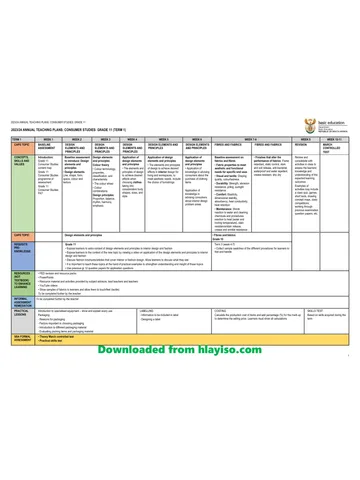
Consumer Studies Grade 11 Eastern Cape November 2016 Memo
Grade 11 Consumer Studies memorandum from the Eastern Cape November 2016 (English), 12 pages. Read online or download the free PDF.
Consumer Studies · Grade 11 · Eastern Cape November · 2016. Memorandum, 12 pages. Read online or download the PDF.
- Subject
- Consumer Studies
- Grade
- Grade 11
- Document type
- Memorandum
- Year
- 2016
- Exam period
- Eastern Cape November
- Curriculum
- CAPS
- Pages
- 12
- File size
- 894.3 KB
Free to read online, no sign-up needed
Loading document…
Loading document…
1 of 12
This exam
Eastern Cape November 2016
Document textSearch extracted text and jump to a page.
Downloaded from hlayiso.com
2 CONSUMER STUDIES (EC/NOVEMBER 2016)
QUESTION 1: SHORT QUESTIONS
1.1 1.1.1 A it is not necessary to carry large amount of cash. (1)
1.1.2 C use the item before it is fully paid (1)
1.1.3 B It helps you to control how your money is spent (1)
1.1.4 D Credit Bureau (1)
1.1.5 B Age, gender and state of health (1)
1.1.6 A rickets. (1)
1.1.7 C Lowers the level of cholesterol (1)
1.1.8 D Vitamin C (1)
1.1.9 A Warm colours and diagonal lines (1)
1.1.10 D Continuous line (1)
1.1.11 A Orange, green, purple (1)
1.1.12 D Radial balance (1)
1.1.13 B open (1)
1.1.14 B hardwearing and easy to clean (1)
1.1.15 C ensure that physical comfort is maintained. (1)
1.1.16 D Read the contract and guarantee carefully before buying on (1)
credit
1.1.17 C ensure that he sells the correct number of products. (1)
1.1.18 A produce his products more effectively than his competitors. (1)
1.1.19 C evaluate a product idea. (1)
1.1.20 B fulfils an unmet need in the marketplace. (1)
1.2 1.2.1 C The minimum opening deposit ranges from R0 to R50 (1)
1.2.2 G It is used as an investment; money should not be withdrawn (1)
1.2.3 F A minimum balance of R1 000 must be maintained at all times (1)
1.2.4 E Money is invested for a fixed period of time with higher interest
rates (1)
1.2.5 B Bank offers a low interest rate plus an overdraft facility (1)
1.3 1.3.1 D Important for good vision (1)
1.3.2 B Regulate the fluid balance in the cells (1)
1.3.3 E Releases energy from carbohydrates, protein and fat (1)
1.3.4 G Builds strong teeth and bones (1)
1.3.5 A Part of enzymes and insulin (1)
1.4 1.4.1 floor plan (1)
1.4.2 architect (1)
1.4.3 traffic pattern (1)
1.4.4 orientation (1)
1.4.5 zone (1)
1.5 1.5.1 tone (1)
1.5.2 Embossing (1)
1.5.3 Value (1)
1.5.4 Sanforising (1)
1.5.5 Harmony (1)
[40]
Copyright reserved Please turn over
Downloaded from hlayiso.com
(EC/NOVEMBER 2016) CONSUMER STUDIES 3
QUESTION 2: THE CONSUMER
2.1 Define the term budget.
A budget is an estimate of income and spending for a set period of time
OR
A detailed breakdown of all your income and planned expenses for a
specified period. (2)
2.2 Explain what fixed expenses are.
Fixed expenses – expenses that you pay at regular intervals such as weekly or
monthly. / Specific regular amounts that usually involve a contract or
agreement, e.g. rent, school fees, medical aid, insurance, car payment, furniture
payment, home loan. (2)
2.3 2.3.1 Describe FIVE ways in which a budget can help the family with
their finances.
It helps you to reduce expenses.
It helps you to set goals for you and your family.
It helps you in emergencies.
It prevents you from getting into serious debt.
It puts you in control of your money.
It teaches you the value of money. (Any 5 x 1) (5)
2.3.2 Identify this family’s source of income.
Salary
Pension
Business profit (Any 2 x 1) (2)
2.3.3 Discuss the FIVE factors that influence this family’s expenditure
pattern.
Household composition − Mr and Mrs Abrahams and the
grandmother contribute to the disposable income.
Financial resources and disposable income − there is a fixed income
and their business income and the credit card.
Needs − buy branded clothes / food from Woolworths/ gambling /
holiday at the sea / Eating out quite often
Housing − living in an expensive housing complex
Location − expensive housing complex
Preferences − organic food and branded clothes. (Any 5 x 2) (10)
Copyright reserved Please turn over
Downloaded from hlayiso.com
4 CONSUMER STUDIES (EC/NOVEMBER 2016)
2.3.4 Explain the disadvantages of this family using their credit card for
clothes, organic food and holidays.
The bank deducts a percentage of the purchase amount before paying
the business.
High interest are charged.
Can be a financial burden as it can get you into more debt.
If you draw cash at an ATM, the credit card company charges you
higher interest fee.
Late payment can result in blacklisting. (Any 3 x 1) (3)
2.4 Analyse the advantages of the grandmother saving her pension in a call
account.
Always have access to funds.
Can make additional deposits at any time.
Can earn competitive interest rates.
Can transfer interest to another account.
The interest gained is calculated on daily balance and reinvested. (Any 2 x 1) (2)
2.5 2.5.1 Explain what a pyramid scheme is.
At level 1 a person recruits four people to pay him some money. These
four people each recruit four people to pay them money and so forth.
Part of the money also goes to the first person. (2)
2.5.2 Give TWO reasons why Mr Abrahams should not join the pyramid
scheme.
When people at the bottom level cannot recruit any new people the
scheme collapses. The people at the lower level of the scheme lose
all the money they have invested.
Pyramid schemes are forbidden in South Africa (Section 43 of the
Consumer Protection Act) (2)
[30]
Copyright reserved Please turn over
Downloaded from hlayiso.com
(EC/NOVEMBER 2016) CONSUMER STUDIES 5
QUESTION 3: FOOD AND NUTRITION
3.1 List FOUR functions of protein.
It forms part of all body cells, tissues, blood enzymes, antibodies, nails,
skin, hair and some hormones.
It is needed for the growth, repair and maintenance of the body tissue.
It supplies energy if there is a shortage of carbohydrates and fats.
It helps to maintain the fluid balance in the body. (4 x 1) (4)
3.2 Give THREE reasons why a diet containing too much starch is not
advisable.
Excess carbohydrates can be converted to fat.
Too much sugar can cause obesity or tooth decay.
Too much sugar makes us feel full, so we eat less nutritious food, e.g.
fruit and vegetables. (3 x 1) (3)
3.3 Explain why a person, who would like to lose weight, should not cut out
all sources of starch from their diet.
A diet deficient of starch may lead to a lack of energy.
Protein may be used to supply energy, but then tissue cannot be build.
The body needs starch for the normal oxidation of the fats in the body.
Starch contains fibre which increases the feeling of fullness.
Starch delays the emptying of the stomach; this will help with weight
loss. (Any 2 x 1) (2)
3.4 Compare the nutritional needs of a toddler to the nutritional needs of a
young adult.
Specific
Toddler Young adult
nutritional needs
3.4.1 Protein Intake should be Intake should be adequate to
adequate to ensure support growth
growth
3.4.2 Iron Food will supply High iron requirements –
enough for their increase in blood volume
requirements
3.4.3 Calcium Needed for Need more calcium than
mineralisation of children grow fast
bones (6)
NOTE: Must be in table form – if not deduct 1 mark
Copyright reserved Please turn over
Downloaded from hlayiso.com
6 CONSUMER STUDIES (EC/NOVEMBER 2016)
3.5 3.5.1 Explain what fortified means.
It means that vitamins and minerals have been added to food.
The added vitamins and minerals may not occur naturally in the
food. (2)
3.5.2 Identify the type of bread rolls that supply the most energy and
give reasons for your answer.
Bread rolls, white, high-protein will supply the most energy
because they supply 1 146 kJ, the fat content is 2,4 and the
carbohydrates are 47,8. (4)
3.5.3 Recommend the bread rolls which would be most suitable for a
growing child and give a reason for your answer.
Bread rolls, white, high-protein supply 11,7 g protein per 100 g/
contain the most protein. (2)
3.5.4 Give reasons why government decided to fortify bread flour.
Most families which do not have enough money for food and
often go hungry, buy bread flour.
The fortified bread will supply energy and micronutrients the
children need and thus improve the general health of the
population.
Many people believe in making use of the home-baked bread as
their staple food. (3)
3.6 Describe how cross-contamination takes place in the kitchen.
Contaminated food may splash/drip on to other food.
Bacteria can be transferred by unwashed hands of workers, clothing of
workers, cloths used for wiping or washing equipment and surfaces.
When raw and cooked food are prepared on the same work
surface/chopping boards/utensils are not washed.
When handles of fridges/doors are touched by unwashed hands.
(4 x 1) (4)
3.7 Explain why people working with food should wear protective clothing.
Objects, e.g. hair, fingernails, rings, earrings and plasters may fall into
food and contaminate it.
Closed shoes will protect them from burning. (2 x 1) (2)
Copyright reserved Please turn over
Downloaded from hlayiso.com
(EC/NOVEMBER 2016) CONSUMER STUDIES 7
3.8 Evaluate the suitability of the recipe below for elderly people.
Elderly people often:
Experience dental problems which cause difficulty with chewing – the
mince pie does not require a lot of chewing because minced meat and
mashed potatoes are used (soft does not require a lot of chewing).
Have an increased risk of hypertension – a little salt is used in this
recipe, but may be omitted and substituted with herbs.
Have indigestion problems – tomato, onions and potato contain fibre
which will increase the ability of the small intestine to digest food.
Experience a decrease in muscle strength – the mincemeat supplies
protein which is needed to build tissue/muscles.
The recipe contains proteins, minerals, vitamins, carbohydrates and
fat/well balanced/nutrient dense – elderly people needs various
nutrients to stay healthy. (Any 8 x 1) (8)
[40]
QUESTION 4: CLOTHING
4.1 4.1.1 Identify the focal point of this outfit.
The frill on the shoulder
The belt (Any 1 x 1) (1)
4.1.2 Give TWO reasons why harmony of design has been achieved.
The design on the material uses small shapes which are in
harmony with the body size of the wearer/design does not stand
out to create an illusion of large proportion.
The frill on the shoulder is not too large – also in harmony with
dress and body size. (2)
4.1.3 Identify the type of balance that has been achieved.
Informal balance (1)
4.2 Identify the colour scheme
Monochromatic colour scheme
Analogous colour scheme
Complementary colour scheme
Double complementary colour scheme (1)
4.3 4.3.1 Identify the lines illustrated in the picture.
Horizontal lines (1)
Copyright reserved Please turn over
Downloaded from hlayiso.com
8 CONSUMER STUDIES (EC/NOVEMBER 2016)
4.3.2 Describe the effect of these lines on the wearer’s body.
Horizontal lines make things seem wider thus the top part of
the wearer’s body appears to be wider/larger/bigger.
A person with narrow shoulders should wear this to make the
shoulders appear broader/wider. (2)
4.3.3 Identify the fabric construction technique for:
(a) T-shirt material – weft knit (1)
(b) Denim material – twill weave (1)
4.3.4 Compare the fabric properties of the fabrics used for the outfit
above by completing the table in your ANSWERBOOK
Fabric properties T-shirt material Denim
(a) Durability T-shirt material is not Denim is
so durable. It could durable/hard wearing
ladder if caught on a and will last a long
sharp object. time
(b) Comfort T-shirt material is Stretch denim is very
knitted and will comfortable to wear
stretch with the body as it stretches with
measurements, thus the body.
very comfortable.
(c) Dimensional The t-shirt may Denim is very stable
stability become longer and and will not change
narrower once it has shape.
been laundered (6)
NOTE: Not in a table – deduct 1 mark.
4.3.5 Explain what sanforised means.
Sanforised – usually applied to natural fibres (cotton) that tend to
shrink when washed. Alkalis and steam are applied to the fabric to
stretch and shrink it. Sanforised fabric will not shrink more than 2%
when washed. (3)
4.4 Explain why anti-bacterial finishes are applied on socks and active wear.
Bacterial growth may occur when the wearer perspires and the antibacterial
finish will make the yarn resistant to the growth of microorganisms. (2)
Copyright reserved Please turn over
Downloaded from hlayiso.com
(EC/NOVEMBER 2016) CONSUMER STUDIES 9
4.5 Characteristics of figure shapes
FIGURE SHAPE CHARACTERISTICS
4.5.1 Triangle or A-shape (a) Chest/bust line is narrower than the
hips
(b) Sloping shoulder line/small waist full
thighs (2)
4.5.2 Rectangle or H-shape (a) Straight up and down shape/
average to large waist/small medium
bust
(b) Chest, hips and waist about the
same width straight torso (2)
4.5.3 Apple or Oval shape (a) A large bust/rounded waist area/
wide hips
(b) Broad chest and shoulders/well-
proportioned body/medium to narrow
waist and hips (2)
[30]
QUESTION 5: HOUSING AND INTERIOR
5.1 List the THREE types of artificial lighting used in a home.
General lighting
Task lightning
Decorative lighting (3)
5.2 Discuss THREE factors a family with small children should keep in mind
when buying furniture for their living room.
The furniture should be strong and durable/hard wearing to cope with
wear and tear subjected to it.
The furniture should be easy to clean because small children can be
messy. (Any 3 x 1) (3)
5.3 Explain what a person should keep in mind when evaluating existing house
plans with regard to:
5.3.1 Economic aspects
The house should be affordable.
Consider whether future renovations required to meet the
changing needs of the family, will be affordable. (2)
5.3.2 Available storage
Check if there is enough convenient and accessible storage.
Storage space should be incorporated throughout the house. (2)
Copyright reserved Please turn over
Downloaded from hlayiso.com
10 CONSUMER STUDIES (EC/NOVEMBER 2016)
5.4 Explain to Abigail how and where she can apply the design elements
improve the room. Write your answer in paragraph form.
Keep the furniture in proportion to the room. Avoid large bulky pieces of
furniture. Arrange objects close to the walls to create space in the middle
of the room. Choose an analogous colour scheme of light colours for
the walls and the floor. Do not place an object such as a coffee table or a
mat in the empty space in a room. (Any 3 x 1)
For the low ceiling paint it white or a light colour. Make use of vertical
lines for wall coverings. Apply rhythm by using decor items in a way that
forces the eye to move from the floor to the ceiling. A south-facing room is
cold and dark, she can create warmth to balance the atmosphere by using
warm colours/combinations. (Any 3 x 1)
NOTE: If not in a paragraph – deduct 1 mark. (6)
5.5 Name THREE responsibilities consumers have before buying furniture.
Compare the prices of different stores before buying furniture to ensure
that you do not pay too much at one store/get a good deal.
Compare your budget with the price (include all the hidden costs) to ensure
that you have enough money to pay for the furniture.
Read the contract and the guarantee carefully so that you are sure of
your rights.
Find a reputable store that you can trust to ensure that you do not lose
money. (Any 3 x 1) (3)
5.6 5.6.1 THREE basic zones of a home
Work area − kitchen
Rest area − bedrooms and bathrooms
Social area − lounge and dining room (3)
5.6.2 FIVE symbols
Bath, toilet, sink, basin, shower, doors, windows
and stove (Any 5 x 1) (5)
5.6.3 Is this an open plan or a closed plan? Give a reason for your
answer.
Closed plan because the house is divided into different
rooms. Each room has a door that closes the room off from
other rooms. (3)
[30]
Copyright reserved Please turn over
Downloaded from hlayiso.com
(EC/NOVEMBER 2016) CONSUMER STUDIES 11
QUESTION 6: ENTREPRENEURSHIP
6.1 List THREE factors that affect a profitable business.
Passion
Product/service
Competition
Price
Target market
Capacity and ability
Location, environment, economy (Any 3 x 1) (3)
6.2 Explain what product specification is.
It is a written description of an item/a product including the detail about
the size and appearance. It should list all the ingredients, components
and equipment needed to produce the item/product. (3)
6.3 6.3.1 At which stage is their business in the product life cycle?
Introduction stage (1)
6.3.2 Overheads
Rent
Transport
Packaging (3)
6.3.3 Components of the marketing mix.
Product – cake forks with beaded handles
Price – competitive price
Place – local flea market
Promotion – advertise on Facebook
People – customers coming to the flea market (5 x 2) (10)
6.3.4 Competitive advantage over other cake fork sellers.
The cake forks handles have beads.
It has packaging.
Advertise on Facebook. (3)
Copyright reserved Please turn over
Downloaded from hlayiso.com
12 CONSUMER STUDIES (EC/NOVEMBER 2016)
6.4 Calculations:
6.4.1 Production costs = R3,50 + R2,00 + R1,20
= R6,70 (1)
6.4.2 Selling price for 1 = R6,70 x 60/100 = R4,02
R6,70 + R4,02 = R10,72 (3)
6.4.3 Selling price for 100 = R10,72 x 100
= R1 072,00 (2)
6.4.4 Profit
(Selling Price – Product costs = Profit)
R1 072,00 – R670,00
= R402,00 (2)
[30]
TOTAL: 200
Copyright reserved Please turn over
Study this subject
Recommended for this subject
Memorandum
Consumer Studies Grade 11 Eastern Cape November 2016 Memo
Question paper
Consumer Studies Grade 11 Eastern Cape November 2016 QP
Question paper
Consumer Studies Grade 11 Eastern Cape November 2016 QP
Memorandum
Consumer Studies Grade 11 Eastern Cape November 2019 Memo
Memorandum
Consumer Studies Grade 11 Eastern Cape November 2019 Memo
Memorandum
Consumer Studies Grade 11 Eastern Cape November 2018 Memo
More from Grade 11 Consumer Studies
Annual teaching plan
Gr 11 Con Stu ATP 2023 24
Question paper
Consumer Studies Grade 11 Eastern Cape November 2022 QP
Question paper
Consumer Studies Grade 11 Eastern Cape November 2022 QP
Question paper
Consumer Studies Grade 11 Eastern Cape November 2020 QP
Question paper
Consumer Studies Grade 11 Eastern Cape November 2020 QP
Memorandum