
Downloaded from hlayiso.com
GRADE 10
ECONOMICS P1
JUNE 2019
MARKING GUIDELINES
MARKS: 100
These marking guidelines consist of 11 pages.
Demo
NW/JUNE/ECOM/ EMIS/6*******
Skip to contentAll 2019 papers 
View all
Economics Grade 10 Paper 1 North West June 2019 Memo
Grade 10 Economics Paper 1 memorandum from the North West June 2019, 11 pages. Read online or get the free PDF download, question paper linked when available.
Economics · Grade 10 · North West June · 2019. Memorandum, 11 pages. Read online or download the PDF.
- Subject
- Economics
- Grade
- Grade 10
- Document type
- Memorandum
- Year
- 2019
- Exam period
- North West June
- Paper
- 1
- Curriculum
- CAPS
- Pages
- 11
- File size
- 889.2 KB
Free to read online, no sign-up needed
Loading document…
Loading document…
1 of 11
This exam
North West June 2019
- Paper 1Question paperMemo
- Paper 2Question paperMemo
Questions in this paper
Document textSearch extracted text and jump to a page.
Downloaded from hlayiso.com
SECTION A (COMPULSORY) QUESTION
1 1.1 MULTIPLE CHOICE QUESTIONS
1.1.1 A depends on opinions
1.1.2 Athere are not enough resources to produce all the goods and services.
1.1.3 CScarcity
1.1.4 B Injections
1.1.5 C Prosperity (2x5) (10)
1.2 MATCH THE COLUMNS
1.2.1 C. √ Ensures that the benefits of society`s resources are fairly
among society members.
1.2.2 B. √ The sector that manufactures and processes raw
materials
so that they are in a form fit for human consumption.
1.2.3 A. √ Households
1.2.4 E. The period of very high economic activity just before the
economy slows down.
1.2.5 D. √ The economic indicator that moves the same way that
the economy does.
(1x5)(5)
1.3. GIVE ONE TERM
1.3.1 Econometrics √
1.3.2 Human right√
1.3.3 Closed√
1.3.4 Balance of payments√
1.3.5 Random fluctuations√
(1x5)(5)
TOTAL SECTION A:[ 20]
Demo
NW/JUNE/ECOM/ EMIS/6*******
Downloaded from hlayiso.com
SECTION B QUESTION 2
ANSWER THE QUESTIONS
2.1.1 Name ANY TWO fields of study that are related to Economics.
Accounting√
Business studies. √
Commercial law. √
Mathematics of finance. √ ( Any
2x1)(2)
2.1.2 What is the relationship between scarcity and opportunity cost?
When resources are scarce, consumers must choose to satisfy certain
needs over others, in the process giving up their satisfaction of other
needs. √√
(1x2)(2)
2.2 Study the extract below and answer the questions that follow:
2.2.1 Which element of economics is depicted by the diagram above?
Scarcity
(1x1) (1)
2.2.2 Name the economic system where the authorities decide on the
production
distribution of the products
Command economy (1x1)
(1)
2.2.3 Briefly explain Economic efficiency.
• Economic efficiency occurs when we make the best use of our
resources to produce goods and services. √√
(1x2) (2)
2.2.4 Why is it easier to test the prediction of a theory in the natural sciences
than
in the social sciences?
• Natural sciences deal with the natural world and social sciences deal
with human beings. . √√
• Natural sciences test their theories in laboratories whilst social scientist
test their theories and predictions under ideal conditions. . √√
(Any1x2)(2)
Demo
NW/JUNE/ECOM/ EMIS/6*******
Downloaded from hlayiso.com
2.2.5 If you were appointed to conduct a research using scientific method
what steps would you follow? Mention only TWO
• Firstly I would observe human behaviour. √√
• On the basis of the observation a pattern will be recognised. √√
• State a pattern of behaviour as a theory. √√
OR
• Identify the problem√√
• Data collection√√
• Present the data√√
• Explain the results √√
Any (2x2(4)
2.3 Study the table below and answer the questions that follow:
2.3.1 Which method was used to calculate GDP in the above table?
Expenditure method (1x1) (1)
2.3.2 Name any other ONE method used to calculate the GDP.
Production method
Income method
(Any1x1)(1)
2.3.3 Briefly describe the term factor income.
This is the total income earned from the sale of factors of production,
e.g.
salaries and wages earned on
labour (2)
2.3.4 Why it is important that the government and other South Africans buy
local
products?
So that the imports are not more than the exports.
(1x2) (2)
Demo
NW/JUNE/ECOM/ EMIS/6*******
Downloaded from hlayiso.com
2.3.5 Use figures in the table above to calculate the value of A. Show all
calculations.
GDP at market prices R2425 billion
Plus factor income earned abroad by South Africans R34 billion
Minus factor income earned in South Africa by R87 billion
foreigners
Gross National Income R2372 billion
(4)
2.4 Briefly outline the career opportunities that are available to someone who
Studies Economics.
The study of economics prepares you for many different careers including:
• careers in commerce and industry,
• entrepreneurship
• business management
• marketing,
• finance,
• banking
• tourism
Any (4x2) (8)
2.5 Analyse leakages and injections of the circular flow with relevant examples.
Injection – addition of money into the economy√√, e.g. export, government
spending and investment√
Leakages- means withdrawal of money from the economy √√ includes
Savings
(S) Taxes (T) and Imports (M) √
Any (4x2) (8)
Demo
NW/JUNE/ECOM/ EMIS/6*******
Downloaded from hlayiso.com
QUESTION 3
ANSWER THE QUESTIONS
3.1.1 Name any TWO types scarcity.
• Relative scarcity
• Absolute scarcity (Any 2x1)
(2)
3.1.2 Explain the term exogenous factors
Factors that influences the business cycle from outside the system.
e.g. weather conditions, money supply, structural changes, political
events shocks and natural events. (2x1) (2)
3.2 Data response
3.2.1 Which factor of production is depicted by the cartoon above?
Natural resources / land
(1)
3.2.2 Name the economic industry depicted by the above scenario.
Fishing Industry / Primary Sector
(1)
3.2.3 Briefly describe the term relative scarcity.
When a good or service is available, but one does not have the resources to
acquire it / Relative scarcity exists where the demand for a good is greater
than the supply of a good (2)
3.2.4 What can the government do to solve the water crisis?
• Build more dams to trap more water
• Drill boreholes to utilise underground water
• Encourage South Africans to conserve water
(Accept any other correct relevant answer) (Any 1x2) (2)
3.2.5 How does the situation above have an effect on the economy?
• There will be a shortage of fish
• Increase unemployment rates in the country
• Poverty rates may increase
(Accept any correct relevant answer) (2 x 2) (4)
Demo
NW/JUNE/ECOM/ EMIS/6*******
Downloaded from hlayiso.com
3.3 Data Response
3.3.1 What is the name of the graph above?
Business cycles
(1) 3.3.2 Which point on the graph may be associated with lowest GDP?
D (1)
3.3.3 Briefly describe the term economic growth.
• It is the increase in the value of goods and services produced over a period of time,
measured in terms of real gross domestic product. (2)
3.3.4 Briefly explain the effect of business cycles on economic growth.
• During periods of downswings the economy has a negative growth, while during
periods of upswings the economy has a positive growth. (2)
3.3.5 How can government reduce unemployment in an economy?
• The government can invest in job creation initiatives like the Expanded Public Works
Programme
• The government can invest in education and training to address skills shortages in
the country
(Accept any other correct relevant answer) (2x2) (4)
3.4 List and explain any TWO categories of consumer goods, provide
examples.
• These are goods that consumers want for their own sake. Because they satisfy our
wants directly. This group is usually subdivided into durable goods, semi -
durable goods and non- durable goods
• Durable goods: these includes goods such as furniture and household
appliance, personal transport, equipment (motor cars and bicycles), jewellery and
entertainment goods. They produce a steady stream of satisfaction and their
value diminishes relatively slowly through age and use .
• Semi-durable goods: can be reused but usually for shorter periods than
durable goods an example clothing, glassware, motor car tyres, accessories and
parts recreational and entertainment goods.
• Non- durable goods: These are goods such as food and groceries,
beverages, fuel, power cleaning materials, medical, pharmaceutical and petroleum
products. They are consumed or destroyed in the process of being used, which
means that they are used once only.
• Services: These are goods such as rent, household services (including
domestic services) ,medical services, transport and communication, recreational,
entertainment and educational services
Any(2x4) (8)
3.5 With the aid of examples, explain leading and lagging business cycle
indicators.
Leading indicators
These indicators moves up and down according to the changes in the economy and
reach their turning points before the other indicators. for example changes in
Demo
NW/JUNE/ECOM/ EMIS/6*******
Downloaded from hlayiso.com
Net gold and other foreign reserves, Number of new motor cars sold, Net
new companies registered
Lagging indicators
This category of indicators takes too long to return to their pointsthey are used
to show: employment in non-agricultural sectors, number of commercial vehicles
sold,
real investment in machinery and equipment
(4x2)(8)
[40]
SECTION C
QUESTION 4 [40 MARKS]
BASIC PROBLEM
• Discuss exchange as one of the stages of the basic economic processes.
(26)
• Briefly explain how all aspects of basic problem of choice may be resolved.
(10)
INTRODUCTION
In the modern economy exchange takes place when money is used to access good
and services. Consumption is the use of utilities that have been created
(Accept any relevant introduction)
BODY: MAIN PART
In the market economy the exchange takes place as the following conditions
exist:
Surpluses are required
In the modern economy producers produces surpluses of commodities that they
specialise in.
The producers then sell the goods for money.
Exchange happens in markets
Exchange takes place when consumers buy goods and services that are availed to
them by the producers.
Successful exchange can take place in efficient markets.
Markets are therefore mechanism which brings the buyers and sellers together
Groups of markets
Demo
NW/JUNE/ECOM/ EMIS/6*******
Downloaded from hlayiso.com
Markets can be distinguished into three groups:
Wholesale market
They are markets that link the producers and the retailer’s
Storage: Wholesalers buy goods from producers in large quantities from
producersand then sell them in smaller quantities to retailers.This saves
retailers space and capital costs. Wholesalers as middlemen are often accused of
inflating the pricesThe wholesalers provide an important service of availing a
variety of goods.
Retail markets
Retail markets are markets that link consumers and retailers.
Retail markets are also called consumer markets
Producers observe the consumers’ behaviour in order to provide good that the
consumers demand more.
Consumers influence the production and the quality of goods through the decisions
they make of to buy or not to buy.
Services markets
Services are bought by consumers, businesses and public sector.
Services rely more on communication networks unlike retail markets who depend on
transport.
Max 26 marks
BODY: ADDITIONAL PART
All aspects of basic problem of choice may be resolved in the following ways:
Custom: Choice may be guided by custom in some societies.
Consumption and production may me organised according to traditional patters.
The state: In some societies the choice is exercised by the Government.
The market: The choices in other society may be guided by demand and
supply.
Max 10
marks
CONCLUSION
The basic problem of choice is depended on the different societies thus determining
the type of goods consumed in different society; this also has a direct relation to
economics process.(Accept any relevant conclusion) max 2 marks
[40]
Demo
NW/JUNE/ECOM/ EMIS/6*******
Downloaded from hlayiso.com
QUESTION 5
• Discuss the role of the four participants in an open economy.
(26)
• Is it important to have foreign sector in the South African economy?
Motivate your answer. (10)
INTRODUCTION
The circular flow model is a model of an economy showing how the participants in
an economy interact with one another. (2)
BODY: MAIN PART
The participants:
Households
Also known as consumers.
Are the primary economic participants, because they own directly and indirectly the
factors of production namely land, labour, capital and entrepreneurship.
Consumers have needs, which are satisfied through the consumption of goods and
services which they purchase from the firms.
Consumers’ demand for goods and services stimulate economic activity by
prompting firms and the state to produce goods and services.
Consumers sell their factors of production to firms in return for remuneration
(wages, rent, interest and profit).
Firms
Also known as businesses or producers.
They purchase the factors of production from the households in the factor
Market.
They use the factors of production to produce goods and services, which they
then sell on the goods market to households.
Firms are motivated by the profit-motive.
Government
Also known as the state or public sector.
Governments act to provide goods and services which cannot be provided by
Firms.
The state also has certain functions and roles to play in the economy, for
example, protection services, social services and economic services.
Governments receive revenue from firms and households in the form of taxes and
revenue from state-owned property and state-owned enterprises.
Foreign sector
The foreign sector so that countries can trade with each other. Because natural
resources are unevenly distributed of goods and services.
Foreign exchange any currency other than the local currency that is used in
setting international transactions.
Demo
NW/JUNE/ECOM/ EMIS/6*******
Downloaded from hlayiso.com
Systems of trading in converting the currency of one country into that of another
foreign currency.
Max 26
BODY: ADDITIONAL PART
Is it important to have foreign sector in the South African economy?
Motivate your answer.
There are two main reasons why we have to trade with each other. A country may
have an absolute advantage in the production of two different products.
This means one country can produce one of the products at a lower cost than its
trading partner.
Each country will then specialise in a particular production which it has absolute
advantage.
It will import the other product from the other country.
Secondly countries trade because the opportunity cost involved in the production of
two products are different.
If one country can produce both products economically than another country then they
will decide what to produce based on the comparative advantage.
Max 10
Conclusion
It shows how their behaviour determines flow of income, spending and
production in the economy.
Accept any relevant conclusion (2)
TOTAL SECTION C: 40
GRAND TOTAL: 100
Demo
NW/JUNE/ECOM/ EMIS/6*******
Study this subject
Recommended for this subject
Question paper
Economics Grade 10 P1 North West June 2019 Question Paper
Memorandum
Economics Grade 10 P1 Eastern Cape November 2019 Memo (Afr)
Memorandum
Economics Grade 10 P1 Eastern Cape November 2019 Memo (Eng)
Memorandum
Economics Grade 10 P1 North West November 2019 Memo (Afr)
Memorandum
Economics Grade 10 Paper 1 North West June 2017 Memo
Question paper
Economics Grade 10 P2 North West June 2019 Question Paper
More from Grade 10 Economics
Question paper
Economics Grade 10 P2 November Mock 2026 QP (Eng)
Annual teaching plan
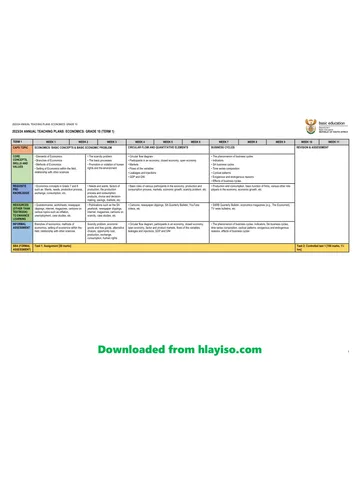
Gr 10 Eco ATP 2023 24
Question paper and memo
Economics Grade 10 Limpopo March Test 2025 Paper & Memo
Question paper
Economics Grade 10 P2 Gauteng June 2024 Question Paper (Afr)
Question paper
Economics Grade 10 P2 Gauteng June 2024 Question Paper (Eng)
Question paper