
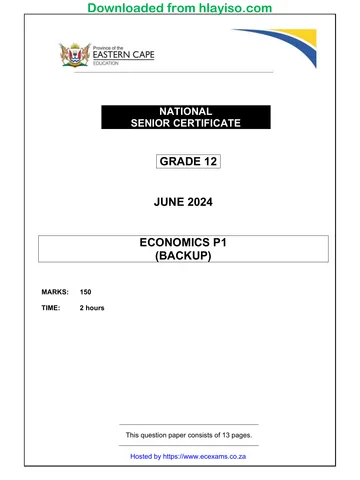
Downloaded from hlayiso.com
NATIONAL
SENIOR CERTIFICATE
GRADE 12
ECONOMICS
ECONOMICS
PAPER
P1 1
MACROECONOMICS & ECONOMIC PURSUITS
FEBRUARY/MARCH
MARCH 2016 2016
MARKS: 150
TIME: 2 hours
This question paper consists of 11 pages.
Copyright reserved Please turn over
Skip to contentAll 2016 papers 
View all
Economics Grade 12 P1 NSC Supplementary 2016 QP (Eng)
Grade 12 Economics Paper 1 question paper from the NSC Supplementary Exam 2016 (English), 11 pages. Read online or download the free PDF.
Economics · Grade 12 · NSC Supplementary Exam · 2016. Question paper, 11 pages. Read online or download the PDF.
- Subject
- Economics
- Grade
- Grade 12
- Document type
- Question paper
- Year
- 2016
- Exam period
- NSC Supplementary Exam
- Paper
- 1
- Curriculum
- CAPS
- Pages
- 11
- File size
- 514.7 KB
Free to read online, no sign-up needed
Loading document…
Loading document…
1 of 11
This exam
NSC Supplementary Exam 2016
Questions in this paper
- Question 1.1South Africa’s industrial policies and their suitability in terms of international best practice16 marks
- Question 1.2The foreign exchange market and the balance of payments accounts8 marks
- Question 1.3The foreign exchange market and the balance of payments accounts12 marks
- Question 2The circular flow model, national account aggregates and the multiplier40 marks
- Question 3South African economic and social indicators40 marks
- Question 4The foreign exchange market and the balance of payments accounts40 marks
Document textSearch extracted text and jump to a page.
Downloaded from hlayiso.com
Economics/P1 2 DBE/Feb.–Mar. 2016
NSC
INSTRUCTIONS AND INFORMATION
1. Answer FOUR questions as follows in the ANSWER BOOK:
SECTION A: COMPULSORY
SECTION B: Answer TWO of the three questions.
SECTION C: Answer ONE of the two questions.
2. Answer only the required number of questions. Answers in excess of the
required number will NOT be marked.
3. Number the answers correctly according to the numbering system used in this
question paper.
4. Write the question number above each answer.
5. Read the questions carefully.
6. Start EACH question on a NEW page.
7. Leave 2–3 lines between subsections of questions.
8. Answer the questions in full sentences and ensure that the format, content
and context of your responses comply with the cognitive requirements of the
questions.
9. Use only black or blue ink.
10. You may use a non-programmable pocket calculator.
11. Write neatly and legibly.
Copyright reserved Please turn over
Downloaded from hlayiso.com
Economics/P1 3 DBE/Feb.–Mar. 2016
NSC
SECTION A (COMPULSORY)
QUESTION 1 30 MARKS – 20 MINUTES
1.1 Various options are provided as possible answers to the following questions.
Choose the answer and write only the letter (A–C) next to the question
number (1.1.1–1.1.8) in the ANSWER BOOK, for example 1.1.9 C.
1.1.1 A measure used to indicate the economic prosperity of a country is
called the …
A gross domestic income.
B per capita national income.
C net national income.
1.1.2 Exogenous factors such as … can cause fluctuations in the level of
economic activity.
A weather patterns
B inflexibility of markets
C demand patterns
1.1.3 An example of a positive externality is …
A education.
B pollution.
C tobacco smoking.
1.1.4 Which ONE of the following can cause a deficit on the balance of
payments?
A Inward foreign investments
B Increase in foreign currency reserves
C Decline in mineral exports
1.1.5 When the government sells more than 50% of the state-owned
shares of a public enterprise, it is called …
A privatisation.
B nationalisation.
C free trade.
1.1.6 The North-South divide highlights the economic … that exist
between the developed and developing countries.
A similarities
B programmes
C differences
Copyright reserved Please turn over
Downloaded from hlayiso.com
Economics/P1 4 DBE/Feb.–Mar. 2016
NSC
1.1.7 The industrial development policy that aims at promoting
long-term industrialisation is called …
A the Industrial Policy Action Plan.
B Special Economic Zones.
C Spatial Development Initiatives.
1.1.8 The main objective of the Skills Support Programme is to …
A reduce government expenditure.
B encourage greater investment in training.
C build five million houses. (8 x 2) (16)
1.2 Choose a description from COLUMN B that matches the item in COLUMN A.
Write only the letter (A–I) next to the question number (1.2.1–1.2.8) in the
ANSWER BOOK.
COLUMN A COLUMN B
1.2.1 Gross domestic product A uses interest rates to influence the
level of expenditure
1.2.2 Peak
B gives member countries the
1.2.3 Monetary policy opportunity to obtain financial
support from the IMF
1.2.4 Production price index
C laws and regulations to enhance
1.2.5 Special Drawing Rights manufacturing operations
1.2.6 BRICS D assess the performance of the
economy
1.2.7 Industrial policy
E the total value of all final goods and
1.2.8 Economic indicator services produced within the
borders of a country in a given year
F the weighting of domestically
manufactured outputs
G the upper turning point of the
business cycle
H output produced by permanent
residents
I a trade agreement between a group
of emerging markets
(8 x 1) (8)
Copyright reserved Please turn over
Downloaded from hlayiso.com
Economics/P1 5 DBE/Feb.–Mar. 2016
NSC
1.3 Give ONE term for each of the following descriptions. Write only the term next
to the question number (1.3.1–1.3.6) in the ANSWER BOOK.
1.3.1 The process whereby the standard of living of people in a country
improves
1.3.2 The trade policy whereby the country encourages the local
production of goods rather than importing the goods
1.3.3 When authorities deliberately increase the value of a currency
1.3.4 The turning point in the business cycle where the level of economic
activities is at its lowest
1.3.5 A country's record of transactions with the rest of the world over a
period of time
1.3.6 The introduction of money into the circular flow (6 x 1) (6)
TOTAL SECTION A: 30
Copyright reserved Please turn over
Downloaded from hlayiso.com
Economics/P1 6 DBE/Feb.–Mar. 2016
NSC
SECTION B
Answer any TWO of the three questions in this section in the ANSWER BOOK.
QUESTION 2: MACROECONOMICS 40 MARKS – 30 MINUTES
2.1 Answer the following questions:
2.1.1 Name TWO instruments of fiscal policy. (2 x 1) (2)
2.1.2 How can the appreciation of the rand affect the exports of goods
and services? (1 x 2) (2)
2.2 Study the extract below and answer the questions that follow.
THE MULTIPLIER EFFECT
The government of Valspar has decided to expand the national road network
by R200 million this year. The tendency of households is to save 20 per cent
of their income.
2.2.1 What percentage of their income do households spend? (2)
2.2.2 Explain the term multiplier. (2)
2.2.3 What impact will a tax increase have on the multiplier? (2)
2.2.4 Calculate the size of the multiplier. Show ALL calculations. (4)
2.3 Study the cartoon below and answer the questions that follow.
IT'S TIME TO SPEED UP THE RECOVERY
[Source: Sheneman, Tribune Media Services]
2.3.1 What message is depicted in the cartoon above? (2)
2.3.2 Give a reason for the current state of the economy. (2)
Copyright reserved Please turn over
Downloaded from hlayiso.com
Economics/P1 7 DBE/Feb.–Mar. 2016
NSC
2.3.3 What main economic indicator is used to determine the state of the
South African economy? (2)
2.3.4 How can the government speed up the recovery of the economy? (4)
2.4 Differentiate between real flows and money flows in the circular-flow model.
(2 x 4) (8)
2.5 In your opinion, how can the Reserve Bank reduce the deficit on the balance
of payments? (4 x 2) (8)
[40]
QUESTION 3: ECONOMIC PURSUITS 40 MARKS – 30 MINUTES
3.1 Answer the following questions.
3.1.1 Name TWO indicators related to foreign trade. (2 x 1) (2)
3.1.2 What is the effect of increased investment spending on the
economy? (1 x 2) (2)
3.2 Study the table below and answer the questions that follow.
LIFE EXPECTANCY TRENDS IN SOUTH AFRICA
LIFE EXPECTANCY LIFE EXPECTANCY
YEAR AT BIRTH AT BIRTH
WITHOUT HIV WITH HIV
2002 64,2 53,4
2005 65,5 52,1
2008 66,3 56,0
2011 67,1 58,7
2014 67,9 61,2
[Source: www.statssa.gov.za]
3.2.1 Which year, according to the table above, indicates the highest life
expectancy without HIV? (1)
3.2.2 Which institution is responsible for publishing life expectancy
trends in South Africa? (1)
3.2.3 Explain the term life expectancy. (2)
3.2.4 What impact will HIV/Aids have on productivity levels? (2)
3.2.5 In your opinion, what brought about the improvement in life
expectancy from 53,4 years to 61,2 years? (2 x 2) (4)
Copyright reserved Please turn over
Downloaded from hlayiso.com
Economics/P1 8 DBE/Feb.–Mar. 2016
NSC
3.3 Study the extract below and answer the questions that follow.
OUR FUTURE: MAKE IT WORK – NDP 2030
The NDP aims to eliminate poverty and reduce inequality by 2030.
South Africa can realise these goals by drawing on the energies of its people,
growing an inclusive economy, building capabilities, enhancing the capacity of
the state, and promoting leadership and partnerships throughout society.
[Source: www.nda.org.za]
3.3.1 What does the abbreviation NDP stand for? (2)
3.3.2 What is meant by an inclusive economy? (2)
3.3.3 Give a reason why it is important to eliminate poverty and reduce
inequality in South Africa. (2)
3.3.4 What impact does the Expanded Public Works Programme have
on your local community? (2 x 2) (4)
3.4 Briefly discuss employment as an economic indicator. (4 x 2) (8)
3.5 How will the new demarcated special economic zones (SEZs) benefit regional
development in South Africa? (4 x 2) (8)
[40]
Copyright reserved Please turn over
Downloaded from hlayiso.com
Economics/P1 9 DBE/Feb.–Mar. 2016
NSC
QUESTION 4: MACROECONOMICS AND ECONOMIC PURSUITS
40 MARKS – 30 MINUTES
4.1 Answer the following questions.
4.1.1 Name TWO items in the financial account of the balance of
payments. (2 x 1) (2)
4.1.2 What effect does inflation have on the poor? (1 x 2) (2)
4.2 Study the graph below and answer the questions that follow.
EXCHANGE RATES
MARKET FOR US DOLLARS
D S2 S S1
Exchange rate
R12 E2
R11 E
R/US$
R10 EE
E1
S2
S S1 D
0 30 40 50 Millions
Quantity of dollars
4.2.1 Which supply curve indicates a decrease in the supply of dollars? (1)
4.2.2 What type of exchange rate system is currently used in
South Africa? (1)
4.2.3 Explain the term exchange rate. (2)
4.2.4 State ONE factor that could have led to an increase in the supply of
dollars. (2)
4.2.5 Use the above graph to explain the effect of the increase in the
supply of US dollars on the R/US$ exchange rate. (2 x 2) (4)
Copyright reserved Please turn over
Downloaded from hlayiso.com
Economics/P1 10 DBE/Feb.–Mar. 2016
NSC
4.3 Study the table below and answer the questions that follow.
PUBLIC SECTOR'S BUDGET FRAMEWORK
R BILLION REVISED MEDIUM-TERM ESTIMATES
(MTEF)
2012/2013 2013/2014 2014/2015 2015/2016
Revenue 830 904 1 005 1 118
Percentage of GDP 27% 27% 27,8% 28%
Expenditure 972 1 058 1 149 1 239
Percentage of GDP 32% 32% 31% 31%
Surplus/Deficit –142 –153 –143 –12
Percentage of GDP –4% –4% –4% A
Gross domestic product 2 995 3 301 3 622 3 997
[Adapted from The National Treasury: Budget Review]
4.3.1 What does the abbreviation MTEF stand for? (2)
4.3.2 What is the international benchmark for budget deficits as a
percentage of the GDP? (2)
4.3.3 Calculate the budget deficit as a percentage of the GDP (A). (2)
4.3.4 In your opinion, what can the government do to reduce the budget
deficit? (4)
4.4 Explain how the amplitude and trend line can be used in the forecasting of
business cycles. (2 x 4) (8)
4.5 How can taxation be used to stimulate employment in South Africa? (4 x 2) (8)
[40]
TOTAL SECTION B: 80
Copyright reserved Please turn over
Downloaded from hlayiso.com
Economics/P1 11 DBE/Feb.–Mar. 2016
NSC
SECTION C
Answer any ONE of the two questions in this section in the ANSWER BOOK.
Your answer will be assessed as follows:
MARK
STRUCTURE OF ESSAY
ALLOCATION
Introduction Max. 2
Body
Main part: Discuss in detail/In-depth discussion/Examine/Critically Max. 26
discuss/Analyse/Compare/Evaluate/Distinguish/Differentiate/Explain/
Assess/Debate
Additional part: Give own opinion/Critically discuss/Evaluate/Critically Max. 10
evaluate/Draw a graph and explain/Use the graph given and explain/
Complete the given graph/Calculate/Deduce/Compare/Explain/
Distinguish/Interpret/Briefly debate/How?/Suggest
Conclusion
Any higher-order conclusion should include: Max. 2
• A brief summary of what has been discussed without repeating facts
already mentioned
• Any opinion or valued judgement on the facts discussed
• Additional support information to strengthen the discussion/analysis
• A contradictory viewpoint with motivation, if required
• Recommendations
TOTAL 40
QUESTION 5: MACROECONOMICS 40 MARKS – 40 MINUTES
To be internationally competitive, a country needs to have suitable trade policies in
place. They have to grow their industries if they want to increase the standard of living.
• Discuss, in detail, the arguments in favour of protectionism. (26 marks)
• In your opinion, how can the government use subsidies to ensure that local
industries are protected against unfair competition from abroad? (10 marks) [40]
QUESTION 6: ECONOMIC PURSUITS 40 MARKS – 40 MINUTES
Internationally, the main instruments on which growth and development policies are
based are called demand and supply-side approaches. The supply-side approach
focuses more on microeconomic goals.
• Examine, in detail (without using a graph), the supply-side approach in terms of
South Africa's efforts to promote economic growth and development. (26 marks)
• In your opinion, have the RDP and GEAR been successful as growth and
development policies? (10 marks) [40]
TOTAL SECTION C: 40
GRAND TOTAL: 150
Copyright reserved
Study this subject
Recommended for this subject
Question paper
Economics Grade 12 P1 NSC Supplementary 2016 QP (Afr)
Memorandum
Economics Grade 12 P1 NSC Supplementary 2016 Memo (Afr)
Question paper
Economics Grade 12 Paper 1 Gauteng Mock 2016 Question Paper
Question paper
Economics Grade 12 P1 NSC June 2016 Question Paper (English)
Question paper
Economics Grade 12 P1 NSC Supplementary 2015 QP (Afr)
Memorandum
Economics Grade 12 Paper 1 NSC November 2016 Memo (English)
More from Grade 12 Economics
Memorandum
Economics Grade 12 P2 Eastern Cape June 2025 Memo (Afr)
Memorandum
Economics Grade 12 Paper 2 Gauteng June 2025 Memo (English)
Memorandum
Economics Grade 12 Paper 1 NSC June 2025 Memo (English)
Memorandum
Economics Grade 12 Paper 2 NSC June 2025 Memo (Afrikaans)
Question paper
Economics Grade 12 P2 NW June 2025 Question Paper (English)
Question paper