
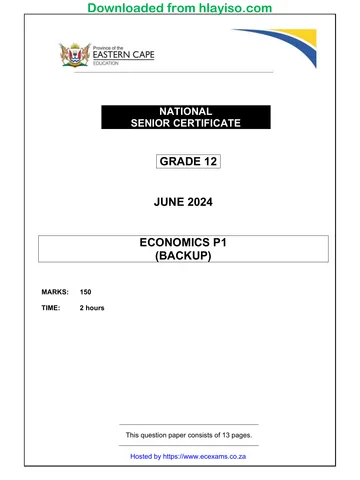
Downloaded from hlayiso.com
NATIONAL
SENIOR CERTIFICATE
GRADE 12
ECONOMICS
ECONOMICS
PAPER
P1 1
MACROECONOMICS & ECONOMIC PURSUITS
NOVEMBER
MARCH 2019
2016
MARKS: 150
TIME: 2 hours
This question paper consists of 12 pages.
Copyright reserved Please turn over
Skip to contentAll 2019 papers 
View all
Economics Grade 12 P1 NSC November 2019 Question Paper (Eng)
Grade 12 Economics Paper 1 question paper from the NSC November Exam 2019 (English), 12 pages. Read online or download the free PDF.
Economics · Grade 12 · NSC November Exam · 2019. Question paper, 12 pages. Read online or download the PDF.
- Subject
- Economics
- Grade
- Grade 12
- Document type
- Question paper
- Year
- 2019
- Exam period
- NSC November Exam
- Paper
- 1
- Curriculum
- CAPS
- Pages
- 12
- File size
- 482.7 KB
Free to read online, no sign-up needed
Loading document…
Loading document…
1 of 12
This exam
NSC November Exam 2019
Questions in this paper
- Question 1.1Business cycles and forecasting16 marks
- Question 1.2Business cycles and forecasting8 marks
- Question 1.3The circular flow model, national account aggregates and the multiplier12 marks
- Question 2The role of the public sector32 marks
- Question 3South African economic and social indicators40 marks
- Question 4The foreign exchange market and the balance of payments accounts40 marks
Document textSearch extracted text and jump to a page.
Downloaded from hlayiso.com
Economics/P1 2 DBE/November 2019
NSC
INSTRUCTIONS AND INFORMATION
1. Answer FOUR questions as follows in the ANSWER BOOK:
SECTION A: COMPULSORY
SECTION B: Answer TWO of the three questions.
SECTION C: Answer ONE of the two questions.
2. Answer only the required number of questions. Answers in excess of the
required number will NOT be marked.
3. Number the answers correctly according to the numbering system used in this
question paper.
4. Read the questions carefully.
5. Start EACH question on a NEW page.
6. Leave 2–3 lines between subsections of questions.
7. Answer the questions in full sentences and ensure that the format, content
and context of your responses comply with the cognitive requirements of the
questions.
8. Use only black or blue ink.
9. You may use a non-programmable pocket calculator.
10. Write neatly and legibly.
Copyright reserved Please turn over
Downloaded from hlayiso.com
Economics/P1 3 DBE/November 2019
NSC
SECTION A (COMPULSORY)
QUESTION 1 30 MARKS – 20 MINUTES
1.1 Various options are provided as possible answers to the following questions.
Choose the answer and write only the letter (A–D) next to the question
numbers (1.1.1 to 1.1.8) in the ANSWER BOOK, e.g. 1.1.9 D.
1.1.1 A period when there is a general increase in economic activities is
known as a(n) …
A downswing.
B upswing.
C depression.
D recession.
1.1.2 National income will increase when …
A G + I + X > S + T + M.
B G + I + X < S + T + M.
C G + I + X = S + T + M.
D S + T + M > G + I + X.
1.1.3 Indicators that change at the same time and in the same direction
as the economy changes are known as … indicators.
A leading
B lagging
C composite
D co-incident
1.1.4 Where one country can produce goods or services cheaper than
another country within a given time period it is called …
A comparative advantage.
B absolute advantage.
C terms of trade.
D free trade.
1.1.5 The Laffer curve shows the relationship between …
A tax revenue and tax rate.
B income and expenditure.
C nominal and real figures.
D tax revenue and wages.
1.1.6 Production, as an economic indicator, relates to …
A foreign trade.
B inflation.
C money supply.
D real GDP.
Copyright reserved Please turn over
Downloaded from hlayiso.com
Economics/P1 4 DBE/November 2019
NSC
1.1.7 The Department of Trade and Industry initiative that focuses on
improving competitiveness in production is called the …
A National Industrial Policy Framework.
B National Research and Development Strategy.
C Integrated Manufacturing Strategy.
D Small Business Support Programme.
1.1.8 The demand-side policy relates to …
A a reduction in costs.
B improving the efficiency of inputs.
C the influence on inflation and unemployment.
D improving the efficiency of markets. (8 x 2) (16)
1.2 Choose a description from COLUMN B that matches the item in COLUMN A.
Write only the letter (A–I) next to the question numbers (1.2.1 to 1.2.8) in the
ANSWER BOOK.
COLUMN A COLUMN B
1.2.1 Leakages A estimate figures or trends in future
from facts that are known
1.2.2 Exogenous approach
B a country's export prices are
1.2.3 Human Development compared to its import prices
Index
C the removal of laws, regulations and
1.2.4 Extrapolation bylaws by government
1.2.5 Portfolio investment D independent factors that influence
business cycles and originate outside
1.2.6 Terms of trade the economy
1.2.7 Gross domestic product E a trade policy where the state
discourages the import of certain
1.2.8 Deregulation
goods and services to protect local
industries
F outflow of money from the economy
G total value of final goods and services
produced within the boundaries of
a country for a specific period
H buying of financial assets such as
shares in companies on the stock
exchange of another country
I the well-being of people determined
by health, education and income
(8 x 1) (8)
Copyright reserved Please turn over
Downloaded from hlayiso.com
Economics/P1 5 DBE/November 2019
NSC
1.3 Give ONE term for each of the following descriptions. Write only the term next
to the question numbers (1.3.1 to 1.3.6) in the ANSWER BOOK.
Abbreviations, acronyms and examples will NOT be accepted.
1.3.1 The initial change in spending produces a proportionately larger
increase in national income
1.3.2 The point where the economic contraction is at its lowest
1.3.3 A transfer of functions and ownership from the public sector to the
private sector
1.3.4 An increase in the price of a currency in terms of another currency
due to market forces
1.3.5 The movement of imports and exports between countries without
any restrictions
1.3.6 The social indicator that relates to the size of the country's
population (6 x 1) (6)
TOTAL SECTION A: 30
Copyright reserved Please turn over
Downloaded from hlayiso.com
Economics/P1 6 DBE/November 2019
NSC
SECTION B
Answer any TWO of the three questions in this section in the ANSWER BOOK.
QUESTION 2: MACROECONOMICS 40 MARKS – 30 MINUTES
2.1 Answer the following questions.
2.1.1 Name TWO types of business cycles that occur in a market
economy. (2 x 1) (2)
2.1.2 Why would an increase in import tariffs benefit the South African
economy? (1 x 2) (2)
2.2 Study the information below and answer the questions that follow.
Eish! It looks like I will have
to revise the medium-term
expenditure framework.
[Adapted from Google images.com]
2.2.1 Name any ONE state-owned enterprise in the country. (1)
2.2.2 What is the current VAT rate in South Africa? (1)
2.2.3 Briefly describe the term Medium-Term Budget Policy Statement. (2)
2.2.4 Explain the relationship between the main budget and the MTEF. (2)
2.2.5 What can the government do to solve the current financial challenges
of state-owned enterprises? (2 x 2) (4)
Copyright reserved Please turn over
Downloaded from hlayiso.com
Economics/P1 7 DBE/November 2019
NSC
2.3 Study the table below and answer the questions that follow.
FINAL CONSUMPTION EXPENDITURE BY HOUSEHOLDS
at constant 2010 prices
2012 2015 2018
Durable goods 175 675 183 493 192 049
Semi-durable goods 153 492 172 570 187 892
Non-durable goods 673 670 693 594 711 569
Services 765 528 804 000 845 886
TOTAL 1 768 365 1 853 657 1 937 396
[Source: Quarterly Bulletin, SA Reserve Bank, March 2019]
2.3.1 Identify the year currently being used by the Reserve Bank as a
base year. (1)
2.3.2 Give any ONE example of a non-durable good. (1)
2.3.3 Briefly describe the term at constant prices. (2)
2.3.4 Why is there a rise in household expenditure while unemployment
is steadily increasing? (2)
2.3.5 How will an increase in the repurchase (repo) rate affect the
economy? (2 x 2) (4)
2.4 Use the graph below to explain the impact of an increase in exports to China
on the value of the rand.
Price of yuan
in terms of rand D S
S1
R2,00
R1,40
S D
S1
0 100 150
Quantity of Chinese yuan
(4 x 2) (8)
2.5 With reference to the Phillips curve, analyse the relationship between inflation
and unemployment. (8)
[40]
Copyright reserved Please turn over
Downloaded from hlayiso.com
Economics/P1 8 DBE/November 2019
NSC
QUESTION 3: ECONOMIC PURSUITS 40 MARKS – 30 MINUTES
3.1 Answer the following questions.
3.1.1 Name TWO types of economic indicators related to price changes.
(2 x 1) (2)
3.1.2 What can local governments do to prevent service delivery
protests? (1 x 2) (2)
3.2 Study the extract below and answer the questions that follow.
CLEAN ENERGY IN AFRICA FACES SHORT-CIRCUIT
There is a high demand but a shortage of trained workers. In Sub-Saharan
Africa, where more than 600 million people still lack access to electricity,
off-grid renewable power is seen as one of the fastest ways to get energy to
where it is needed, especially to remote and rural areas.
However, there are only a few trained workers able to plan, install and
maintain clean energy systems. In Sub-Saharan Africa there are only
16 000 people working in renewable energy outside South Africa. This
accounts for 0,1% of the global renewable energy workforce which impacts
globalisation.
[Adapted from Sunday Times, 3 February 2019]
3.2.1 Which economic indicator is addressed in the above extract? (1)
3.2.2 Name the social indicator that includes 'access to electricity'. (1)
3.2.3 Briefly describe the term globalisation. (2)
3.2.4 What impact will a shortage of trained workers have on global trade? (2)
3.2.5 How could education, as a social indicator, reduce inequalities
experienced worldwide? (2 x 2) (4)
Copyright reserved Please turn over
Downloaded from hlayiso.com
Economics/P1 9 DBE/November 2019
NSC
3.3 Study the dialogue below and answer the questions that follow.
Yes, that might be true,
I agree. Since but the National
democracy (1994), Development Plan (NDP)
policies, like the GEAR, holds much promise!
RDP and AsgiSA, have
failed us.
I feel that
government
policies have not
done much for
economic
development …
[Adapted from Google images.com]
3.3.1 Identify the first government policy implemented in 1994 to address
the imbalances of the past. (1)
3.3.2 Give ONE aim of the National Development Plan. (1)
3.3.3 Briefly describe the term economic development. (2)
3.3.4 Why did AsgiSA fail? (2)
3.3.5 How will South Africa benefit in a dynamic global environment if the
NDP succeeds? (2 x 2) (4)
3.4 Explain the role of international institutions in the standardisation of a
country's indicators. (4 x 2) (8)
3.5 How can unequal standards of living related to the North-South divide
be addressed? (8)
[40]
Copyright reserved Please turn over
Downloaded from hlayiso.com
Economics/P1 10 DBE/November 2019
NSC
QUESTION 4: MACROECONOMICS AND ECONOMIC PURSUITS
40 MARKS – 30 MINUTES
4.1 Answer the following questions.
4.1.1 Name TWO types of markets that form part of the financial system.
(2 x 1) (2)
4.1.2 Why is it important to use moving averages to forecast business
cycles? (1 x 2) (2)
4.2 Study the extract below and answer the questions that follow.
WORLD POWERS WARN SOUTH AFRICA
The presidency received an unprecedented memo on corruption in which the
five world powers warned the leaders of the country that the investment drive
could fail unless South Africa started to take action against perpetrators of
state capture, corruption and other serious crimes.
The governments of the United Kingdom and Switzerland stated that political
commitment to honest and ethical business practices should prevail. The UK
and Switzerland, together with three other countries, account for 75% of
foreign direct investment in South Africa that might definitely affect the
balance of payments negatively.
[Adapted from Sunday Times, 3 February 2019]
4.2.1 Identify the country in the extract that belongs to the G8 countries. (1)
4.2.2 What is the impact of corruption on full employment as a
macroeconomic objective? (1)
4.2.3 Briefly describe the term balance of payments. (2)
4.2.4 Why would public sector failure lead to economic instability? (2)
4.2.5 How could foreign direct investments influence the growth rate in
South Africa? (2 x 2) (4)
Copyright reserved Please turn over
Downloaded from hlayiso.com
Economics/P1 11 DBE/November 2019
NSC
4.3 Study the cartoon below and answer the questions that follow.
Oh-oh, perhaps this is not the BRICS
best time to establish our own should
trade protocol!!! succeed!!!
[Adapted from Google Images, 2019]
4.3.1 Name any ONE country that is a member of BRICS. (1)
4.3.2 What is the purpose of BRICS? (1)
4.3.3 Briefly describe the term recession. (2)
4.3.4 Why would a recession affect emerging market economies more
than developed economies? (2)
4.3.5 How can countries benefit from international trade agreements?
(2 x 2) (4)
4.4 Briefly explain the role of households and the business sector in the circular
flow model. (2 x 4) (8)
4.5 How can the monetary policy contribute to economic growth? (8)
[40]
TOTAL SECTION B: 80
Copyright reserved Please turn over
Downloaded from hlayiso.com
Economics/P1 12 DBE/November 2019
NSC
SECTION C
Answer any ONE of the two questions in this section in the ANSWER BOOK.
Your answer will be assessed as follows:
MARK
STRUCTURE OF ESSAY
ALLOCATION
Introduction
The introduction is a lower-order response. Max. 2
A good starting point would be to define the main concept related to the
question topic.
Do not include any part of the question in your introduction.
Do not repeat any part of the introduction in the body.
Avoid mentioning in the introduction what you are going to discuss in the
body.
Body
Main part: Discuss in detail/In-depth discussion/Examine/Critically discuss/ Max. 26
Analyse/Compare/Evaluate/Distinguish/Differentiate/Explain
Additional part: Give own opinion/Critically discuss/Evaluate/Critically evaluate/
Draw a graph and explain/Use the graph given and explain/Complete the given
graph/Calculate/Deduce/Compare/Explain/Distinguish/Interpret/Briefly debate/ Max. 10
How/Suggest
Conclusion
Any higher-order conclusion should include: Max. 2
A brief summary of what has been discussed without repeating facts already
mentioned
Any opinion or value judgement on the facts discussed
Additional support information to strengthen the discussion/analysis
A contradictory viewpoint with motivation, if required
Recommendations
TOTAL 40
QUESTION 5: MACROECONOMICS 40 MARKS – 40 MINUTES
Examine South Africa's export promotion trade policy. (26 marks)
Evaluate the success of protectionism as a trade policy to protect industries against
foreign competitors. (10 marks) [40]
QUESTION 6: ECONOMIC PURSUITS 40 MARKS – 40 MINUTES
Discuss in detail the South African endeavours (initiatives) in regional
development. (26 marks)
How successful has the government been in promoting industrial development in
South Africa? (10 marks) [40]
TOTAL SECTION C: 40
GRAND TOTAL: 150
Copyright reserved
Study this subject
Recommended for this subject
Memorandum
Economics Grade 12 P1 NSC November 2019 Memo (Afrikaans)
Question paper
Economics Grade 12 P1 Gauteng Mock 2019 Question Paper (Afr)
Question paper
Economics Grade 12 P1 Gauteng Mock 2019 Question Paper (Eng)
Question paper
Economics Grade 12 P1 North West Mock 2019 QP (Afr)
Question paper
Economics Grade 12 P1 NSC November 2023 Question Paper (Eng)
Question paper
Economics Grade 12 P1 NSC November 2021 Question Paper (Afr)
More from Grade 12 Economics
Memorandum
Economics Grade 12 P2 Eastern Cape June 2025 Memo (Afr)
Memorandum
Economics Grade 12 Paper 2 Gauteng June 2025 Memo (English)
Memorandum
Economics Grade 12 Paper 1 NSC June 2025 Memo (English)
Memorandum
Economics Grade 12 Paper 2 NSC June 2025 Memo (Afrikaans)
Question paper
Economics Grade 12 P2 NW June 2025 Question Paper (English)
Question paper