
31-DEC-c@87 23:80 From: ~
GAUTENG PROVINCE
CUA EPE IE
UAT TASTE
REPUBLIC, CaF SOUTH AFRICA
GAUTENG DEPARTMENT OF EDUCATION
PREPARATORY EXAMINATION
2015
” 10841
PHYSICAL SCIENCES: PHYSICS
FIRST PAPER
MARKS: 150
TIME: 3 hours
18 pages and
3 data sheets
PHYSICAL SCIENCES: Papar
NUN
41E
X1@
TN
P.ivet
P70,
Skip to contentAll 2015 papers 


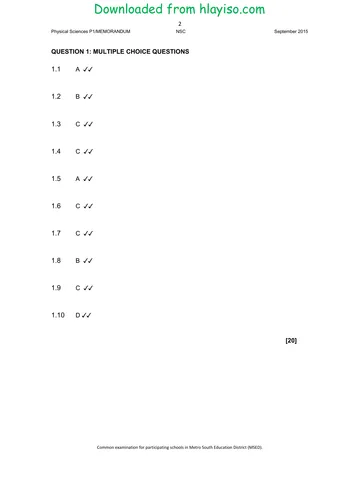
View all





Physical Sciences Grade 12 P1 Gauteng Mock 2015 QP
Grade 12 Physical Sciences Paper 1 question paper from the Gauteng Mock Exam 2015, 21 pages. Read online or download the free PDF.
Physical Sciences · Grade 12 · Gauteng Mock Exam · 2015. Question paper, 21 pages. Read online or download the PDF.
- Subject
- Physical Sciences
- Grade
- Grade 12
- Document type
- Question paper
- Year
- 2015
- Exam period
- Gauteng Mock Exam
- Paper
- 1
- Curriculum
- CAPS
- Pages
- 21
- File size
- 405.3 KB
Free to read online, no sign-up needed
Loading document…
Loading document…
1 of 21
This exam
Gauteng Mock Exam 2015
- Paper 1Question paperMemo
- Paper 2Question paperMemo
- Other filesQuestion paperQuestion paper (2)MemoMemo (2)
Questions in this paper
Document textSearch extracted text and jump to a page.
seers "Downloaded From hlayiSo°cont’
P.ered
PHYSICAL SCIENCES: PHYSICS
(First Paper) 10841/15
GAUTENG DEPARTMENT OF EDUCATION
PREPARATORY EXAMINATION — 2015
PHYSICAL SCIENCES: PHYSICS
(First Paper)
TIME: 3 hours
MARKS: 150
INSTRUCTIONS AND INFORMATION
1.
2.
10.
11.
12.
Write your name on the ANSWER BOOK provided.
The question paper consists of TWELVE questions. Answer ALL the questions
in the ANSWER BOOK provided.
Start EACH question on a NEW page.
Number the answers correctly according to the numbering system used in this
question paper.
Leave ONE line between subsections, for example between
QUESTION 2.1 and QUESTION 2.2,
You may use a non-programmable calculator.
You may use appropriate mathematical instruments.
You are advised to use the attached DATA SHEETS.
Show the formulae and substitutions in ALL calculations.
Round off your final numerical answers to TWO decimal places.
Give brief motivations, discussions, et cetera where required,
Write neatly and legibly.
P,T.O.
P.3et
wesc 2 "Downloaded from hlayiSo-cor?
PHYSICAL SCIENCES: PHYSICS 3
(First Paper) 1084115
QUESTION 1: MULTIPLE-CHOICE QUESTIONS
Four options are provided:as possible answers to the follewing questions, Each
question has only ONE correct answer. Write Only.the letter (A—-D) next to the question
number (1.1-1.10) in the ANSWER BOOK, for example 1.11 D.
1.1 An object is free failing towards the surface of the earth.
Which ONE of the following best describes the direction of acceleration of the
object?
A . The acceleration. is 9,8 m-s® downward.
B The acceleration is 98 m-s* upward,
CG The accelération is less than 9,8 m-s® downward:
D - The acceleration is tess than 9,8 m-s* upward.
(2)
1.2 A1kgmass has‘a constant acceleration.
Which ONE of the following sketch graphs correctly shows the retationship
between the net force, Fre and acceleration, a?
A B
Fret a” Fret
reso ee
a a
Cc D
Fret F, net
pe
tn
a a
(2)
P.T.Q.
31-DEC-20a7 23:08 "YY ownloaded*fForh hlayiSo°C6ri"
P.4-ea1
PHYSICAL SCIENCES: PHYSICS
4
(First Paper) 10841/15
1.3 Two objects, each of mass m are placed a distance d apart as shown below.
The gravitational foreé between: them is F .
(") d (»)
The magnitude of the force increases to 4F when the ...
A_ distance between the objects decreased to ia.
B . distance between the objects decreased to 5d.
C mass ofeach object decreased to : m.
D mass of each object increased to 4m. (2)
14 A. car has an initial momentum of 5 000 kgs” easl. The vector below
shows the initial momentum of the car, N
pi = 6 000 kg-m:s™ |
This caris involved in-a collision and the change in momentum of the car is
represented below,
N
Ap = 2.000 kg-m-s”
—_.
The vector representing the final: momentum of the car after the collision
Pi = 3.000 kg-ms
A +>
B pr = 3 000 kg-m-s™
—
C Pr = 8 000 kg-m-s"! .
D oo Pr = 8000 kg-m-s7
° (2)
P.T.O,
31-DEC-20a7 23:08 "Downloaded from hlayiS0:c6r"’
P.Svel
PHYSICAL SCIENCES: PHYSICS
(First Paper)
10841/15
1.5 The graph bélow shows the: relationship between the applied force (F) on an
object and the displacement (x) of the object in the direction of the applied
force.
Force [N}
4x displacement (m)
‘ The average work in joules; done by the applied force for a displacement of
4x mis...
A x
B 2x
CG 3x
D 4x
(2)
P.T.O.
Si-DEC-2887 25:81 Fr ownloaded fram hlayi8o°cBrr
1.6
P.6-e21
PHYSICAL SCIENCES: PHYSICS
6
(First Paper) 10841/15
Study the following absorption spectra for three different.stars as observed
from earth. :
Red
Star X
Red
Star Y fi
tah |
; Blue Red
Star Z
Which ONE of thie follawing combinations correctly describes the speed of
the stars relative.to earth?
Star moving away fram earth | Star moving towards earth at
. at the greatest speed the greatest speed
A ¥Y. 4
B Y x
Cc Z Y
D Zz x (2)
P.T.O.
P.?¢ed
rere ==""Downloaded From hlayiSo-cSrr
PHYSICAL SCIENCES: PHYSICS 7
(First Paper) 10841/15
1.7 Sphere A, with a charge of +Q, and sphere B, with a charge of +2Q, are
suspended from the same insulated point.as shown’ in the diagram below.
(The diagram is ‘not drawn to scale.)
A B
+0 +20
mo. The spheres‘are allowed to move freely until they come to rest on their own,
How will the values of the angles « and compare to each other once the
spheres come to rest?
A a=8
B a<p
C usp
D a=B=0 (2)
P.T.O.
soso 2"Downloaded from hlayiSo:cor*
1.8
1.9
1.10
P.8-ei
PHYSICAL SCIENCES: PHYSICS 8
(First Paper) 10841/15
The diagram below shows part of-a circuit diagram. R, and Rp are identical
ohmic resistors connected in parallel, With the switch open, the ammeter
reads 1 A and the voltmeter across the parallel section reads 3 V:
I fa)
TE es ()
—
(v)
are
Switch 8 is closed. The reading on the ammeter and voltmeter will now be ...
Reading on ammeter Reading on voltmeter
fA greater than 1A 7 greater than.3 V
B less than 1A equal to 6 V
CG greater than 1A , less than 3V
D equal to 1A “equalto3 Vo | (2)
Which ONE of the following phrases correctly explains how a generator
works? It works ...
A _ by converting electrical energy to mechanical energy.
B by using the motor effect.
C according to Lenz’s law.
D using electromagnetic induction. (2)
When an excited. electron moves from a higher energy level to a lower
energy level a specific ...
A emission line in-an emission spectrum is observed,
B absorption line in.an emission spectrum is observed.
CG emission line in an absorption spectrum is observed.
D absorption line in an absorption spectrum is observed.
(2)
[20]
P.T.Q.
31-DEC-2887 23:83 "DY ownloaded from hlayiSorconr
P.oved
PHYSICAL SCIENCES: PHYSICS 9
(First Paper) 10841/15
QUESTION 2 (Start on.anew page.)
Block A of mass 5 kg is attached to block B Of unknown mass. The string Joining the
blocks is INELASTIC and WEIGHTLESS. The string passes over a frictionless pulley as
shown below,
Rough horizontal surface (plane)
An applied force F with magnitude 15'N acts at an angle of 30° relative to the horizontal
plane on block A. Block A accelerates at 2,2 m-s* to the night across the rough
horizontal plane. :
The coefficient of kinetic friction.betweén the surface of block A and the plane is 0,35.
2.1 Define Newton's Second Law in words. (2)
2.2 Draw a labelled FREE BODY diagrarn of all the forces acting on block A. (5)
23 Calculate the magnitude of the frictional force experienced by block A. (3)
2.4 Calculate the mass of block B. ti
P,T.O.
S1-DEC-2887 23:64 From: Downloaded from hlayiS6 COM
P.ie-et
PHYSICAL SCIENCES: PHYSICS 10
(First Paper) 10841/15
QUESTION 3 (Start on a new page.)
The velocity~ time sketch graph for a ball of mass 160 g, thrown vertically upwards with a
velocity of 6 m-s™ from a certain height above the ground, is shown below.
On the way down the ball. crashes through a thin horizontal glass pane and then
continues downward, eventually bouncing on the ground.
Ignore all effects of air friction and assume none of the broken pieces of glass sticks to
the ball.
v (ms)
6 JA
8 ts)
3,2
ms)
3.44 Write down the magnitude and direction of the acceleration of the ball when it
reaches position Bas indicated on the graph. (2)
3.2 How many times did the bail bounce on the ground? (1)
3.3 According to the graph, which direction, DOWNWARDS or UPWARDS is taken
as the positive direction? (1)
3.4 Calculate the distance between the pane of glass and the initial position from
which the ball was thrown. (4)
3.5 Draw a rough position-time graph’ far the motion of the ball. Show the points A
to E on the graph. Do not show any displacement or time values on the graph.
Take the. initial position of the ball as zero.
(5)
[13]
P.T.O.
sree "Downloaded Frorn hlayiSo:cor?
P.iivet
PHYSICAL SCIENCES: PHYSICS "1
(First Paper) 10847/15
QUESTION 4 (Start on a new page.)
Mars has an average radius of 3 390 ‘km and a mass of 6,39 x 1079 kg. Mars has two
moons.
47 State Newton’s Law of Universal Gravitation in words, (2)
4.2 lf the gravitational force exerted by Mars on one of its moons with mass
1,08 x.10"* kg, is 5,71 10'° N, calculate the distance between the centre of
thig moon and the surface of Mars. (6)
[8]
QUESTION 5 (Start on:a new page.)
An ice-skater with a mass of 54 kg, is holding a box as part of her act. She skates with a
velocity of 0,08 m-s? east. She throws the 1,5 kg box directly away from her with a
velocity of 10,2 m-s” east.
5.1 State the principle of conservation of linear momentum. (2)
5.2 Calculate the ice-skater's velocity immediately after throwing the box away from
her. (4)
5.3 Calculate the magnitude of the force exerted on the box by the ice-skater if she
exerted this force for 1,2 s. (3)
[9]
P,T.O.
31-DEC-2887 23:85 "Downloaded from hlayiS0°cor? P.ievet
PHYSICAL SCIENCES: PHYSICS 12
(First Paper) 10841/15
QUESTION 6 (Start on a new page.)
A box of mass 86 kg is accelerating down a surface inclined at 25° to the horizontal.
aa
Aman applies a force F-upwards parallel to the plane in an attempt to prevent the box
from sliding. down the inclined-plane. In spite of the man’s efforts the box is accelerating
down the inclined plane.
6.1
6.2
6.3
6.4
6.5
What is a non-conservative:force? (2)
The coefficient of kinetic friction (41) between the box and the surface of the
plane is 0,22.
Prove that the magnitude of the kinetic frictional force is 168,04 N. (2)
State the work-energy theorem in words. (2)
Draw a labelled FREE BODY diagram of all the forces acting on the box, (4)
The box accelerates parallel down the inclined plane for a distance of 0,9 m at
1,54 m-s”, Use'the work-eneray theorem and calculate the work done by the
man onthe box, (5)
[15]
P.T.O.
S1-DEC-2887 23:66 "Downloaded from hlayiSo:cor? P.iaeet
PHYSICAL SCIENCES: PHYSICS
(First Paper) 10841/15
13
QUESTION. (Start on anew page.)
White standing still.near a railroad crossing, a girl hears a train horn in the distance. The
horn emits a sound of frequency 430 Hz.
The. speed of sound In air is taken as 335 m-s”.
7A State the Doppiar effect.
72 The train is moving-with a constant velocity of 25 m-s'' in a straight line
towards the girl.who Is standing still at the crossing. Calculate the wavelength
of the sound observed by the girl while the train is approaching her.
7.3 Will the frequency of the sound observed by the train driver be HIGHER,
LOWER or THE SAME as that.emitted by the horn of the train?
Give reasons for the answer.
(2)
(6)
(3)
{11]
P.T.O.
31-DEC-2887 23:66 "Downloaded from hlayiS0°cor? P.i4-et
PHYSICAL SCIENCES: PHYSICS 14
(First Paper) 1084/15
QUESTION 8 § (Start-on.a new page.):
Two identical conducting spheres A.and B with charges of Q. and Q» respectively are
placed in fixed positions along the same straight line as shown in the diagram below.
Spheres A and B are placed 30cm from each other. Point P is positioned 30 cm to the
right of sphere B on the same straight line.
The charge on sphere B is positive. The net eléctric field Enet at point P as a result of
the two charges Q, and Qp is. towards the right as shown in the diagram below.
. [= Enet
E, Es
8.1 What is the sign ‘of the charge-on sphere A? Give a reason for the answer. (3)
8.2 The net electric field at point P is 1 600 N-C" to the right and the charge on
sphere B has a magnitude of +12 nc.
Calculate the magnitude of the charge on sphere A. (7)
A proten is placed at point P without changing the chatges and positions of spheres A
and B.
8.3 Calculate the net electrostatic force experlenced by the proton. (4)
[15]
P.T.G.
S1-DEC-2887 23:66 "Downloaded from hlayiS6:cor? P.isvet
PHYSICAL SCIENCES: PHYSICS 15
(First Paper) 10841/15
QUESTION 9. (Start. on'a new. page.)
Learners investigate how ‘a’ CHANGE IN THE TOTAL CURRENT of the circuit affects
the INTERNAL RESISTANCE OF A CELL. Two groups of learners were given the
following apparatus:
GROUP A GROUP B
» Anew AAA cell * Anew AAA cell with a higher internal
« Voltmeter resistance than for group A.
« Ammeter + Voltmeter
« Rheostat « Ammeter | He
* Switch * Rheostat
* Connecting wires « Switch
« Connecting wires |
94 Write down the independent variable for the investigation. (1)
92 Refer to the apparatus provided to the learners and draw the appropriate
circuit diagram required for the investigation. (3)
Group. A use their réadings to draw the following graph.
Vito
104: f
P.T.0.
S1-DEC-2e8? 23:88 Fr" ownloaded from hlayi8a:cor?
9.3
9.4
P.ié-et
PHYSICAL SCIENCES: PHYSICS 46
(First Paper) 1OB41/15
Use the graph and determing.the internal resistance of the AAA cell provided
to group A. ; (3)
The AAA cell provided to group B has a higher internal resistance.
How will the gradient of the graph drawn by group B compare to that of
group A?
Write only GREATER THAN, SMALLER THAN or THE SAME AS. (1)
[8]
QUESTION 10 (Start on a new page.)
The.diagram below shows the circuit for an electri¢ blanket. It has three different
resistance settings A, B and C to regulate the amount of HEAT generated by the
blanket.
3 A 3,79 77340
r—l || 8D
Cc
Ra
The electric blanket is connected to a battery with an emf of 20 V and an internal
resistance of 1.0.
10.1 With the switch connected to position A, calculate the:
10.1.1 Total resistance of the external circuit. (2)
10.1.2 Total current through the circuit. (3)
10.2 How does the total current change when the switch. is connected to position B?
Write INCREASES, DECREASES or STAYS THE SAME.
Explain the answer. : (3)
10.3 Calculate the power.output of the electric blanket when the switch is connected
to C given that the total current at this setting is 2,31 A. (4)
[12]
P.T.O,
S1-DEC-2@87 23:89 "Downloaded from hlayiSo:cor P.lrvei
PHYSICAL SCIENCES: PHYSICS 17 |
(First Paper) 10841/15
QUESTION 11 (Start on a new page.)
A learner built the foliowirig simple generator based on a dynamo used to power bicycle |
headlights. He used the gerierator to demonstrate that he could use mechanical energy i
to generate electrical energy.
Wheel/Crank
BV globe Soft iron. core
Copper coil
Rotating
magnet.
WA Is this a DC or an AG generator? Give a reason for the answer. (3)
11.2 How will the learmer know that electrical energy is produced? q)
11.3 Explain how this generatoris able to produce electrical current when there is
no electrical Connection between the rotating magnet and the copper coil. (3)
41.4 List TWO changes that canbe made to the generator to INCREASE the
BRIGHTNESS of the globe. (2)
A generator (dynamo) used to power. a light on a bicycle needs an average power of
6 W and a potential difference of 12 Vins .
11.5 Calculate thé maximum current that can flow through the globe. (4)
[13]
P.T.O.
QUESTION 12 (Start ona new page:)
S1-DEC-2e87 23:18 F°" ownloaded from hlayi8o:cor?
P.ie-et
PHYSICAL SCIENCES: PHYSICS
10841/15
18
(First Paper)
During the investigation ofa specific type of cathode of a photoelectric cell, radiation
with different wavelengths were used and the following results were obtained,
The graph below was drawn using the results.
Wavelength
(nm)
Maximum
kinetic energy
(J)
250
0,401x 10°”
215
1,73.% 10"
187
3,04%.10°
167
4,37«.107°
150
5,70x 10⁷?
A
A (nm)
300-5
200- EK)
150-4
1004
>
oO 9 4 6
12.1 Define the work function for a specific metal.
12.2
What is the relationship between the wavelength of the radiation and the
maximum kinetic energy of the photoelectron?
Explain the answer.
12.3
How does an increase in the intensity of the radiation affect the maximum
kinetic energy of the photoelectrons?
Write only INCREASES, DECREASES or STAYS THE SAME.
12.4
this cathode is 255:nm.
The maximum wavelength for the radiation that is able to emit electrons from
Calculate the maximum velocity of a photoelectron emitted if radiation with a
wavelength of 160 nm is used.
TOTAL:
(x07) Ek max (J)
(2)
(5)
[12]
150
P.T.O.
31-DEC-2007 23:18 "Downloaded from hlayiSo°corn
P.19ve24
(First Paper)
PHYSICAL SCIENCES: PHYSICS
1084415
19
DATA FOR PHYSICAL SCIENCES GRADE 12
PAPER 1 (PHYSICS)
GEGEWENS VIR FISIESE WETENSKAPPE GRAAD 12
VAAESTEL 1 (FISIKA)
TABLE 1: PHYSICAL CONSTANTS/TABEL 1: FISIESE KONSTANTES
Radius van die aarde
NAMEWNAAM SYMBOL/SIMBOOL VALUE/WAARDE
Masse ven die aarde. M 5,98 x 10°" kg
Radius of earth Ae 6,38 x 4 ofm
P.T.O.
' S1-DEC-2887 23:11 "Downloaded from hlayi8o°cor?
P.ceeet
PHYSICAL SCIENCES: PHYSICS
(First Paper) 10841/15
20
TABLE 2: FORMULAE/TABEL 2: FORMULES
MOTION/BEWEGING
Ax =v,At+aAt® or/of Ay = v,At+ daat®
2
v/s v7 -b2aax otlof v," =v" 2aay
ax=(“%2*" Jat onot ay =[% "Jat
FORGE/KRAG
Fret = Pa p=mv
foe se NN f, = 1,
Fig At =Ap wom
Ap= mv, ~mv, omg
mm cy mM M M
F=G e ovlof F-G—- ; g=G-5 orfof 9-65
WORK, ENERGY AND POWER/ARBEID, ENERGIE EN DRYWING
W =FAxcosé
U=mgh orfof E,=mgh
2
1 1
K= 3 im orfof .~ B, =5 mv?
Woe, = AK oof W.,,, = AE,
AK=K,-—K,; orfof AE, =E, -E,
W,, = AK +AU or/of, W,, = AE, + AE,
pa
Al
Pave ™ FV ave t Poem = Fy gem
WAVES, SOUND AND LIGHT/GOLWE, KLANK EN LIG
vata t=!
f
Viv, Viiv c
f= Let f, = f = =h—
L viv, ° L viv,” E=hf orfof E ny
E=WotEny Ofof. E=W,+K,,, where/waar
E=hf and/en W, =hf, and/en Ey. = Vg orfof K =hmvg
ata, max
P.T.0.
S1-DEC-e087 23:12 "Downloaded fron hlayi8ocort
P.eivet
(First Paper)
PHYSICAL SCIENCES: PHYSICS
10841/15
21
ELECTROSTATICS/ELEKTROSTATIKA
F
_kQ,Q,
r?
V=
n=
alOlots
or/ot
Q
n=
ELECTRIC CIRCUITS/ELEKTRIESE STROOMBANE
emf (£) = I(R +f)
Raw
I emk (¢)=(R +1)
R, =Ry+Re +
tli, q= lat
R, AR, R,
W=vVq pW
Bt
W=VIAt
w= Rat PeVi
; p=PR
W- VFAt _vt
i “R.
Pave = Vine! ems / Poem = Voge Tan
Pave = Tins / Pos = Trae R
z ve
Pave = Nive / Poem = =a
R R
END
Study this subject
Recommended for this subject
Question paper
Physical Sciences Grade 12 Gauteng Mock 2015 Question Paper
Question paper
Physical Sciences Grade 12 P1 Western Cape Mock 2015 QP
Memorandum
Physical Sciences Grade 12 P1 Mpumalanga November 2015 Memo
Memorandum
Physical Sciences Grade 12 Paper 1 NSC November 2015 Memo
Memorandum
Physical Sciences Grade 12 P1 NSC Supplementary 2015 Memo
Memorandum
Physical Sciences Grade 12 P1 Western Cape Mock 2015 Memo
More from Grade 12 Physical Sciences
Memorandum
Physical Sciences Grade 12 P2 Eastern Cape June 2025 Memo
Memorandum
Physical Sciences Grade 12 P1 Eastern Cape Mock 2025 Memo
Memorandum
Physical Sciences Grade 12 Paper 1 Limpopo June 2025 Memo
Memorandum
Physical Sciences Grade 12 Paper 2 Limpopo June 2025 Memo
Memorandum
Physical Sciences Grade 12 Paper 1 Limpopo Mock 2025 Memo
Question paper