
Downloaded from hlayiso.com
Page 1 of 6
KZN DEPARTMENT OF EDUCATION
GREENBURY SECONDARY SCHOOL
JUNE EXAMINATION — 2015
GEOGRAPHY — GRADE 10
EXAMINER :R. RANGANATHAN : DATE 2 18/06/15
MODERATOR :F. PARUK DURATION : 2 HOURS
MAX MARKS: 140
NAME : GRIDIV. :
INSTRUCTIONS :
1. This paper consists of 2 Questions and 6 pages + a separate Addendum.
2. Answer all questions.
3. Number questions as per question paper and rule off after each question.
4. Write neatly and legibly.
5. Use a blue or black pen — no neon colours allowed.
QUESTION 1 — ATMOSPHERE AND GEOMORPHOLOGY
1.1 Match the statement in Column A with the concepts in Column B. Write
down the numbers 1.1 — 1.5 and next to each, the letter of the correct
answer from Column B.
COLUMN A COLUMN B
1.1 Gaseous layer that supports life on earth. a) Evaporation
1.2 Process whereby water changes to water b) Atmosphere
vapour. c) Isobar
1.3 Long wave radiation that heats lower layers d) Precipitation
of earth. e) Solar radiation
1.4 Any form of water that falls from the f) Isotherm
atmosphere. g) Terrestrial radiation
1.5 Lines on map that join places of equal h) condensation
temperature.
5X1=[5]
PTO + 2
Skip to contentAll 2015 papers 
View all
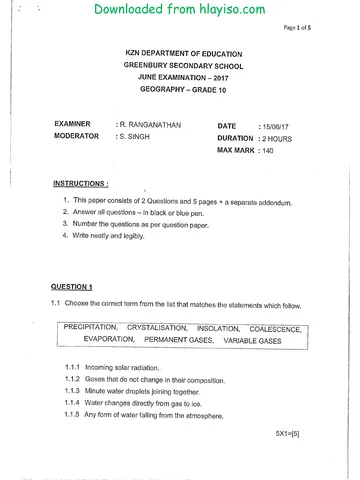
Geography Grade 10 Paper 1 KZN June 2015 Paper & Memo
Grade 10 Geography Paper 1 question paper and memo from the KZN June Exam 2015, 18 pages. Read online or get the free PDF download.
Geography · Grade 10 · KZN June Exam · 2015. Question paper and memorandum, 18 pages. Read online or download the PDF.
- Subject
- Geography
- Grade
- Grade 10
- Document type
- Question paper and memo
- Year
- 2015
- Exam period
- KZN June Exam
- Paper
- 1
- Curriculum
- CAPS
- Pages
- 18
- File size
- 1.7 MB
Free to read online, no sign-up needed
Loading document…
Loading document…
1 of 18
This exam
KZN June Exam 2015
- Paper 1Paper and memo
- Paper 2Paper and memo
Document textSearch extracted text and jump to a page.
Downloaded from hlayiso.com
Page 2 of 6
1.2 Refer to the graph (Source 1A) - structure of the atmosphere and answer
the following questions.
1.2.1 Provide labels for the layers of the atmosphere 1, 2, 3 and 4. [4]
1.2.2 In which layer is the ozone layer found? [2]
1.2.3. Explain the role of the ozone layer. [2]
1.3 Study the figure (Source 1B) — heating of the atmosphere and answer the
following questions.
1.3.1 Define the following terms :
a) Greenhouse effect [2]
b) Deforestation [2]
c) Fossil fuels [2]
1.3.2 List 3 sources of greenhouse gases that are illustrated in Source 1B. [3]
1.3.3 Predict what will happen to the temperature if more greenhouse gases
continue to be added to the atmosphere as depicted in Source 1B. {2]
1.3.4 List 3 ways in which insolation is lost in the atmosphere. [3X1=3}
1.4 With the aid of a simple sketch, explain how latitude affects temperature. [8]
1.5 State whether the following are ‘true’ of ‘false’.
1.5.1. The Core is the inner most layer of the earth.
1.5.2 An upfold of rocks is called syncline.
1.5.3 Igneous rock was the first type of rock to form.
1.5.4 Magma is rock that is in solid form.
1.5.5 Sandstone is an example of sedimentary rock.
[5]
PTO 4083
C)
Downloaded from hlayiso.com
Page 3 of 6
1.6 Refer to Source 1C (the layers of the earth) and answer the following
questions.
1.6.1 Provide labels for A, B, C and D.
1.6.2 Name the 3 types of rocks that you have studied.
1.6.3 What 2 factors cause rocks to metamorphose?
1.6.4 Explain what you understand by weathering.
[4]
[8]
[2]
[2]
1.7 Refer to diagram Source 1D (igneous intrusions) and answer the following
questions.
1.7.1 Provide labels for features 1, 2, 3, 4.
1.7.2. Explain your understanding of volcanism.
1.7.3 Differentiate between intrusive and extrusive volcanism.
1.7.4. Name the 3 types of volcanic cones that you studied.
“ToraL - Question 1 = [70]
PTO. Quest 2... 4
Downloaded from hlayiso.com . og
Page 4 of 6
QUESTION 2
2.1 Choose the correct term from the list below that matches the statements
which follow.
CRYSTALISATION SUBLIMATION, HUMIDITY,
TEMPERATURE, RELATIVE-HUMIDITY, HEAT BALANCE,
COALESCENCE EVAPORATION, CLIMATE
2.1.1 Degree of heat or cold.
2.1,2 Water changes directly from gas to ice.
2.1.3 Proportion of water vapour compared to the amount it can hold at any given ( )
temperature.
2.1.4 Earth radiates the same amount of energy that it receives from the sun.
2.1.5 Many minute water droplets joining together.
[5x1=5]
2.2 Refer to the case study. Consequences of Global Warming (Source 2A)
and answer the following questions.
2.2.1 Explain your understanding of global warming. (2]
2.2.2 List 3 possible consequences of global warming according to the case
study. [3X2=6]
2.2.3 Explain why poor countries such as those in Africa will be affected worst
by global warming. [2X2=4]
2.2.4 The following quotation is also from the UNICEF article.
“Glimate change is a global issue. Addressing it is a shared responsibility.
Yet it is increasingly apparent that the world’s poorest countries and most
vulnerable people will bear the brunt of climate change.”
With reference to the above quotation, answer the following questions.
2.2.4.1. According to the quote, addressing the climate change issue is a shared
responsibility. Who needs to share this responsibility? Give a reason for
your answer. [2+2=4]
2.2.4.2 If you were on a panel to decide how to address the issue of climate
change, what points would you need to consider before making any
recommendations? (List 3 points) [3X26]
PTO 85
Downloaded from hlayiso.com
Page 5 of 6.
2.3 Draw a weather station model that is experiencing the following weather
conditions
¢ Cloud cover —% cloudy
¢ Wind direction — north easterly
e Wind speed — 25 knots
e Air temperature - 27°C
e Dew point temperature - 10°C
¢ Precipitation — rainfall [6+2=8]
2.4 Choose the correct term from the list below.
FOCUS, TSUNAMI, RIFT VALLEY, FAULT FOLDING,
OVERFOLD, BLOCK MOUNTAIN
2.4.1 Greater pressure on one side.
2.4.2 Point of origin of the earthquake.
2.4.3 Huge tidal wave.
2.4.4 Acrack or fracture in the rock.
2.4.5 Block of land that moves upwards along fault lines.
[5]
2.5 Refer to Source 2B (Plate tectonics and continental drift) and answer the
following questions.
2.5.1 What is the name of the single continent that existed approximately 175
million years ago? [1]
2.5.2 Name the 2 landmasses the single continent formed about 170 million
years ago. [2]
2.5.3 Give 2 pieces of evidence to back up this theory of continental
drift. [2X2=4]
PTO te] 6
Downloaded from hlayiso.com
Page 6 of 6
2.6 Study the article (Japanese Volcano awakens — Source 2C and answer the
following questions.
2.6.1 Explain your understanding of volcanologist. [2]
2.6.2 The Shinmoedake volcano can be classified as dormant. Provide
evidence from the article to support this statement. [2]
2.6.3 Discuss the impact that this volcanic activity had on the residents of
the area. [2X2=4]
2.6.4 Give one advantage that volcanic eruptions can have. [2]
2.7 Refer to article (Earthquake — Nepal) Source 2D and answer the following
questions.
2.7.1 Define the following terms :
a) Earthquake [2]
b) Epicentre [2]
2.7.2 is a magnitude of 7.8 severe or less severe? [1]
2.7.3 Explain your understanding of an avalanche. [2]
2.7.4 What damage did the avalanche cause? [2]
2.7.5 According to the article, three UNESCO world heritage sites were
damaged. Discuss the impact of this on the economy of Nepal. [2X2=4]
“TOTAL - Question 2 = [70]
TOTAL : [140]
GREENBURY SECONDARY SCHOOL
DEPARTMENT OF HSS
H.0.D. MR D RAMASANIE
(240é fig:
C:
Downloaded from hlayiso.com
ADDENDUM
GRADE: 10
GEOGRAPHY
Souree Downloaded from hlayiso.com
120 4 nge
rotate 0
10 6. Tene
100 4
905 4
80
70-5
Height in kilometres
QD
Oo
I
~40 -20 0 20
-100 -80 -60
Temperature (°C)
rbed by
atmosphere
Deforestation and earth 5 Oil and absorbed by
petrol engines greenhouse
gasses
Source 1¢ 7. a= ]
()
Downloaded from hlayiso.com
Source 1
Source 2A
Case study: Consequences of global warming
Climate change is with us now.
We see the impacts all around us.
For the vast majority of people the
impact of climate change means an
increased risk of losing their homes
and livelihoods, more disease, less
security and sometimes death.
Children in the world’s poorest
communities are the most vulnerable.
They are already seeing the impacts of
climate change through malnutrition,
disease, poverty, inequality and
increasing tisk of conflict — and
ultimately an increase in child
mortality rates.
All the essential effects we are seeing
now are associated with a temperature
increase since 1850 of less than 1 °C.
Past actions and the likely trend of
emissions of greenhouse gasses over
the next few years imply that another 1
or 2 °C will be hard to avoid, even with
responsible action. It will be the young
and the poor and developing countries,
such as [in] Africa, that will suffer
earliest and hardest.
Pa,
Our children — particularly those
in Africa and Asia — are already facing
a future in which it appears likely
that disasters will increase in number
and become more intense, where
economic growth will falter and
incomes fall, where disease outbreaks
will be more frequent, clean water and
good sanitation harder to. secure, and
habitats and communities less stable.
As a consequence, children may also
have to cope with higher levels of
conflict and other pressures which
keep them out of school and force
them into work too soon.
Many developing countries
have poor infrastructure and lack
the technologies that could help
them cope with a changing climate,
such as flood defences and early
warning systems. They are thus more
vulnerable to the impact of climate
change and their children are the most
vulnerable of all.
(UNICEF UK Climate Change Report
2008)
Fro & RS
DOUICE i) ded from hla is =
“Se SO an
|
|
|
I
DoS - —
( LAURASIA &
{ e
‘ an
WN Ge —
1. The world was one large landmass called Pangaea 180 2. Pangaea began to break up into Laurasia and
million years ago. Gondwanaland 175 million years ago.
ae
; er ASIA y
Caan we
SS
ane ra)
\ i
OCEANIA,
V/a
“FO ANTARCTICA,
se sven nat
Japanese volcano awakens with a vengeance
By North Asia correspondent Mark Willacy Updated Mon Jan 31, 2011 9:06 pm.
VOLCANIC LIGHTNING STRIKES ABOVE SHINMOEDAKE PEAK AS IT ERUPTS
Officials in southern Japan have urged more than 1000 residents of a town near an erupting volcano
to evacuate amid reports of large rocks falling in the area. Mount Shinmoe’s first major eruption in
almost 200 years is sending plumes of ash and rocks kilometres into the sky.
The eruption, on the southern island of Kyushu, has disrupted flights and train services and sparked
warnings about another, even more powerful blast. More than 600 people have alreacly been
evacuated.
;
$
i
|
i
£
t
t
Voicanologists say a giant lava dome on the volcano has now grown to more than 500 metres in
diameter. For some people living near the volcano it is nothing more than a nuisance, but for others |
it is like a biblical curse. “It’s good that it’s not hovering in the air,” a,used car lot owner said, taking
a break from shovelling up the mess. “But it’s getting heavier and harder to clean up. This ash piled
up on the cars will be hard to remove,” he complained, as his once immaculate lot of cars sits under
centimetres of grey paste - the windscreen wipers on each vehicle sticking forlornly up in the air. Hi
The mayor of Takaharu, a town near the volcano, says people have never seen Mount Shinmoe like it
is. “It’s the first time the people of my community have experienced volcanic ash like this, so we are
very concerned about their health,” Mitsuhiro Hidaka said. :
With 108 active volcanoes, or 10 per cent of the world’s total, japan shakes precariously on the
infamous Pacific Ring of Fire. ]
The Japanese are wearily familiar with eruptions like Mount Shinmoe’s, but scientists warn there :
could be worse to come. In the past nine months volcanologists estimate seven million cubic metres
of magma have accumulated in two vast reservoirs underneath the peak and small pyroclastic
| flows, or super-heated clouds of gas travelling at up to 700 kilometres per hour, have been seen
| sweeping down Mount Shinmoe. The volcano’s behaviour is said to be eerily similar to its belligerent
' demeanour 300 years ago, when it belched and bellowed on and off for 18 months. :
For the people living around Shinmoedake, this is just the latest biblical-style cataclysm, “Then came 2
the avian flu. Now the first eruption of the Shinmoedake volcano in 52 years. It is indeed a triple 4
blow of disasters we're suffering from now.” 4
Adapted from http://www.abe.net,au/news/stories/2011/01/31/3126199.htm — &
‘mere eacrspetteer mt REE renee ANH an oc a ee er ee ne Eh
E ‘sepijspue Aq
aOO|q JO pebewep
of speod uleyunow
9 Auey| “sseooe
“S,0} puey JO yo no
uBwes yorum seae
Sowa ul weajoun
= SI uoenys ay.
d=" pewuyuos Bulag
[f@8 ave sounful pue
ewep Jo syodey
©
Downlo
TOOHDS ANWINODES AN: 1"
“SJOUO LQ painful pue
ajdoad /| jsea] ye parry euouejene 8y} ‘Soda 0} Bulpsoooy ‘ulejunowW aU} pusose
O} JOUJEOM BU} Ul YeOIG & JO} HulpeM alam SyaqUUl|o SJ8YM ‘dues aseq ou} paAonsep
SUSUBIEAE BY] Jejuscide ay] jo jseeyyou-jsee Wy OgL Ajayewuxoudde peyeoo|
‘JS9J9AF “IW JO sadojs yInos ay} uO eyouejene Jofew e pere66y ayenbyyes oy L
‘000°S UeU} evolu Bulunful pue Qo¢‘z UeU} crow Surry pue uoiBeu au}
ssoioe eBewep peaidsepim Buisneo ‘se|dwe} pue shuipying ‘sewou
pouspey eyenbyyes ey] “sjueyqeyul uoHIW gL Aueou 0} swoy
S! Je} |edan Jo Ajo jeydeo ayy ‘npuewyyey Jo ysomyyou (say gy)
Wy Z/ Jajusolde ue YIM pa.inoso ayenbyyes 9-7 aspnyubew y
"UBISN{Ed pue jedi} jo uoibai
S,PUIUD ‘ysepe|bueg ‘elpuy jo sued ssouoe Il YO, Sq 0} yBnous
Bucs sem eyenbyyes oy], “sels abeWey pros ooseul eel}
pebewep Ajaisnes pue NPUBWUJEY JO spooysoqyuBbieu jsapjo au}
JO sUJeEMs pafo.sep jj “syeaX QQ JAAO Ul eden WY 0} SOM aUy
SEM ‘eydeo ay] ‘npuewUey apisino pesajusd ayenbuyes ay]
SqUITLO FY aquipavay,
OLN °2:11:90 38 SoZ ‘sz Widy ‘Kepan~s Sia]
~ "“WeliIN a7 epnuuBbein ;
qZ gounae
P4
Downloaded from hlayiso.com
|
i
D wnloaded f from hlayiso.com
—arede (0 — a ee
low Een oF _
Mearbys a. Mewo + . . _
CQuoahor |
Hi.
B
|
[3. G
ta, DP
IS. F
21 t= Trcpesphone.
}
a- Statlos phere
3- Meso
4- “Tlarndyhere.
}22. Stratosphere
Fictecks wo fiowr boubarduont of the claygernu UV Rage,
(23,
2 o) tapped hoot tm the atuntbhere_-
—()
by Chopbric of tees ji remopel of frota/ forests
\,
- cLeod lauds 2 Auneds remavis —— mctonts opis.
Zs, “Tetap “ Remage. ~ bec the move. Grecmnbcee Ges, The
more tae loug -wewe Fenesbil radlictrn,) willbe absorbed. feuse
Areateat Wereage._ (a te ppefore Che fears.
{B2.. Cres Trehos [eas [ackones [be wurnteg of easy} Fick. . . |
1 Reflection /Seattenga -h Hc |
|
Hosp daly estat)
Downloaded from hlayiso.com
Downloaded from hlayiso.com
Choatron a
FI
i
ald tem nperostore-
QA, _ crystals ze ion es — ee
sf]
213, relotive - huuniddch .
bare heat balawee
| las Coaleseence.
22). Laceasug of the Words weve temp .
2. _alteed weattor palfirwa [eyahts/ Fllo/ph lnda cw anal cle.
longer [ Ras”
323. (or comtier such aa /Fican Courduta — guts lo vem [lHe
_f coubot eed of Globe werner
Te ane. bimitive — hoace. at fone eecks oF G Wanna
Hones made of pow building mateo /Lack temelagy g Soleo
Economies me to ao ete_ / foor lw Froahucfure San fawn eft
te beflvent Stet pte Sie tke lead in cleeesiau! wakwg
— Govt Should one agieull wrth egferts ty tho Sed
— perfectly _ ta Femotwnally - tfergout fare’ Shyu id
a “puke ts address the Isgues,
Pe Bee claerawis ace unll kame Far -reacl j Condoguanted
en peeps [vey ~ gebs/h hive liboxd! Shalt
G))_ hot conclave ‘pe i there about fhe Cows op Clunake chapge
or globe warmunel *
teh Countusa Ar food, =e Cllowcek “elonge” ee
im Whet—awe Ju eplicatiia Ee Folare
(ie Ga
Cohen EBA) ~
22-4]. Got — ultuiote decision wake | lu Couch = has Maney
al
safe -oeeneconnontanecmmnmen none netctontnnttnsert tAST nt
|
~ = spt Gensel fepaloton ~ Thro” ference nbc a muanouns
Data bs the evidece CF chwiate chage ehable and conclusive? |
I
|
|
Downloaded from hlayiso.com
Tash PAGER
Downloaded from hlayiso.com
mes [eg Ye lent vibretioa of cartes ¢ crust Gly vr of oP croc Pike) —
= Teel, above ae ae —wkuahy 02 te -
. _eetigate elt _ .
ara. Severe ) —
ara. Large paas _of Ice cam thot fale chim slope ov © Cheam powdery
—— feet peeled Fe base cane |
Rt at leagt Fale ; ee ae
ft ae |
_ a. b-- i fourofe fe ve) “WHS _ “hoaee. leay wicome—g Gar
~ Reber a cf — tu pach cvely on ex ontinns
- ~ 7
“ ™ — |
i a esr NE RTL a egETZEA tals — aiesonaaceai |
a a — se
en _ a a
Downloaded from hlayiso.com
Study this subject
Recommended for this subject
Question paper and memo
Geography Grade 10 Paper 2 KZN June 2015 Paper & Memo
Question paper and memo
Geography Grade 10 March Test 2015 Paper & Memo
Question paper and memo
Geography Grade 10 NSC Prelim 2015 Paper & Memo
Question paper and memo
Geography Grade 10 September Test 2015 Paper & Memo
Question paper and memo
Geography Grade 10 P1 KwaZulu Natal June 2017 Paper & Memo
Question paper and memo
Geography Grade 10 P1 KwaZulu Natal June 2016 Paper & Memo
More from Grade 10 Geography
Study guide
Gr10 Geografie OG studyguide LR
Annual teaching plan
Gr 10 Geo ATP 2023 24
Question paper
Geography Grade 10 P1 North West November 2024 QP (Eng)
Question paper
Geography Grade 10 P2 North West November 2024 QP (Eng)
Question paper
Geography Grade 10 Gauteng March Test 2023 QP (Afr)
Question paper