
Downloaded from hlayiso.com
GAUTENG DEPARTMENT OF EDUCATION /
GAUTENGSE DEPARTEMENT VAN ONDERWYS
PROVINCIAL EXAMINATION / PROVINSIALE EKSAMEN
JUNE / JUNIE 2017
GRADE / GRAAD 10
PHYSICAL SCIENCES P2
FISIESE WETENSKAPPE V2
CHEMISTRY / CHEMIE
MEMORANDUM
7 pages / bladsye
Skip to contentAll 2017 papers 
View all
Physical Sciences Grade 10 Paper 2 Gauteng June 2017 Memo
Grade 10 Physical Sciences Paper 2 memorandum from the Gauteng June 2017, 7 pages. Read online or download the free PDF.
Physical Sciences · Grade 10 · Gauteng June · 2017. Memorandum, 7 pages. Read online or download the PDF.
- Subject
- Physical Sciences
- Grade
- Grade 10
- Document type
- Memorandum
- Year
- 2017
- Exam period
- Gauteng June
- Paper
- 2
- Curriculum
- CAPS
- Pages
- 7
- File size
- 548.2 KB
Free to read online, no sign-up needed
Loading document…
Loading document…
1 of 7
This exam
Gauteng June 2017
Questions in this paper
Document textSearch extracted text and jump to a page.
Downloaded from hlayiso.com
PHYSICAL SCIENCES / FISIESE WETENSKAPPE
MEMORANDUM (Paper / Vraestel 2) GRADE / GRAAD 10
GAUTENG DEPARTMENT OF EDUCATION /
GAUTENGSE DEPARTEMENT VAN ONDERWYS
PROVINCIAL EXAMINATION / PROVINSIALE EKSAMEN
PHYSICAL SCIENCES P2 /
FISIESE WETENSKAPPE V2
MEMORANDUM
QUESTION / VRAAG 1
1.1 C✓✓
1.2 C✓✓
1.3 C✓✓
1.4 C✓✓
1.5 B✓✓
1.6 A✓✓
1.7 D✓✓
1.8 A✓✓
1.9 C✓✓
1.10 C✓✓
(10 x 2) [20]
QUESTION / VRAAG 2
2.1 To determine the heating curve of water / Om die verhittingskurwe van water te
bepaal ✓✓ (2)
2.2 2.2.1 temperature / temperatuur ✓ (1)
2.2.2 time / tyd ✓ (1)
2.3 – ice and thermometer placed in the beaker / ys en termometer word in
beker geplaas ✓
beaker placed on top of tripod stand with wire gauze / beker word bo-op
staander met draad geplaas ✓
bunsen burner placed under the tripod stand / plaas bunsenbrander word
onder driepootstaander geplaas✓
stop watch used to measure the time interval during heating / gebruik
stophorlosie om tydintervalle te meet. ✓ (4)
2
Downloaded from hlayiso.com
PHYSICAL SCIENCES / FISIESE WETENSKAPPE
MEMORANDUM (Paper / Vraestel 2) GRADE / GRAAD 10
2.4 2.4.1 – Weak forces of attraction ✓
– Average kinetic energy very high due to the amount of heat✓
– Boiling water and gas will be found here✓
Tussen D en E word vloeistof en gas aangetref, die
waterstofverbindings (aantrekkingskragte is amper almal gebreek
vir hierdie fase verandering. Die gemiddelde kinetiese energie is
hoog omrede die hoeveelheid hitte energie. (3)
2.4.2 – Strong forces of attraction ✓
– Average kinetic energy is low✓
– Water is still in its solid phase✓
By punt A, is die aantrekkingskragte baie sterk omrede water nog
in soliede fase is. Die gemiddelde kinetiese energie sal laag wees
omrede die hoeveelheid hitte energie. (3)
2.5 Physical✓ – no new substances are formed / Fisies – geen nuwe stowwe word
gevorm. ✓✓ (3)
2.6 No ✓, substance (water) only underwent changes in phase , it remained with
constant chemical composition throughout / Nee, water het slegs fase verander.
Dit het konstante chemiese samestelling behou. ✓✓ (3)
[20]
QUESTION / VRAAG 3
3.1 An element is a pure substance that is only made up of one type of particle. ✓✓
A compound is a pure substance that is made up of two or more elements that are
chemically bonded together. ✓✓
ʼn Element is ʼn stof wat nie opgebreek kan word in eenvoudiger stowwe.
Verbinding is ʼn stof wat bestaan uit twee of meer elemente wat chemies in ʼn
vaste verhouding aan mekaar verbind is. (4)
3.2 3.2.1 A✓ (1)
3.2.2 Covalent bond / Kovalente bindings✓ (1)
3.2.3 A - N2✓
B - NO2✓
C - NH3✓ (3)
3
Downloaded from hlayiso.com
PHYSICAL SCIENCES / FISIESE WETENSKAPPE
MEMORANDUM (Paper / Vraestel 2) GRADE / GRAAD 10
3.2.4 .x
. .
x N N .x
.x
x
✓✓
..
H . N . H ✓✓
x x
.
x
H (4)
3.2.5 A-Nitrogen / Stikstof ✓
B-Nitrogen dioxide / Stikstofdioksied ✓
C-Nitrogen hydride / Waterstofnitried ✓ (3)
3.2.6 ✓ ✓ √ √
+ → ✓✓ balanced equation
gebalanseerde
vergelyking (4)
[20]
4
Downloaded from hlayiso.com
PHYSICAL SCIENCES / FISIESE WETENSKAPPE
MEMORANDUM (Paper / Vraestel 2) GRADE / GRAAD 10
QUESTION / VRAAG 4
4.1 F✓ (1)
4.2 First ionisation energy is the energy required to remove the first electron from an
atom in the gaseous phase. / Eerste ionisasie energie is die energie wat nodig is
om ʼn elektron uit ʼn atoom in die gasfase te verwyder. ✓✓ (2)
4.3 F✓ (1)
4.4 7✓ (1)
4.5 N / Nitrogen / N / Stikstof ✓ (1)
4.6 D✓ (1)
4.7 A✓
Boron / Boor ✓ (2)
[9]
QUESTION / VRAAG 5
5.1 Atoms of the same element that have the same atomic number (number of
protons) and different atomic mass numbers (number of neutrons) /
Atome van dieselfde element wat dieselfde atoomgetal (protongetal) en
verskillende atoommassa getal (neutrone getal ) het ✓✓ (2)
5.2 2p ✓
2s ✓
1s ✓ (3)
5.3 The mass of an element or compound relative to carbon-12 / Die massa van ʼn
element / verbinding relatief tot koolstof-12 ✓✓ (2)
5.4 Assume 100 g of substance / Aanvaar 100 g van ʼn stof
Ar (Mg) = (23,985 x 78,99) + (24,986 x 10,00) +(25,985x 11,01) ✓
100✓
= 24,31 ✓✓ (4)
5
Downloaded from hlayiso.com
PHYSICAL SCIENCES / FISIESE WETENSKAPPE
MEMORANDUM (Paper / Vraestel 2) GRADE / GRAAD 10
5.5 5.5.1 1s2 2s2 2p6 3s2 ✓✓ (2)
5.5.2 The ionization energy of an element increases as the number of
consecutive electrons removed increases. / Ionisasie-energie van ʼn
element verhoog soos hoeveelheid opeenvolgende elektrone verwyder,
verhoog. ✓✓ (2)
5.5.3 Valence electrons are the electrons in the outermost orbital that is not
completely filled – less energy is required to remove these electrons. ✓✓
Core electrons are electrons found in the inner orbitals of an atom that are
completely filled, more energy is required to remove these electrons. ✓✓
Valenselektrone is elektrone in die buitenste orbitale wat nie heeltemal
gevul is. Minder energie word benodig om hierdie elektrone te verwyder.
Kern elektrone is elektrone wat in die binneste orbitale gevind word van ʼn
atoom. Hulle is heeltemal gevul, meer energie word benodig om hierdie
elektrone te verwyder. (4)
[19]
QUESTION / VRAAG 6
6.1 The total mass of the particles before a reaction and the total mass of the
particles after a reaction remain constant (law of conservation of mass). ✓✓
or
During a chemical reaction or a physical change, the sum of the masses of the
reactants is equal to the sum of the mass of the products. ✓✓
Die totale massa van stowwe wat deelneem aan ʼn chemiese reaksie bly behoue
tydens ʼn reaksie. (2)
6.2 6.2.1 synthesis / Sintese ✓ (1)
6.2.2 N2(g) + 3H2(g) → 2NH3(g) (2)
MARKING CRITERIA
both reactants correct & products are correct✓
Balancing (3H2 and 2NH3) ✓
Albei reagense korrek
Produkte korrek
Balansering
6
Downloaded from hlayiso.com
PHYSICAL SCIENCES / FISIESE WETENSKAPPE
MEMORANDUM (Paper / Vraestel 2) GRADE / GRAAD 10
6.3
N2 + H2 NH3
(14+14) + (1 + 1) (14+3x1)
(28 + 2)√ 34√
Before / Voor: 30✓ = After: 34√
Mass before ≠ Mass after / Massa voor ≠ Massa na ✓ (5)
6.4 N2(g) + 3H2(g) ✓ → 2NH3(g) ✓ (2)
[12]
TOTAL SECTION B / TOTAAL AFDELING B: 80
TOTAL / TOTAAL: 100
7
Study this subject
Recommended for this subject
Memorandum
Physical Sciences Grade 10 P1 Gauteng June 2017 Memo (Afr)
Memorandum
Physical Sciences Grade 10 P2 National November 2017 Memo
Memorandum
Physical Sciences Grade 10 P2 Gauteng June 2022 Memo (Eng)
Memorandum
Physical Sciences Grade 10 P2 Gauteng June 2019 Memo (Afr)
Memorandum
Physical Sciences Grade 10 P2 Gauteng June 2018 Memo (Afr)
Question paper
Physical Sciences Grade 10 P1 Gauteng June 2017 QP (Afr)
More from Grade 10 Physical Sciences
Question paper
Physical Sciences Grade 10 P2 November Mock Exam 2 2026 QP
Annual teaching plan
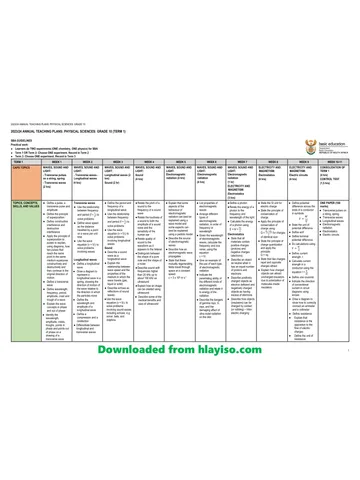
Gr 10 Phys Sci ATP 2023 24
Question paper and memo
Physical Sciences Grade 10 Eastern Cape June 2025 QP & Memo
Question paper
Physical Sciences Grade 10 Eastern Cape March Test 2025 QP
Question paper and memo
Physical Sciences Grade 10 Free State June 2025 Paper & Memo
Question paper and memo