
Downloaded from hlayiso.com
NATIONAL
SENIOR CERTIFICATE
GRADE 11
NOVEMBER 2016
ECONOMICS P1
MEMORANDUM
MARKS: 150
This memorandum consists of 13 pages.
Skip to contentAll 2016 papers 
View all

Economics Grade 11 P1 Eastern Cape November 2016 Memo (Eng)
Grade 11 Economics Paper 1 memorandum from the Eastern Cape November 2016 (English), 13 pages. Read online or download the free PDF.
Economics · Grade 11 · Eastern Cape November · 2016. Memorandum, 13 pages. Read online or download the PDF.
- Subject
- Economics
- Grade
- Grade 11
- Document type
- Memorandum
- Year
- 2016
- Exam period
- Eastern Cape November
- Paper
- 1
- Curriculum
- CAPS
- Pages
- 13
- File size
- 865.4 KB
Free to read online, no sign-up needed
Loading document…
Loading document…
1 of 13
This exam
Eastern Cape November 2016
Questions in this paper
Document textSearch extracted text and jump to a page.
Downloaded from hlayiso.com
2 ECONOMICS P1 (EC/NOVEMBER 2016)
SECTION A
QUESTION 1
1.1 MULTIPLE-CHOICE QUESTIONS
1.1.1 C rent.
1.1.2 A gross domestic product.
1.1.3 B Motivation
1.1.4 A electricity
1.1.5 B roads.
1.1.6 C IDZ.
1.1.7 B Interest rate
1.1.8 C Monetary union (8 × 2) (16)
1.2 MATCHING ITEMS
1.2.1 B Payment made for the use of factor of production which is
limited in supply
1.2.2 D Are consumed or destroyed in process of being used
1.2.3 F Wealth passed on from one generation to the next
1.2.4 A Services such as transport and communication
1.2.5 C Is a mechanism for tackling the problem of scarcity and
choice
1.2.6 E The percentage of people living on an income which is less
than the poverty line income
1.2.7 H Refers to what money can buy economic growth and
economic development in Southern Africa
1.2.8 I Individuals are free to perform their professions, trade
without state intervention (8 × 1) (8)
1.3 IDENTIFY THE CONCEPT
1.3.1 Intermediate goods/inputs
1.3.2 Macroeconomics
1.3.3 Imports
1.3.4 Social services
1.3.5 Economic goods
1.3.6 Capital widening (6 × 1) (6)
TOTAL SECTION A: 30
Copyright reserved Please turn over
Downloaded from hlayiso.com
(EC/NOVEMBER 2016) ECONOMICS P1 3
SECTION B
QUESTION 2: MACROECONOMICS
2.1 List TWO methods of determining the GDP.
2.1.1 Income method
Production method
Expenditure method (Any 2 × 1) (2)
2.1.2 Why is it important for government to use the procurement
system?
To address past discriminatory policies and practices
To redistribute wealth by channelling funds to businesses
belonging to previously disadvantaged groups
To achieve anti-discrimination objectives in a workplace
To direct investment funds into underdeveloped and
disadvantaged rural communities by means of conventional
constructional projects
To the participation of SMME’s in providing goods and services for
government procurement
(Accept any relevant information) (Any 1 × 2) (2)
2.2 DATA RESPONSE
2.2.1 Name the industry of the primary sector presented in the above
picture.
Forestry (2)
2.2.2 Highlight the relationship between primary sector and secondary
sector.
The primary sector provides raw materials for further
processing.
The secondary industries process or manufacture the raw material
into more useful products for use by all of the sectors.
(Any relevant information) (Any 1 × 2) (2)
2.2.3 In your own opinion, explain the cause of selling unfinished
furniture.
It is caused by low levels of technology and capital.
(Any relevant information) (Any 1 × 2) (2
2.2.4 Why is the contribution to GDP important in the primary sector?
Primary sector decreased in terms of the direct value it added
The relative decline represents a structural change
It means a country becomes less dependent on the primary sector
and more dependent on the secondary and tertiary sectors
Industry has a very important role because it provides food to
domestic population
Contributes greatly to employment and exports earnings
(Any 2 × 2) (4)
Copyright reserved Please turn over
Downloaded from hlayiso.com
4 ECONOMICS P1 (EC/NOVEMBER 2016)
2.3 DATA RESPONSE
2.3.1 Explain the term final consumption expenditure.
Is the amounts household use to buy goods and services that they
need to satisfy their wants. (2)
2.3.2 Provide a letter that normally denotes “Gross capital
formation”.
Letter I (2)
2.3.3 Why is it important for the economy to use GDP?
To measure the performance / growth or contraction of
economies (Any relevant information) (2)
2.3.4 Calculate the GDE in the above table labelled (A). Show your
calculations.
GDE = 1,8 +0,7+1,5 -1,2 + 0,7- 1,3 = 2,2 (2 + 2) (4)
2.4 Explain how the natural resources enrich our lives.
Land provides space for walking and the enjoyment of natural
surroundings.
Provides fish, water and is also a source of recreation and relaxation.
The atmosphere provides space to fly aeroplanes and to communicate
electronically.
Also provides fresh oxygen-rich air and clean, clear skies.
It allows jobs to be created in tertiary industry.
(Accept any relevant information) (Any 4 × 2) (8)
2.5 How important is transport infrastructure in the economy??
Allows goods produced in one area to be processed in another area and
sold all over the country.
Goods can be exported.
The country can be part of the globalised world.
Allows the growth of tourism.
Provides employment and contributes to the GDP.
(Accept any relevant explanation) (Any 4 × 2) (8)
[40]
Copyright reserved Please turn over
Downloaded from hlayiso.com
(EC/NOVEMBER 2016) ECONOMICS P1 5
QUESTION 3: ECONOMIC PURSUIT
3.1 3.1.1 Name TWO sources of measuring inequality.
Lorenz curve
Gini-coefficient/Gini Index (2 × 1) (2)
3.1.2 Why is money used as a unit of account?
Trade is simplified: Consider the chaos which would result if
the price of goods were not expressed in terms of money.
By using money as a unit of account all these problems are
eliminated and the exchange process is simplified.
Relative values of goods and services are expressed: If a
shirt cost R120 and a pair of shoes R240, these prices indicate
that the pair of shoes is twice as expensive as the shirt.
(Accept any relevant information) (Any 1 × 2) (2)
3.2 DATA RESPONSE
3.2.1 Name the curve that represents the Lorenz curve.
Curve C (2)
3.2.2 Explain the term Lorenz curve.
Is a method of measuring the degree of inequality of income and
wealth distribution between households. (2)
3.2.3 What happens when the Lorenz curve is away from the line of
equality?
There will be a greater degree of inequality. (2)
3.2.4 Why is income and wealth in a country such as South Africa so
unequally distributed?
South Africa do not have a saving culture - means that poor
and middle income families are unlikely to gain wealth as they
are not saving money and investing but rather spending
everything they earn.
Poor families tend to have larger families than wealthy people
- they are unlikely to have any money left at the end of the month
to save and generate wealth.
The education system in South Africa is still producing huge
numbers of students that do not qualify to study at tertiary
institutions - this means that the skill shortage in this country
is not being addressed.
Skilled workers will thus continue to command higher wages than
the unskilled workers.
With these higher wages the skilled workers are able to save and
generate wealth.
(Accept any relevant information) (Any 2 × 2) (4)
Copyright reserved Please turn over
Downloaded from hlayiso.com
6 ECONOMICS P1 (EC/NOVEMBER 2016)
3.3 DATA RESPONSE
3.3.1 Explain the term Consumer Price Index.
It is the measure that examines the weighted average of prices of a
basket of consumer goods and services and medical care. (2)
3.3.2 Name the institution that uses CPI to measure headline inflation.
Stats SA (2)
3.3.3 According to the table when is the CPI published?
Monthly (2)
3.3.4 Briefly explain how CPI is calculated.
CPI is calculated by taking price changes for each item in the basket
of goods and averaging them, the goods are weighted according
their importance. (2 × 2) (4)
3.4 Explain low life expectancy and lack of education as the characteristics
of developing country.
Low life expectancy
Developing country has a low life expectancy, average 51 years,
compared to 75 years for developed countries.
Means that a smaller portion of a developing country’s population is
available as an efficient labour force.
They are fighting an endless battle against diseases, ill health
malnutrition. (Any 2 × 2)(4)
Low standard living
Low living standards are also related to low levels of education.
The level and effectiveness of education are expressed by the adult
literacy rate.
This is a percentage of people aged 15 years and above who can
read, write and speak.
Literacy rates in developing countries are low compared to those in
developed countries.
Education deficiencies and the apartheid legacy have caused severe
skills shortages in South Africa.
The most important way of escaping poverty for individuals is
education.
An improved education system is necessary to grow the economy as a
whole. (Any 2 × 2)(4) (8)
Copyright reserved Please turn over
Downloaded from hlayiso.com
(EC/NOVEMBER 2016) ECONOMICS P1 7
3.5 Briefly explain the kinds of economically marginalised groups.
The marginalised group are people who are excluded from meaningful
participation in a society and whose needs are largely not addressed by
the authorities.
They include:
o The poor, people with special needs, minority groups, people with
HIV/Aids, woman and children.
o These groups are generally denied jobs, quality education and social
services and are usually exploited and discriminated against.
o Their pledge is increasing being highlighted and programmes are
slowly being put in place to grant them equal opportunities to
participate in the economy.
(Accept any relevant explanation) (4 × 2) (8)
[40]
QUESTION 4: MACROECONOMICS AND ECONOMIC PURSUIT
4.1 4.1.1 List any TWO forces that determine interest rates.
Savings
Spending
Borrowing
Investment
Exchange rates (Any 2 × 1) (2)
4.1.2 Explain the term real wage.
Refers to the purchasing power of the money earned – the goods and
services bought with the money earned.
(Any relevant explanation) (Any 1 × 2) (2)
4.2 DATA RESPONSE
4.2.1 What factor of production is represented in the above extract?
Natural resource/Land (2)
4.2.2 Who is the current the Minister of Water and Sanitation?
Ms Nomvula Makonyane (accept a change if cabinet is reshuffled) (2)
4.2.3 What was the aim of the 2016 Water Week?
To emphasize the importance of water, the scarcity of this
resource and the need to manage the resource in a sustainable
way. (2)
4.2.4 How is the South African economy affected by drought?
Drought leaves many households without access to water.
Causing devastation to crop producers and livestock farmers.
(2 × 2) (4)
Copyright reserved Please turn over
Downloaded from hlayiso.com
8 ECONOMICS P1 (EC/NOVEMBER 2016)
4.3 DATA RESPONSE
4.3.1 Explain the term foreign trade.
Is when countries exchange the goods and services across
international borders (2)
4.3.2 Where is the country’s trade with other countries recorded?
Balance of payment/BOP (2)
4.3.3 What does the balances shows on the current account?
It shows whether the countries are living within or beyond their means
when they show respectively surplus or deficit.
(Any relevant information) (2)
4.3.4 How do most countries balance the deficit on the balance of
payments?
By capital grants (donations)
Foreign direct investment (FDI) (fixed investment)
Other capital inflows (portfolio investment)
Long term borrowing (Any 2 × 2) (4)
4.4 Briefly explain improving efficiency and creating new wealth as
importance of an entrepreneur.
Improving efficiency
Entrepreneurs with new ideas and technology use resources
efficiently
Efficiency increase profitability which leads to more competition
They are important for guiding and combining the other factors of
production.
They do not waste resources and are efficient. (Any 2 × 2)(4)
Creating new wealth
Entrepreneurs entering a market for the first time do so with their and
their family’s meagre savings and the money that they borrow.
They create new wealth (2 × 2)(4) (8)
4.5 How is income redistributed in SA?
A country’s income distribution shows how the total income is distributed
among its population.
This may be even or uneven.
If there is unequal distribution of income, small number of people will be
rich and the majority will be poor.
Not everyone receive the same income Spending patterns will also
differ the poor will have limited choices, while the rich would be
privileged to have a large range of goods and services at their disposal
(Any relevant information) (Any 4 × 2) (8)
[40]
TOTAL SECTION B: 80
Copyright reserved Please turn over
Downloaded from hlayiso.com
(EC/NOVEMBER 2016) ECONOMICS P1 9
SECTION C
MARK ALLOCATION FOR ESSAY RESPONSES
STRUCTURE OF THE ESSAY: MARK
ALLOCATION:
Introduction: Max. 2
A good starting point would be to define a concept or key word
that appears in the question.
Include other sentences to support the topic.
Do not include in your introduction any part of the question.
Avoid saying in the introduction what you are going to discuss
in the body.
Body
Main part: Discuss in detail / In depth discussion / Examine /
Critically discuss / Analyse / Compare / Explain /
Distinguish / Differentiate / Analyse / Evaluate /
Assess / Assess / Debate Max. 26
Additional part: Give won opinion / Critically discuss / Evaluate /
Critically evaluate / Draw a graph and explain /
Use the graph given and explain / Complete the
given graph / Calculate /
Deduce / Compare / Explain / Distinguish /
Interpret / Briefly debate / How / Suggest / Use
the information and argue, debate, evaluate … Max. 10
Conclusion
The conclusion is a wrap up of the discussion of the topic in
the body and should be treated as a higher order response.
The conclusion can take the form of an own opinion, examples
to support your discussion or contradictory viewpoint from
what has been discussed.
No aspect from either the introduction or body should be
included in the body. Max. 2
TOTAL 40
Copyright reserved Please turn over
Downloaded from hlayiso.com
10 ECONOMICS P1 (EC/NOVEMBER 2016)
QUESTION 5: MACROECONOMICS
South Africa has made a choice of a mixed economic system merging the advantages
of both market and centrally planned economic systems into one.
Briefly discuss the advantages of mixed economy. (26 marks)
Why is the South African economy considered a mixed economy?
(10 marks)
INTRODUCTION
Mixed economy is a method to organise the economy to produce goods and
services.
(Any relevant introduction accepted) Max 2 (2)
BODY
MAIN PART
The private sector
Private ownership, the profit motive and competition are the forces that
ensure the production of a great variety of goods and services.
Exports create employment and contribute to economic growth.
Imports supplement domestic variety and choice
These are the advantages of the private sector inherited from the market
system.
The public sector
Protection, education, health care, social benefits and opportunities for the
poor are provided.
The public sector also includes economic issues such as the handling of
market failure, provision of adequate infrastructure and creation of solid
economic framework.
Optimum mix
The optimum will would ensure an optimum standards of living for all
citizens.
Government allows sufficient room for the private sector to pursue its market
objectives.
The private sector should appreciate that the public sector needs the
resources and room to pursue its social and economic objectives.
The environment and human rights
Mixed economies have better environment and human rights records than
either centrally planned or market economies.
(If only listed Max. 6 marks) Max 26 (26)
Copyright reserved Please turn over
Downloaded from hlayiso.com
(EC/NOVEMBER 2016) ECONOMICS P1 11
ADDITIONAL PART
Explain why the South African economy is considered a mixed economy.
South Africa has a mixed economy because the government plays a role in
providing collective goods and services and in regulating the market, while the
other economic activities are driven by decisions of buyers and sellers.
The outcomes of this mix are that resources are allocated on the decisions by both
private sector and the government.
The functioning of the economy is left to the market mechanism of the private
sector, while the government controls the economy indirectly through fiscal and
monetary policies and laws.
If the government were to nationalise mines, farms, banks and other institutions,
the economic system would change to one or other form of centrally planned
economy with the characteristics, advantages and disadvantages of such
system.
(Any relevant information accepted) (Any 5 × 2) (10)
CONCLUSION
Any relevant higher order conclusion that should include:
A summary of what has been discussed without repeating facts already
mentioned in the body
An opinion or valued judgement on the facts discussed/
Additional support information to strengthen the discussion/
A contradictory viewpoint with motivation Max 2 (2)
[40]
Copyright reserved Please turn over
Downloaded from hlayiso.com
12 ECONOMICS P1 (EC/NOVEMBER 2016)
QUESTION 6: ECONOMIC PURSUIT
In South Africa many smaller banks have gone out of business in the past few years.
These failures can be attributed to typical risks of banking together with
mismanagement.
Discuss the various reasons for their failure related to bank risks. (26 marks)
How do depositors and shareholders suffer when banks fail? (10 marks)
INTRODUCTION
A bank failure occurs when a bank is unable to meet its obligations to its depositors or
other creditors because it has become insolvent to meets its liabilities. Max 2 (2)
BODY
MAIN PART
Credit risk
One of the core functions of banks is to lend money in the forms of loans.
Credit risk emerges from the concern that loans might not be repaid by
clients, but the bank still has to able to repay deposits of their clients.
Liquidity risk
Banks borrow over short term and lend over long term.
If a large deposit holder withdraws a sizeable amount, and the bank has to
scramble to find accommodation, rumours of a liquidity squeeze will
immediately encourage other depositors to cash in as well.
A run will then start, which is very difficult to halt.
Interest rates risk
High interest rate fluctuations can cause problems for banks if they are not
appropriately prepared.
High interest rates affect a bank’s deposit rates and the lending rates that
clients have to carry.
This could decrease the bank’s profile.
Investment risk
Banks invest money in shares, property.
Should the asset of the market suddenly lose value, gains would slow and
losses could be made.
These would then have to be subsidised from the profile.
Copyright reserved Please turn over
Downloaded from hlayiso.com
(EC/NOVEMBER 2016) ECONOMICS P1 13
Capital risk
Banks have to maintain capital and undistributed profit reserves to an amount
that is more than 10% of their total liabilities.
If a bank’s capital ratio approaches this margin, some shareholders may sell
their shares.
This is because it means that the bank will have to issue new shares.
Such shares will share in profits and that will dilute the earnings of the existing
shareholders.
Depositors also start feeling uneasy.
(If only listed Max. 5 marks) Max 26 (26)
ADDITIONAL PART
Explain how the depositors and shareholders suffer when banks fail.
Depositors:
When a bank fails, e.g. because of run on it, the bank will stop repaying deposits
when it runs out of cash and also has no more assets to make use of the Reserve
Bank’s repurchasing facility. The SARB may appoint a curator to sell the assets
and pay the proceeds to the locked-in depositors. They may or may not get all of
their deposit money back.
Shareholders:
Shareholders are last in the line to get something out of a bank failure. Their
dividends disappear even before the bank fails. However, at the first sign of
problems the board of directors will try to sell the bank as a going concern.
(Any relevant information) Max 10 (10)
CONCLUSION
Any relevant higher order conclusion that should include:
A summary of what has been discussed without repeating facts already
mentioned in the body/
An opinion or valued judgement on the facts discussed/
Additional support information to strengthen the discussion/
A contradictory viewpoint with motivation.
(Any relevant conclusion is acceptable) (Max 1 × 2) (2)
[40]
TOTAL SECTION C: 40
GRAND TOTAL: 150
Copyright reserved Please turn over
Study this subject
Recommended for this subject
Memorandum
Economics Grade 11 P1 Eastern Cape November 2016 Memo (Afr)
Errata
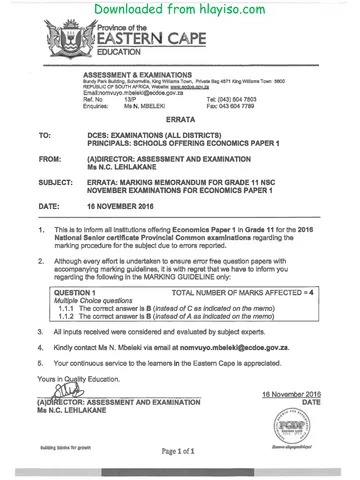
Economics Grade 11 Paper 1 Eastern Cape November 2016 Errata
Question paper
Economics Grade 11 P1 Eastern Cape November 2016 QP (Afr)
Question paper
Economics Grade 11 P1 Eastern Cape November 2016 QP (Eng)
Memorandum
Economics Grade 11 P2 Eastern Cape November 2016 Memo (Eng)
Memorandum
Economics Grade 11 Paper 1 Gauteng June 2016 Memo
More from Grade 11 Economics
Question paper
Economics Grade 11 P2 Eastern Cape November 2025 QP (Afr)
Question paper and memo
Economics Grade 11 Limpopo March Test 2025 Paper & Memo
Question paper
Economics Grade 11 P2 Eastern Cape November 2024 QP (Afr)
Question paper
Economics Grade 11 P2 Gauteng June 2024 Question Paper (Afr)
Question paper
Economics Grade 11 P2 Gauteng June 2024 Question Paper (Eng)
Question paper