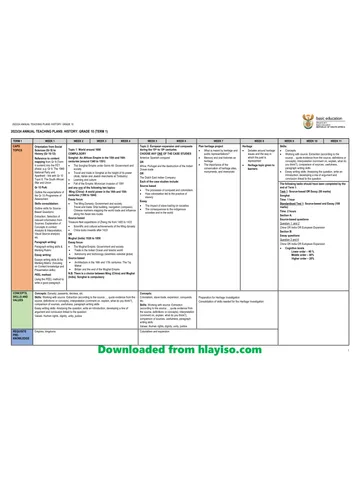
NATIONAL
SENIOR CERTIFICATE
GRADE 10
NOVEMBER 2019
HISTORY
MARKING GUIDELINE
MARKS: 150
This marking guideline consists of 21 pages.
You're offline
Skip to contentMemorandum 
/HISTORY%20P1%20GR10%20MEMO%20NOV2020_Afrikaans--04b1f811-a033-4d75-b6b3-8a4c2466e8a0/v1-cbf9bb2b57bd4ace5715/card.webp)
/HISTORY%20P2%20GR%2010%20NOV2020%20MEMO%20Afrikaans--bb5e6e0c-b600-4321-b92b-3bb58ac61341/v1-e1edbbb952834b80e42d/card.webp)
View all
HISTORY GR10 MEMO NOV2019 Eng D
History · Grade 10 · National November Exam · 2019. Memorandum, 21 pages. Read online or download the PDF.
- Subject
- History
- Grade
- Grade 10
- Document type
- Memorandum
- Year
- 2019
- Exam period
- National November Exam
- Pages
- 21
- File size
- 238.6 KB
Loading document…
Loading document…
1 of 21
Document textSearch extracted text and jump to a page.
2 HISTORY (EC/NOVEMBER 2019)
1. SOURCE-BASED QUESTIONS
1.1 The following cognitive levels were used to develop source-based questions:
WEIGHTING
COGNITVE
HISTORICAL SKILLS OF
LEVELS
QUESTIONS
Extract evidence from sources
LEVEL 1 Selection and organisation of relevant 40%
(L1) information from sources (20)
Define historical concepts/terms
Interpretation of evidence from sources
LEVEL 2 40%
Explain information gathered from sources
(L2) (20)
Analyse evidence from sources
Interpret and evaluate evidence from the
sources
Engage with sources to determine their
LEVEL 3 20%
usefulness, reliability, bias and limitations
(L3) (10)
Compare and contrast interpretations and
perspectives presented in sources and draw
independent conclusions
1.2 The following information indicates how the source-based questions are
assessed:
In the marking of source-based questions, credit needs to be given to any
valid and relevant viewpoints, arguments, evidence or examples.
In the allocation of marks, emphasis should be placed on how the
requirements of the questions have been addressed.
In the marking guideline, the requirements of the questions (skills that need
to be addressed) as well as the level of the questions are indicated in
italics.
1.3 Assessment procedures for source-based questions
Use a tick () for each correct answer
Pay attention to the mark scheme e.g. (2 x 2) translates to two reasons which are
given two marks each ( ); (1 x 2) translates to one reason and is given two
marks ()
If a question carries 4 marks, then indicate by placing 4 ticks
Copyright reserved Please turn over
(EC/NOVEMBER 2019) HISTORY 3
Paragraph question
Paragraphs are to be assessed globally (holistically). Both the content and structure of
the paragraph must be taken into account when awarding a mark. The following steps
must be used when assessing a response to a paragraph question:
Read the paragraph and place a bullet (•) at each point within the text where the
candidate has used relevant evidence to address the question.
Re-read the paragraph to evaluate the extent to which the candidate has been
able to use relevant evidence to write a paragraph.
At the end of the paragraph indicate the ticks () that the candidate has been
awarded for the paragraph; as well as the level (1, 2 or 3) as indicated in the
holistic rubric and a brief comment e.g.
___________ . __________________________ . __________________
_________________ . ____________________________ . __________
Level 2
Used mostly relevant evidence to write a basic paragraph.
Count all the ticks for the source-based question and then write the mark on
the right-hand bottom margin e.g. 32
50
Ensure that the total mark is transferred accurately to the front/back cover of
the answer script.
2. ESSAY QUESTIONS
2.1 The essay questions require candidates to be able to structure their argument in a
logical and coherent manner. They need to select, organise and connect the relevant
information so that they are able to present a reasonable sequence of facts or an
effective argument to answer the question posed. It is essential that an essay have an
introduction, a coherent and balanced body of evidence, and a conclusion.
2.2 Marking of essays questions
Markers must be aware that the content of the answer will be guided by the
textbooks in use at the particular centre.
Candidates may have any other relevant introduction and/or conclusion than those
included in a specific essay marking guideline for a specific essay.
When assessing open-ended source-based questions, learners should be credited
for any other relevant answer.
2.3 Global assessment of the essay
The essay must be assessed holistically (globally). This approach requires the teacher
to score the overall product as a whole, without scoring the component parts separately.
This approach encourages the learner to offer an individual opinion by using selected
factual evidence to support an argument. The learners will not be required to simply
regurgitate ‘facts’ in order to achieve a high mark. This approach discourages learners
from preparing ‘model’ answers and reproducing them without taking into account the
specific requirements of the question. Holistic marking of the essay credits learners’
opinions supported by evidence. Holistic assessment, unlike content-based marking,
does not penalise language inadequacies as the emphasis is on the following:
The construction of argument
The appropriate selection of factual evidence to support such argument
The learner’s interpretation of the question
Copyright reserved Please turn over
4 HISTORY (EC/NOVEMBER 2019)
2.4 Assessment procedures of the essay
2.4.1 Keep the synopsis in mind when assessing essays.
2.4.2 During the first reading of the extended writing, ticks need to be awarded for a
relevant introduction (indicated by a bullet in memorandum); each of the main
points/aspects that is properly contextualised (also indicated by bullets in the
memorandum); and a relevant conclusion (indicated by a bullet in the
memorandum) e.g. in an answer where there are 5 main points there will be 7
ticks.
2.4.3 The following additional symbols can also be used:
Introduction, main aspects and conclusion not properly
contextualised
Wrong statement
Irrelevant statement
Repetition R
Analysis A√
Interpretation I√
2.5 The matrix
2.5.1 Use of the analytical matrix in the marking of essay.
In the marking of essays, with reference to page 6, the given criteria shown in
the matrix should be used. In assessing the extended writing note should be
taken of both the content and presentation. At the point of intersection of the
content and presentation based on the seven competency levels, a mark
should be awarded.
(a) The first reading of an essay will be to determine to what extent the
main aspects have been
covered and to allocate the C LEVEL 4
content level (on the matrix).
(b) The second reading of essay will relate to the level (on the matrix) of
presentation. C LEVEL 4
P LEVEL 3
(c) Allocate an overall mark with
C LEVEL 4
the use of the matrix. 26–27
P LEVEL 3
Copyright reserved Please turn over
(EC/NOVEMBER 2019) HISTORY 5
MARKING MATRIX FOR ESSAY – TOTAL: 50
LEVEL 7 LEVEL 6 LEVEL 5 LEVEL 4 LEVEL 3 LEVEL 2 LEVEL 1
Very well planned and Very well planned Well planned Planned and Shows some Attempts to Little or no
structured essay. and structured and constructed evidence of a structure an attempt to
PRESENTATION Good synthesis of essay. Developed structured an argument. planned and answer. structure
information. a relevant line of essay. Evidence constructed Largely the essay.
Developed an original, argument. Attempts to used to some argument. descriptive or
well balanced and Evidence used to develop a extent to Attempts to some attempt
independent line of defend the clear support the sustain a line at developing
argument with the use argument. Attempts argument. line of of argument. a line of
of evidence and to draw an Conclusion argument. Conclusions argument. No
CONTENT sustained and independent drawn from Conclusions not clearly attempt to
defended the conclusion from the the evidence reached supported by draw a
argument throughout. evidence to support to support based on evidence. conclusion.
Independent the line of the line of evidence.
conclusion is drawn argument. argument.
from evidence to
support the line of
argument.
LEVEL 7
Question has been
fully answered.
Content selection
47–50 43–46
fully relevant to
line of argument.
LEVEL 6
Question has been
answered.
Content selection
43–46 40–42 38–39
relevant to a line of
argument
LEVEL 5
Question
answered to a
great extent.
Content
38–39 36–37 34–35 30–33 28–29
adequately
covered and
relevant.
LEVEL 4
Question
recognisable in
answer. Some 30–33 28–29 26–27
omissions or
irrelevant content
selection.
LEVEL 3
Content selection
does not relate to
the question, but
does not answer it,
or does not always
26–27 24–25 20–23
relate to the
question.
Omissions in
coverage.
LEVEL 2
Question
inadequately 20–23 18–19 14–17
addressed.
Sparse content.
LEVEL 1
Question
inadequately
addressed or not 14–17 0–13
at all. Inadequate
or irrelevant
content.
*Guidelines for allocating a mark for Level 1:
Question not addressed at all/totally irrelevant content; no attempt to structure the essay =0
Question includes basic and generally irrelevant information; no attempt to structure the essay = 1–6
Question inadequately addressed and vague; little attempt to structure the essay = 7–13
Copyright reserved Please turn over
6 HISTORY (EC/NOVEMBER 2019)
SECTION A: SOURCE-BASED QUESTIONS
QUESTION 1: WHY WERE THE ZULUS CONSIDERED TO BE THE MOST
FEARSOME WARRIORS IN AFRICA UNDER SHAKA?
1.1 Use Source 1A.
1.1.1 [Extraction of evidence from the Source 1A – L1]
He was helped by Dingiswayo to become the chief of the Zulus
after the death of Senzangakhona
He was an outcast (2 x 1) (2)
1.1.2 [Extraction of evidence from the Source 1A – L1]
Shaka Zulu (1 x 1) (1)
1.1.3 [Extraction of evidence from Source 1A – L1]
He consolidated a number of military innovations.
A powerful military machine was produced.
All young men were incorporated into regiments.
A new horn formation was also introduced. (2 x 1) (2)
1.1.4 [Extraction of evidence from Source 1A – L1]
Short stabbing spear (1 x 1) (1)
1.1.5 [Interpretation of evidence from Source 1A – L2]
He was born out of wedlock.
He was an illegitimate son.
He was disowned by his father.
He was not considered heir to the chieftainship.
He was brought up among a number of neighbouring groups.
Any other relevant answer (1 x 2) (2)
1.1.6 [ Interpretation of evidence from Source 1A – L2]
To engage in close range/combat.
To kill the enemy easily.
Any other relevant answer. (1 x 2) (2)
1.1.7 [Interpretation of evidence from Source 1A – L2]
His kingdom’s population increased rapidly, and the power was
centralised.
Zuluness was instilled in his people through national identities
and national ceremonies.
British traders were also welcomed in his kingdom.
National ceremonies were introduced.
Any other relevant response. (1 x 2) (2)
Copyright reserved Please turn over
(EC/NOVEMBER 2019) HISTORY 7
1.2 1.2.1 [Extraction of evidence from Source 1B – L1]
The assegai
The formation
The discipline (3 x 1) (3)
1.2.2 [Interpretation of evidence from Source 1B – L2]
Either they win the battle or die instead of losing.
Any other relevant answer. (1 x 2) (2)
1.2.3 [Extraction of evidence from Source 1B – L1]
(a) Young men enrolled alongside others from all sections of
the kingdom.
They had common identity.
Each had its own name and they became military
communities. (1 x 2) (2)
(b) Young women assembled at the military settlements,
They were wards of the king.
They were organised in female equivalents of the male
amabutho.
They took part in ceremonial dancing and displays. (1 x 2) (2)
1.2.4 [Interpretation of evidence from Source 1B – L2]
Fearless army
Powerful army
Conquering neighbouring tribes
Any other relevant answer. (1 x 2) (2)
1.2.5 [Interpretation of evidence from Source 1B – L2]
The short-stabbing spear was used to engage close combat.
The body length cowhide shield to protect the soldiers from
spears that are thrown to them.
Horn formation to attack the enemy from all angles.
Disciplined soldiers that can run barefoot over thorny ground.
The use of Amabutho for both male and females.
Any other relevant answer (2 x 2) (4)
1.3 1.3.1 [Extraction of evidence from Source 1C – L1]
He ordered that no crops should be planted.
No milk was to be used.
Any woman who became pregnant was to be killed along with
her husband.
Any other relevant answer. (2 x 1) (2)
1.3.2 [Interpretation of evidence from Source 1C – L2]
They endured hard times together.
He was disowned by his father.
They fled to the Mthethwa tribe.
Any other relevant answer. (1 x 2) (2)
Copyright reserved Please turn over
8 HISTORY (EC/NOVEMBER 2019)
1.3.3 [Interpretation of evidence from Source 1C – L2]
He loved his mother dearly.
They endured hard times together
He had a difficult childhood.
Any other relevant answer (1 x 2) (2)
1.3.4 [Extraction of evidence from Source 1C – L1]
Insufficient grief-stricken.
They did not display enough grief. (1 x 2) (2)
1.4 1.4.1 [Extraction of evidence from Source 1D – L1]
Sides – horns
Middle – Chest
Back – Loins (3 x 1) (3)
1.4.2 [Interpretation of evidence from Source 1D – L2]
Enemy can be attacked unexpectedly from all angles.
Vicious and brilliant attack.
Any other relevant answer. (1 x 2) (2)
1.4.3 [Comparison of Source 1C and Source 1D - -L3]
Both sources show Shaka’s brilliant ways of attacking the enemy
unexpectedly.
Source 1B states that warriors were trained to move up to their
opponents in close formation and Source 1C shows the enemy
encircled closely through the horn formation.
Any other relevant answer (2 x 2) (4)
1.5 [Interpretation, evaluation and synthesis of evidence from relevant sources –
L3]
Candidates could include the following aspects in their responses:
Shaka built a formidable army (Source 1A)
He used brilliant military tactics (Source 1B and 1D)
He incorporated young men as his warriors (Source 1A)
The Zulu army under Shaka had 40 000 men (Source 1A)
The short-stabbing spear was used to engage in close combat (Sources
1A and 1B)
Shaka consolidated a number of military innovations (Source 1A)
His army was fearless and powerful thus became the terror of the land
(Source 1B)
He distinguished himself as a skilled warrior (Source 1A)
Shaka’s courage had an influence on the resolve of his warriors. (own
knowledge)
He had influence and a reputation to compel people to join him. (own
knowledge)
Any other relevant response.
Copyright reserved Please turn over
(EC/NOVEMBER 2019) HISTORY 9
Use the following rubric to allocate marks:
Uses evidence in an elementary manner, e.g. MARKS
shows no or little understanding of why the 0–2
Zulus were considered to be the most
LEVEL 1
fearsome warriors in Africa under Shaka.
Uses evidence partially or cannot write a
paragraph.
Evidence is mostly relevant and relates to a great MARKS
extent on the topic, e.g. why were the Zulus 3–4
considered to be the most fearsome warriors
LEVEL 2
in Africa under Shaka.
Uses evidence in a very basic manner to write a
paragraph.
Uses relevant evidence, e.g. demonstrates a MARKS
thorough understanding of why the Zulus 5–6
were considered to be the most fearsome
LEVEL 3 warriors in Africa under Shaka.
Uses evidence very effectively in an organised
paragraph that shows an understanding of the
topic. (6)
[50]
Copyright reserved Please turn over
10 HISTORY (EC/NOVEMBER 2019)
QUESTION 2: HOW DID COLONIALISM IMPACT NEGATIVELY ON THE
LIVES OF BOTH THE XHOSAS AND BOERS IN THE CAPE
COLONY?
2.1 [Extraction of evidence from Source 2A – L1]
2.1.1 The British wanted to control South Africa because it was one of
the trade routes to India.
When gold and diamonds were discovered in the 1860s–1880s,
their interest in the region increased
British rule has increasingly made their country an industrial and
business world (Any 2 x 1) (2)
2.1.2 [Explanation of historical concept from Source 2A – L1]
The policy or practice of acquiring full or partial political control
over another country, occupying with settlers, and exploiting it
economically.
Any other relevant answer. (1 x 2) (2)
2.1.3 [Interpretation of evidence from Source 2A – L2]
It changed their lifestyle because they were used to a simple family
life.
Their land was taken from them – had to move inland.
Most of them were turned into slaves
They were encouraged to engage in wars
Any other relevant answer (2 x 2) (4)
2.1.4 [Interpretation of evidence from Source 2A – L2]
The Boers wanted a simple life.
The British made their country a country of industry and business.
The British took their land.
The British took their power/culture and dignity
Any other relevant response. (2 x 2) (4)
2.2 2.2.1 [Extraction of evidence from the Source 2B – L1]
The community would rise from the dead.
All cattle must be slaughtered (2 x 1) (2)
2.2.2. [Extraction of evidence from Source 2B – L1]
Sent emissaries to the Gxarha River to investigate the prophecies.
Two councillors were sent to notify the chiefs under British
jurisdiction to sacrifice bewitched cattle. (2 x 2) (4)
2.2.3 [Interpretation of evidence from Source 2B – L2]
The White settlers would be driven into the sea.
The Xhosa nation would reign supreme again.
Any other relevant answer. (1 x 2) (2)
Copyright reserved Please turn over
(EC/NOVEMBER 2019) HISTORY 11
2.3 2.3.1 [Extraction of evidence from Source 2C – L1]
‘Your land shall be marked out …’
‘… shall be divided into districts, towns and villages …’
‘… with English names.’
‘… speak English at schools which I will establish …’ (2 x 1) (2)
2.3.2 [Extraction of evidence from Source 2C – L1]
They must learn English
Have towns with English names
Taught how to plough and become traders
Learn how to use money and buy things for themselves
Any other relevant response (4 x 1) (4)
2.3.3 [Interpretation of evidence from Source 2C – L2]
He degraded the Xhosas
Undermining their dignity
Xhosas had no future in South Africa
Any other relevant response. (1 x 2) (2)
2.3.4 [Interpretation of evidence from Source 2C – L2]
Not wearing clothes
Not knowledgeable/uncivilised/barbarians
Any other relevant response. (1 x 2) (2)
2.3.5 [Interpretation of evidence from Source 2C – L2]
Land taken from them.
Changing their lifestyle/dignity and language
Any other relevant answer. (2 x 2) (4)
2.3.6 [Evaluating usefulness from Source 2C – L3]
Primary source – A speech made by the British Governor to the
defeated Xhosa nation.
Gives an understanding on the conditions of the new system
imposed by the British on the defeated Xhosa chiefs
Any other relevant response. (2 x 2) (4)
2.4 2.4.1 [Extraction of evidence from Source 2D – L1]
Piet Retief (1 x 1) (1)
2.4.2 [Extraction of evidence from Source 2D – L1]
Grahamstown Journal (1 x 1) (1)
2.4.3 [Extraction of evidence from Source 2D – L1]
They felt threatened by the behaviour of vagrants.
False accusations against them by missionaries in England.
These farms were plundered by the Xhosas.
They suffered losses after the emancipation of their slaves. (2 x 1) (2)
Copyright reserved Please turn over
12 HISTORY (EC/NOVEMBER 2019)
2.4.4 [Interpretation of evidence from Source 2D – L2]
They felt that the British government did nothing to protect them
They suffered financial losses, after the emancipation of their slaves
The frontier war also left them ruined
Voortrekkers/Boers could not live with the idea that slaves were
regarded as equal with them
Any other relevant response. (1 x 2) (2)
2.5 [Interpretation, evaluation and synthesis of evidence from relevant sources –
L3]
Candidates could include the following aspects in their responses:
Forced to leave the Colony against their will.
They were mistreated (Source 2A)
Break-up of families (Source 2C)
Conflict over land (Source 2C)
Xhosas lost their dignity (Source 2B)
Lost their lives as well as their livestock (Source 2B)
They were engaged in wars (Source 2A)
It changed their lifestyle (Source 2A)
Both the Boers and the Xhosas had to adjust to the new changes. (own
knowledge)
It completely changed the lives of the South Africans. (own knowledge)
It led to the eventual emergence of Boer republics such as the TVL and
OFS. (own knowledge)
Any other relevant response.
Use the following rubric to allocate marks:
Uses evidence in an elementary manner, e.g. MARKS
shows no or little understanding of the 0–2
negative impact that colonialism had on the
LEVEL 1 lives of both the Xhosas and the Boers in the
Cape Colony.
Uses evidence partially or cannot write a
paragraph.
Evidence is mostly relevant and relates to a great MARKS
extent on the topic, e.g. the negative impact 3–4
that colonialism had on the lives of both the
LEVEL 2
Xhosas and the Boers in the Cape Colony.
Uses evidence partially or cannot write a
paragraph.
Evidence is mostly relevant and relates to a great MARKS
extent on the topic, e.g. the negative impact 5–6
that colonialism had on the lives of both the
LEVEL 3
Xhosas and the Boers in the Cape Colony.
Uses evidence in a very basic manner to write a
paragraph. (6)
[50]
Copyright reserved Please turn over
(EC/NOVEMBER 2019) HISTORY 13
QUESTION 3: WHAT WERE THE CONDITIONS INSIDE THE BRITISH
CONCENTRATION CAMPS DURING THE SOUTH AFRICAN
WAR?
3.1 3.1.1 [Extraction of evidence from Source 3A – L1]
Scouts
Spies
Drivers
Labourers
Stretcher bearers
Servants (Any 4 x 1) (4)
3.1.2 [Interpretation of evidence from Source 3A – L2]
A war between white Afrikaners and the British people. (1 x 2) (2)
3.1.3 [Interpretation of evidence from Source 3A – L2]
No sense of appreciation/acknowledgement given to the Barolong.
They were not compensated for their loss of lives and cattle. (1 x 2) (2)
3.1.4 [Extraction of evidence from Source 3A – L1]
Lost their crops
Lost their lives and houses
Cattle theft
Thousands were put in concentration camps.
Many people died in black camps than in white camps. (Any 4 x 1) (4)
3.1.5 [Interpretation of evidence from Source 3A – L2]
They fought alongside the British but could not vote after the war.
Britain ignored their plea – objection of the Union
They lost their land through the Native Land Act of 1913.
Any other relevant responses (2 x 2) (4)
3.2 3.2.1 [Extraction of evidence from Source 3B – L1]
To show final defiance towards Britain.
To show loyalty to her own country and people. (1 x 2) (2)
3.2.2 [Interpretation of evidence from Source 3B – L2]
It was ruthless, heartless and inhumane.
Any other relevant response. (1 x 2) (2)
3.2.3 [Extraction of evidence from Source 3B – L1]
Hated England
Thirsty for revenge
Willingness to fight until they govern the country in future (2 x 1) (2)
Copyright reserved Please turn over
14 HISTORY (EC/NOVEMBER 2019)
3.3 3.3.1 [Extraction of evidence from Source 3C – L1]
Shelter was totally inadequate.
There was no room to move.
No soap provided.
There was a shortage of water
No bedsteads and mattresses’ (4 x 1) (4)
3.3.2 [Interpretation of evidence from Source 3C – L2]
Land, animals and farms were destroyed by British troops.
Civilians targeted.
People’s ability to be self-sufficient was destroyed.
Not enough food or water.
Thousands of children died.
Any other relevant answer. (2 x 2) (4)
3.3.3 [Extraction of evidence from Source 3C – L1]
It led to starvation. (1 x 1) (1)
3.3.4 [Extraction of evidence from Source 3C – L1]
Emily Hobhouse (1 x 1) (1)
3.3.5 [Comparison of sources and ascertaining similarities between
Sources 3A and 3C – L3]
Both sources refer to victims of farm burning.
Both sources show that people were put in concentration camps.
Both sources highlight shortage of food and water as well as its
consequences.
Both sources indicate lack of sanitation facilities.
Any other relevant response (2 x 2) (4)
3.4 3.4.1 [Interpretation of evidence from Source 3D – L2]
Children died in concentration camps.
They died of starvation.
children died of measles and dysentery
Pain of war depicted/shown
Any other relevant answer. (2 x 2) (4)
3.4.2 [Interpretation of evidence from Source 3D – L2]
Angry
Bitter
Hatred
Any other relevant response (1 x 2) (2)
3.4.3 [Extraction of evidence from Source 3D – L1]
Measles
Dysentery (2 x 1) (2)
Copyright reserved Please turn over
(EC/NOVEMBER 2019) HISTORY 15
3.5 [Interpretation, evaluation and synthesis of evidence from relevant sources –
L3]
Candidates could include the following aspects in their responses:
Poor living conditions (Source 3C)
Shortage of food (Source 3C)
No bedstead or mattresses (Source 3C)
Children died of measles and dysentery (Source 3D)
Many died due to infections and weakness (Source 3A)
Many people died in Black camps than in White camps (Source 3A)
It had devastating effects for both the Boers and the Xhosas (own
knowledge)
People were deprived of their livelihoods. (own knowledge)
Black farmers lost their crops and livestock as they were taken as army
supplies. (own knowledge)
Treatment of women and children during that time encouraged a sense of
Afrikaner nationalism. (own knowledge)
Any other relevant response.
Use the following rubric to allocate marks:
Uses evidence in an elementary manner, e.g. MARKS
shows no or little understanding of the 0–2
conditions inside the British concentration
LEVEL 1
camps during the South African War.
Uses evidence partially or cannot write a
paragraph.
Evidence is mostly relevant and relates to a great MARKS
extent on the topic, e.g. conditions inside the 3–4
British concentration camps during the South
LEVEL 2
African War.
Uses evidence in a very basic manner to write a
paragraph.
Uses relevant evidence, e.g. demonstrates a MARKS
thorough understanding of the conditions 5–6
inside the British concentration camps during
LEVEL 3 the South African War.
Uses evidence very effectively in an organised
paragraph that shows an understanding of the
topic. (6)
[50]
Copyright reserved Please turn over
16 HISTORY (EC/NOVEMBER 2019)
SECTION B: ESSAY QUESTIONS
Answer at least ONE question, but not more than TWO questions from this section.
QUESTION 4: TRANSFORMATION IN SOUTHERN AFRICA AFTER 1750 – THE
EMEGENCE OF THE SOTHO KINGDOM UNDER KING
MOSHOESHOE
[Plan and construct an original argument based on relevant evidence using analytical
and interpretive skills.]
SYNOPSIS
Candidates should describe Moshoeshoe as a nation builder and a diplomat in
building the Sotho kingdom.
MAIN ASPECTS
Candidates should include the following aspects in their response:
Introduction: Candidates need to take a line of argument and indicate whether they
agree or not with the statement.
ELABORATION:
Moshoeshoe’s diplomacy
Moshoeshoe was a clever, loving leader who gave refugees a place to stay
Southern Sotho were united into a nation by Moshoeshoe, a leader with both
military and diplomatic skills
He welcomed and protected the frightened fleeing people
In dealing with Kora and Griqua attacks, he used diplomacy and force
He bought off attackers with gifts of cattle
Defended his people by moving them to Thaba Bosui Mountain to easily guard
against attackers
Routes were few to the mountain, plenty of water to support 3 000 people and
animals
Mafisa
o Moshoeshoe lent cattle to impoverished people
o Moshoeshoe helped refugees through Mafisa
Relationship with Trekboers
o Moshoeshoe accepted Trekboers
o He gave them the right to use land
o He lived peacefully with Trekboers
o He was careful not to sign any document or accept gifts
o He wanted to ensure that they did not later allege that they bought the land
Boers and Moshoeshoe
o Moshoeshoe allowed some Boers to stay as guests in the Caledon Valley
o Trading with them increased
o Basotho exchange grain and cattle with Boers for guns and gunpowder
o Conflict between Boers and Basotho started in 1840s when the Boers claimed
they owned the land they occupied.
Copyright reserved Please turn over
(EC/NOVEMBER 2019) HISTORY 17
Moshoeshoes relations with his neighbours
o Used relationships with his neighbours to strengthen his kingdom
o Sent tributes to Shaka in the hope that he would be left in peace
o After he defeated the Ndebele he treated them well
o Invited missionaries who helped and advised Moshoeshoe in dealing with
white people
o After various battles Moshoeshoe asked for protection from Britain in 1868
o Basotho land became British territory but Moshoeshoe still managed to
preserve his kingdom
o Any other relevant response
Conclusion: Candidates should tie up their argument with a relevant conclusion.
Use the rubric on page 6 to assess this essay question. [50]
Copyright reserved Please turn over
18 HISTORY (EC/NOVEMBER 2019)
QUESTION 5: COLONIAL EXPANSION AFTER 1750 – CO-OPERATION
CONFLICT ON THE HIGHVELD
[Plan and construct an argument based on evidence using analytical and
interpretative skills – L1]
SYNOPSIS
Candidates need to discuss the reasons for the conflict between the Xhosa and the
settlers on the Eastern frontier.
MAIN ASPECTS
Candidates should include the following aspects in their response
Introduction: The reasons for the conflict between the Xhosa and the settlers.
ELABORATION
Even before the British had taken over the Cape, there had been contact and
conflict between Dutch farmers and Xhosa chiefdoms along the eastern frontier of
the colony.
Both the Dutch and the Xhosa were cattle farmers and so there was competition
between them for the best grazing land.
There had already been three Frontier Wars between them.
There had also been more peaceful contact in the form of trade, and missionaries
set up mission stations and schools among the Xhosa.
Some Xhosa worked on settler farms as cattle herders, in return for tobacco,
copper and iron.
The British government decided to put an end to the conflict over land by forcing
the Xhosa to move eastwards.
In 1811–12 a large army of British, settler and Khoi soldiers attacked the Xhosa,
captured their cattle and forced them to move east of the Fish River.
The British army used scorched earth tactics and burned villages and crops.
After each war, more land was taken over by the colony and the Xhosa were
forced to move even further eastwards.
In 1850 the Xhosa attacked to regain their land.
They were joined by Khoi from the mission stations, as well as farm labourers,
who feared losing their jobs and homes because of the growth in wool farming
which did not require as much labour as other types of farming.
For a while there was panic amongst settlers who feared that the revolt would
spread.
But this did not happen, and once again troops were sent to the eastern Cape to
crush resistance.
Although the Xhosa had guns, they could not keep up with the endless supply of
guns and soldiers which the British seemed to have.
By 1857 the Xhosa had fought eight Frontier Wars against the British.
They had lost a lot of their land, there was a bad drought that led to crops failing,
and many of their cattle were dying from lung sickness.
They were a defeated nation, but they made a last desperate attempt to resist
colonial control.
Copyright reserved Please turn over
(EC/NOVEMBER 2019) HISTORY 19
It started when a young woman, called Nongqawuse had a vision in which she
believed that the ancestors had spoken to her.
She told the Xhosa that if they killed their cattle and did not plant crops, their
power would be restored, and the settlers would be swept into the sea.
They did as she had said.
The result was a tragedy for the Xhosa people.
About 400 000 cattle were killed, and, in the famine that followed, about 50 000
people died of starvation.
Many Xhosa started to believe that the colonial authorities were responsible for
spreading the story telling them to kill their cattle.
As they had no other option, thousands of people went to the Cape Colony to work
as labourers.
The colonial authorities took over more Xhosa land and imprisoned some of the
Xhosa chiefs on Robben Island.
As a result of the Cattle Killing and all the Frontier Wars, the independence of the
Xhosa was broken.
All of their land became part of the Cape Colony and was controlled by the British.
Conclusion: Candidates must tie up their argument with a relevant response.
Use the rubric on page 6 to assess this essay question. [50]
Copyright reserved Please turn over
20 HISTORY (EC/NOVEMBER 2019)
QUESTION 6: SOUTH AFRICAN WAR AND THE UNION – THE NATIVE LAND
ACT OF 1913
[Plan and construct an argument based on evidence using analytical and interpretative
skills – L1]
SYNOPSIS
Candidates must explain how the Natives Land Act of 1913 laid the foundations for
the system of apartheid.
MAIN ASPECTS
Introduction: Natives Land Act had laid foundations for the system of apartheid.
ELABORATION
Before the Land Act was passed many black farmers had become successful
sharecroppers on white-owned farms.
Sharecroppers farmed the land and sold the crops they produced
They gave a share of the profits to the owner of the land.
The Land Act put a stop to sharecropping.
Sharecroppers had to work as labourers on white-owned farms
Or move to the areas set aside in the Land Act as native reserves
The reserves were overcrowded
Conditions there were very poor, with soil erosion, malnutrition and diseases
increasing.
It could not support the number of people who were forced to live there.
Most of the land that was allocated for reserves was not suitable for farming
This meant that Africans could no longer survive on subsistence farming
They would have to seek for work outside of the reserves in order to support their
family.
The Land Act ended the possibility of Africans ever becoming successful
commercial farmers in competition with whites.
Because of the desperate situation it caused, this Act meant that Africans were at
the mercy of mining companies and white landowners and could be paid as little
as possible.
It led to further exploitation of black South Africans at the hands of the white
minority government.
As a result, many people had to leave the reserves to find work as labourers on
white-owned farms
On the mines
Or in the towns
This is exactly what the government wanted.
People travelled through the countryside looking for places where they could stay.
They took their livestock and all their belongings with them
In the end they were forced to sell their stock in order to survive
Copyright reserved Please turn over
(EC/NOVEMBER 2019) HISTORY 21
The law also stated that to provide a landless black person with a place to live
was forbidden
Under a penalty of 100 pounds or six months imprisonment.
They no longer had any form of wealth.
The only way they could make a living was by selling their own labour
In 1916 the government appointed the Beaumont Commission to investigate
the effects of the Land Act.
Although the commission reported that the reserves were far too small, the
government did not take any action.
Conclusion: Candidates to tie up their argument with a relevant conclusion.
Use the rubric on page 6 to assess this essay question. [50]
TOTAL: 150
Copyright reserved Please turn over
Recommended for this subject
Published documents with matching subject and grade metadata.
Memorandum
HISTORY P1 GR10 MEMO NOV2020 Afrikaans hlayiso.com
Memorandum
HISTORY P1 GR10 MEMO NOV2020 English hlayiso.com
Memorandum
HISTORY P2 GR 10 NOV2020 MEMO Afrikaans hlayiso.com
Memorandum
HISTORY P2 GR 10 NOV2020 MEMO English hlayiso.com
Memorandum
HISTORY P1 GR10 MEMO NOV2020 Afrikaans
Memorandum
HISTORY P2 GR 10 NOV2020 MEMO Afrikaans
Related documents
Matched using subject, grade, language, document type and exam metadata.
More from Grade 10 History
Explore more published documents in this catalogue.