
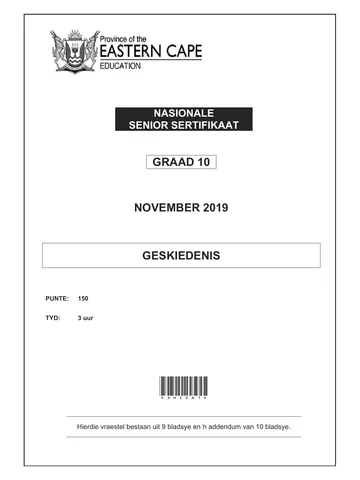
NATIONAL
SENIOR CERTIFICATE
GRADE 10
NOVEMBER 2019
HISTORY
MARKS: 150
TIME: 3 hours
*XHISE1*
This question paper consists of 9 pages and an addendum with 10 pages.
You're offline
Skip to contentQuestion paper View all
%20Term%201%20Controlled%20Test%201%202023%20Addendum_hlayiso.com_--48741a44-1ab1-444b-86d4-58897c42c11d/v1-335be09d3493899c7cdb/card.webp)
HISTORY GR10 QP NOV2019 Eng D
History · Grade 10 · National November Exam · 2019. Question paper, 16 pages. Read online or download the PDF.
- Subject
- History
- Grade
- Grade 10
- Document type
- Question paper
- Year
- 2019
- Exam period
- National November Exam
- Pages
- 16
- File size
- 169.8 KB
Loading document…
Loading document…
1 of 16
Document textSearch extracted text and jump to a page.
2 HISTORY (EC/NOVEMBER 2019)
INSTRUCTIONS AND INFORMATION
1. This question paper consists of SECTION A and SECTION B based on the
prescribed content framework in the CAPS document: THREE source-based
questions under SECTION A and THREE essay questions under SECTION B.
SECTION A: SOURCE-BASED QUESTIONS
QUESTION 1: TRANSFORMATION IN SOUTHERN AFRICA AFTER 1750
QUESTION 2: COLONIAL EXPANSION AFTER 1750
QUESTION 3: SOUTH AFRICAN WAR AND UNION
SECTION B: ESSAY QUESTIONS
QUESTION 4: TRANSFORMATION IN SOUTHERN AFRICA AFTER 1750: THE
EMERGENCE OF THE SOTHO KINGDOM UNDER KING
MOSHOESHOE
QUESTION 5: COLONIAL EXPANSION AFTER 1750: CO-OPERATION AND
CONFLICT IN THE HIGHVELD
QUESTION 6: SOUTH AFRICAN WAR AND THE UNION: THE NATIVE LAND
ACT OF 1913
2. SECTION A consists of THREE source-based questions. Source materials that are
required to answer these questions will be found in the ADDENDUM.
3. SECTION B consists of THREE essay questions.
4. Answer three questions as follows:
4.1 At least ONE source-based question must be answered and at least ONE
essay must be answered.
4.2 The THIRD question can be either a source-based question or an essay.
5. When answering the questions, you should apply your knowledge, skills and
insight.
6. You will be disadvantaged by merely rewriting the sources as answers.
7. Number the answers correctly according to the numbering system used in this
question paper.
8. Write neatly and legibly.
Copyright reserved Please turn over
(EC/NOVEMBER 2019) HISTORY 3
SECTION A: SOURCE-BASED QUESTIONS
Answer at least ONE question, but not more than TWO questions, in this section.
Source material to be used to answer these questions is contained in the
ADDENDUM.
QUESTION 1: WHY WERE THE ZULUS CONSIDERED TO BE THE MOST
FEARSOME WARRIORS IN AFRICA UNDER SHAKA?
Study Sources 1A, 1B, 1C and 1D and answer the questions that follow.
1.1 Use Source 1A.
1.1.1 Provide TWO pieces of evidence from the source that suggest that Shaka
was not the hereditary successor. (2 x 1) (2)
1.1.2 Who succeeded Senzangakhona as a leader of the Zulus? (1 x 1) (1)
1.1.3 According to the source, what was the first thing Shaka did when he
became the leader of the Zulus? (2 x 1) (2)
1.1.4 Identify a traditional weapon that Shaka introduced to his regiments or
army. (1 x 1) (1)
1.1.5 Explain why Shaka was referred to as an outcast. (1 x 2) (2)
1.1.6 Using the information in the source and your own knowledge explain why
Shaka introduced the short stabbing spear. (1 x 2) (2)
1.1.7 Comment on how Shaka’s diplomatic skills made him a powerful Zulu
leader. (1 x 2) (2)
1.2 Read Source 1B.
1.2.1 Provide the THREE most important military tactics that were used by
Shaka during his battles. (3 x 1) (3)
1.2.2 Explain what Shaka meant by his war cry, ‘victory or death’. (1 x 2) (2)
1.2.3 How, according to the source, would you describe the following:
(a) The male amabutho (1 x 2) (2)
(b) The female amabutho (1 x 2) (2)
1.2.4 Comment on the statement that, ’Shaka built up his forces, which soon
became the terror of the land’. (1 x 2) (2)
1.2.5 Using the information in the source and your own knowledge, explain
why Shaka’s military tactics were successful in conquering other
kingdoms. (2 x 2) (4)
Copyright reserved Please turn over
4 HISTORY (EC/NOVEMBER 2019)
1.3 Use Source 1C.
1.3.1 Provide TWO quotes from the source that suggest that Shaka became
very cruel after the death of his mother. (2 x 1) (2)
1.3.2 Comment on how Nandi contributed towards Shaka becoming a great
leader. (1 x 2) (2)
1.3.3 Explain what is meant by this statement, ‘Shaka loved his mother
almost to the point of worship’. (1 x 2) (2)
1.3.4 Why, according to the source, did Shaka kill people? (1 x 2) (2)
1.4 Consult Source 1D.
1.4.1 Identify THREE attacking positions as shown in the photograph. (3 x 1) (3)
1.4.2 Explain how Shaka’s military formation was successful in defeating his
enemies. (1 x 2) (2)
1.4.3 Compare Source 1B with Source 1D. Explain how the information in
Source 1B supports the evidence in Source 1D regarding Shaka’s
military strategy. (2 x 2) (4)
1.5 Using the information in the relevant sources and your own knowledge, write a
paragraph of about SIX lines (about 60 words) explaining why the Zulus under
Shaka were considered to be the most fearsome warriors in Africa. (6)
[50]
Copyright reserved Please turn over
(EC/NOVEMBER 2019) HISTORY 5
QUESTION 2: HOW DID COLONIALISM IMPACT NEGATIVELY ON THE
LIVES OF BOTH THE XHOSAS AND BOERS IN THE CAPE?
Study Sources 2A, 2B, 2C and 2D and answer the questions that follow.
2.1 Consult Source 2A.
2.1.1 Why, according to the source was Britain interested in taking control
of South Africa? (2 x 1) (2)
2.1.2 Define the term colonialism in your own words. (1 x 2) (2)
2.1.3 Comment on the negative impact that colonialism had on the lives of
both the Xhosas and the Boers in the Cape Colony. (2 x 2) (4)
2.1.4 Use the information in the source and your knowledge and explain
why the Boers disliked the British rule. (2 x 2) (4)
2.2 Refer to Source 2B.
2.2.1 What, according to the source, did Nongqawuse report to her family
after her encounter with the man? (2 x 1) (2)
2.2.2 How, according to the source, did the Xhosa paramount chief, Sarhili
respond to the prophecies? (2 x 2) (4)
2.2.3 Describe in your own words how this prophecy would have led to the
defeat of the white man. (1 x 2) (2)
2.3 Study Source 2C.
2.3.1 Quote TWO phrases from the source that suggest that the Xhosa’s
independence and freedom was taken away from them. (2 x 1) (2)
2.3.2 Name any FOUR changes that the British Governor brought to the
defeated Xhosa nation. (4 x 1) (4)
2.3.3 Comment on the attitude of the British Governor, Harry Smith
regarding the future of the Xhosas in South Africa. (1 x 2) (2)
2.3.4 Explain in your own words what the Governor meant with ‘naked and
wicked’. (1 x 2) (2)
2.3.5 Using the source and your own knowledge, explain the negative role
played by the British on the Xhosas. (2 x 2) (4)
2.3.6 Explain the usefulness of this source for students researching the
effects of British colonialism on the Xhosa people. (2 x 2) (4)
Copyright reserved Please turn over
6 HISTORY (EC/NOVEMBER 2019)
2.4 Use Source 2D.
2.4.1 Identify the person that wrote this manifesto. Use the visual clue in
the photograph. (1 x 1) (1)
2.4.2 In which newspaper was this manifesto published? (1 x 1) (1)
2.4.3 Why, according to the source, did the Boers decide to leave the Cape
Colony? (2 x 1) (2)
2.4.4 What conclusions can be drawn from the Boers attitude towards the
emancipation of slaves? (1 x 2) (2)
2.5 Using the information in the relevant sources and your own knowledge, write a
paragraph of about SIX lines (about 60 words) explaining the negative effects
that colonialism had on the lives of both the Xhosas and the Boers in the Cape
Colony. (6)
[50]
Copyright reserved Please turn over
(EC/NOVEMBER 2019) HISTORY 7
QUESTION 3: WHAT WERE THE CONDITIONS INSIDE THE BRITISH
CONCENTRATION CAMPS DURING THE SOUTH AFRICAN
WAR?
Study Sources 3A, 3B, 3C and 3D and answer the questions that follow.
3.1 Read Source 3A.
3.1.1 What role did Blacks play during the South African War? (4 x 1) (4)
3.1.2 Explain what is meant the ‘white man’s war’. (1 x 2) (2)
3.1.3 Comment on the British response to the Barolong after they had
assisted them in saving Mafikeng. (1 x 2) (2)
3.1.4 List FOUR ways in which the South African War affected black
farmers. (4 x 1) (4)
3.1.5 Explain why Black South Africans felt betrayed by the British
after the war. (2 x 2) (4)
3.2 Study Source 3B.
3.2.1 What, according to the source, prompted the girl to sing the national
anthem? (1 x 2) (2)
3.2.2 What conclusions can be drawn from the source regarding the British
attitude towards Boer women and children? (1 x 2) (2)
3.2.3 How, according to the source, did the Boers respond to the treatment
of their women and children in the concentration camp? (2 x 1) (2)
3.3 Consult Source 3C.
3.3.1 Use the information in the source to describe the conditions in the
concentration camps. (4 x 1) (4)
3.3.2 Comment on how the treatment of the Afrikaner women and children
was regarded as barbaric. (2 x 2) (4)
3.3.3 What, according to the source, was the consequence of food
shortage in the camps? (1 x 1) (1)
3.3.4 Name the English woman who helped the women and children in the
concentration camps. (1 x 1) (1)
3.3.5 How does Source 3A complement (support) Source 3C in describing
the conditions in the concentration camps? (2 x 2) (4)
Copyright reserved Please turn over
8 HISTORY (EC/NOVEMBER 2019)
3.4 Use Source 3D.
3.4.1 What do you think was the intention of the photographer in publishing
this picture? (2 x 2) (4)
3.4.2 Explain how Afrikaners might have felt about the British after viewing
this picture. (1 x 2) (2)
3.4.3 Name the TWO diseases in the source that led to the death of
children in the concentration camps. (2 x 1) (2)
3.5 Use the relevant sources and your own knowledge and write a paragraph of
SIX lines (60 words) explaining the conditions inside the British concentration
camps during the South African War. (6)
[50]
Copyright reserved Please turn over
(EC/NOVEMBER 2019) HISTORY 9
SECTION B: ESSAY QUESTIONS
Answer at least ONE question, but not more than TWO questions from this section.
QUESTION 4: TRANSFORMATION IN SOUTHERN AFRICA AFTER 1750 –
THE EMERGENCE OF THE SOTHO KINGDOM UNDER KING
MOSHOESHOE
‘Moshoeshoe was described as a nation builder and a diplomat in building the
Sotho kingdom.’
Do you agree with the statement? Substantiate your answer with relevant examples. [50]
QUESTION 5: COLONIAL EXPANSION AFTER 1750 – CO-OPERATION AND
CONFLICT ON THE HIGHVELD
‘The conflict between the Xhosa and the settlers was about land and cattle.’
Do you agree with the statement? Support your line of argument with relevant
evidence. [50]
QUESTION 6: SOUTH AFRICAN WAR AND THE UNION – THE NATIVE
LAND ACT OF 1913
Critically discuss how the Native Land Act of 1913 laid the foundations for the
system of apartheid. [50]
TOTAL: 150
Copyright reserved Please turn over
Recommended for this subject
Published documents with matching subject and grade metadata.
Related documents
Matched using subject, grade, language, document type and exam metadata.
More from Grade 10 History
Explore more published documents in this catalogue.
Annual teaching plan
Gr 10 His ATP 2023 24
Question paper and memo
EC History Grade 10 March 2025 QP and Memo
Question paper and memo
LP MW History Grade 10 March 2025 QP and Memo
Addendum
GR10 HISTORY ADDENDUM ENG
Addendum
Gr 10 History Term 1 Controlled Test 2023 Addendum hlayiso.com
Addendum