
PREPARATORY EXAMINATION
2025
MARKING GUIDELINES
ACCOUNTING PAPER 1 (10711)
11 pages
MARKING PRINCIPLES:
1. Unless otherwise stated in the marking guidelines, penalties for foreign items are applied only if the
candidate is not losing marks elsewhere in the question for that item (no penalty for misplaced items). No
double penalty applied.
2. Penalties for placement or poor presentation (e.g. details) are applied only if the candidate is earning
marks on the figures for that item.
3. Award full marks for a correct answer. If an answer is incorrect, mark the workings provided.
4. If a pre-adjustment figure is shown as a final figure, allocate the part-mark for the workings for that figure
(not the method mark for the answer). Note: If figures are stipulated in the marking guidelines for
components of workings, these do not carry the method mark for the final answer as well.
5. Unless otherwise indicated, the positive or negative effect of any figure must be considered to award the
mark. If no + or – sign or bracket is provided, assume that the figure is positive.
6. Where indicated, part-marks may be awarded to differentiate between differing qualities of answers from
candidates.
7. Where penalties are applied, the marks for that section of the question cannot be a final negative.
8. Operation means 'check operation'. 'One part correct' means operation and one part correct.
Note: Check operation must be +, -, x, ÷, or per marking guideline.
9. One part correct means ‘operation and one part correct’. Where method marks are awarded for one part
correct, the marker must inspect the reasonableness of the answer and at least one part must be correct
before awarding the mark. If a figure has earned a method-mark, this will be regarded as ‘one part
correct’.
10. In calculations, do not award marks for workings if the numerator and denominator are swapped – this
also applies to ratios.
11. In awarding method marks, ensure that candidates do not get full marks for any item that is incorrect at
least in part. Indicate with an .
12. Be aware of candidates who provide valid alternatives beyond the marking guidelines. Note that one
comment could contain different aspects.
13. Codes: f = foreign item; p = placement/presentation.
Skip to contentAll 2025 papers 
View all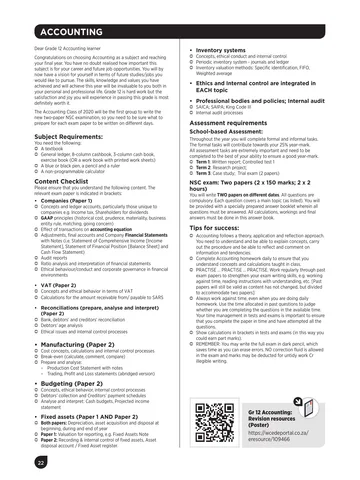
Accounting Grade 12 Paper 1 Gauteng Mock 2025 Memo (English)
Grade 12 Accounting Paper 1 memorandum from the Gauteng Mock Exam 2025 (English), 11 pages. Read online or download the free PDF.
Accounting · Grade 12 · Gauteng Mock Exam · 2025 · English. Memorandum, 11 pages. Read online or download the PDF.
- Subject
- Accounting
- Grade
- Grade 12
- Language
- English
- Document type
- Memorandum
- Year
- 2025
- Exam period
- Gauteng Mock Exam
- Paper
- 1
- Curriculum
- CAPS
- Pages
- 11
- File size
- 584.0 KB
Free to read online, no sign-up needed
Loading document…
Loading document…
1 of 11
This exam
Document textSearch extracted text and jump to a page.
10711/25
QUESTION 1
Do not accept abbreviations.
1.1 1.1.1 Current liabilities ✓
1.1.2 Statement of comprehensive income ✓
1.1.3 Financial assets ✓ 3
1.2.1 CORRECT NET PROFIT AFTER TAX FOR YEAR ENDED 30 JUNE 2025
Incorrect net profit before tax 1 153 150
Provision for bad debts – 7 350 ✓
Insurance + 12 000 ✓
Rent income [103 600/14] [7 400 + 500]
– 15 300 *#
(7 400 ✓✓ + 7 900 ✓)
Directors’ fees one mark one mark
– 85 000 *#
1 126 250 ✓ x [200/2 650] ✓ OR 1 126 250 – 1 211 250
Net profit before tax 1 057 500
Income tax [235 000 + 55 000] ignore sign/brackets – 290 000 ✓✓
Net profit after tax 767 500
check operation; Income tax must be subtracted 12
*one part correct, with correct sign; Accept the use of brackets for “-‘ sign
If sign incorrect, award full marks for workings
#If wrong, mark workings. Cannot get full marks if there is superfluous working
If a working is shown as a final answer, award working mark/s only
1.2.2 RETAINED INCOME NOTE
Balance at the beginning of the year 670 100
Net profit after tax see 1.2.1 767 500
Repurchase of shares (100 000 ✓ x 2,10 ✓) (210 000) *#
Ordinary share dividends (504 000)
Interim dividend 0
Final dividend (2 400 000 x 21/100) 504 000 ✓*
Balance at the end of the year 723 600
Check operation, shares repurchased and OSD must be subtracted 7
*one part correct
# ignore brackets
2
10711/25
STATEMENT OF FINANCIAL POSITION (BALANCE SHEET)
ON 30 JUNE 2025
ASSETS
NON-CURRENT ASSETS 10 999 000 *
Fixed assets [8 647 000 +1 352 000] 9 999 000
Fixed deposit [1 500 000 – 500 0] 4 1 000 000
CURRENT ASSETS TA - NCA 1 345 200
Inventory balancing figure 233 810
Trade and other receivables
(424 000 – 7 350 + 12 000 – 9 560 )) 419 090 *
Prov bd Insurance Transfer
Cash and cash equivalents (192 300 + 500 000) 692 300 *
TOTAL ASSETS see Total E+L 12 344 200
9
EQUITY AND LIABILITIES
SHAREHOLDERS' EQUITY operation 10 323 600
Ordinary share capital 9 600 000
Retained income see 1.2.2 2 723 600
NON-CURRENT LIABILITIES 984 000
Loan: XY Bank [1 800 000 – 546 000]
984 000 *
1 254 000 – 270 000 4
CURRENT LIABILITIES 1 036 600 *
Trade and other payables
(116 860 + 15 300 – 9 560 + 85 000 ) 207 600 *
Rent inc Transfer Dir. fees
Current portion of loan 270 000
Shareholders for dividends see 1.2.2 504 000 #
SARS (Income tax) 55 000 #
TOTAL EQUITY AND LIABILITIES SE + NCL + CL 9 12 344 200 28
* one part correct
# Inspect: if included in T&OP
- 1 foreign item (max -2); presentation -1 (max -1);
Note Principle 11 when awarding method marks: Operation as per candidate’s operation, unless specified.
TOTAL MARKS
50
3
10711/25
QUESTION 2
Do not accept abbreviations
2.1 2.1.1 Dividends ✓
2.1.2 inflow ✓
2.1.3 financing ✓ 3
2.2.1 Ordinary Share Capital Note on 31 May 2025
500 000 ✓ Ordinary shares at the beginning of year 5 160 000
300 000 ✓ New shares issued during year balancing figure
3 000 000
Check operation: repurchase must be subtracted
(95 000) ✓# Repurchased shares at R10,20 ✓ (969 000) *#
705 000 ✓ Shares at the end of the year 7 191 000 7
*one part correct
# ignore brackets
2.2.2 Calculate: Tax paid
WORKINGS ANSWER
37 600 + 553 000 – 111 000 479 600 *#
Ignore brackets
OR 111 000 – 553 000 – 37 600
4
Calculate: Dividends paid
WORKINGS ANSWER
# 48c – 28c (R224 000/800 000)
SfD o/balance + Interim div.
[500 000 x 22/100] [800 000 x #20/100] ] 270 000 *#
110 000 + 160 000 Both parts to be added
Ignore brackets
5
*one part correct
# Be alert to alternative workings such as ledger account or use of brackets or signs reversed.
Ensure that only one option is marked consistently
If a working/s amount is shown as a final figure, award the mark/s allocated.
4
10711/25
2.2.3 CASH FLOW FROM FINANCING ACTIVITIES
Proceeds from shares issued see 2.2.1 3 000 000 *
Repurchase of shares (1 140 000)*#
See OSC [ASP x 100/85] OR [10,20 + 1,80] If x Rep. shares
95 000 x R12 OR 969 000 + 171 000 (2.2.1)
Loan repaid [8 950 000 x 0,6]
(451 600)
5 821 600 – 5 370 000
6
*one part correct
If the correct amount is provided without workings or brackets, award all working marks only (not final mark)
NET CHANGE IN CASH AND CASH EQUIVALENTS 1 063 800 *
CASH AND CASH AT BEGINNING
(127 800)
[– 360 800 + 233 000]
CASH AND CASH AT END 936 000 4
*one part correct
2.2.4 The directors have identified options to fund R1,5 million needed to
import new products and expand the business, without increasing the
business’s risk in the next financial year.
What funding options can the company consider, avoiding additional
loans? Quote TWO sources with figures.
• Retained income – R1 759 000
2
• Income from shares issued – R3 000 000
5
10711/25
2.2.5 Calculate the following indicators for the year ended 31 May 2025:
% Net profit after tax on sales
WORKINGS ANSWER
1 633 100 x 100* 8,1%*
20 250 000 1 one part correct
% is not necessary
2
Net asset value per share
WORKINGS ANSWER
8 950 000 x 100* 1 270 cents *
705 000 1 Accept 1 269,5
one part correct
cents is not necessary
3
Dividends pay-out rate
WORKINGS ANSWER
(800 000 x 48/100) OR (224 000 + 160 000)
23,5% *
384 000 x 100* OR 0,48 x 100 one part correct
1 633 100 1 2,04 1 % is not necessary
4
• For EACH calculation, the ‘x 100’ is not ‘one part correct’
• Numerators and denominators must be marked as such.
• Do not award marks for any operations done to stand-alone figures e.g. no tick if anything else added to R8 950 000 or
R705 000 or R1 633 100.
TOTAL MARKS
40
6
10711/25
QUESTION 3
3.1 Profitability:
Quote TWO financial indicators with figures and trends of the company
which showed an improvement in their operating efficiency.
Financial indicators figures and trends
Nasha Ltd shows an improvement:
• % Operating expense on sales decreased (from 22%) to 18%/ by
4% points/by 18%
• % Net profit after tax on sales increased (from 13,1%) to 13,8%/ by 4
0,7% points/ by 5,3%
Do not accept mark-up %
3.2 Liquidity:
The directors of Dodo Ltd are concerned about stock control. Quote
ONE financial indicator and other relevant financial data to support this
concern.
Financial indicator ✓ financial data ✓ figures and trends ✓ ✓
• Stock turnover rate decreased (from 8,9 times) to 8,2 times/by 0,7 times.
• Trading stock deficit has increased (from R12 470) to R25 030/by
R12 560/ by 100,7%.
4
Identify the company that holds more stock. Show calculations and
explain using financial indicators.
Dodo Ltd
2,3 : 1 – 0,8 : 1 = 1,5 : 1 ✓
Nasha Ltd
1,9 : 1 – 1,1 : 1 = 0,8 : 1 ✓
Dodo Ltd is holding 0,7 : 1 more stock than Nasha Ltd. ✓ 3
3.3 Dividends pay-out policy:
Explain to Ben which company has accumulated sufficient money to
finance expansion in the upcoming financial year. Quote relevant
figures and provide a comparison to support your answer.
Nasha Ltd retains more profit ✓
• Dodo retains 3,4% (3%) of its earnings ✓✓
• Nasha retains 49,7% (50%) of its earnings ✓✓
For FIVE MARKS:
Nasha Ltd retains 46,3% (47%) more profit than Dodo Ltd. 5
7
10711/25
3.4 Share price on stock exchange:
Comment on the change of share price on the Johannesburg Security
Exchange (JSE) of each company at the end of financial year. Quote
figures and trends.
Comparison of MP to NAV ✓ ✓ figures ✓ ✓
• Market price of 720c is less than NAV of 792c
Dodo Ltd
For ONE mark:
• Market price decreased from 933 cents to 720 cents
• Market price of 1 320c is higher than NAV of 1 028c
Nasha Ltd For ONE mark:
• Market price increased from 1 123 cents to 1 320 cents 4
Provide ONE factor for each company which could have influenced
changes in their share price.
One valid explanation ✓ ✓
• Lack of investor confidence / A qualified audit report or
disclaimer of opinion may have raised concerns about
reliability of company's financial statements.
• Company’s shares are undervalued.
Dodo Ltd • Lack of growth or innovation may not excite the market
• There might be cash flow problems or high debt concerns.
• Ineffective leadership that affect strategic direction.
• Lack of innovation as compared to competitors.
• High demand of shares / unqualified report may increase
investor confidence
• There is significant growth prospects/potential expansion
• Consistent high earnings which increase investor demand
Nasha Ltd
• Positive confidence in leadership with future strategic
deals.
• Credibility of management with positive track record 2
3.5 Financing strategy:
The chief operating officer (COO) of Nasha Ltd persuaded the senior
management team to take a loan. Quote ONE financial indicator with
figures and trends to confirm this statement.
Financial indicator ✓ figures and trend ✓ ✓
• Debt equity ratio increased from 0,4 : 1 to 0,5 : 1 3
8
10711/25
3.6 Shareholding:
Calculate the total amount Ben received from selling his shares in
Dodo Ltd.
WORKINGS ANSWER
132 000 x 933/100 1 231 560
2
*one part correct
Calculate the additional amount, apart from the amount earned, from the
sale of his shares in Dodo Ltd, that Ben had to contribute to buy the
shares in Nasha Ltd.
WORKINGS ANSWER
[132 000 x 1 123/100] see above
1 482 360 – 1 231 560 250 800 *
4
Explain TWO benefits that Ben will lose after selling his shares in
Dodo Ltd.
Any TWO valid explanations ✓✓ ✓✓
• He will no longer be able to influence decisions
• He will not have the power to appoint or remove board of directors
• His voting power will be restricted
• Have no influence over company policies.
• Lose the privilege to access strategic updates. 4
• He will lose a portion dividends that he used to earn.
Ben’s shareholding % will change after buying additional shares in
Nasha Ltd. Explain TWO potential challenges or problems of being a
majority shareholder.
Any TWO valid explanations ✓✓ ✓✓
• Stand to be held more accountable to all stakeholders.
• Increased responsibility to make key decisions that affect company’s
future.
• Losing a significant amount of money when the company performs poorly. 4
• Decision made may benefit him personally but not the company..
• He may be blamed for poor company performance.
• Reputation is tied to the company’s public image.
• May be expected to inject capital during tough times.
9
10711/25
3.7 Success of a director:
Explain THREE essential qualities of a successful director in a profitable
company.
Any THREE valid explanations ✓✓ ✓✓ ✓✓ part marks for incomplete or unclear response
• Good leadership and management skills to guide the company towards
profitability and stability.
• Make strategic decisions that drive business growth and sustainability/
Understands core processes to guide in making informed decisions.
• Have a clear long-term vision for the company, identifying opportunities for
expansion and innovation.
• Make decisions that help build trust among stakeholders.
• Uphold high ethical standards/Acts honestly and in the best interest of the
company
• Understanding and implementing good corporate governance.
• Ensures the company operates responsibly with high ethical standards.
• Good communication skills that clearly conveys positive ideas.
• Understands company laws, compliance and governance.
• Familiar with market trends and day to day operations.
• Understands financial reporting better. 6
TOTAL MARKS
45
10
10711/25
QUESTION 4
4.1 4.1.1 External auditor ✓
4.1.2 International Financial Reporting Standards (IFRS) ✓ 2
4.2 Identify TWO corporate governance issues evident in the Kings Ltd case.
• Lack of transparency ✓
• Weak oversight/Lack of effective supervision ✓ 2
4.3 Provide TWO points indicating why transparency is crucial as an element
of ethics in corporate governance within a company.
Any TWO valid explanations ✓✓ ✓✓
• It ensures ethical practices are followed/It reduces unethical behaviour.
• It promotes trust among different stakeholders.
• It makes it easier for company to identify areas of improvement.
• Ensures stakeholders have same information.
• Eliminates unethical behaviour and financial misconduct. 4
• It prevents insider trading and protects minority shareholders.
• Company builds long term value and resilience.
• Identifies risk early and allows timely mitigation.
4.4 Explain TWO roles of an audit committee in preventing discrepancies in
financial reporting.
Any TWO valid explanations ✓✓ ✓✓ part marks for incomplete or unclear response
• They ensure the company adheres to Generally Accepted Accounting
Principles (GAAP)/IFRS to maintain integrity.
• They evaluate the company's internal controls to ensure accurate and
reliable financial reporting.
• They review audit findings and recommendations to ensure the accuracy
of financial reporting.
• They ensure the financial reports are accurate, complete, and comply with
relevant standards and regulations 4
4.5 List THREE consequences of poor corporate governance for a company
like Kings Ltd.
Any THREE valid explanations ✓ ✓ ✓
• Damage to the company’s reputation/Loss of customer loyalty.
• A significant drop in share value.
• Legal consequences, such as lawsuits and investigations.
• Improper financial management which will increase fraud or loss.
• It could affect long term success of the company negatively. 3
• Creditors may be reluctant to provide funding.
• Existing shareholders may sell their shares.
• Damage supplier trust resulting to stricter terms.
TOTAL MARKS 15
TOTAL: 150
11
Study this subject
Recommended for this subject
Addendum
Accounting Grade 12 P1 Eastern Cape June 2025 Addendum (Eng)
Question paper
Accounting Grade 12 P1 Eastern Cape June 2025 QP (Eng)
Addendum
Accounting Grade 12 P1 Gauteng June 2025 Addendum (English)
Addendum
Accounting Grade 12 Paper 1 NSC June 2025 Addendum (English)
Question paper
Accounting Grade 12 P1 NW June 2025 Question Paper (English)
Memorandum
Accounting Grade 12 Gauteng Mock 2015 Memo (English)
More from Grade 12 Accounting
Study guide
Accounting
Question paper
Accounting Grade 12 P2 Eastern Cape June 2025 QP (Eng)
Addendum
Accounting Grade 12 P2 Gauteng June 2025 Addendum (English)
Addendum
Accounting Grade 12 Paper 2 KZN June 2025 Addendum
Question paper
Accounting Grade 12 P1 Eastern Cape June 2024 QP (Eng)
Question paper