
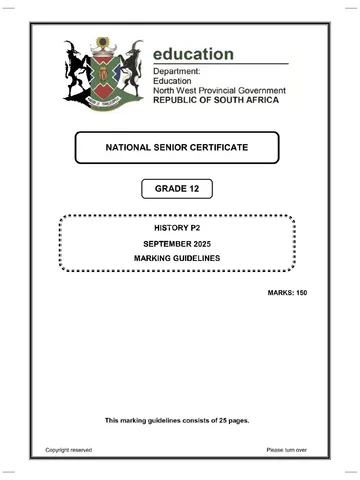
education
Department:
Education
North West Provincial Government
REPUBLIC OF SOUTH AFRICA
HISTORY P2
SEPTEMBER 2025
MARKS: 150
TIME: 3 hours
This question paper consists of 9 pages and an addendum of 14 pages.
Copyright reserved Please turn over
You're offline
Skip to contentQuestion paper 
%20SEP%202022%20Question%20Paper_hlayiso.com_--4ecf07fc-c5be-4181-868c-5e74b2676b7a/v1-37bffaf38506ee52a7a5/card.webp)
View all
History-Grade-12-NSC-P2-QP-September-2025-North-West.pdf
History · Grade 12 · North West Mock Exam · 2025. Question paper, 9 pages. Read online or download the PDF.
- Subject
- History
- Grade
- Grade 12
- Document type
- Question paper
- Year
- 2025
- Exam period
- North West Mock Exam
- Paper
- 2
- Pages
- 9
- File size
- 1.9 MB
Loading document…
Loading document…
1 of 9
Document textSearch extracted text and jump to a page.
NW/September 2025
INSTRUCTIONS AND INFORMATION
1. This question paper consists of SECTION A and SECTION B based on the
prescribed content framework in the CAPS document.
SECTION A: SOURCE-BASED QUESTIONS
QUESTION 1: CIVIL RESISTANCE, 1970s TO 1980s: SOUTH
AFRICA
QUESTION 2: THE COMING OF DEMOCRACY TO SOUTH AFRICA
AND COMING TO TERMS WITH THE PAST
QUESTION 3: THE END OF THE COLD WAR AND A NEW WORLD
ORDER, 1989 TO THE PRESENT
SECTION B: ESSAY QUESTIONS
QUESTION 4: CIVIL RESISTANCE. 1970s TO 1980s: SOUTH AFRICA:
THE CRISIS OF APARTHEID IN THE 1980s.
QUESTION 5: THE COMING OF DEMOCRACY TO SOUTH AFRICA
AND COMING TO TERMS WITH THE PAST
QUESTION 6: THE END OF THE COLD WAR AND A NEW WORLD
ORDER: THE EVENTS OF 1989
2. SECTION A consists of THREE source-based questions Source material
that is required to answer these questions can be found in the ADDENDUM.
Ss SECTION B consists of THREE essay questions.
4. Answer THREE questions as follows:
4.1 Atleast ONE must be a source-based question and at least ONE
must be an essay question.
4.2 The THIRD question can be either a source-based question or an
essay question.
5. You are advised to spend at least ONE hour per question.
6. When answering questions, candidates should apply their knowledge, skills
and insight.
7. You will be disadvantaged by merely rewriting the sources as answers.
8. Number the answers correctly according to the numbering system used in
this question paper.
9. Write neatly and legibly.
Copyright reserved Please turn over
NW/September 2025
SECTION A: SOURCE-BASED QUESTIONS
Answer at least ONE question, but not more than TWO questions, in this SECTION.
Source material to be used to answer these questions is contained in the
ADDENDUM.
QUESTION 1: WHAT ROLE DID THE UNITED DEMOCRATIC FRONT (UDF)
PLAY TO RESIST PW BOTHA’S REFORMS OF APARTHEID IN
THEN 1980s?
Study Sources 1A, 1B, 1C and 1D and answer the questions that follow.
1.1
12
1.3
14
Read Source 1A.
1.1.1. Why, according to the source, did people across South Africa organise
community based groups? (T1)
1.1.2 Identify TWO groups from the source that formed the community-
based groups. (2x 1)
1.1.3 Define the concept tri-cameral parliament in your own words. (1 x 2)
1.1.4 Using the information in the source and your own knowledge, explain
why the United Democratic Front was formed. (2 x 2)
Refer to Source 1B.
1.2.1 State THREE challenges that brought together the coalition groups
and organisation under the UDF’s struggle against apartheid. (3 x 1)
1.2.2 Quote any TWO objectives of the UDF from the source. (2x 1)
1.2.3 Comment on why you think Allan Boesak was critical of the apartheid
government. (2 x 2)
1.2.4 Why would a historian regard the source as reliable when researching
the reasons for the formation of the United Democratic Front. (2 x 2)
Consult Source 1C.
1.3.1. Why you think the UDF decided to produce this poster?.
(2 x 2)
1.3.2 Using the information in the source and your own knowledge, comment
on why the elections were regarded as the “Apartheid Elections”.
(2 x 2)
Refer to Sources 1A and 1C. Explain how the information in Source 1A
supports the evidence in Source 1C regarding the UDF’s anti-apartheid
activities in the 1980s. (2 x 2)
Copyright reserved Please turn over
(1)
(2)
(2)
(4)
(3)
(2)
(4)
(4)
(4)
(4)
(4)
NW/September 2025
1.5 Use Source 1D.
1.5.1. Name TWO entities from which the UDF gained considerable support
in their struggle against apartheid. (2x1) (2)
1.5.2 Using the information in the source and your own knowledge, explain
why you think the South African (apartheid) government declared a
state of emergency in the 1980s. (2x2) (4)
1.5.3 Explain the concept state of emergency in the context of the
government's reaction to internal resistance. (1x2) (2)
1.6 Using the information in the relevant sources and your own knowledge, write
a paragraph of about EIGHT lines (about 80 words) explaining the role played
by the United Democratic Front (UDF) to resist PW Botha’s reforms of
apartheid in the 1980s. (8)
[50]
Copyright reserved Please turn over
NW/September 2025
QUESTION 2: HOW SUCCESSFUL WAS THE TRUTH AND RECONCILIATION
COMMISSION (TRC) IN ADDRESSING CRAIG WILLIAMSON'S
APPLICATION FOR AMNESTY?
Study sources 2A, 2B, 2C and 2D and answer the questions that follow.
2.1 Refer to Source 2A.
aA
2.1.2
2.1.3
When, according to the source was the TRC established? (1x 1)
Identify the FOUR reasons for the formation of the TRC. (4x 1)
Explain why you think ‘Mandela was obliged to concede’ that a
guarantee of amnesty be written into the new constitution. (2 x 2)
2.2 Consult Source 2B
2.2.1
2.2.2
2.2.3
2.2.4
2:25
Define the concept assassination in your own words. (1 x 2)
Comment on the significance of the TRC conducting the amnesty
hearing despite the murders taking place beyond the country’s
borders. (1 x 2)
Using information in the source and your own knowledge, explain why
the apartheid government had Ruth First and Katryn Schoon
assassinated. (2 x 2)
Identify THREE piece of evidence to support the TRC’s decision to
grant Williamson amnesty. (3 x 1)
Quote from the source specific ways in which the killings were intended
to affect the ANC and SACP. (1 x 2)
2.3 Read Source 2C.
2.3.1
2.3.2
2.3.3
Explain the term amnesty in the context of the framework of the TRC.
(1 x 2)
Comment on the significance of Craig Williamson’s words, “I swear to
tell just enough truth as | think will be required to buy me amnesty”,
regarding his motivations in applying for amnesty. (2 x 2)
Using the information in the source and your own knowledge, explain
why a historian would find the source useful when researching the
portrayal of the amnesty process at TRC. (2 x 2)
Copyright reserved Please turn over
(1)
(4)
(4)
(2)
(2)
(4)
(3)
(2)
(2)
(4)
(4)
NW/September 2025
2.4 Study Source 2D.
2.4.1. What do you think is the significance of seeking judicial review on
behalf of the Schoon family? (1x2) (2)
2.4.2 According to the source, who were granted amnesty by the TRC?
(2x1) (2)
2.4.3. Explain what is implied by the reaction of local radio station
presenters and the dedication of songs to the victims’ families
following the announcement of amnesty. (1x2) (2)
2.5 Consult Sources 2C and 2D. Comment on how the evidence in Source 2C
supports the information in Source 2D regarding Craig Williamson’s
representation at his amnesty hearings. (2x2) (4)
2.6 Using the information in the relevant sources and your own knowledge, write
a paragraph of about EIGHT lines (about 80 words) explaining how successful
the TRC was in addressing Craig Williamson’ application for amnesty. (8)
[50]
Copyright reserved Please turn over
NW/September 2025
QUESTION 3: HOW DID STRUCTURAL ADJUSTMENT PROGRAMMES (SAP)
AFFECT THE ECONOMIES OF DEVELOPING NATIONS?
Study Source 3A, 3B, 3C and 3D and answer the questions that follow.
3.1 Refer to Source 3A.
3.1.1. Define the term globalisation in your own words.
(1x2)
3.1.2 Identify the TWO financial institutions that were the driving force behind
globalisation.
(2x1)
3.1.3. Using the information in the source and your own knowledge, explain
the relationship between globalisation and democracy.
(2x 2)
3.1.4 Explain why you think the adoption of the trade liberation would have
assisted developing countries to grow their economies.
3.2 Consult Source 3B.
(1 x 2)
3.2.1 Give TWO reasons from the source for the implementation of the
Structural Adjustment Policies.
(2x1)
3.2.2 What, according to the source, contributed to poverty and dependency
of developing countries on powerful nations?
3.2.3. How, according to the source, did developing countries
3.3. Study Source 3C.
3.3.1 Explain the messages conveyed by the cartoon.
(1x 2)
grow richer?
(1x 2)
(2x 2)
3.3.2 Name any FOUR of the SIX commandments of the IMF to be
followed by developing countries when borrowing money.
(4x 1)
3.3.3. Comment on the limitations of this source for a historian researching
the IMF and its contribution on poverty alleviation.
(2x 2)
3.4 Refer Sources 3B and 3C. Explain how the information in Source 3B supports
the evidence in Source 3C regarding how Structural Adjustment Programmes
like the IMF dealt with developing countries.
Copyright reserved
(2 x 2)
Please turn over
(2)
(2)
(4)
(2)
(2)
(2)
(2)
(4)
(4)
(4)
(4)
NW/September 2025
3.5 Use Source 3D.
3.5.1. Explain the term economic renaissance in the context of the global
capitalism in Africa. (1x2) (2)
3.5.2 Using information in the source and your own knowledge, explain
why the IMF was seen as having failed in Africa. (2x2) (4)
3.5.3. Comment on why you think debt cancellation for countries in Africa
became a necessity. (2x2) (4)
3.6 Using the information in the relevant sources and your own knowledge, write
a paragraph of about EIGHT lines (about 80 words) explaining how the
Structural Adjustment Programmes (SAPs) affected the economies of
developing countries. (8)
[50]
Copyright reserved Please turn over
NW/September 2025
SECTION B: ESSAY QUESTIONS
Answer at least ONE question, but not more than TWO questions, in this section.
Your essay should be about THREE pages long.
QUESTION.4: CIVIL RESISTANCE, 1970s TO 1980s: SOUTH AFRICA
Explain to what extent did the philosophy of the Black Consciousness Movement
influenced students of Soweto to challenge the apartheid regime in the 1970s.
Use relevant historical evidence to support your line of argument. [50]
QUESTION 5: THE COMING OF DEMOCRACY TO SOUTH AFRICA AND
COMING TO TERMS WITH THE PAST
‘South Africa’s road to democracy was affected with various challenges, problems
and obstacles. It was the spirit of intense negotiations, resolute (firm) leadership and
commitment to democracy that eventuaily led to the birth a democratic dispensation
in 1994’.
Do you agree with this statement? Use relevant historical evidence to support your
line of argument. [50]
QUESTION 6: THE END OF THE COLD WAR AND A NEW WORLD ORDER
Mikhail Gorbachev's policies of perestroika and glasnost were directly responsible
for the political and economic transformation that occurred in South Africa after the
1990s.
Critically discuss this statement. Support your line of argument with relevant
historical evidence. [50]
TOTAL: 150
Copyright reserved
Recommended for this subject
Published documents with matching subject and grade metadata.
Question paper
History-Grade-12-NSC-P1-QP-September-2025-Mpumalanga.pdf
Question paper
HISTORY P2 GR12 QP SEPT 2024_Afrikaans_hlayiso.com_.pdf
Question paper
Gr 12 History P2 (Afrikaans) 2024 Question Paper X05_hlayiso.com_.pdf
Question paper
Gr 12 History P2 (Afrikaans) June 2024 Question Paper_hlayiso.com_.pdf
Question paper
HISTORY P2 GR12 QP JUNE 2023_Afrikaans_hlayiso.com_.pdf
Question paper
History P2 Nov 2023 Afr_hlayiso.com_.pdf
Related documents
Matched using subject, grade, language, document type and exam metadata.
Memorandum
History-Grade-12-NSC-P2-MEMO-September-2025-North-West.pdf
Question paper
NW NSC HISTORY P2 AFR SEPT 2019_hlayiso.com_.pdf
Addendum
History-Grade-12-NSC-P2-ADDENDUM-September-2025-Mpumalanga.pdf
Question paper
Gr12 History P2 (English) SEP 2022 Question Paper_hlayiso.com_.pdf
Question paper
History P2 May June 2022 Afr_hlayiso.com_.pdf
Question paper
History P2 Add June 2021 English_hlayiso.com_.pdf
More from Grade 12 History
Explore more published documents in this catalogue.
Memorandum
History P1 May-June 2025 MG Eng.pdf
Addendum
HISTORY P1 ADDEN GR12 SEP 2024_Afrikaans_hlayiso.com_.pdf
Addendum
HISTORY P2 GR12 ADDENDUM SEPT 2024_Afrikaans_hlayiso.com_.pdf
Memorandum
HISTORY P1 MEMO GR12 SEPT2024_ Afrikaans_hlayiso.com_.pdf
Addendum
HISTORY P2 GR12 ADDENDUM JUNE 2024_Afrikaans_hlayiso.com_.pdf
Addendum