
Downloaded from hlayiso.com
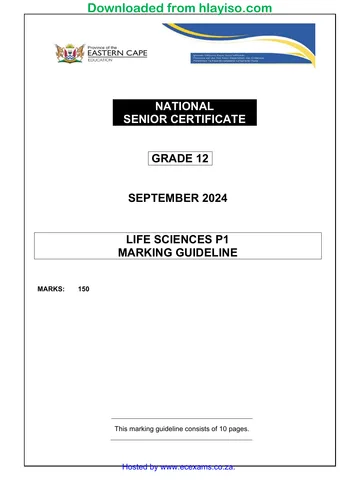
NATIONAL
SENIOR CERTIFICATE
GRADE 12
SEPTEMBER 2020
LIFE SCIENCES P2
MARKING GUIDELINE
MARKS: 150
This marking guideline consists of 10 pages.
Skip to contentAll 2020 papers 
View all
Life Sciences Grade 12 P2 Eastern Cape Mock 2020 Memo (Eng)
Grade 12 Life Sciences Paper 2 memorandum from the Eastern Cape Mock Exam 2020 (English), 10 pages. Read online or download the free PDF.
Life Sciences · Grade 12 · Eastern Cape Mock Exam · 2020 · English. Memorandum, 10 pages. Read online or download the PDF.
- Subject
- Life Sciences
- Grade
- Grade 12
- Language
- English
- Document type
- Memorandum
- Year
- 2020
- Exam period
- Eastern Cape Mock Exam
- Paper
- 2
- Curriculum
- CAPS
- Pages
- 10
- File size
- 273.3 KB
Free to read online, no sign-up needed
Loading document…
Loading document…
1 of 10
This exam
Eastern Cape Mock Exam 2020
Questions in this paper
Document textSearch extracted text and jump to a page.
Downloaded from hlayiso.com
2 LIFE SCIENCES P2 (EC/SEPTEMBER 2020)
PRINCIPLES RELATED TO MARKING LIFE SCIENCES
1. If more information than marks allocated is given
Stop marking when maximum marks is reached and put a wavy line and ‘max’ in
the right-hand margin.
2. If, for example, three reasons are required and five are given
Mark the first three irrespective of whether all or some are correct/incorrect.
3. If whole process is given when only a part of it is required
Read all and credit the relevant part.
4. If comparisons are asked for but descriptions are given
Accept if the differences/similarities are clear.
5. If tabulation is required but paragraphs are given
Candidates will lose marks for not tabulating.
6. If diagrams are given with annotations when descriptions are required
Candidates will lose marks.
7. If flow charts are given instead of descriptions
Candidates will lose marks.
8. If sequence is muddled and links do not make sense
Where sequence and links are correct, credit. Where sequence and links are
incorrect, do not credit. If sequence and links become correct again, resume
credit.
9. Non-recognised abbreviations
Accept if first defined in answer. If not defined, do not credit the unrecognised
abbreviation but credit the rest of the answer if correct.
10. Wrong numbering
If answer fits into the correct sequence of questions but the wrong number is
given, it is acceptable.
11. If language used changes the intended meaning
Do not accept.
12. Spelling errors
If recognisable, accept the answer, provided it does not mean something else in
Life Sciences or if it is out of context.
13. If common names are given in terminology
Accept, provided it was accepted at the national memo discussion meeting.
14. If only the letter is asked for but only the name is given (and vice versa)
Do not credit.
Copyright reserved Please turn over
Downloaded from hlayiso.com
(EC/SEPTEMBER 2020) LIFE SCIENCES P2 3
15. If units are not given in measurements
Candidates will lose marks. Marking guideline will allocate marks for units
separately.
16. Be sensitive to the sense of an answer, which may be stated in a
different way.
17. Caption
All illustrations (diagrams, graphs, tables, etc.) must have a caption.
18. Code-switching of official languages (terms and concepts)
A single word or two that appear(s) in any official language other than the
learners' assessment language used to the greatest extent in his/her answers
should be credited if it is correct. A marker that is proficient in the relevant official
language should be consulted. This is applicable to all official languages.
Copyright reserved Please turn over
Downloaded from hlayiso.com
4 LIFE SCIENCES P2 (EC/SEPTEMBER 2020)
SECTION A
QUESTION 1
1.1 1.1.1 A
1.1.2 C
1.1.3 D
1.1.4 D
1.1.5 A
1.1.6 B
1.1.7 C
1.1.8 B
1.1.9 B
1.1.10 A (10 x 2) (20)
1.2 1.2.1 alleles
1.2.2 double helix
1.2.3 interphase
1.2.4 population
1.2.5 Prophase I
1.2.6 phylogenetic tree / cladogram
1.2.7 biogeography
1.2.8 extinction (8)
1.3 1.3.1 A only
1.3.2 Both A and B
1.3.3 Both A and B (3 x 2) (6)
1.4 1.4.1 James Watson, Francis Crick (2)
1.4.2 Double helix (1)
1.4.3 - DNA codes for the formation of different proteins required in the
body
- DNA is responsible for transmitting hereditary characteristics (2)
1.4.4 Nucleus
Mitochondrion (2)
1.4.5 Maurice Wilken (1)
(8)
1.5 1.5.1 Dihybrid cross (1)
1.5.2 (a) red (1)
(b) ffhh (2)
(c) red, tall (2)
(d) FH, Fh, fH, fh (1-3 correct, 4 correct ) (2)
(8)
TOTAL SECTION A: 50
Copyright reserved Please turn over
Downloaded from hlayiso.com
(EC/SEPTEMBER 2020) LIFE SCIENCES P2 5
QUESTION 2
2.1 2.1.1 Protein Synthesis (1)
2.1.2 cytoplasm /outside the nucleus (1)
2.1.3 (a) DNA (1)
(b) polypeptide chain /protein (1)
2.1.4 UGU (2)
2.1.5 ACG (1)
2.1.6 CCA (2)
2.1.7 Lysine (1)
2.1.8 If base sequence was UUU instead of AAA then:
- anticodon on tRNA would be AAA
- therefore amino acid would be Phenylanine
- instead of Lysine (3)
(13)
2.2 2.2.1 pedigree diagram (1)
2.2.2 (a) Blue skin female (1)
(b) Nn (1)
2.2.3 recessive allele (1)
2.2.4 Mabala and Maurice are both normal but their son Lunar has blue
skin therefore, Mabala and Maurice are carriers of the disease
OR
Cletus and Ben are heterozygous and does not have the
disease/is normal (2)
2.2.5
P1 Phenotype Normal skin male x Normal skin female
Genotype Nn x Nn
Meiosis
G/gametes N, n x N, n
Fertilisation
F1 Genotype NN ; Nn ; Nn ; nn
Phenotype 3 Normal and 1 blue skin
They have a 25% * chance of having a child with blue skin
P1 and F1
Meiosis and fertilisation
1 compulsory* + Any 6
Copyright reserved Please turn over
Downloaded from hlayiso.com
6 LIFE SCIENCES P2 (EC/SEPTEMBER 2020)
OR
P1 Phenotype Normal male x Normal female
Genotype Nn x Nn
Meiosis
G/gametes N, n x N, n
Fertilisation Gametes N n
F1 N NN Nn
n Nn nn
Correct genotypes
Phenotype 3 Normal and 1 blue skin
They have a 25% * chance of having a child with blue skin
P1 and F1
Meiosis and fertilization
1 compulsory* + Any 6 (7)
2.3 2.3.1 - In the original population of Antarctic fish there was variation
- Some fish produced the antifreeze protein while others did not
- Those that did not produce antifreeze protein did not survive the
icy, freezing waters
- Those that produced antifreeze survived the icy, freezing waters
- They reproduced and past on their characteristic to the next
generation
- And eventually over time the number of antifreeze producing fish
in the population increased (Any 5 x 1) (5)
2.3.2 Genetic Modification (1)
2.3.3 - Engineer cold resistant plants
- preserving food at very low temperatures (2)
2.3.4 - The gene coding for antifreeze protein production is isolated from
a fish cell
- The gene is cut out using restriction enzymes
- A bacterial plasmid is removed and is cut open using restriction
enzymes
- The antifreeze producing gene is inserted into the plasmid
- The genetically modified plasmid is returned to the bacterium
- The bacterium multiplies and all of the offspring have the gene for
antifreeze protein production
- The bacteria produce anti-freeze (Any 5) (5)
2.3.5 - People who are allergic to fish proteins may not know that the plant
contains it and will therefore be at risk.
- Vegans and vegetarians may not want to eat animal products and
will be forced to if it is in plants
Mark first ONE only (Any 1) (1)
[40]
Copyright reserved Please turn over
Downloaded from hlayiso.com
(EC/SEPTEMBER 2020) LIFE SCIENCES P2 7
QUESTION 3
3.1 3.1.1 Co-dominance (1)
3.1.2 Both alleles are expressed in the offspring’s phenotype (2)
3.1.3
Genotype RR RB BB
Number of offspring 5 10 5
OR
Genotype Number of offspring
RR 5
RB 10
BB 5
Guidelines for assessing the table
Correct table format 1
(separation of columns)
Column headings 2
Data entered 1 : 1 to 2 sets correctly entered
2 : All 3 data sets correctly entered (5)
3.1.4 Both parents have a Phenotype – Red and Genotype – RR (2)
3.2 3.2.1 (a) Increase in Muscle Protein Synthesis (1)
(b) Amount of protein (1)
3.2.2 - Get permission from participants / doctor
- Determine how to measure MPR / how data will be collected
- Train data collectors on how to measure MPR
- Determine sample size
Mark first TWO only (Any 2) (2)
3.2.3 - It had a large sample size /100 participants
- It obtained similar results to two other investigations (2)
3.2.4 Percentage increase
1
= x 100 = 9,09% (2)
11
3.2.5 - There is very little increase in MPR from 20 g to 40 g
- therefore you will gain very little for double the amount of protein (2)
(10)
Copyright reserved Please turn over
Downloaded from hlayiso.com
8 LIFE SCIENCES P2 (EC/SEPTEMBER 2020)
3.3 3.3.1 Stem cell are undifferentiated cells that has the potential to form any
tissue of organ (2)
3.3.2 Cord blood, umbilical cord blood
Bone marrow
Blood, peripheral blood stem cells
Menstrual blood OR Adult stem cells
Skin
Teeth
Placental tissue
(Any 2) (2)
3.3.3 Spinal cord injuries /neurodegenerative diseases (Parkinson’s
disease / Alzheimer’s disease / Amyotrophic lateral sclerosis) (Any 1) (1)
3.4 3.4.1 There are 3 alleles / more than two for blood groups A, B and O (2)
3.4.2 I BI B
I Bi (2)
3.4.3 If the man was IBi and the woman was IAi then they would both pass
the recessive allele/I to their child. (3)
3.4 3.5.1 - All elephants had short trunks / noses
- They frequently stretched their trunk / nose to reach for leaves in the
trees
- As a result, their trunks became longer
- The characteristic for long trunks acquired in this way was then passed
on to the next generation
- Eventually all elephants had long trunks (5)
3.5.2 - Organisms evolved, not because they wanted to evolve but because
changes took place randomly, in response to the environment
- There is very little evidence to support Lamarck’s idea that changes
brought about by adaptation to the environment are inherited from
parent to offspring (2)
3.5.3 Characteristics are past from parents to offspring (1)
[40]
TOTAL SECTION B: 80
Copyright reserved Please turn over
Downloaded from hlayiso.com
(EC/SEPTEMBER 2020) LIFE SCIENCES P2 9
SECTION C
QUESTION 4
Composition of karyotype
- There are 23 pairs /46 chromosomes in
- human somatic cells /body cells
- which are arranged into homologous pairs
- Each somatic cell has 22 pairs/44 autosomes and
- a pair/2 gonosomes /sex chromosomes/ X and Y chromosome
- Autosomes are arranged in pairs from largest to smallest in a karyotype
- Males have XY chromosomes
- Females have XX chromosomes
- The X chromosome is larger than the Y chromosome (Any 6) (6)
Importance of meiosis
- Production of haploid gametes
- Halving effect overcomes the doubling effect of fertilization
- Thus, maintaining a constant chromosome number
- Introduces variation (Any 3) (3)
Effect of non-disjunction in humans
- Humans may be affected by aneuploidy
- Aneuploidy/Non-disjunction occurs when chromosomes do not separate
- during anaphase
- During anaphase 1 a single pair of homologous chromosomes do not separate
- Or during anaphase 2 chromatids do not separate
- One gamete will receive two copies of the same chromosome
- While the other gamete will receive none
- If fertilisation occurs between the abnormal gamete and a normal gamete the
resulting cell / zygote will have one less chromosome / the zygote will be
monosomic
- Or the zygote may have an extra chromosome / the zygote will be trisomic
- Down Syndrome / Trisomy 21 is an example of aneuploidy in humans
(Any 8) (8)
Copyright reserved Please turn over
Downloaded from hlayiso.com
10 LIFE SCIENCES P2 (EC/SEPTEMBER 2020)
ASSESSING THE PRESENTATION OF THE ESSAY
Criterion Relevance (R) Logical sequence (L) Comprehensive (C)
Generally All information provided Ideas are arranged in a All aspects required by
is relevant to the logical/cause-effect the essay have been
question sequence sufficiently addressed
In this Only information All the information At least:
essay in relevant to the regarding the
Q4 description of: 4/6 for composition of
- Composition of karyotype
- Composition of karyotype, importance of 2/3 for importance of
karyotype, importance meiosis and effect of meiosis
of meiosis and effect non-disjunction 6/8 for effect of non-
of non-disjunction disjunction
Is given in a logical
There is no irrelevant manner
information
Mark 1 1 1
Content 17
Synthesis 3
TOTAL SECTION C: 20
GRAND TOTAL: 150
Copyright reserved Please turn over
Study this subject
Recommended for this subject
Question paper
Life Sciences Grade 12 P2 Eastern Cape Mock 2022 QP (Eng)
Question paper
Life Sciences Grade 12 P2 Eastern Cape Mock 2019 QP (Eng)
Question paper
Life Sciences Grade 12 P2 Eastern Cape Mock 2018 QP (Eng)
Memorandum
Life Sciences Grade 12 P2 Gauteng Prelim 2024 Memo (English)
Memorandum
Life Sciences Grade 12 P2 Gauteng Mock 2022 Memo (English)
Memorandum
Life Sciences Grade 12 P2 Eastern Cape Mock 2015 Memo (Afr)
More from Grade 12 Life Sciences
Question paper
Life Sciences Grade 12 Eastern Cape June 2025 QP (Eng)
Question paper
Life Sciences Grade 12 KZN March Test 2025 Question Paper
Memorandum
Life Sciences Grade 12 Paper 2 Mpumalanga Mock 2025 Memo
Question paper
Life Sciences Grade 12 P1 Mpumalanga Mock 2025 QP
Question paper
Life Sciences Grade 12 P1 North West Mock 2025 QP
Memorandum