
Downloaded from hlayiso.com
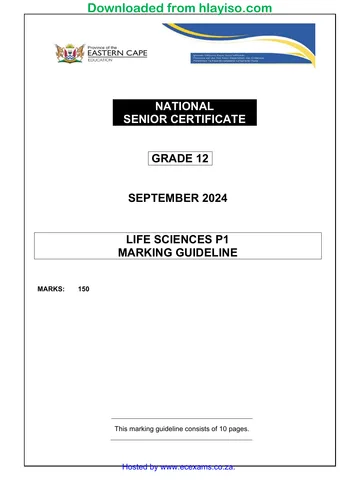
NATIONAL
SENIOR CERTIFICATE
GRADE 12
SEPTEMBER 2022
LIFE SCIENCES P2
MARKING GUIDELINE
MARKS: 150
This marking guideline consists of 10 pages.
Skip to contentAll 2022 papers 
View all
Life Sciences Grade 12 P2 Eastern Cape Mock 2022 Memo (Eng)
Grade 12 Life Sciences Paper 2 memorandum from the Eastern Cape Mock Exam 2022 (English), 10 pages. Read online or download the free PDF.
Life Sciences · Grade 12 · Eastern Cape Mock Exam · 2022 · English. Memorandum, 10 pages. Read online or download the PDF.
- Subject
- Life Sciences
- Grade
- Grade 12
- Language
- English
- Document type
- Memorandum
- Year
- 2022
- Exam period
- Eastern Cape Mock Exam
- Paper
- 2
- Curriculum
- CAPS
- Pages
- 10
- File size
- 207.5 KB
Free to read online, no sign-up needed
Loading document…
Loading document…
1 of 10
This exam
Questions in this paper
Document textSearch extracted text and jump to a page.
Downloaded from hlayiso.com
2 LIFE SCIENCES P2 (EC/SEPTEMBER 2022)
PRINCIPLES RELATED TO THE MARKING OF LIFE SCIENCES
1. If more information than marks allocated is given
Stop marking when maximum marks is reached and put a wavy line and ‘max.’
in the right-hand margin.
2. If, for example, three reasons are required and five are given
Mark the first three irrespective of whether all or some are correct/incorrect.
3. If whole process is given when only a part of it is required
Read all and credit the relevant parts.
4. If comparisons are asked for but descriptions are given
Accept if the differences/similarities are clear.
5. If tabulation is required but paragraphs are given
Candidates will lose marks for not tabulating.
6. If diagrams are given with annotations when descriptions are required
Candidates will lose marks.
7. If flow charts are given instead of descriptions
Candidates will lose marks.
8. If sequence is muddled and links do not make sense
Where sequence and links are correct, credit. Where sequence and links are
incorrect, do not credit. If sequence and links become correct again, resume
credit.
9. Non-recognised abbreviations
Accept if first defined in answer. If not defined, do not credit the unrecognised
abbreviation but credit the rest of the answer if correct.
10. Wrong numbering
If answer fits into the correct sequence of questions but the wrong number is
given, it is acceptable.
11. If language used changes the intended meaning
Do not accept.
12. Spelling errors
If recognisable, accept the answer, provided it does not mean something else
in Life Sciences or if it is out of context.
13. If common names are given in terminology
Accept, provided it was accepted at the national memo discussion meeting.
14. If only the letter is asked for but only the name is given (and vice versa)
Do not credit.
Copyright reserved Please turn over
Downloaded from hlayiso.com
(EC/SEPTEMBER 2022) LIFE SCIENCES P2 3
15. If units are not given in measurements
Candidates will lose marks. Marking guideline will allocate marks for units
separately.
16. Be sensitive to the sense of an answer, which may be stated in a different
way.
17. Caption
All illustrations (diagrams, graphs, tables, etc.) must have a caption.
18. Code-switching of official languages (terms and concepts)
A single word or two that appear(s) in any official language other than the
learners’ assessment language used to the greatest extent in his/her answers
should be credited, if it is correct. A marker that is proficient in the relevant
official language should be consulted. This is applicable to all official languages.
Copyright reserved Please turn over
Downloaded from hlayiso.com
4 LIFE SCIENCES P2 (EC/SEPTEMBER 2022)
SECTION A
QUESTION 1
1.1 1.1.1 A ✓✓
1.1.2 C ✓✓
1.1.3 B ✓✓
1.1.4 C ✓✓
1.1.5 C ✓✓
1.1.6 A ✓✓
1.1.7 A ✓✓
1.1.8 D ✓✓
1.1.9 A ✓✓
1.1.10 D ✓✓ (10 x 2) (20)
1.2 1.2.1 Chiasma ✓/ chiasmata
1.2.2 Gene ✓
1.2.3 Interphase ✓
1.2.4 Mitochondrial DNA ✓
1.2.5 DNA profile ✓
1.2.6 Punctuated equilibrium ✓
1.2.7 Population ✓
1.2.8 (Biological) evolution ✓ (8 x 1) (8)
1.3 1.3.1 A only ✓✓
1.3.2 B only ✓✓
1.3.3 B only ✓✓ (3 x 2) (6)
1.4 1.4.1 4✓ (1)
1.4.2 (a) Male without albinism ✓ (1)
(b) nn ✓✓ (2)
(c) Nn ✓✓ (2)
1.4.3 75 ✓✓% (2)
1.5 1.5.1 (Double) Helix ✓ (1)
1.5.2 (a) Deoxyribose ✓ (1)
(b) Adenine ✓ (1)
(c) Hydrogen ✓ bond (1)
1.5.3 • Double stranded ✓
• Has thymine ✓ not uracil
• Nitrogenous bases are in pairs ✓ (Any 2 x 1)
(Mark first TWO only) (2)
1.5.4 Nucleus ✓
Mitochondrion ✓
(Mark first TWO only) (2)
TOTAL SECTION A: 50
Copyright reserved Please turn over
Downloaded from hlayiso.com
(EC/SEPTEMBER 2022) LIFE SCIENCES P2 5
QUESTION 2
2.1 2.1.1 GGG - CCA- AGU ✓✓ (ALL or NONE) (2)
2.1.2 Glycine ✓ - Proline ✓ - Serine ✓ (3)
2.1.3 • The codon would change to UGG ✓
• The anticodon with ACC ✓
• will bring the tryptophan ✓
• instead of glycine ✓
• sequence of amino acids will change ✓ /a different protein will
form (Any 4 x 1) (4)
2.1.4 • Each tRNA carries a specific amino acid ✓
• to the codon on the mRNA ✓/ ribosome (2)
2.1.5 DNA Replication Transcription
Two DNA strands are used as One DNA strand is used as
template ✓ template ✓
Free DNA nucleotides join ✓ to Free RNA nucleotides join ✓ to
DNA template DNA template
Whole DNA unwinds A part of DNA unwinds
A pairs with T A pairs with U
Table ✓
Mark first TWO only (Any 2 x 2 + 1) (5)
2.2 2.2.1 The number and appearance/type of chromosomes in the cell of an
organism. ✓✓ (2)
2.2.2 8✓ (1)
2.2.3 • Females are XX ✓
• and males are XY ✓ (2)
2.3 2.3.1 • When two homozygous organisms with contrasting characteristics
are crossed, ✓
• all the individuals of the F1 generation will display the dominant
trait ✓
OR
• An individual that is heterozygous for a particular characteristic ✓
• will have the dominant trait as the phenotype ✓ (Any 1 x 2) (2)
Copyright reserved Please turn over
Downloaded from hlayiso.com
6 LIFE SCIENCES P2 (EC/SEPTEMBER 2022)
2.3.2 P1 Phenotype Red-eyed x White-eyed male ✓
female
Genotype XR Xr ✓ x Xr Y ✓
Meiosis
G/gametes XR , Xr x Xr , Y✓
Fertilisation
F1 Genotype XR Xr ; XR Y ; Xr Xr ; Xr Y ✓*
Phenotype 1 Red-eyed female : 1 red-eyed male:
1 white-eyed female : 1 white-eyed male ✓*
P1 and F1 ✓
Meiosis and fertilisation ✓ (Any 5 + *2 Compulsory)
OR
P1 Phenotype Red eyed x White eyed male ✓
female
Genotype XR Xr ✓ x Xr Y ✓
Meiosis
G/gametes XR, Xr x Xr, Y✓
Gametes Xr Y
Fertilisation XR
XR Xr XR Y
F1 Xr Xr Xr Xr Xr
Correct genotypes ✓*
Phenotype 1 Red eyed female: 1 red eyed male:
1 white eyed female: 1 white eyed male ✓*
P1 and F1 ✓
Meiosis and fertilisation ✓ (Any 5 + *2 Compulsory) (7)
2.4 2.4.1 Continuous ✓ variation (1)
2.4.2 There is a range of intermediate phenotypes ✓✓/heights (2)
2.4.3 • Plant breeders/people select ✓ characteristic and
• not nature selecting ✓ characteristic
• They select those characteristics that are desirable to them ✓/
people
• and is not beneficial to survival ✓ (2 x 2) (4)
2.4.4 Incomplete ✓ dominance (1)
2.4.5 Yes ✓
• The orange flowers carry one red allele ✓/ are heterozygous
• If both plants pass on one red allele the offspring will be red (3)
Copyright reserved Please turn over
Downloaded from hlayiso.com
(EC/SEPTEMBER 2022) LIFE SCIENCES P2 7
2.5 2.5.1 Anaphase 1 ✓ (1)
2.5.2 Chromosomal ✓mutation (1)
2.5.3 • A gamete with an extra copy of chromosome 21 ✓ will be formed
• If this gamete fuses with a normal gamete ✓/ gamete with 23
chromosomes
• A zygote with 47 chromosomes ✓/ an extra copy of chromosome
21 will be formed
• This will lead to Down syndrome ✓ (4)
2.5.4
• Three single stranded chromosomes drawn ✓
• Correct size of three chromosomes ✓ (2)
2.5.5 • Sperm ✓ cells / spermatozoa (1)
[50]
Copyright reserved Please turn over
Downloaded from hlayiso.com
8 LIFE SCIENCES P2 (EC/SEPTEMBER 2022)
QUESTION 3
3.1 3.1.1 Many embryos were transferred into the surrogate mothers ✓/ large
sample size of embryos was used. (1)
3.1.2 Success rate of cloning ✓ (1)
3.1.3
Graph showing the percentage success rate(%) in
various animals
Percentage success rate (%)
50
40
30
20
10
0
sheep cattle goats pigs
Type of animal
Guideline for assessing graph
CRITERIA ELABORATION MARK
Correct type of graph (T) Bar graph 1
Caption of Graph (C) Both variables included 1
Axes labels (L) x- and y-axis correctly
labelled 1
Scale for x- and y-axis Equal space between bars
and width of bars for x-axis
and
-correct scale for y-axis 1
Plotting of bars 1 to 3 bars plotted correctly 1
All 4 bars plotted correctly 2 (6)
3.1.4 - Produce organisms with desired traits ✓ e.g. health; appearance;
nutritious; yield; shelf-life; etc.
- Conservation of threatened species ✓
- To create tissues/organs for transplant ✓
- Replace damaged tissue ✓
- Prevent genetic diseases ✓
- Improve food supply/quality ✓
Mark first ONE only (Any 1 x 1) (1)
3.1.5 The cost of cloning is very high ✓/ costs R300 000
The meat would be too expensive ✓
The success rate is low ✓/ success rate is 28%
It would take a long time/effort to produce each cow. ✓ (4)
Copyright reserved Please turn over
Downloaded from hlayiso.com
(EC/SEPTEMBER 2022) LIFE SCIENCES P2 9
3.2 3.2.1 • Elephants normally eat grass, leaves, fruit, bark of trees and the
roots of legumes. ✓ (1)
3.2.2 33
✓x 91 ✓ = 30 ✓ female elephants (3)
100
3.2.3 • There is a great deal of variation amongst the population of
elephants ✓
• Some have tusks, and some do not ✓
• When there was an increase in poaching ✓
• Elephants without tusks, survived ✓
• whilst elephants with tusks, were killed ✓
• The elephants that survived, reproduced ✓
• and pass on the allele for the favourable characteristic to their
offspring ✓
• The next generation therefore had a higher proportion of
individuals without tusks. ✓ (Any 5 x 1) (5)
3.2.4 • There will be more legumes and trees ✓
• and less grass ✓
• as elephants now eat more grass ✓/less legumes/ less bark
(Any 2 x 1) (2)
3.3 3.3.1 • Is more prognathous ✓
• Have smaller cranium ✓
• Have larger jaws ✓
• Have more U-shape jaw ✓
• Have prominent brow ridges ✓ (Any 2 x 1)
(Mark first TWO only) (2)
3.3.2 • They ate more raw food ✓
• and therefore, have large teeth ✓ to tear and rip (2 x 1) (2)
3.3.3 The hole at the base of the skull where the spinal cord leaves/enters
the skull. ✓ (1)
3.3.4 • In Homo sapiens the foramen magnum is in a forward position ✓
• therefore, are bipedal ✓
• In the gorilla the foramen magnum is in a backward position ✓
• therefore, are quadrupedal ✓/not bipedal (4)
3.3.5 • Homo sapiens have a larger brain ✓
• and therefore, more intelligent ✓ (2)
Copyright reserved Please turn over
Downloaded from hlayiso.com
10 LIFE SCIENCES P2 (EC/SEPTEMBER 2022)
3.4 • Oldest fossils of Ardipithecus found in Africa ONLY ✓
• Australopithecus fossils found in Africa ONLY ✓
• fossils of Homo habilis found in Africa ONLY ✓
• Oldest fossils of Homo erectus found in Africa ✓
• Oldest fossils of Homo sapiens found in Africa ✓
• while the younger fossils of Homo erectus / Homo sapiens were found in
other parts of the world ✓ (Any 5 x 1) (5)
3.5 3.5.1 Phylogenetic tree ✓ (1)
3.5.2 5✓ (1)
3.5.3 1 mya ✓ (1)
3.5.4 Australopithecus africanus ✓ (1)
3.5.5 • There is no direct line from Homo erectus to Homo sapiens ✓
because
• Homo erectus and Homo sapiens both evolved from a common
ancestor ✓ (2)
3.5.6 Homo neanderthalensis ✓ (1)
3.5.7 Prof. Lee Burger ✓ (1)
3.5.8 Sterkfontein Caves ✓/Cradle of Humankind
Taung ✓ (2)
[50]
TOTAL SECTION B: 100
GRAND TOTAL: 150
Copyright reserved Please turn over
Study this subject
Recommended for this subject
Memorandum
Life Sciences Grade 12 P2 Gauteng Mock 2022 Memo (English)
Question paper
Life Sciences Grade 12 P2 Eastern Cape Mock 2020 QP (Eng)
Question paper
Life Sciences Grade 12 P2 Eastern Cape Mock 2019 QP (Eng)
Question paper
Life Sciences Grade 12 P2 Eastern Cape Mock 2018 QP (Eng)
Memorandum
Life Sciences Grade 12 P2 Gauteng Prelim 2024 Memo (English)
Memorandum
Life Sciences Grade 12 Paper 2 Limpopo Mock 2022 Memo
More from Grade 12 Life Sciences
Question paper
Life Sciences Grade 12 Eastern Cape June 2025 QP (Eng)
Question paper
Life Sciences Grade 12 KZN March Test 2025 Question Paper
Memorandum
Life Sciences Grade 12 Paper 2 Mpumalanga Mock 2025 Memo
Question paper
Life Sciences Grade 12 P1 Mpumalanga Mock 2025 QP
Question paper
Life Sciences Grade 12 P1 North West Mock 2025 QP
Memorandum