
Downloaded from hlayiso.com
NATIONAL
SENIOR CERTIFICATE
GRADE 12
SEPTEMBER 2017
MUSIC P1
MARKING GUIDELINE
MARKS: 120
This marking guideline consists of 48 pages.
Skip to contentAll 2017 papers 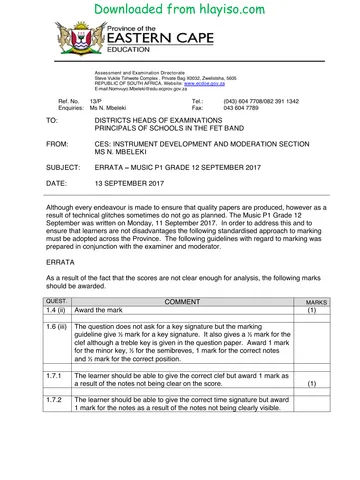
View all
Music Grade 12 Paper 1 Eastern Cape Mock 2017 Memo (English)
Grade 12 Music Paper 1 memorandum from the Eastern Cape Mock Exam 2017 (English), 48 pages. Read online or download the free PDF.
Music · Grade 12 · Eastern Cape Mock Exam · 2017 · English. Memorandum, 48 pages. Read online or download the PDF.
- Subject
- Music
- Grade
- Grade 12
- Language
- English
- Document type
- Memorandum
- Year
- 2017
- Exam period
- Eastern Cape Mock Exam
- Paper
- 1
- Curriculum
- CAPS
- Pages
- 48
- File size
- 1.3 MB
Free to read online, no sign-up needed
Loading document…
Loading document…
1 of 48
This exam
Eastern Cape Mock Exam 2017
Questions in this paper
- Question 1Scales, Keys, Modes & Intervals20 marks
- Question 2Harmony, Chords & Composition15 marks
- Question 3Harmony, Chords & Composition27 marks
- Question 4Harmony, Chords & Composition15 marks
- Question 5Western Art Music (WAM) — General Knowledge & Set Works [WAM]20 marks
- Question 6Western Art Music (WAM) — General Knowledge & Set Works [WAM]10 marks
Show all 11 questions
- Question 7Western Art Music (WAM) — General Knowledge & Set Works [WAM]5 marks
- Question 11Indigenous African Music (IAM) — General Knowledge & Set Works [IAM]10 marks
- Question 12Jazz — General Knowledge & Set Works [Jazz]5 marks
- Question 16Indigenous African Music (IAM) — General Knowledge & Set Works [IAM]10 marks
- Question 19Indigenous African Music (IAM) — General Knowledge & Set Works [IAM]5 marks
Document textSearch extracted text and jump to a page.
Downloaded from hlayiso.com
2 MUSIC P1 (EC/SEPTEMBER 2017)
INSTRUCTIONS AND INFORMATION
1. This question paper consists of FIVE sections, namely SECTIONS A, B, C, D
and E.
2. SECTIONS A and B are COMPULSORY.
3. SECTION C: WESTERN ART MUSIC (WAM), SECTION D: JAZZ and SECTION
E: INDIGENOUS AFRICAN MUSIC (IAM) are choice questions.
Answer only ONE of these sections (SECTION C or D or E).
4. Write all music notation in SECTION A in pencil and all written text in blue or
black ink. Answer in the spaces provided on this question paper.
5. Answer SECTION B and SECTION C or D or E in blue or black ink in the
ANSWER BOOK provided.
6. Number the answers correctly according to the numbering system used in this
question paper.
7. The last page of this question paper is manuscript paper intended for rough work.
It may be removed by the candidate.
8. Use the table on the next page as a guide for mark and time allocation when
answering each question.
9. Write neatly and legibly.
Copyright reserved Please turn over
Downloaded from hlayiso.com
(EC/SEPTEMBER 2017) MUSIC P1 3
MARKING GRID
SECTION QUESTION MARKS MARKER MODERATOR
A: THEORY OF MUSIC 1 20
(COMPULSORY) 2 15
3 10
4 15
SUBTOTAL 60
AND
B: GENERAL MUSIC
KNOWLEDGE 5 20
(COMPULSORY)
SUBTOTAL 20
AND
C: WAM 6 10
7 5
8 5
9 5
10 15
SUBTOTAL 40
OR
D: JAZZ 11 10
12 5
13 5
14 5
15 15
SUBTOTAL 40
OR
E: IAM 16 10
17 5
18 5
19 5
20 15
SUBTOTAL 40
GRAND TOTAL 120
Copyright reserved Please turn over
Downloaded from hlayiso.com
4 MUSIC P1 (EC/SEPTEMBER 2017)
SECTION A: THEORY OF MUSIC (COMPULSORY) (90 minutes)
Answer QUESTION 1
AND QUESTION 2.1 OR 2.2
AND QUESTION 3.1 OR 3.2
AND QUESTION 4.1 OR 4.2
Answer all the questions in the spaces provided on this question paper.
1. Study the Prelude from Op.28. No. 4 by Chopin below and answer the
questions that follow.
(iv)
6
(ii) 1.7.1
12
(i)
1.7.2
18
(iii)
Copyright reserved Please turn over
Downloaded from hlayiso.com
(EC/SEPTEMBER 2017) MUSIC P1 5
1.1 Name the relative key of the piece.
Answer:
G major/G
G major/G = 1 mark
g major = 1 mark
g = No mark (1)
1.2 What does the abbreviation “Op.” stand for?
Answer:
Opus (1)
1.3 Give the English meaning for the term “Largo”.
Answer:
In a very slow tempo and with great dignity/very slow and dignified. (1)
1.4 Identify the intervals marked (i) and (ii) complete according to type and
distance.
Answer:
(i) Diminished 5th
(ii) Augmented 2nd
Diminished 5th = 1 mark
Augmented 2nd = 1 mark
Distance only, i.e. just 2nd/5th No ½ mark (2)
1.5 Invert the interval at (i) and write its correct description underneath it.
Answer: Augmented 4th
Augmented 4th = 1 mark
Correct distance and accidental = 1 mark (2)
Copyright reserved Please turn over
Downloaded from hlayiso.com
6 MUSIC P1 (EC/SEPTEMBER 2017)
1.6 Name the triad marked (iii) according to type and inversion. Re-write it in
root position, using semibreves.
Answer:
(iii) Minor triad
Minor triad = 1 mark
Semibreves = ½ mark
Correct notes = ½ mark
Clef (bass) = ½ mark
Key signature = ½ mark (3)
1.7 1.7.1 Transpose the violin part of bar 17 for Clarinet in B-flat. Insert the
new key signature.
Answer:
Correct key signature = 1 mark
Notation (correct sounding with incorrect key = 1 mark
signature)
Minus ½ mark per error up to a maximum of 1 mark. (2)
Copyright reserved Please turn over
Downloaded from hlayiso.com
(EC/SEPTEMBER 2017) MUSIC P1 7
1.7.2 Rewrite the violin part of bar 18 in double the note values. Insert
the new time signature.
Answer:
Correct time signature = 1 mark
Notation = ½ mark per beat (3)
1.8 Identify the compositional technique used to change (iv).
Answer:
Doubling Diminution Inversion
(1)
Copyright reserved Please turn over
Downloaded from hlayiso.com
8 MUSIC P1 (EC/SEPTEMBER 2017)
1.9 1.9.1 Write the E Blues scale ascending, without key signature, in the
tenor clef.
Answer:
OR
Correct clef = 1 mark
Notation = 1 mark
Minus ½ mark per error to a maximum of 1 mark (2)
Copyright reserved Please turn over
Downloaded from hlayiso.com
(EC/SEPTEMBER 2017) MUSIC P1 9
1.9.2 Write the G wholetone scale descending in the alto clef.
Answer:
OR
Correct clef = 1 mark
Notation = 1 mark
Minus ½ mark for each pitch error (2)
[20]
Copyright reserved Please turn over
Downloaded from hlayiso.com
10 MUSIC P1 (EC/SEPTEMBER 2017)
QUESTION 2 (25 minutes)
Answer EITHER QUESTION 2.1 OR QUESTION 2.2.
2.1 Using the opening motif, complete a twelve-bar melody in ternary form
for any single-line melodic instrument of your choice. Indicate the
instrument for which you are writing, adding dynamics, tempo indication
and articulation marks.
Instrument: Flute/ Recorder/Violin/Guitar/Saxophone/Clarinet/Trumpet
(Any suitable instrument NOT PIANO.)
Concept answer:
Imperfect cadence in c or
Perfect cadence in g/Eb
Imperfect cadence in c or
Perfect cadence in g/Eb
Perfect cadence in c
OR
Copyright reserved Please turn over
Downloaded from hlayiso.com
(EC/SEPTEMBER 2017) MUSIC P1 11
2.2 Use the opening motif below to complete a twelve-bar melody in ternary form for any
single-line melodic instrument of your choice. Indicate the instrument for which you
are writing and add tempo, dynamic and articulation marks.
Instrument: Cello/Double Bass/Trombone
(Any suitable instrument NOT PIANO.)
Concept answer:
Imperfect cadence in E or
Perfect cadence in B/c#
Imperfect cadence in E or
Perfect cadence in B/c#
Perfect cadence in E
Copyright reserved Please turn over
Downloaded from hlayiso.com
12 MUSIC P1 (EC/SEPTEMBER 2017)
The melody will be marked according to the following criteria:
DESCRIPTION MARK ALLOCATION
Form and cadential
1 mark per phrase x 3 3
points
Correctness
Note stems, beats per bar,
Minus ½ mark per error up to 2 marks 2
accidentals, spacing and
layout
Excellent
Coherent and musical; phrases
imaginatively define the form; opening motif
9–10 innovatively continued; successful use of
tonality; melodic shape masterfully handled;
creative approach to choice of pitches and
rhythms.
Quality Good
- Quality of melody and Correct and musical; phrases clearly
suitability for chosen indicate the form; opening motif sensibly
7–8
instrument. continued; stable tonality; melodic shape
- Appropriate tempo, satisfying; choice of pitches and rhythm
accurate. 10
articulation and
dynamic indications Average
enhance the quality of Musically not convincing; not all phrases
the answer clear; opening motif not well utilised;
4–6
- Musicality tonality unstable; melodic shape is suspect;
choice of pitches and rhythm
unimaginative.
Not acceptable
No musical sense; no sense of phrasing;
0–3 opening motif ignored; no sense of tonality;
no melodic shape; pitches and rhythm
random.
TOTAL Markers may use ½ marks 15
Copyright reserved Please turn over
Downloaded from hlayiso.com
(EC/SEPTEMBER 2017) MUSIC P1 13
QUESTION 3 (10 minutes)
ANSWER EITHER QUESTION 3.1 OR QUESTION 3.2.
3.1 Study the extract Der Span auf den Wellen from Op. 17 No. 7 by Jean
Sibelius below and answer the questions that follow.
Answer:
1
4
4
8
4
Copyright reserved Please turn over
Downloaded from hlayiso.com
14 MUSIC P1 (EC/SEPTEMBER 2017)
12
15
(d)
19
(c)
(e)
23
(a) (b)
Copyright reserved Please turn over
Downloaded from hlayiso.com
(EC/SEPTEMBER 2017) MUSIC P1 15
3.1.1 Name the key of the first section of the piece.
Answer:
Ab major/Ab
Ab major/Ab = 1 mark
ab major = 1 mark
ab = No mark (1)
3.1.2 Name the relative key of the second section of the piece.
Answer:
d minor/d
d minor/d = 1 mark
D = 0 mark (1)
3.1.3 Identify the cadence on which the piece ends and write the chords of
the cadence, e.g. Interrupted cadence: V – VI.
Answer:
Perfect cadence: V – I
Perfect cadence/perf. cadence = 1 mark
V–I = 1 mark (2)
3.1.4 Choose the correct answer for the compositional technique that
appears regularly in the melody.
Answer:
Repetition Sequence Inversion (1)
3.1.5 Figure the chords at (a), (b) and (c) complete using Roman
numbers, e.g. G: V (or Va) OR chord symbols, e.g. D.
Answer:
(a) F: I 6/4 or F/C (1)
(b) F: V or C (1)
(c) F: vi or Dm (1)
1 mark per chord
Minus ½ mark per error
Minus ½ mark for NO or wrong inversion
Markers should mark either chord symbols or figuring;
not a mixture
Copyright reserved Please turn over
Downloaded from hlayiso.com
16 MUSIC P1 (EC/SEPTEMBER 2017)
3.1.6 Name the type of non-chordal notes at (d) and (e):
Answer:
(d) Accented passing note (1)
(e) Unaccented passing note (1)
Accented/unaccented = ½ mark
Type of non-chordal note (passing note, etc.) = ½ mark
[10]
OR
Copyright reserved Please turn over
Downloaded from hlayiso.com
(EC/SEPTEMBER 2017) MUSIC P1 17
3.2 Study the extract below from 15 Easy Pieces for Piano by D. Valeras
and answer the questions that follow.
(b)
(a)
(c)
(ii)
(i)
(d)
(e)
X
Cadence
Copyright reserved e Please turn over
Downloaded from hlayiso.com
18 MUSIC P1 (EC/SEPTEMBER 2017)
3.2.1 Name the key of the piece.
Answer:
F major/F
F major/F = 1 mark
F major = 1 mark
f = No mark (1)
3.2.2 Identify the chords (a) to (e) and number them correctly below. Use
chord symbols, e.g. C/E.
Answer:
(a) Bb9 (b) Dm7
(c) C13 (d) Am7
(e) Ab (5 x 1)
1 mark per chord = 5 marks
No ½ marks will be given (5)
3.2.3 Name the type of non-chordal notes at (i) and (ii).
Answer:
(i) (Unaccented) upper auxiliary note
(ii) (Accented) lower auxiliary note (2)
2 correct answers 1 mark each = 2 marks
No ½ marks will be given
3.2.4 Name the cadence at the end of the piece. Identify the cadence by
adding the correct chord symbols.
Answer:
Perfect cadence
C13(b9) − F (
Perfect = 1 mark
Chords = 1 mark (2)
[10]
Copyright reserved Please turn over
Downloaded from hlayiso.com
(EC/SEPTEMBER 2017) MUSIC P1 19
QUESTION 4 (30 minutes)
ANSWER EITHER QUESTION 4.1 OR QUESTION 4.2.
4.1 Complete the four-part vocal harmonisation below by adding the alto, tenor and bass
parts. Use at least ONE non-chordal note in the added parts.
Concept answer:
Copyright reserved Please turn over
Downloaded from hlayiso.com
20 MUSIC P1 (EC/SEPTEMBER 2017)
The harmonisation will be marked according to the following criteria:
DESCRIPTION MARK ALLOCATION
Chord progression
1 mark between each pair of chords
Choice of chords, correct use 14
(except between beat 1 and 2 of bar 4).
of cadence
Correctness
Minus ½ mark per error, but not more
Notation, doubling, spacing 16
than 1 mark per chord.
and voice leading
Excellent 9–10
Good 7–8
Quality
Musicality, non-chordal notes,
Average 5–6 10
awareness of style and
creativity
Weak 3–4
Unacceptable 0–2
Note to marker:
40 (÷ 8 x 3)
Mark out of 40 must not contain a ½ mark
TOTAL: 15
Candidates must be credited for a different/creative and correct harmonisation not given
in the memorandum. The figuring serves as a guide for the marker, but no marks are
allocated for the symbols as such.
[15]
OR
Copyright reserved Please turn over
Downloaded from hlayiso.com
(EC/SEPTEMBER 2017) MUSIC P1 21
4.2 Complete the piece below by adding suitable harmonic material in the
bass clef. Ensure that you continue to write in the given style.
Concept answer:
Copyright reserved Please turn over
Downloaded from hlayiso.com
22 MUSIC P1 (EC/SEPTEMBER 2017)
The harmonisation will be marked according to the following criteria:
DESCRIPTION MARK ALLOCATION
Chord progression
Choice of chords, correct use 1 mark between each pair of chords 15
of cadence
Correctness
Minus ½ mark per error, but not more
Notation, doubling, spacing 15
than 1 mark per chord.
and voice leading
Excellent 9 – 10
Good 7–8
Quality
Musicality, non-chordal notes,
Average 5–6 10
awareness of style and
creativity
Weak 3–4
Unacceptable 0–2
Note to marker:
40 (÷ 8 x 3)
Mark out of 40 must not contain a ½ mark.
TOTAL: 15
Candidates must be credited for a different/ creative and correct harmonisation not given
in the memorandum. The figuring serves as a guide for the marker, but no marks are
allocated for the symbols as such.
[15]
TOTAL SECTION A: 60
Copyright reserved Please turn over
Downloaded from hlayiso.com
(EC/SEPTEMBER 2017) MUSIC P1 23
SECTIONS B, C, D, E: GENERAL MUSIC KNOWLEDGE (90 minutes)
Answer SECTION B
AND SECTION C (Western Art Music)
OR SECTION D (Jazz)
OR SECTION E (Indigenous African Music)
Answer these in the ANSWER BOOK provided.
Note to marker: One mark will be allocated for each correct fact. Candidates must be
credited for any correct answer not given in this memorandum.
SECTION B: GENERAL KNOWLEDGE (COMPULSORY)
QUESTION 5
5.1 Four options are provided as possible answers to the following questions.
Choose the correct answer and write only the letter (A–D) next to the
question number in the ANSWER BOOK, e.g. 5.1.12 E.
5.1.1 C
5.1.2 A
5.1.3 C
5.1.4 D
5.1.5 D
5.1.6 A
5.1.7 D
5.1.8 B
5.1.9 C
5.1.10 B
1 mark for each correct answer = 10 marks (10)
Copyright reserved Please turn over
Downloaded from hlayiso.com
24 MUSIC P1 (EC/SEPTEMBER 2017)
5.2 Answer the following questions.
5.2.1 Describe shortly what the music industry entails.
The music industry entails various steps that are followed to
get the product from the producer to the consumer.
Correct answer = 1 mark (1)
5.2.2 Define needletime rights.
It is royalties paid to recording artists when a song is used.
These are the people who help in the recording of music –
such as backing vocalists, musicians, etc. These royalties
are paid when a song is played/recorded/performed.
Correct answer =1 mark (1)
5.2.3 Give a short description on how music royalties work.
Songwriters register their work/songs at SAMRO. SAMRO has
licenses over those works/songs that can be sold to people in
order to collect money for songwriters. People that buy
licenses from SAMRO include TV stations, radio stations,
Internet websites, restaurants, stores, etc. The money
collected from these businesses, is distributed between all
members of SAMRO, depending on the airtime they attained.
SAMRO determines airtime by requesting written information
from live venues, television stations and radio stations.
Any 2 correct facts = 2 marks (2)
5.2.4 How many years must lapse after the death of a composer, for
his/her works to become public domain, unless the copyright is
renewed by family?
50 years
Correct answer = 1 mark (1)
Copyright reserved Please turn over
Downloaded from hlayiso.com
(EC/SEPTEMBER 2017) MUSIC P1 25
5.3 Give the Italian term for the following description:
5.3.1 To play a specific passage of music with fire and vehement
energy.
Con fuoco
Correct answer = 1 mark (1)
5.4 Name TWO very specific style characteristics of the music of Beethoven.
He was the master of thematic material and he used the following 2
types: 1st themes were broken up into short motives – 1st movement
of Symphony no. 6; Cantabile melodies were found in the last
movement of Symphony No. 6. He used the old contrapuntal
practices and was a master of this.
In Form, he was a master at using thematic development, he
expanded the sonata form. He used Free Fantasy in the 1st movement
of Moonlight Sonata. He exceeded the limits of the choral idiom,
treating his chorus as additional instrumental colour – Symphony no.
9. He developed the use of harmony by using heavy thick chords and
modulations to other keys than subdominant and dominant keys.
Any 2 correct facts = 2 marks (2)
5.5 Describe the difference between sonata and sonata form.
The sonata has 3 sections: exposition, development and
recapitulation. The sonata usually ends on a coda (Italian for “tail”).
Although it has a breakdown into what looks like three movements;
it is actually a single movement structure.
Do not confuse it with a sonata, which is a complete composition
made up of different movements.
1 fact for sonata form = 1 mark
1 fact for sonata which shows the differences = 1 mark (2)
TOTAL SECTION B: 20
Copyright reserved Please turn over
Downloaded from hlayiso.com
26 MUSIC P1 (EC/SEPTEMBER 2017)
Answer SECTION C (WAM)
OR SECTION D (JAZZ)
OR SECTION E (IAM).
QUESTION 6
6.1 Define the following:
6.1.1 Grand opera
It is a spectacular opera, with the plots based on or around
dramatic historic events. It involved royalty, heroism, ballet
scenes and are long, normally four or five acts. It is
characterised by large-scale casts and orchestras.
Any 2 correct facts = 2 marks (2)
6.1.2 The development of instrumentation in the Romantic era.
A huge accent on broadening the range of instrumental
colour and diversity. The string section was lengthened. The
instruments played deep expressive melodies. Orchestral
players had to adapt tone colour to individual composer’s
style. Technical virtuosity was improved to meet the demand
of the music and the public.
Any 2 correct facts = 2 marks (2)
6.1.3 Alberti bass
The bass line was now only the accompaniment, called
the Alberti bass – the breaking of the chords into a simple
pattern and it is then repeated. Albert bass is a type of
broken chord or arpeggiated accompaniment.
Correct answer = 1 mark (1)
6.2 What is the significance of the number three in Mozart’s opera, Die
Zauberflöte?
It was as a result of the influence of the Freemasons.
Correct answer = 1 mark (1)
Copyright reserved Please turn over
Downloaded from hlayiso.com
(EC/SEPTEMBER 2017) MUSIC P1 27
6.3 Name TWO examples which feature the number three in Die Zauberflöte.
It represents the 3 knocks on the door by entering the Masonic
meetings: 3 ladies; 3 youths; 3 geniis; 3 temples; 3 trials; Home key
(E flat major with its 3 flats); Repeated idea – short-long-long – in
overture and 2nd Act; 3 heavy chords that open overture, again
repeated in temple scene when Tamino’s trials begin; Setting in Egypt
– rites of Freemasonry.
Any 2 correct facts = 2 marks (2)
6.4 Describe ONE technique used to change the theme when composing in
Theme and Variation style.
Composers removed notes, added notes, changed key, harmony,
rhythm, repeat with different accompaniment patterns. Composers
often improvised on given theme during concert – impress them with
their skills – a person from audience would suggest theme,
composer would then improvise in as many ways as possible.
Any one correct fact = 1 mark (1)
6.5 Why is Beethoven’s Symphony No. 6 Opus 68 in F major different to
other symphonies?
It has 5 movements, instead of the normal 4 movements.
The last 3 movements are played without a break.
It contains explicitly programmatic content.
The 6th Symphony is one of only two symphonies Beethoven
intentionally named.
Any one correct fact = 1 mark (1)
[10]
Copyright reserved Please turn over
Downloaded from hlayiso.com
28 MUSIC P1 (EC/SEPTEMBER 2017)
QUESTION 7
7.1 Name THREE characteristics of the opera music of the Florentine
Camerata.
The Camerata wanted to develop a new vocal style modelled on the
music of the ancient Greek tragedy, who based their theories on
literary accounts that survived. The music was more important than
the text. The Camerata stated that music should always be the
servant of the text. They avoided any polyphonic treatment and made
little use of the aria and chorus. They composed short vocal pieces
called monodies – the singer was given a melodic setting of text
supported by instrument that provided a simple chordal bass
accompaniment and singer could sing the rhythm of the text in
accordance with natural rhythms of the text. The vocal line followed
the rhythms and pitch fluctuations of speech – this later became
known as recitative (recited). The recitative was sung by a soloist
with a simple chordal accompaniment. The texture of the music was
homophonic.
1 mark each for any 3 correct facts = 3 marks (3)
7.2 One of the most important opera composers was Monteverdi. Explain th
meaning of this statement.
Along with the Camerata was one of the greatest opera composers,
known as the founder of the opera, namely Claudio Monteverdi
(1567−1643). His 1st great true opera, L’Orfeo, set the standard for
other European composers and helped to establish their national
traditions in the 17th century. His opera contained recitatives, choral
works, instrumental dances, interludes (later known as ritornelli).
Monteverdi expanded the function of the orchestra, using a larger
variety of instruments and also more singers than his predecessors.
Monteverdi captured the meaning of the text in the music. He became
master of the new homophonic dramatic style.
1 mark for 2 correct facts = 2 marks (2)
[5]
Copyright reserved Please turn over
Downloaded from hlayiso.com
(EC/SEPTEMBER 2017) MUSIC P1 29
QUESTION 8
8.1 Compare Singspiel with Music Drama. Name TWO differences and ONE
similarity regarding the style types.
Similarities:
Both Singspiel and Music Drama are sub-genres of the opera.
Both are a form of opera.
Differences:
Singspiel Music Drama
One person composes the A single person writes both the
music and a second person text and the music;
writes the text;
Singspiel plots are generally An opera in which the musical
comic or romantic in nature; and dramatic elements are of
equal importance and strongly
infused;
Developed by W.A. Mozart; Developed by Richard Wagner;
Characterised by spoken Characterised by a continuous
dialogue among sung phrases; flow of orchestra music;
Music and drama form a
cohesive structure
Characterised by ensembles, Singing is free from formal
songs, ballads and arias, which division into arias, recitatives,
are often strophic or folk-like; etc.;
Combination of all the art forms
Elements of magic, fantastical Characterised by an integrative
creatures and comically use of musical themes
exaggerated characterisations (leitmotifs);
of good and evil are typical of a
Singspiel;
A form of German light opera A form of German opera whose
structure is governed by
considerations of effectiveness
1 similarity (correct fact) = 1 mark
Any 2 differences (4 correct facts) = 4 marks (5)
[5]
Copyright reserved Please turn over
Downloaded from hlayiso.com
30 MUSIC P1 (EC/SEPTEMBER 2017)
QUESTION 9
9.1 Write a short description about the significant elements of the second theme
of “Fingal’s Cave” regarding the instrumentation.
The second theme, meanwhile, depicts movement at sea and
“rolling waves”.
It is written in D major and scored for bassoons and cellos.
The theme is first played by the cellos and bassoons in D major.
The change from minor to major create a sunnier mood.
The theme is accompanied by strings playing soft semiquavers
and this repetition of the semiquavers create the idea of a calm sea.
1 mark for each correct fact = 5 marks (5)
[5]
Copyright reserved Please turn over
Downloaded from hlayiso.com
(EC/SEPTEMBER 2017) MUSIC P1 31
QUESTION 10
Write an extensive article for your school newspaper regarding the FOURTH and
FIFTH movements of Beethoven’s Symphony No 6, opus 68. Discuss, amongst
other facts, the use of the instruments to show the events taking place in nature.
The FOURTH movement is called “Thunderstorm” and the pace is Allegro
and a punctuated half-note = 80. It is written in F minor, the time signature
is 4/4 and is in free single-form, comparable to program music with
interesting orchestral colors. In this movement Beethoven adds the
following instruments to the "classical" orchestra – a piccolo, flute, Clarinet
in Bb, bassoon, Horn in F, trombone (alto and tenor), timpani and other
stringed instruments. Beethoven also creates an ongoing music flow by
moving sections and motives from one instrument or instrument group to
another. In this way, timbre has started to play an important role.
The movement depicts a violent thunderstorm with painstaking realism,
building from just a few drops of rain to a great climax with thunder,
lightning, high winds, and sheets of rain. The storm eventually passes, with
an occasional peal of thunder still heard in the distance.
The role of the instruments is very important. The violins play pp staccato
quavers give effect of first raindrops. The drums represent the 1st big roll of
thunder with low quintuplets in the cellos and quadruplets in the bass,
giving a rumbling effect. When the piccolo enters in Bar 82, it strengthens
the storm. 2 Trombones in bar 106 give additional strength to the climax of
the storm. Upper strings play ff tremolos, giving the feeling of intense
excitement. The storm reaches its climax with drum rolls and tremolos. The
music gradually becomes softer after the storm when the quavers re-appear
as dolce minims in the oboe over a dominant pedal point in tonic key. The
thunder is still heard in the distance.
This movement has many romantic elements – dynamic contrasts, harmonic
colours, melodic continuity, and freer form structure. There is a seamless
transition into the final movement. This movement parallels Mozart's
procedure in his String Quintet in G minor K. 516 of (1787). The tempo
indication is Allegro and a dotted minim = 80. It is composed in F minor. The
time signature is 4/4. The form is Programme music (or free on-part form)
with interesting orchestral colours. Beethoven added new instruments –
Piccolo, Flute, Oboe, Clarinet in Bb, Bassoon, Horn in F, Trombones (alto
and tenor), Timpani and strings.
Copyright reserved Please turn over
Downloaded from hlayiso.com
32 MUSIC P1 (EC/SEPTEMBER 2017)
The FIFTH movement is the finale and is called the ‘”Shepherd’s song –
Happy and grateful feelings after the storm.” The pace is Allegretto and a
punctured quarternote = 60. It is written in F major and is in sonate round
form (7-leaf round shape). The main theme is in the tonic key at the
beginning of the development, as well as in the exposition and
recapitulation.
This movement is the final. Like many classical finales, this movement
emphasises a symmetrical eight-bar theme, in this case representing the
shepherds' song of thanksgiving. As the storm moves away, there is a
feeling of relief and all the animals emerge.
The 5th movement starts with a yodel “Ranz des Vanches” (a simple melody
played by the horn of the Swiss Alpine herdsmen when they drove their cattle
to or from the pasture), played by the clarinet and imitated by the horn over
dominant and tonic harmonies, softly played together by the strings.
Beethoven uses the same "extra" instruments as for the fourth movement,
leaving out only the piccolo.
The coda starts quietly and gradually builds to an ecstatic culmination for the
full orchestra (minus "storm instruments"), with the first violins playing very
rapid forte triplet tremolo on a high F. There follows a fervent passage
suggestive of prayer, marked by Beethoven "pianissimo, sotto voce"; most
conductors slow the tempo for this passage. After a brief period of afterglow,
the work ends with two emphatic F major chords.
The key is F major and the time signature is 6/8. The form is sonata rondo
form, meaning that the main theme is in tonic key at the beginning of the
development as well as the exposition and the recapitulation. Beethoven
used the same instruments as for the Thunderstorm, except for the piccolo −
Flute, Oboe, Clarinet in Bb, Bassoon, Horn in F, Trombone, and Strings. (15)
[15]
Copyright reserved Please turn over
Downloaded from hlayiso.com
(EC/SEPTEMBER 2017) MUSIC P1 33
The essay will be marked according to the following criteria:
CRITERIA MARK ALLOCATION
Fourth movement: 1 mark for each correct fact x 6 6
Fifth movement: 1 mark for each correct fact x 6 6
Excellent
An introduction, conclusion with a
substantial argument in the body of essay = 3 marks
evident.
Good
An introduction, conclusion with a
= 2 marks
reasonable argument evident in the body
of the essay.
Average
Logical presentation An introduction, conclusion with an
= 1½ marks
and structure of the insignificant argument evident in the body 3
essay of the essay.
Below average
An introduction, conclusion with a weak
= 1 mark
argument evident in the body of the
essay.
Weak
A single paragraph: a poor attempt at an = ½ mark
essay.
Not acceptable
Only facts in bullet form. = 0 mark
TOTAL: 15
TOTAL SECTION C: 40
OR
Copyright reserved Please turn over
Downloaded from hlayiso.com
34 MUSIC P1 (EC/SEPTEMBER 2017)
SECTION D: JAZZ
QUESTION 11
11.1 Choose the correct answer from COLUMN B to match the
statement/name in COLUMN A. Write only the correct matching letter
(A–F) next to the question number in the ANSWER BOOK, e.g. 11.1.7 G.
11.1.1 E
11.1.2 D
11.1.3 F
11.1.4 B
11.1.5 A
11.1.6 C
1 mark for each correct answer = 6 marks (6)
11.2 Name TWO similarities between Mbaqanga and Marabi.
Swing and Kwela
2 correct facts = 2 marks (2)
11.3 With which instrument is Marabi associated?
Pedal organ
1 mark for correct answer (1)
11.4 The “Merry Blackbirds” enjoyed playing the music of American
ragtime, as well as written jazz arrangements. Name ONE artist
whose arrangements they played.
Louis Armstrong, Duke Ellington, Count Bassie, Sy Oliver
Any correct answer = 1 mark (1)
[10]
Copyright reserved Please turn over
Downloaded from hlayiso.com
(EC/SEPTEMBER 2017) MUSIC P1 35
QUESTION 12
12.1 Write a paragraph, describing the Marabi style of The Jazz Maniacs and
their influence and contribution of Solomon Cele in the development of the
style.
It reflected political goals in the USA and SA. It was developed in
Sophiatown and District Six. The band consisted of the self-taught
pianist, Solomon Cele. He listened and imitated the shebeen music.
The band started with 4 members and increased to 13. The other
instruments were saxophone, guitar, and trombone. Cele said the
swing-sound was ideal to transfer his music ideas and they
combined jazz, swing and local melodies. All of this led to the
development of Marabi. The band would take musical ideas of some
American bands and made it their own instead of just copying it.
Their music was influenced by Louis Armstrong, Buck Clayton and
Harry James.
1 mark each for any 3 correct facts = 3 marks (3)
12.2 Describe New Jazz in a short paragraph and name ONE important artist
of this style.
The New Jazz style refers to the development of South African Jazz
after the 1950’s. It was not derived from Marabi or Kwela and did not
fit in to the Mbaqanga category. The musicians developed their own
highly individualistic/independent styles.
Artists: Todd Matshikiza, Gideon Nxumalo, The Jazz Epistles,
Philip Tabane
1 correct fact = 1 mark
1 correct artist = 1 mark (2)
[5]
Copyright reserved Please turn over
Downloaded from hlayiso.com
36 MUSIC P1 (EC/SEPTEMBER 2017)
QUESTION 13
13.1 What was the origin of Kwela music? How did Kwela influence the music
scene in South Africa?
Kwela is a South African jive style, derived from Marabi. The most
significant instrument is the pennywhistle, which was later replaced
by the saxophone. The music was played on the streets by township
youths. This was the birth of new, lively music that did not require
much money. Pennywhistle kwela or Kwela is a historical turning
point in the development of popular African music and jazz in South
Africa. The pennywhistle was a small instrument and thus easy to
carry around. As shepherd boys moved from the rural areas to the
cities, they took their pennywhistles with, but later replaced them with
a German produced one. Typical instruments for Kwela music is the
pennywhistle, homemade guitar (isingci), rattles made from empty
milk tins and a one-snare teabus bass. Kwela consists of a vamp on
the Snare bass and guitar (ostinato pattern), filled on with the rattles,
shakers and drums. Young African men would play this music on the
street corners, while keeping an eye open at the same time for the
police, named kwela-kwela.
Kwela music was also popular with the “Boere” musicians and Fred
Woodridge’s “Penniefluitjie Kwela” was very popular. This was the
first truly indigenous music from South Africa and it spoke to the
people. But it was the African musicians that elevated this style to
international status.
Years later the saxophone replaced the pennywhistle and the electric
guitar replaced the acoustic one. By the end of the 1950’s the
pennywhistle completely disappeared from the band and Kwela was
now known as Sax Jive and would later be known as Mbaqanga and
would dominate the South African music scene for the next 20 years.
1 mark each for any 5 correct facts = 5 marks (5)
[5]
Copyright reserved Please turn over
Downloaded from hlayiso.com
(EC/SEPTEMBER 2017) MUSIC P1 37
QUESTION 14
14.1 How did Jazz in exile influence the development of the music of South
African musicians?
In the 1960’s, the African jazz musicians had 2 choices – fight or leave.
The majority that left the country, were politicians and artistically
professionals. Although not all of them had successful music careers
overseas, they still had this yearning to express themselves through
the music of their country of origin. It also helped develop their talent
and to work as professional musicians. To leave the country would be
the last option, as travel permits to perform overseas, have been
continuously declined. It was almost impossible to be a musician in
South Africa, due to the “nagklok” rule and that concert venues could
not accommodate Black and white performers at the same time. It was
a real difficult time. Jazz musicians consciously promoted multi-racial
co-operation through their music and it helped to keep the
professional music in jazz going in our country.
1 mark for any 5 correct answers = 5 marks (5)
[5]
Copyright reserved Please turn over
Downloaded from hlayiso.com
38 MUSIC P1 (EC/SEPTEMBER 2017)
QUESTION 15
Write a comprehensive essay on the music of ONE of the following South African
artists:
Miriam Makeba
Josephine ‘Dolly’ Rathebe
Thandi Klaassen
You will be credited for the logical presentation of facts and the structure of your
essay.
Miriam Makeba
She was born in 1932 in Johannesburg. Her full names were Zenzile Miriam
Makeba and was nicknamed Mama Africa, She was a South African singer and
civil rights activist, and was the 1st artist from Africa who popularised African
music around the world. She sang in the choir of the Kilnerton Institute,
Pretoria. Her 1st solo performance was at 15 before King George VI of England.
Miriam had a daughter with her then first husband. She started her
professional in the 1950’s with the Manhattan Brothers. Then she formed her
own all- woman group, The Skylarks, and they sang a blend of jazz and
traditional melodies. In 1956, she released the well-known “Pata Pata”. In 1959,
she had a short-lived second marriage to Sonny Pillay. She starred in the anti-
apartheid document, Come back, Africa and this gave her a big break. It helped
her win the female singing lead role in King Kong in 1959. It got her into hot
water with the SA authorities when the director wanted her to present the film
at the Venice Film Festival in 1959. Her incredible voice earned her the
nickname, The Empress of African Song. She did not return to South Africa
and took refuge in London, where she met Harry Belafonte and he helped her
immigrate to America. In 1960, she wanted to attend her mother’s funeral, only
to find out that her SA passport was cancelled. In the same year, she signed
with RCA Victor and released her album “Miriam Makeba”. In 1962, Makeba
and Belafonte sang at the birthday party of JF Kennedy. In 1963, she released
her second album, “The world of Miriam Makeba”. During the latter part of
1963, Miriam testified against apartheid in SA before the UN and her music was
banned in South Africa and her SA citizenship and her right to return to SA,
was revoked. She stayed in the USA, but also had international passports from
Guinea, Belgium and Ghana and so became a citizen of the world. She married
Hugh Masakela in 1964, divorcing in 1966. She received a Grammy Award for
Best Folk Song Recording with Belafonte in 1966 and the album was titled, An
Evening with Belafonte/Makeba. This album dealt with political plight of black
South Africans under apartheid. It presented traditional Zulu, Sotho and
Swahili songs in a unique setting. Her fame and reputation grew; She released
The Click Song (Qongqothwane) and Malaika. Her voice (tones, warmth) was
compared to Ella Fitzgerald and Frank Sinatra. She never wore make-up, never
curled her hair and this hairstyle became known as the Afro. In 1967, 10 years
after she wrote Pata Pata, it was recorded and released as a single in the USA
and became an international hit.
Copyright reserved Please turn over
Downloaded from hlayiso.com
(EC/SEPTEMBER 2017) MUSIC P1 39
Her marriage in 1968 to Stokely Carmichael (civil rights activist) caused great
controversy. Her recording contracts and tours were cancelled and had her
flee to Guinea; Here she stayed for the next 15 years. She separated from
Carmichael in 1973 and continued to perform in Africa, Europe and Asia, but
not in the USA due to a boycott. She was one of the main entertainers in 1974
at the match between Muhammed Ali and George Foreman in Zaire. In 1975,
she addressed the UN for a 2nd time. In 1978, she divorced Carmichael and
married an airline executive in 1980. During 1985, her daughter died and she
moved to Belgium. She was Guinea’s official delegate to the UN and in 1986
won the Dag Hammerskjöld Peace Prize. In 1987, she returned to world
prominence when she performed with Paul Simon on his Graceland album
tour (thanks to Masakela). Warner Bros. Records signed her and she released
Sangoma as a tribute to her mother who was a sangoma.
Her autobiography was published and also translated into Spanish, German,
Dutch, French, Italian and Japanese. In 1988, she participated in the Nelson
Mandela 70th Birthday Tribute at Wembley Stadium. This performance helped
pressurise the SA government to release Mandela. In 1990, Mandela was
released and during the same year, bans were reversed on the ANC and other
anti-apartheid organisations and announced that Mandela would soon be
released. In February 1990, he was released and Nelson Mandela persuaded
her to return to South Africa, which she did in June 1990. In 1991, Makeba
recorded Eyes on tomorrow, together with Gillespie, Nina Simone and
Masakela; combination of jazz, R&B, pop, African music. Makeba and
Masakela toured the world to promote the album. During 1991, she appeared
on an episode of The Cosby Show. In 1992, she played the role of Angelina,
the main character’s mother in Sarafina! In 1993, she released Sing me a Song.
In 1999, she was nominated Goodwill Ambassador of the UN’s Food and
Agricultural Organisation. In 2000, Homeland was nominated for a Grammy
Award; It was called a love letter to Africa.
In 2001, the United Nations of Germany awarded her the Otto Hahn Peace
Medal in Gold; she received her prize for the King of Sweden, Carl XVI Gustaf
in 2002. Also in 2002, she participated in the documentary Amandla: A
Revolution in Four-Part Harmony. In 2004, Makeba was voted 38th in South
Africa’s Top 100. She started her worldwide farewell tour in 2005. She fell ill
after a performance in Italy in 2008 (singing Pata Pata), had a heart attack and
could not be revived at the hospital.
Copyright reserved Please turn over
Downloaded from hlayiso.com
40 MUSIC P1 (EC/SEPTEMBER 2017)
Her style, characteristics and contribution:
She listened to traditional Xhosa and Zulu songs and quicly picked up on
the languages. She also listened to music on the radio and gramophone
records. She loved the music of Ella Fitzgerald. Her music was joyous,
uplifting, soft-spoken and had a serious political message. She is a pioneer
who blended styles such as blues, gospel, contemporary jazz, folk and
traditional Xhosa. In 1987, her autobiography, Makeba: My Story, was
published and translated into German, Dutch, French, Italian, Spanish and
Japanese. She showed a great versatility in many languages and settings,
such as jazz and blues, yet she became known for singing in her native
tongue and became known for the distinguishable explosive clicks.
She used many different styles in her music – English ballades, Portuguese
fados, Brazilian bossa novas, Hebrew and Yiddish melodies, Italian chants
and other folk and popular styles from around the world. She also received
credit for bringing rhythm and spiritual sounds of Africa to the west. Her
music is a mix of soulful jazz, blues and traditional African folk songs that
had political overtones. The album, Eyes on tomorrow, had a commercial
mix of pop, blues and jazz. Musicians on this album – Jazz trumpeter Dizzy
Gillespie, Rhythm and blues singer Nina Simone, Hugh Masakela
Albums: Miriam Makeba, The Voice of Africa, Eyes on Tomorrow,
Homeland (2000), Reflections (2004)
Hits: Pata Pata, The Click Song (Qongqothwane), Malaika, Mbube
(Wimoweh)
OR
Josephine “Dolly” Rathebe (1928 – 2004)
She was born in 1928 in Randfontein and grew up in Sophiatown. Her career
started when a talent scout for Gallo heard her sing. She was only 21 when
she was the star of the film, “Jim comes to Joburg”. Her photoshoot in 1956
– posing in a bikini – added to her star status. She joined the African
Inkspots group as singer, but her reputation preceded her and any group
she sang with. She was a mentor for many a young musician, including
Miriam Makeba, Thandi Klaassen and Dorothy Masuka. She never left the
country during the “apartheid” years, even though the “aandklok” rule made
it almost impossible for her to appear in public, especially when she was
lead singer for The Elite Swingsters. Her association with this elite group
secured her international reputation. They sang at Nelson Mandela’s
inauguration as South Africa’s first
democratically elected president. They also performed at Westminster Abby
to celebrate South Africa’s return to the Commonwealth. She was awarded
the South African “staatsorde” Ikhamanya in Silver for her amazing
contribution to music and the performing arts and her dedication to the
ideals of justice, freedom and democracy. Even though Rathebe was very
successful, her family did not have the money to put a headstone on her
grave. This was done in 2015 when a learner form Johannesburg started a
project to honour her legacy.
OR
Copyright reserved Please turn over
Downloaded from hlayiso.com
(EC/SEPTEMBER 2017) MUSIC P1 41
Thandi Klaassen (b. 1931)
Thandi Klaassen is a South African legend. Her career stretches over more
than 50 years. She grew up in Sophiatown. Her longing to be a singer started
when she attended a concert at her school by The Jazz Maniacs and Emily
Kwenane. She started to sing in local churches and started her own quartet,
The Quad Sisters. They were also the first female group to record in South
Africa.
She was injured during her teenage years when acid was thrown in her face.
She was in hospital for a year and her face was permanently maimed and it
looked like her career as performer was doomed. She gained her confidence
and carried on singing with Dolly Rathebe, Miriam Makeba and Dorothy
Masuka. She was one of the role players when King Kong was performed
and she even performed in London. After the play ended in London, she did
not return to South Africa, but started performing internationally with Patti
LaBelle and Roberta Flack. At the same time, she was building her reputation
as an excellent jazz singer. She is now retired, but still performs at special
occasions. While she was overseas, Thandi participated in anti-apartheid
campaigns and continued with music that addressed the situation in her
country. She received many awards, including “The Woman of Distinction”
award in Canada (1999) and a “Lifetime Achievement Award” (12th MTN
SAMA). She also received the “staatsorde” Boabab in Gold. She is well-
known for her Mbaqanga interpretations. As acknowledgement of her
heritage, she also sings in e’Kasi, the folk dialect spoken in Sophiatown.
Thandi Klaassen suffered from pancreatic cancer and passed away on
15 January 2017, aged 86. She was given a state funeral. (15)
Copyright reserved Please turn over
Downloaded from hlayiso.com
42 MUSIC P1 (EC/SEPTEMBER 2017)
The essay will be marked according to the following criteria:
CRITERIA MARK ALLOCATION
Music characteristics 1 mark for each correct fact x 5 5
Origins and influence 1 mark for each correct fact x 5 5
Albums/songs 1 mark for each correct fact x 2 2
Excellent
An introduction, conclusion with a
substantial argument in the body of = 3 marks
essay evident.
Good
An introduction, conclusion with a
= 2 marks
reasonable argument evident in the
body of the essay.
Average
Logical presentation An introduction, conclusion with an = 1½
and structure of the insignificant argument evident in the marks 3
essay body of the essay.
Below average
An introduction, conclusion with a weak
= 1 mark
argument evident in the body of the
essay.
Weak
A single paragraph: a poor attempt at = ½ mark
an essay.
Not acceptable
Only facts in bullet form. = 0 mark
TOTAL: 15
TOTAL SECTION D: 40
OR
Copyright reserved Please turn over
Downloaded from hlayiso.com
(EC/SEPTEMBER 2017) MUSIC P1 43
SECTION E: INDIGENUOUS AFRICAN MUSIC
QUESTION 16
16.1 Choose the correct answer from COLUMN B to match the item in
COLUMN A. Write only the correct matching letter (A–F) next
to the question number in the ANSWER BOOK, e.g. 16.1.6 F.
16.1.1 E
16.1.2 C
16.1.3 A
16.1.4 B
16.1.5 D
1 mark for each correct answer = 5 marks (5)
16.2 What was the origin of the word “mbaqanga” and the symbolic meaning of
it under musicians?
Mbaqanga is a Zulu word for steamed mealie bread. The symbolic
meaning under musicians was “music bread”.
1 mark for each correct answer = 2 marks (2)
16.3 From which word is “Maskandi/Maskanda” derived?
It is derived from the Afrikaans word “musikante” (musicians).
Correct answer = 1 mark (1)
16.4 Explain the goal of Isicathamiya.
The goal is to reach a harmonious mix of voices (and not the roar of
the lion).
Correct answer = 1 mark (1)
16.5 What is the nickname of Philip Tabane?
Dr Malombo
Correct answer = 1 mark (1)
[10]
Copyright reserved Please turn over
Downloaded from hlayiso.com
44 MUSIC P1 (EC/SEPTEMBER 2017)
QUESTION 17
17.1 The saxophonist of the Makgona Tsohle Band, West Nkosi, played a
different instrument and a different style at the start of his music career.
Name the instrument and style. Also describe his path in music until 1963
when he and his band were stranded in Northern Rhodesia for 6 months.
Nkosi first played the pennywhistle and the style of music he played
at first, was kwela. He played his kwela music outside sport centres
and on the street corners. During one of these street performances he
met some of his band members, Joseph Makwela and Lucky Monama.
In 1962 they were appointed by Gallo record company as session
musicians for Reggie Msomi’s Hollywood Jazz Band. Nkosi played
saxophone, Monama the drums and Makwela the electric bass guitar
(he was the 1st black electric bass guitar player in South Africa). In
1963 they toured with Msomi to Northern Rhodesia and was stranded
there for 6 months due to political unrest.
1 mark each for any 5 correct facts = 5 marks (5)
[5]
QUESTION 18
18.1 Discuss the elements of music used by The Cool Crooners as part of their
mix of Mbaqanga, as well as a short overview about the group.
The group was known for their unique mix of jazz, Ndebele, Zulu and
KiSwahili elements in their music. The language, rhythm and electric
guitars showed a strong African influence, which became made it their
own style.
The group was founded by Albert Sithole and other members were
Lucky Thodhlana and the deceased Ben Gumbo. Gumbo was replaced
with Timothy Mkandla. They are a vocal group from Bulawayo,
Zimbabwe. One distinct trademark was the white suits they wore when
performing. They are seen / known as one of the best jazz groups and
have performed locally and internationally. They have performed with
the likes of Bob Nyabinde, Dudu Manhanga, Jazz Invitation and Tanga
WekwaSando. They have released 3 albums − Blue Sky, Ihulugwe
Lami and Isatilo.
1 mark each for any 5 correct facts = 5 marks (5)
[5]
Copyright reserved Please turn over
Downloaded from hlayiso.com
(EC/SEPTEMBER 2017) MUSIC P1 45
QUESTION 19
19.1 There are two specific musical styles and structures in
Maskandi/Maskanda music. The first is Izihlabo. Identify and describe the
second style and its characteristics.
2nd style: Izibongo
Contains quick, spoken Zulu parts and is comparable to the style used
by the praise singers. The content is similar to storytelling and often
tells the story of the modern travelling worker.
1 mark for naming the 2nd style = 1 mark
Any 2 correct facts = 2 marks (3)
19.2 How was the original Kiba style of music style changed to Free Kiba?
Sello Galane blended the Kiba monody with lullabies, storytelling,
wedding songs, church songs, toyi toyi, post initiation repertoire (to
name but a few). Kiba was thus freed from being just Bapedi and
northern Ndebele to become a style of music that was sophisticated
enough and open enough to expression and interpretation through all
good musicians any place in the world.
1 mark each for any 2 correct facts = 2 marks (2)
[5]
Copyright reserved Please turn over
Downloaded from hlayiso.com
46 MUSIC P1 (EC/SEPTEMBER 2017)
QUESTION 20
Isicathamiya is one of the oldest South African choir styles. Write a
comprehensive essay on Isicathamiya, explaining this statement.
You will be credited for the logical presentation of facts and the structure of your
essay.
Isicathamiya does not have a literal meaning, but is derived from the Zulu verb
– cathama, which means to move or step carefully. Its tight choreographed
dance moves include careful steps by walking on the toes. Traditionally it is
an a cappella style of singing that developed from mbube, which is another
style of singing associated with unaccompanied Zulu male choirs. Mbube
means lion and this style is known for its deep, powerful male voices and loud
singing. The goal is to reach a harmonious mix of voices (and not the roar of
the lion). One of the most important mbube singers was Solomon Linda
Ntsele. Together with his group, The Evening Stars, they received
international recognition for the song “In the Jungle”/ The lion sleeps
tonight.” This song cemented the close 4-part harmonic style associated with
Isicathamiya.
Instruments: it is traditionally a cappella. As part of its commercialising, the
groups started singing as pop music groups and would be accompanied by
orchestral instruments and synthesisers. Due to the many renewing features
of Ladysmith Black Mambazo and their international exposure, Isicathamiya
is no longer just a local way of relaxing.
Musical style and structure: traditionally the lyrics are in Zulu and were
nostalgic love songs. The songs were sung by the roaming workers, far from
their own homes, families and loved ones. Themes of the texts started
changing to actual every day realities like Aids, drugs and crime. The lyrics
are also now being sung in English and Xhosa. Some musicians receive new
songs in dreams from their forefathers.
Copyright reserved Please turn over
Downloaded from hlayiso.com
(EC/SEPTEMBER 2017) MUSIC P1 47
Performance: consists of 3 elements:
Preparation: the competitive aspect of the music is high from the
start and can be seen as part of the traditional Zulu culture where
competitiveness is very important. Many competitions are organized
to identify the best performers. As part of the actual performance, the
performers “cook” or prepare the song. The aural and visual parts
are of equal importance. During the preparation, the group form a
circle around their leader and sing in harmony like the sound of bees
or a waterfall (isihomuhomu). Choreography is shaped during this
time. Individual groups wear clothing that is not always traditional.
The choir wears identical suits, shirts, shoes and socks and the
leader wears something different, but that will match theirs. Some
groups change their clothes to match the text, e.g. Ladysmith Black
Mambazo.
Walking onto the stage: off stage the group hold hands for moral
support, but as they enter onto the stage one by one, they let go of
each other’s hands. It can be compared to a trusted leader leading
his group on an unknown path – indlela. Sometimes the group
members will hold their hands over their right ears to help keep them
on pitch.
Real performance on stage: some characteristics are mock fighting
(ukungcweka) which imitates stick fights and walking on their toes
(cothoza). These are part of the Zulu tradition and culture. The leader
starts the song and the rest are supporting parts through their voice
groups.
Many isicathamiya groups have their music recorded for commercial
purposes. Video recordings are also made and the choreography stays an
important part of the performance.
Musicians: A very important group is Ladysmith Black Mambazo. Before the
emergence of this group, competitions were held where 2 songs could be
performed according to the competition rules. There was no money
involved in the amateur competitions. Then Ladysmith Black Mambazo
were formed, had the opportunity to perform with Paul Simon and received
international recognition. This they used to focus the international attention
on the local cultural product. Then Shabalala, Bongani Mthethwa and
Paulos Msimango founded the South African Traditional Music Association
to enhance isicathamiya as traditional music. After this, the nature of the
competition changed. Better venues were used and there were financial
prizes for the winners.
Ladysmith Black Mambazo’s members are all born-again Christians and
they therefore became involved in Gospel music and even here they carried
over the style of isicathamiya in their style of worship music. A good
example of this shift/ change is “Knocking on Heaven’s Door”, which they
recorded with Dolly Parton. Today isicathamiya is a well-recognised and
performed South African style of music.
Other artists: The King Star Brothers, African Music Bombers, Dlamini
King Brothers.
Copyright reserved Please turn over
Downloaded from hlayiso.com
48 MUSIC P1 (EC/SEPTEMBER 2017)
The essay will be marked according to the following criteria:
CRITERIA MARK ALLOCATION
Origin 1 mark for each correct fact x 5 5
Style characteristics 1 mark for each correct fact x 5 5
Artists and songs 1 mark for each correct fact x 2 2
Excellent
An introduction, conclusion with a
substantial argument in the body of = 3 marks
essay evident.
Good
An introduction, conclusion with a
= 2 marks
reasonable argument evident in the
body of the essay.
Average
Logical presentation An introduction, conclusion with an = 1½
and structure of the insignificant argument evident in the marks 3
essay body of the essay.
Below average
An introduction, conclusion with a weak
= 1 mark
argument evident in the body of the
essay.
Weak
A single paragraph: a poor attempt at = ½ mark
an essay.
Not acceptable
Only facts in bullet form. = 0 mark
TOTAL: 15
TOTAL SECTION E: 40
GRAND TOTAL 120
Copyright reserved Please turn over
Study this subject
Recommended for this subject
Errata
Music Grade 12 Paper 1 Eastern Cape Mock 2017 Errata
Memorandum
Music Grade 12 Paper 2 Eastern Cape Mock 2018 Memo (English)
Memorandum
Music Grade 12 Eastern Cape Mock 2017 Memo (Afrikaans)
Memorandum
Music Grade 12 Paper 2 Eastern Cape Mock 2017 Memo (English)
Memorandum
Music Grade 12 Paper 1 NSC November 2017 Memo (English)
Memorandum
Music Grade 12 P1 NSC Supplementary 2017 Memo (Afrikaans)
More from Grade 12 Music
Question paper
Music Grade 12 P1 NSC June 2025 Question Paper (English)
Question paper
Music Grade 12 P1 NSC November 2025 Question Paper (Afr)
Question paper
Music Grade 12 P1 November 2024 NSC Question Paper (English)
Question paper
Music Grade 12 P1 November 2024 NSC Question Paper (Afr)
Question paper
Music Grade 12 P2 November 2024 NSC Question Paper (English)
Question paper