
Downloaded from hlayiso.com
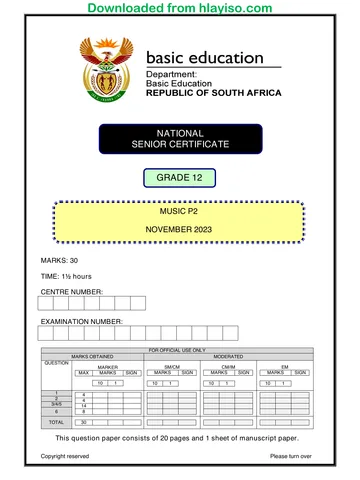
NATIONAL
SENIOR CERTIFICATE
GRADE 12
MUSIC P2
NOVEMBER 2021
MARKS: 30
TIME: 1½ hours
CENTRE NUMBER:
EXAMINATION NUMBER:
FOR OFFICIAL USE ONLY
MARKS OBTAINED MODERATED
QUESTION
MARKER SM/CM CM/IM EM
MAX MARKS SIGN MARKS SIGN MARKS SIGN MARKS SIGN
10 1 10 1 10 1 10 1
1 4
2 4
3/4/5 14
6 8
TOTAL 30
This question paper consists of 20 pages and 1 sheet of manuscript paper.
Copyright reserved Please turn over
Skip to contentAll 2021 papers 
View all
Music Grade 12 P2 NSC November 2021 Question Paper (English)
Grade 12 Music Paper 2 question paper from the NSC November Exam 2021 (English), 21 pages. Read online or get the free PDF download, memo linked when available.
Music · Grade 12 · NSC November Exam · 2021. Question paper, 21 pages. Read online or download the PDF.
- Subject
- Music
- Grade
- Grade 12
- Document type
- Question paper
- Year
- 2021
- Exam period
- NSC November Exam
- Paper
- 2
- Curriculum
- CAPS
- Pages
- 21
- File size
- 619.0 KB
Free to read online, no sign-up needed
Loading document…
Loading document…
1 of 21
This exam
NSC November Exam 2021
Questions in this paper
- Question 1Notation, Rhythm & Metre4 marks
- Question 2Harmony, Chords & Composition4 marks
- Question 3Indigenous African Music (IAM) — General Knowledge & Set Works [IAM]46 marks
- Question 4Western Art Music (WAM) — General Knowledge & Set Works [WAM]14 marks
- Question 5Western Art Music (WAM) — General Knowledge & Set Works [WAM]51 marks
- Question 6Notation, Rhythm & Metre8 marks
Document textSearch extracted text and jump to a page.
Downloaded from hlayiso.com
Music/P2 2 DBE/November 2021
NSC
INSTRUCTIONS AND INFORMATION
1. This question paper consists of THREE sections:
SECTION A: Aural (8)
SECTION B: Recognition of Music Concepts (14)
SECTION C: Form Analysis (8)
2. QUESTION 1, QUESTION 2 and QUESTION 6 are COMPULSORY.
3. Also answer QUESTION 3 (Indigenous African Music (IAM)) OR QUESTION 4
(JAZZ) OR QUESTION 5 (Western Art Music (WAM)).
4. Write ALL your answers on this question paper. Use a pencil for music notation
and blue or black ink for the other answers.
5. This examination will be done while candidates are listening to a CD.
6. The music teacher of the centre must conduct the examination in the presence
of the invigilator.
7. The last page of this question paper is manuscript paper intended for rough
work. The candidate must NOT remove this page.
8. Candidates may NOT have access to any musical instrument for the duration of
this examination.
9. Candidates must take note of the mark allocation of each question to provide
enough information in their answers.
10. Write neatly and legibly.
Copyright reserved Please turn over
Downloaded from hlayiso.com
Music/P2 3 DBE/November 2021
NSC
INSTRUCTIONS TO THE PERSON OPERATING THE SOUND EQUIPMENT
1. The instructions for the person operating the sound equipment appear in frames.
2. The number of each track must be announced clearly each time before it is
played.
3. Each music extract (track) must be played the number of times specified in the
question paper.
4. Allow adequate time between tracks to give candidates time to think and write
their answers before playing the next track.
5. If a school offers more than one stream (Western Art Music (WAM), Jazz,
Indigenous African Music (IAM)), the following guidelines must be followed:
Each stream must do the examination in a separate venue.
Each venue must be equipped with suitable sound equipment.
Each venue must have its own CD with music extracts.
An invigilator must be present in each venue.
6. The tracks have to be played as follows:
IAM candidates: Tracks 1 to 19 and Track 42
JAZZ candidates: Tracks 1 to 9, Tracks 20 to 30 and Track 42
WAM candidates: Tracks 1 to 9 and Tracks 31 to 42
7. A battery-powered CD player must be available in case of a power failure.
Copyright reserved Please turn over
Downloaded from hlayiso.com
Music/P2 4 DBE/November 2021
NSC
SECTION A: AURAL (Compulsory)
QUESTION 1
Play Track 1 TWICE in succession.
1.1 Notate the rhythm of the missing notes in bars 2 to 3 below.
(3)
Play Track 1 TWICE again.
Play Track 2 TWICE in succession.
1.2 Notate the missing notes at (A) and (B).
(1)
Play Track 2 again.
[4]
Copyright reserved Please turn over
Downloaded from hlayiso.com
Music/P2 5 DBE/November 2021
NSC
QUESTION 2
2.1 Identify the cadences at the end of each of the following TWO extracts.
Play Track 3 THREE times in succession.
2.1.1 Cadence: (1)
Play Track 4 THREE times in succession.
2.1.2 Cadence: (1)
Play Track 5 TWICE in succession.
2.2 Identify TWO prominent compositional techniques in this extract.
(2)
2.3 Answer the following questions by making a cross (X) in the appropriate block.
Play Track 6 ONCE.
2.3.1 Identify the genre/style of this music extract.
Bebop Blues Ragtime Dixieland (1)
Play Track 7 ONCE.
2.3.2 Which term best describes the rhythmic feel in this extract?
Irregular Straight Swing Polyrhythmic (1)
Play Track 8 ONCE.
2.3.3 Which term best describes the use of rhythmic texture?
Irregular rhythm Polyrhythmic Monorhythmic Free rhythm (1)
Play Track 9 ONCE.
2.3.4 Which ONE of the following describes the time signature?
Simple Compound Compound
quadruple duple triple (1)
(8 ÷ 2) [4]
TOTAL SECTION A: 8
Copyright reserved Please turn over
Downloaded from hlayiso.com
Music/P2 6 DBE/November 2021
NSC
SECTION B: RECOGNITION OF MUSIC CONCEPTS
Answer QUESTION 3 (IAM)
OR QUESTION 4 (JAZZ)
OR QUESTION 5 (WAM).
QUESTION 3: INDIGENOUS AFRICAN MUSIC (IAM)
Listen to the following tracks and answer the questions that follow.
Play Track 10 TWICE in succession.
3.1 Indicate THREE items in COLUMN A that relate to the music in Track 10.
Make a cross (X) in THREE appropriate blocks.
COLUMN A ANSWER
SATB
Major tonality
Cothoza
TTBB
A cappella
Improvisation
Chord cycle
Izibongo (3)
Play Track 11 TWICE in succession.
3.2 Indicate THREE items in COLUMN A that relate to the music in Track 11.
Make a cross (X) in THREE appropriate blocks.
COLUMN A ANSWER
Minor key
Concertina
Single-part texture
Repetitive accompaniment
Ascending melodic sequences
Uhadi accompaniment
Two-chord cycle
Praise poetry (3)
Copyright reserved Please turn over
Downloaded from hlayiso.com
Music/P2 7 DBE/November 2021
NSC
Play Track 12 TWICE in succession.
3.3 Identify the THREE features (3.3.1 to 3.3.3) heard in this extract.
3.3.1 Vocal technique:
3.3.2 Compositional technique:
3.3.3 Aerophone:
(3)
Play Tracks 13 and 14 in succession.
3.4 Compare the TWO extracts according the features below. Write your answers
in the spaces provided.
FEATURE TRACK 13 TRACK 14
Vocal
technique
Harmony
(Chords)
(4)
Copyright reserved Please turn over
Downloaded from hlayiso.com
Music/P2 8 DBE/November 2021
NSC
Play Tracks 15 and 16 in succession.
3.5 Describe ONE feature of the texture and ONE feature of the accompaniment
for EACH extract. Write your answers in the spaces provided.
Track 15: Texture
Track 15: Accompaniment
Track 16: Texture
Track 16: Accompaniment
(4)
Play Track 17 TWICE.
3.6 3.6.1 Name the style that you hear in this extract.
(1)
3.6.2 Describe the characteristics of direto/izibongo in this extract.
(3)
Play Track 18 ONCE.
3.6.3 Name SIX instruments of the backing band in this extract.
(3)
Copyright reserved Please turn over
Downloaded from hlayiso.com
Music/P2 9 DBE/November 2021
NSC
Play Track 19 ONCE.
3.7 Name the style that you hear in this extract.
(1)
Play Track 19 again.
3.8 Indicate THREE items in COLUMN A that you associate with the music that
you hear. Make a cross (X) in THREE appropriate blocks.
COLUMN A ANSWER
Vocal scoops
Repeated vocal phrase
Isicathamiya
Singer moves from singing to speaking
Ululation
Izibongo
Female vocal ensemble accompaniment
Ukuvamba by the lead guitar (3)
(28 ÷ 2) [14]
OR
Copyright reserved Please turn over
Downloaded from hlayiso.com
Music/P2 10 DBE/November 2021
NSC
QUESTION 4: JAZZ
Listen to the following tracks and answer the questions that follow.
Play Track 20 TWICE in succession.
4.1 Indicate THREE items in COLUMN A that relate to the music in Track 20.
Make a cross (X) in THREE appropriate blocks.
COLUMN A ANSWER
Muted trumpet plays the melody
Saxophone and trombone play a harmonic vamp
Chord cycle
Blues
Tremolo guitar
Big band
Compound duple
Bebop (3)
Play Track 21 TWICE in succession.
4.2 Indicate THREE items in COLUMN A that relate to the music in Track 21.
Make a cross (X) in THREE appropriate blocks.
COLUMN A ANSWER
Idiophones and membranophones
Syncopated melodic line on vibraphone
Irregular accents on the marimba
Piano
String section accompaniment
Melody in major key on electric guitar
Simple triple
Monophonic texture (3)
Copyright reserved Please turn over
Downloaded from hlayiso.com
Music/P2 11 DBE/November 2021
NSC
Play Track 22 TWICE in succession.
4.3 Describe THREE features (4.3.1 to 4.3.3) heard in this extract.
4.3.1 Instrumental
accompaniment:
4.3.2 Introduction:
4.3.3 Texture:
(3)
Play Tracks 23 and 24 in succession.
4.4 Compare the TWO extracts according to the music elements below. Write
your answers in the spaces provided.
ELEMENT TRACK 23 TRACK 24
Harmony
Rhythm
(4)
Copyright reserved Please turn over
Downloaded from hlayiso.com
Music/P2 12 DBE/November 2021
NSC
Play Tracks 25 and 26 in succession.
4.5 Describe TWO features of the melody for EACH extract. Write your answers
in the spaces provided.
Track 25: Melody
Track 26: Melody
(4)
Play Track 27 TWICE.
4.6 4.6.1 Name the style that you hear in this extract.
(1)
4.6.2 Describe the use of melody in this extract.
(3)
Play Track 28 ONCE.
4.6.3 Describe the function of the clarinet in this extract.
(1)
Play Track 28 again.
4.6.4 Besides the clarinet, name FOUR other instruments of the backing
band in this extract.
(2)
Copyright reserved Please turn over
Downloaded from hlayiso.com
Music/P2 13 DBE/November 2021
NSC
Play Track 29 ONCE.
4.7 Indicate THREE items in COLUMN A that you associate with the music that
you hear. Make a cross (X) in THREE appropriate blocks.
COLUMN A ANSWER
Saxophone and flute introduction
Big band
Bebop
12-bar blues
Short irregular phrases
The Jazz Pioneers
Trumpet
Walking bass (3)
Play Track 30 ONCE.
4.8 Identify the time signature in this extract.
(1)
(28 ÷ 2) [14]
OR
Copyright reserved Please turn over
Downloaded from hlayiso.com
Music/P2 14 DBE/November 2021
NSC
QUESTION 5: WESTERN ART MUSIC (WAM)
Listen to the following tracks and answer the questions that follow.
Play Track 31 TWICE in succession.
5.1 Indicate THREE items in COLUMN A that relate to the music in Track 31.
Make a cross (X) in THREE appropriate blocks.
COLUMN A ANSWER
Symphonic
Stringendo
Allegro
Romantic period
String orchestra
Second subject in major key
Concerto
Classical period (3)
Play Track 32 TWICE in succession.
5.2 Indicate THREE items in COLUMN A that relate to the music in Track 32.
Make a cross (X) in THREE appropriate blocks.
COLUMN A ANSWER
Pesante
Impressionistic period
Brass introduction
TTTB
Syncopation in melodic line
Orchestral tutti
Fortissimo introduction
Melismas (3)
Copyright reserved Please turn over
Downloaded from hlayiso.com
Music/P2 15 DBE/November 2021
NSC
Play Track 33 TWICE in succession.
5.3 Describe THREE features (5.3.1 to 5.3.3) heard in this extract.
5.3.1 Most prominent
compositional
feature:
5.3.2 Romantic feature:
5.3.3 Phrases:
(3)
5.4 Answer the following questions.
Play Tracks 34 and 35 in succession.
5.4.1 Compare the TWO extracts according to the given music elements.
Write your answers in the spaces provided.
ELEMENT TRACK 34 TRACK 35
Time
signature
Texture
(4)
Copyright reserved Please turn over
Downloaded from hlayiso.com
Music/P2 16 DBE/November 2021
NSC
Play Tracks 36 and 37 in succession.
5.4.2 Compare the TWO extracts according to the given music elements.
Write your answers in the space provided.
Track 36: Mood
Track 36: Articulation
Track 37: Mood
Track 37: Articulation
(4)
Play Track 38 TWICE in succession.
5.5 5.5.1 Name the character who sings in this extract.
(1)
5.5.2 Name the voice type that you hear in this extract.
(1)
5.5.3 Identify the woodwind instrument with a high pitch that you hear in
this extract.
(1)
Play Track 38 again.
5.5.4 Briefly describe the accompaniment of this aria.
(1)
Copyright reserved Please turn over
Downloaded from hlayiso.com
Music/P2 17 DBE/November 2021
NSC
Play Track 39 TWICE.
5.6 Choose THREE statements in COLUMN A that best describe the music that
you hear. Make a cross (X) in THREE appropriate blocks.
COLUMN A ANSWER
Theme played by the cellos initially
Motives played by the lower woodwinds
Cantabile melodies
Minor tonality
Clarinet and oboe play solo passages
Tranquillo section
Codetta section
Violins play the theme the second time (3)
Play Track 40 TWICE.
5.7 Describe the melody of the extract.
(3)
Play Track 41 TWICE.
5.8 Describe the accompaniment in this extract.
(1)
(28 ÷ 2) [14]
TOTAL SECTION B: 14
Copyright reserved Please turn over
Downloaded from hlayiso.com
Music/P2 18 DBE/November 2021
NSC
SECTION C: FORM ANALYSIS (Compulsory)
QUESTION 6
Read and study the questions for ONE minute.
Play Track 42 ONCE to provide an overview.
Copyright reserved Please turn over
Downloaded from hlayiso.com
Music/P2 19 DBE/November 2021
NSC
Play Track 42 again.
6.1 Name the overall form type of this piece.
(1)
6.2 Motivate your answer to QUESTION 6.1 by giving a schematic layout of the
form. Create rows in the table below and indicate EACH section with its
correlating bar numbers.
SECTIONS BAR NUMBERS
(3)
Copyright reserved Please turn over
Downloaded from hlayiso.com
Music/P2 20 DBE/November 2021
NSC
6.3 Name TWO ways in which the rhythmic motive, is used in this extract.
(2)
6.4 Name the prominent rhythmic feature used in bars 19 to 20.
(1)
6.5 Write down the meaning of D.C. al Fine in English.
(1)
Play Track 42 for a final overview.
TOTAL SECTION C: 8
GRAND TOTAL: 30
Copyright reserved
Downloaded from hlayiso.com
Music/P2 DBE/November 2021
NSC
Copyright reserved
Study this subject
Recommended for this subject
Question paper
Music Grade 12 P2 NSC November 2021 Question Paper (Afr)
Question paper
Music Grade 12 P1 NSC November 2021 Question Paper (English)
Question paper
Music Grade 12 P2 NSC June 2021 Question Paper (English)
Question paper
Music Grade 12 P2 NSC November 2023 Question Paper (English)
Question paper
Music Grade 12 P2 NSC November 2020 Question Paper (English)
Question paper
Music Grade 12 P2 NSC November 2019 Question Paper (English)
More from Grade 12 Music
Memorandum
Music Grade 12 Paper 1 NSC June 2025 Memo (Afrikaans)
Memorandum
Music Grade 12 Paper 2 NSC June 2025 Memo (Afrikaans)
Memorandum
Music Grade 12 Paper 2 NSC November 2025 Memo (English)
Memorandum
Music Grade 12 Paper 1 November 2024 NSC Memo (English)
Memorandum
Music Grade 12 Paper 1 NSC June 2024 Memo (English)
Question paper