
Downloaded from hlayiso.com
NATIONAL SENIOR CERTIFICATE EXAMINATION
NOVEMBER 2018
VISUAL CULTURE STUDIES: PAPER I
MARKING GUIDELINES
Time: 3 hours 100 marks
These marking guidelines are prepared for use by examiners and sub-examiners,
all of whom are required to attend a standardisation meeting to ensure that the
guidelines are consistently interpreted and applied in the marking of learners'
scripts.
The IEB will not enter into any discussions or correspondence about any marking
guidelines. It is acknowledged that there may be different views about some
matters of emphasis or detail in the guidelines. It is also recognised that,
without the benefit of attendance at a standardisation meeting, there may be
different interpretations of the application of the marking guidelines.
IEB Copyright © 2018 PLEASE TURN OVER
Skip to contentMemorandum 
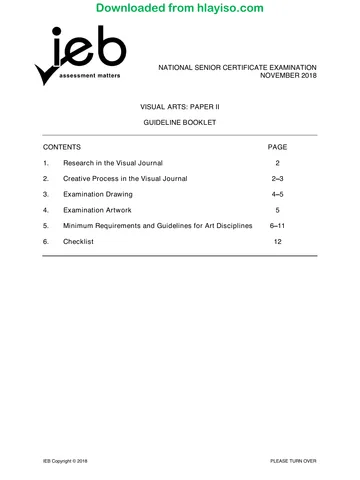
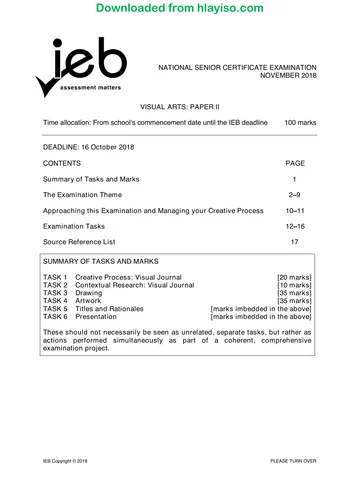
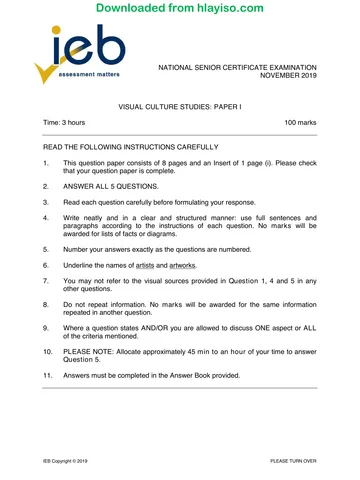
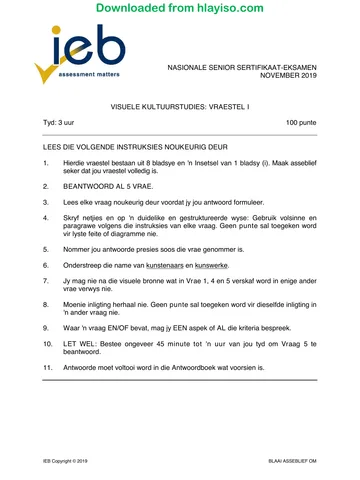
View all
Visual Arts Grade 12 IEB Paper 1 2018 Memo
IEB Grade 12 Visual Arts Paper 1 memorandum from the 2018, 11 pages. Read online or get the free PDF download, question paper linked when available.
Publisher: IEB
Visual Arts · Grade 12 · 2018. Memorandum, 11 pages. Read online or download the PDF.
- Subject
- Visual Arts
- Grade
- Grade 12
- Document type
- Memorandum
- Year
- 2018
- Paper
- 1
- Publisher
- IEB
- Curriculum
- IEB
- Pages
- 11
- File size
- 186.7 KB
Loading document…
Loading document…
1 of 11
Document textSearch extracted text and jump to a page.
Downloaded from hlayiso.com
NATIONAL SENIOR CERTIFICATE: VISUAL CULTURE STUDIES: PAPER I – MARKING GUIDELINES Page 2 of 11
QUESTION 1 VISUAL LITERACY
1.1 Blooms Taxonomy: Level 3 Applying.
• In Image A visual dominance is created by the yellow of Kwezi's shirt in
contrast to the blue of his pants and background.
• The artist achieved this by creating a large central figure with a plain
background.
• The figure also looks like it is advancing towards the viewer.
• The text at the top as well as the scorched/broken earth at the bottom
help to frame the figure making it the dominant subject.
• Any suitable answer.
1.2 Blooms Taxonomy: Level 4 Analysing.
2 marks for identifying why Image A is identified as a comic strip. 1 mark for an
atypical characteristic.
• He has exaggerated muscles for example.
• There is the use of "action lines" for example on either side of Kwezi
showing his downward movement.
• Kwezi has his fists clenched showing determination and/or power. Often
used in comic books.
• It is digitally available and not only in a gallery space. Multiple copies are
available and not a single painting/artwork.
• Bold outlines define the figure.
• Although the figure is naturalistic, it has been simplified.
• Although the figure is naturalistic, movement has been dramatised and
exaggerated similar to comic strips.
• Any suitable answer.
Possible atypical characteristics:
• Mohau, although idealised, is more naturalistic than a typical stylised
artwork.
• The signature of the artist is in the bottom right hand corner.
• There is no text bubble or any text, other than the signature, on the
artwork.
• Any suitable answer.
1.3 Blooms Taxonomy: Level 3 Applying and Level 4 Analysing.
• The figure is wearing clothing that is typical of the Basotho tribe. (African
tribe is also acceptable). His hat and blanket are part of his tribal attire.
• The image is Afrocentric as the subject wears a Basotho hat, African
jewellery and carries a knob-kierie/staff.
• His cloak is not typical of a super-hero cape but rather a Basotho
blanket.
• This attire emphasises the central figure – a black African male, as a
powerful and commanding hero.
• Any suitable answer.
IEB Copyright © 2018 PLEASE TURN OVER
Downloaded from hlayiso.com
NATIONAL SENIOR CERTIFICATE: VISUAL CULTURE STUDIES: PAPER I – MARKING GUIDELINES Page 3 of 11
1.4 Blooms Taxonomy: Level 4 Analysing.
• Image B-Mohau is portrayed as a strong muscular man.
• The low angle of the composition makes him seem powerful and
important.
• He avoids eye contact with the viewer making him an "untouchable
hero" and very idealised rather than naturalistic.
• Image C portrays a beautiful black woman who is naked.
• She is adorned with a massive headdress, making her seem important.
• The headdress also highlights the fact that she is naked.
• She also avoids eye contact making her seem untouchable or
mysterious.
• Any suitable answer.
1.5 Blooms Taxonomy: Level 5 Evaluating.
Argument for Image A
• This image is part of a comic strip and typically part of youth culture.
• It is more informal, using informal language and therefore inspires the
youth.
• It shows a contemporary, cool and youthful hero that the youth can
aspire to.
• Comics are widely accessible – something read in digital format and not
necessarily purchased in hardcopy. This links with the youth's
fascination with digital media.
• The book would be sold in shops that everyone would have access to.
• The topics that are dealt with in the comic book are relevant to the youth
of South Africa and the fact that this comic is published every month or
so means each edition/story is a new way to address important socio-
political issues.
Argument for Image C
• The image shows an ideal beauty and therefore the youth will enjoy this
image as it links with their aspirations.
• The images allow the youth to dream – the head garment of the model
is fantastical and dreamlike.
• The head garment shows a variety of images – and a variety of
interpretations. The youth could easily find individual relevance in the
symbolic images.
• The artwork shows complex images and symbols – something that
takes a while to unpack – something that entertains the youth on a
cerebral level.
• The image shows good skill – something that youthful artists could
aspire to and enjoy.
• Any suitable answer which is well substantiated.
IEB Copyright © 2018 PLEASE TURN OVER
Downloaded from hlayiso.com
NATIONAL SENIOR CERTIFICATE: VISUAL CULTURE STUDIES: PAPER I – MARKING GUIDELINES Page 4 of 11
QUESTION 2 ESSAY: CONCEPTUAL AND INTERNATIONAL CURRENT ART
RUBRIC
Candidates must critically consider the extent to which current and/or conceptual
international artists' work is able to transcend the artist's origin or cultural boundaries and
speak to humanity at large.
Potential valid arguments.
For
• There are themes that run throughout humanity that are the same. War, death, love,
peace. If an artist is talking about his/her own context the artwork still has the power to
speak to humanity at large if the artist has managed to move their audience.
• Most people who frequent art galleries have been educated. Being at a gallery means
you have an interest. Galleries also provide information about the artists and their
rationale. Taking this into consideration it is fair to say that if the work is powerful
enough many viewers would understand the work if they were told about the context
from which it came.
• Most artists consider themselves as global citizens and they deal with issues that are
prevalent within a global context. Arguably there are very few artists who only deal with
their specific culture and if they do, if the work is emotionally powerful enough it could
still move the audience.
Kiefer (A) was born on March 8, 1945 during the final months of World War II. The son of
an art teacher, Kiefer was drawn to art and saw himself as an artist. He was raised in a
Catholic home in the Black Forest near the eastern bank of the Rhine, (F) an environment
that would play a formative role in his development as an artist and would provide imagery
and symbolism for his work. (DA)
The artist is most known for his subject matter dealing with German history and myth (F),
particularly as it relates to the Holocaust. (DA) These works forced his contemporaries to
deal with Germany's past in an era when acknowledgment of Nazism was taboo. Kiefer
incorporates heavy impasto and uncommon materials into his pieces, such as lead, glass
shards, dried flowers, and strands of hay, many of which reference various aspects of
history and myth. Kiefer's repertoire of imagery is wide ranging, (F) incorporating
representational and symbolic motifs, including occult icons, architectural interiors, and
landscape elements to provoke an emotional and psychological effect on the viewer (DA).
Many of these make direct references to aspects of Germany's past, such as the forests
that evoke famous battles or the fairy tales of the Grimm Brothers. (F)
Derived from his interest in mythology, history, and knowledge, Kiefer often uses books as
subject matter representing knowledge and civilization. (F) Similarly, he frequently
incorporates text into his paintings, including excerpts from poems, novels, and nationalist
slogans as well as names of seminal figures, written in a scrawling script. (F)
In his work Nagflar, 1998, (W) which consists of a lead soldered boat which has been
placed on top of a stack of charred and shellacked books (DES), the artist makes
reference to the Norse myth of the Nagflar or Nagflari. This was a boat made entirely from
the fingernails and toenails of the dead. During the events of Ragnarök, Naglfar is foretold
to sail to Vígríðr, ferrying hordes that will do battle with the gods.(F MAX) The Nazi's were
heavily influenced by Norse Mythology and Kiefer therefore is making reference to this
influence and/or connection.
The fact that the boat is positioned on top of old unreadable books makes reference to
Kiefer's culture of storytelling and mythology. It also speaks of all of the inaccurate and
lost, but accurate, accounts of the atrocities of mankind, not only with reference to the
holocaust. (F Max). Even though this artwork arguably makes specific reference to the
heinous genocide that occurred during the Nazi regime it has a far reaching impact on
IEB Copyright © 2018 PLEASE TURN OVER
Downloaded from hlayiso.com
NATIONAL SENIOR CERTIFICATE: VISUAL CULTURE STUDIES: PAPER I – MARKING GUIDELINES Page 5 of 11
humanity in general. (DA) Firstly the Holocaust is a globally known historical event and
many people are familiar with what this event entailed (DA). In this way the artwork pays
homage to this aspect of history in his own unique manner. Secondly, Kiefer's work is
largely based on the premise that history will repeat itself indefinitely. Meaning that similar
events have occurred throughout history and many more events of this nature will occur in
the future. (DA)
Kiefer's work is deliberately designed to evoke a sense of nostalgia and remembrance. He
uses emotive media that arguably any viewer would understand. His work is dark and
sombre with an air of destruction about it. Even if you knew nothing about the Holocaust
one would still be moved by his post-apocalyptic visions. (DA)
Against
• We live in a global village and the concept of "culture" is iffy at best.
• Conceptual art is often all about the idea and has little or nothing to do with the artist's
origins from a cultural perspective.
• Regardless of what culture you come from one still needs to understand art in order to
appreciate it. Not everyone understands art nor have they been educated in this
manner.
Conceptual artist (M), Martin Creed (A), was born in Wakefield, England and studied art at
the Slade School of Art at University College London from 1986 to 1990. (F) Creed's work
often makes use of whatever medium seems suitable to his concept. Painting, films,
installations and live-action sculptures are all characteristic of his work. (F) Since 1987 he
has numbered each of his works, and most of his titles are descriptive: for example Work
No. 79: some Blu-tack kneaded, rolled into a ball and depressed against a wall (1993)
and Work No. 88, a sheet of A4 paper crumpled into a ball (1994). (F) This said, these
descriptive titles do little to explain the concept behind the artworks to the general public.
(DA) Thus leaving the public in the dark in terms of the underlying meaning behind his
work.
Creed's submission for the 2001 Turner Prize show at the Tate Gallery was Work No. 227:
The lights going on and off (W), which won that year's prize. (F) The work was an empty
room in which the lights switched on and off at 5 second intervals. (DES) As so often with
the Turner Prize, this created a great deal of press attention, most of it questioning
whether something as minimalist as this could be considered art at all. (DA and F)
His work has often excited negative reactions from the general public (DA): a visitor threw
eggs at the walls of Creed's empty room as a protest against the prize, (F) declaring that
Creed's presentations were not real art and that "painting is in danger of becoming an
extinct skill in Britain". (DA and F) MAX
This is further evidence to suggest that the public are flummoxed as to how his work could
be seen as art at all. (DA) It lacks all the conventions of what is universally and
traditionally considered as "art". (DA) It is lacking in artistic merit and added to this his
concepts are so obscure in their meaning that the result is the fact that his work is often
disregarded as not-understandable and therefore invalid. (DA)
Martin Creed's is the perfect example of an artist whose work does not transcend his own
cultural or biographical context because it makes no reference to any culture at all. (DA) It
could be argued that this was part of his intended meaning that he was trying to create an
art that had no cultural connotations and that the idea was the most important aspect.
(DA) This is obviously in keeping with the Conceptual Art Movement (F MAX) however
this does not mean that people who come from different cultures would understand it.
(DA) For one thing conceptual art relies heavily on a culture of learning. In other words
one has to understand what conceptual art is in order to appreciate it. This level of
IEB Copyright © 2018 PLEASE TURN OVER
Downloaded from hlayiso.com
NATIONAL SENIOR CERTIFICATE: VISUAL CULTURE STUDIES: PAPER I – MARKING GUIDELINES Page 6 of 11
understanding is not the norm and therefore this work would be lost on a lot of people. It
would be considered as novel or "clever" at best. (DA)
QUESTION 3 TWENTIETH CENTURY ART FROM DADA UP TO BUT
EXCLUDING CONCEPTUAL ART OF THE 1970s
Marks will be awarded to relevant and correctly selected artists and titles of
artworks with a brief description.
3.1 Blooms Taxonomy: Level 1 Remembering.
1 mark per relevant artist.
1 mark per artwork with a brief description.
Marcel Duchamp's LHOOQ 1919, consists of a reproduction of Leonardo
Da Vinci's Mona Lisa which has a moustache and goatee drawn onto her
face.
Andy Warhol's Campbell Soup cans 1962, consists of coloured screen-
printed images of Campbell's soup cans repeated across 32 20 inched
canvases.
3.2 Blooms Taxonomy: Levels 3–5
1 mark per artist explaining how they repurposed objects or used unusual
media and/or process. Applying Level 3–2 marks
1 mark per artist explaining what their views were about the world around
them. Analysing Level 4–2 marks
2 argument marks per artist explaining why this process of repurposing
objects could be viewed as a metaphor for the artist's views and opinions.
Evaluating Level 5–4 marks
Duchamp was a member of the Dada movement. As a movement they
were against the atrocities of WW1. (F)
They chose to express this by ridiculing art, music and literature. In
LHOOQ, Duchamp uses the reproduced image of Leonardo Da Vinci's
Mona Lisa as a metaphor for the epitome of development of Western
society. (F) As a rebellious act he defaces the icon by adding a moustache
and goatee. The famous work of art is further ridiculed by adding the letters
LHOOQ. Said quickly in French it sounds like the reader is saying she has
a hot piece of ass. (F). In this way the artist is aggressively but non-violently
attacking the conventions of Western society and what is deemed as
"socially acceptable". (A) He uses his "assisted readymade" which defaces
the icon of the Renaissance as a metaphor for his disdain for Western
Culture. (A) In other words, if the War is the peak of Western sophistication
and the Renaissance is seen as the highpoint of Western Civilisation, he
uses the destruction of this well-known image as a metaphor because
violence would be contradictory to his beliefs.
IEB Copyright © 2018 PLEASE TURN OVER
Downloaded from hlayiso.com
NATIONAL SENIOR CERTIFICATE: VISUAL CULTURE STUDIES: PAPER I – MARKING GUIDELINES Page 7 of 11
Andy Warhol was an American Pop Artist. The movement was also known
as neo-Dada because they borrowed the concept of using found objects,
i.e. "assisted ready-mades". The main underlying concept of this artist's
work was to pay homage to the growing societal popularity of celebrities
and popular culture. (F) Warhol believed that the art world had become
obsolete because the ideas/concepts and modes of working that were
being explored within this context at the time were too obscure for the
general public. (F) In the meanwhile the public had access to and could
understand the ever-growing world of advertising and cinematography. (F)
By creating an artwork using a popular branded commercial item he was
metaphorically commenting on the act of giving the general masses what
they knew. What they understood. (A) Furthermore, he realised that brands
in and of themselves had become icons. In other words they represented a
far greater meaning. A meaning that metaphorically and literally paid
homage to a capitalist society. (A)
3.3 Any relevant and substantiated argument should be considered valid.
Blooms Taxonomy: Level 5 Evaluating
Arguably both artworks are still relevant but of the two artworks Warhol's
artwork is perhaps more relevant today. There is still an ever-growing world
of advertising and people still find the art world rather obscure and difficult
to understand. (A) With the advent of social media, it could be argued that
people are more focused on their individual popularity and who they "follow"
on social media in comparison to who features in the current elitist art
world. (A) Added to this there are many artists like Banksy, who rely on Pop
art stylistic characteristics. Even today there are many who would hang a
Pop art image of Marilyn Monroe on their wall because of the cultural icon
she has become. Arguably this process was aided by the work of Andy
Warhol. (A)
IEB Copyright © 2018 PLEASE TURN OVER
Downloaded from hlayiso.com
NATIONAL SENIOR CERTIFICATE: VISUAL CULTURE STUDIES: PAPER I – MARKING GUIDELINES Page 8 of 11
QUESTION 4 RESISTANCE ART IN SOUTH AFRICA (1976–1994)
4.1 Blooms Taxonomy: Level 1 Remembering.
1 mark per relevant artist.
1 mark per artwork with a brief description.
Willie Bester, Forced Removals 1988. Which is a mixed media artwork
consisting of oil paint and scrap metal. It depicts a township scene with a
large yellow bulldozer scrapping away an iron shack.
Any other suitable example.
4.2 Blooms Taxonomy: Level 3 Apply
2 marks per discussion of social issues AND/OR artists biographical details.
This is largely dependent on the examples chosen by the artist.
Example of mark allocation:
Willie Bester was born in the town of Montagu near Cape Town in 1956 to a
Xhosa father who was a migrant labourer and a mother classified coloured.
(F) Under the Apartheid laws, Bester was classified "other coloured"
because his parents were defined as a mixed race couple. (F) His siblings,
were classified as black and registered in the name of their father, Vakele.
Under apartheid law, mixed race families were not allowed a home in the
"Coloured" areas of Montagu. The only lodgings available to migrant
workers, in Montagu as elsewhere, were single-sex hostels in large
compounds behind high fences. Therefore, the only circumstances in which
the family could be together during Bester's childhood was to live in informal
accommodation in other people's back yards. (F)
4.3 Blooms Taxonomy: Level 5 Evaluating.
2 marks per discussion of the artists' concept, mode of working, subject
matter AND/OR stylistic characteristics and how these aspects honour or
memorialise those who endured the Apartheid era.
Example of mark allocation:
Bester honed his technique and developed his characteristic use of mixed
media to express his political views by using a combination of photographs,
paint and found materials from township streets and nearby dumps. (A)
Thus his work is physically layered in symbolism from his environment. (A)
These technical developments were accompanied by a growing concern to
record the complex experience of township life and his own history within it.
(A) Forced Removals embodies his signature use of mixed media and it
deals with an aspect of apartheid history that would have affected him
personally on many levels. His works are all linked, because their subjects,
if they are not themselves set in the environment of the Western Cape
townships, are invariably represented in that context. (A)
IEB Copyright © 2018 PLEASE TURN OVER
Downloaded from hlayiso.com
NATIONAL SENIOR CERTIFICATE: VISUAL CULTURE STUDIES: PAPER I – MARKING GUIDELINES Page 9 of 11
4.4 Blooms Taxonomy: Level 6 Creating.
2 marks allocated in terms of the candidates ideas in terms of how to turn
the artwork into a "monument"
Example:
Willie Bester's Forced Removals could be recreated as a life sized
sculpture. (A) Willie Bester is well-known for his three-dimensional work
(Like, Who let the dogs out? 2002) and with a team of helpers he could
recreate the scene portrayed by forced removals using litter and rubbish
from the nearby surroundings. (A) In many ways the use of litter/rubbish
also refers to how his people were viewed under the National Party's rule.
2 marks allocated in terms of where the new "monument" should be
situated and 2 marks that refer to the impact this location may have on the
general public.
Example:
Willie Bester's Forced Removals monument could be placed outside of a
shopping mall, or even inside a shopping mall. (A) Everybody needs to
shop and therefore this would be the perfect place to make an impact on
the general public. I would put it inside the Bay West Mall as this is the
biggest mall in our area. Even though this work deals with Bester's
biographical experience in terms of where he grew up it must be said that
black and coloured people were forcibly displaced all over South Africa. (F)
Within the Eastern Cape South End was such an area that was once
occupied by predominantly black and coloured South Africans. There are
still land claims that are being processed till this day.
Any suitable answer
IEB Copyright © 2018 PLEASE TURN OVER
Downloaded from hlayiso.com
NATIONAL SENIOR CERTIFICATE: VISUAL CULTURE STUDIES: PAPER I – MARKING GUIDELINES Page 10 of 11
QUESTION 5 POST-APARTHEID (POST–APRIL 1994) SOUTH AFRICAN ART
5.1 Blooms Taxonomy: Level 3 Applying.
2 marks for identification of images and allocation of South African or global
references.
South Africa:
• The tag/text "New Money" – as a graffiti image.
• Graffiti is present throughout our cities.
• New Money possibly relates to our socio-economic realities after
apartheid. Many people embraced their economic freedom and came
into wealth. It is possibly also a derogatory term.
• Steve Biko
Global:
• Many images relate to popular global culture are included – and relate to
a specifically American cultural context.
• Statue of Liberty
• Mickey Mouse
• Keith Harring
• Neo-classical architecture, etc.
5.2 Blooms Taxonomy: Level 1 Remembering.
1 mark per relevant artist.
1 mark per artwork with a brief description.
Diane Victor, Smoke Portraits, which depicts a series of portraits of AIDS
victims from a Grahamstown clinic. The images are made from soot
deposits on paper.
Simon Max Bannister, Plastikos, which is sculpture in the shape of a
whirlpool made from discarded plastic found on the beaches of Durban. It
lived in the two Oceans Aquarium for a while in honour of National Marine
Month.
5.3 Blooms Taxonomy: Levels 4 Analysis and 5 Evaluation
5 marks per discussion of artwork.
Example of mark allocation:
Diane Victor has very cleverly chosen to talk about the devastating effects
of the aids virus. Her soot deposit drawings (F) depict real life victims of the
epidemic who live in Grahamstown and the surrounding areas. (F) The
medium she uses creates the illusion that the subjects are therefore a
fleeting moment and thus she refers to the fragility of life. (F) By using real
life people she is giving the disease an identity. She is making people more
aware about the suffering of these people. (F) Aids is often seen in the form
of statistics and thus Victor's work makes the concept of the Aids epidemic
more human. (F)
IEB Copyright © 2018 PLEASE TURN OVER
Downloaded from hlayiso.com
NATIONAL SENIOR CERTIFICATE: VISUAL CULTURE STUDIES: PAPER I – MARKING GUIDELINES Page 11 of 11
Bannister's work has an Afrikaans title which ties to a South African context.
(F) South Africa is well known for its blue flag beaches but unfortunately
due to overpopulation, lack of awareness and a lack of education (F) our
beaches and oceans are being destroyed by litter and human debris. (F)
The fact that the artwork is actually made from this rubbish is very symbolic,
(F) Bannister is referring to the act of recycling and he is making a beautiful
object from the actual problem, the litter. (F) He is thus forcing the viewer to
consider their actions. (F)
5.4 Blooms Taxonomy: Level 5 Evaluation
2 marks per artwork
Both artists have chosen themes that are relevant globally. Bannister's take
on pollution is a global issue and Victor's plight regarding aids is also
relevant all over the world. (A) Victor's choice of using real victims would
have carried the same message regardless of whose portraits she used or
their nationality. (A) Bannister could have collected rubbish from anywhere
in the world and his work would still have voiced a powerful message about
global pollution. (A) The location of both does not rely on a particular
cultural context and therefore they would work visually regardless of where
they were exhibited. (A) Both artists also use media that is innovative and
therefore this would attract any viewer regardless of their nationality. (A)
Total: 100 marks
IEB Copyright © 2018
Study this subject
Revise the topics in this paper, then practise them question by question.
- Grade 12 Visual Arts notes
CAPS revision notes with worked examples.
- Visual Arts questions by topic
Past exam questions sorted by CAPS topic, with memos where available.
- All Grade 12 Visual Arts past papers
Past papers by year, with memos where available.
- Grade 12 IEB past papers
More Visual Arts and other subjects in this collection.
Recommended for this subject
More papers and memos for this grade and subject.
MemorandumIEB
Visual Arts Grade 12 IEB Paper 1 2019 Memo
MemorandumIEB
Visual Arts Grade 12 IEB Paper 1 2019 Memo (Afrikaans)
MemorandumIEB
Visual Arts Grade 12 IEB Paper 1 2017 Memo
MemorandumIEB
Visual Arts Grade 12 IEB Paper 1 2016 Memo
AddendumIEB
Visual Arts Grade 12 IEB Paper 1 2019 Addendum
AddendumIEB
Visual Arts Grade 12 IEB Paper 1 2019 Addendum (Afrikaans)
Related documents
Question paperIEB
Visual Arts Grade 12 IEB Paper 1 2018 Question Paper
AddendumIEB
Visual Arts Grade 12 IEB Paper 2 2018 Addendum
Question paperIEB
Visual Arts Grade 12 IEB Paper 2 2018 Question Paper
Question paperIEB
Visual Arts Grade 12 IEB Paper 2 2018 Question Paper
Question paperIEB
Visual Arts Grade 12 IEB Paper 1 2019 Question Paper
Question paperIEB
Visual Arts Grade 12 IEB Paper 1 2019 Question Paper (Afrikaans)
More from Grade 12 Visual Arts
AddendumIEB
Visual Arts Grade 12 IEB Paper 2 2019 Addendum
AddendumIEB
Visual Arts Grade 12 IEB Paper 2 2019 Addendum (Afrikaans)
Question paperIEB
Visual Arts Grade 12 IEB Paper 2 2019 Question Paper
Question paperIEB
Visual Arts Grade 12 IEB Paper 2 2019 Question Paper (Afrikaans)
Question paperIEB
Visual Arts Grade 12 IEB Paper 2 2019 Question Paper
Question paperIEB