
Downloaded from hlayiso.com
NATIONAL SENIOR CERTIFICATE EXAMINATION
NOVEMBER 2019
VISUAL ARTS: PAPER II
Time allocation: From school's commencement date until the IEB deadline 100 marks
DEADLINE: 10 October 2019
CONTENTS PAGE
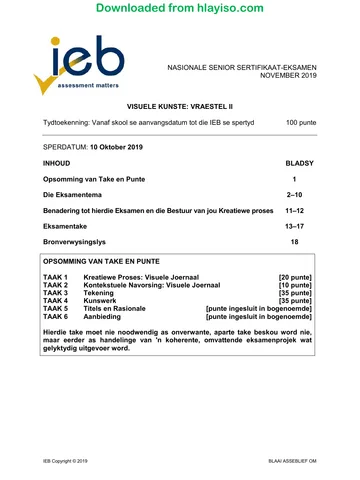
Summary of Tasks and Marks 1
The Examination Theme 2–10
Approaching this Examination and Managing your Creativity 11–12
Examination Tasks 13–17
Source Reference List 18
SUMMARY OF TASKS AND MARKS
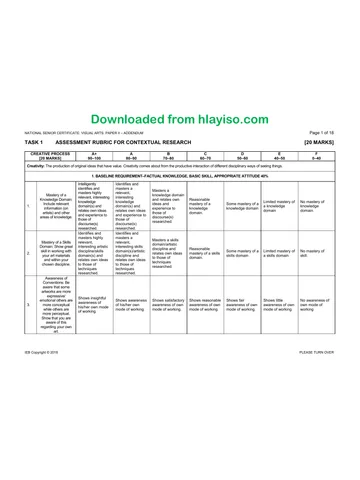
TASK 1 Creative Process: Visual Journal [20 marks]
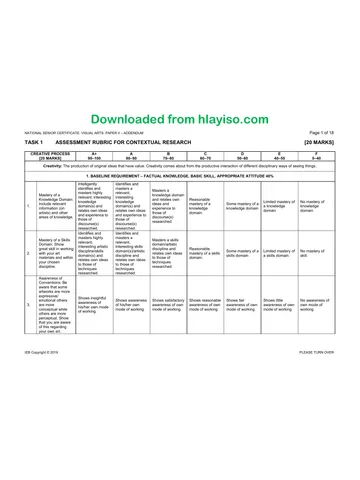
TASK 2 Contextual Research: Visual Journal [10 marks]
TASK 3 Drawing [35 marks]
TASK 4 Artwork [35 marks]
TASK 5 Titles and Rationales [marks imbedded in the above]
TASK 6 Presentation [marks imbedded in the above]
These should not necessarily be seen as unrelated, separate tasks, but rather as
actions performed simultaneously as part of a coherent, comprehensive
examination project.
IEB Copyright © 2019 PLEASE TURN OVER
Skip to contentQuestion paper 
View all
Visual Arts Grade 12 IEB Paper 2 2019 Question Paper
IEB Grade 12 Visual Arts Paper 2 question paper from the 2019, 18 pages. Read online or get the free PDF download, memo linked when available.
Publisher: IEB
Visual Arts · Grade 12 · 2019. Question paper, 18 pages. Read online or download the PDF.
- Subject
- Visual Arts
- Grade
- Grade 12
- Document type
- Question paper
- Year
- 2019
- Paper
- 2
- Publisher
- IEB
- Curriculum
- IEB
- Pages
- 18
- File size
- 1.2 MB
Loading document…
Loading document…
1 of 18
Document textSearch extracted text and jump to a page.
Downloaded from hlayiso.com
NATIONAL SENIOR CERTIFICATE: VISUAL ARTS: PAPER II Page 2 of 18
THE EXAMINATION THEME
Some things to consider:
Marina Abromović said: "We always project into the future or reflect on the past
but we are so little in the present."
In-between the past and the future is the present. This is the LIMINAL space. It is a
space which is transitional. When we are ready, we step out of this space and into the
future.
This space is often explored by artists as it is filled with potential.
Liminal spaces:
• are often at the margins or edges of our lives, which can make this position feel
unclear, and difficult to identify and define.
• can be seen as powerful, magic, dangerous, suspicious, mysterious, thoughtful
and new.
• allow for transformation.
• are transit zones, like airports or train stations, where people move from one
place to another. They are spaces of preparation for a change from one set of
rules and controls to another.
• are spaces of spiritual or social power outside of normal structures.
• are zones like disputed political territories, untouched nature, concentration camps,
shrines, shorelines and crossroads.
• are in-between spaces which can be filled with questions and dispute. While in this
space the disputes cannot be argued. It is a safe space. Issues can only be
addressed when the person has left the space. They do this by leaving and
moving on.
IEB Copyright © 2019
Downloaded from hlayiso.com
NATIONAL SENIOR CERTIFICATE: VISUAL ARTS: PAPER II Page 3 of 18
Read the following questions and record your responses in your visual diary to get
you started.
1. How do you relate, or have related to in the past, to the idea of a Liminal space;
where have you come from, where are you right now and where might you go on to
from this point? Consider your thoughts on the following:
• The position you find yourself in your life.
• Your position in your family.
• Your position in your social group.
• Your thoughts on the position of the country:
‒ Historically
‒ Socially
‒ Politically
‒ Economically and/or
‒ Environmentally
• Your thoughts on the position of the world:
‒ Historically
‒ Socially
‒ Politically
‒ Economically and/or
‒ Environmentally
2. What do you feel are the positive or negative aspects of your present position?
3. What do you see as the next step out of this space?
IEB Copyright © 2019 PLEASE TURN OVER
Downloaded from hlayiso.com
NATIONAL SENIOR CERTIFICATE: VISUAL ARTS: PAPER II Page 4 of 18
Consider the following examples which touch on LIMINALITY in a number of ways.
You may choose to only investigate the examples that you respond to. Write down
your thoughts on your chosen examples in your visual diary:
1
Marina
Abramović
The Artist is
Present (2010)
Performance
MOMA
New York
Use this link to find this work:
<http://bit.ly/IEB2019AbromovicImage>
Yugoslavian artist Marina Abramović explores the
You can use this link to watch relationship between performer and audience. She
a video about this work: is interested in the limits of the body, and the
possibilities of the mind. In this performance she
<http://bit.ly/IEB2019Abromovic> fully engages in the present moment with each
member of the public.
2 Poem about the Liminal
Liminal Space by The space between
Australian poet,
mentor and life coach Neither this, nor that Ripe,
Christine Mc Dougall. potent, uncertain, shaky
A Downing, a Dusking ...
the imminent threshold
emerging crossing ...
to what? Slow down
The moment is calling you
to pay ... exquisite ... attention...
IEB Copyright © 2019
Downloaded from hlayiso.com
NATIONAL SENIOR CERTIFICATE: VISUAL ARTS: PAPER II Page 5 of 18
3
Deborah Bell
Use this link to watch a video
This is What I am Here For (Breathe Through Me)
about this artist's work:
(2016)
<http://bit.ly/IEB2019Bellvideo>
Mixed Media on Paper
172 × 235 cm
Use this link to find this work:
<http://bit.ly/IEB2019BellImage>
Deborah Bell is a South African artist whose work brings together references from many
different cultures. She explores deeply personal, and often spiritual ideas, in her works.
The figures in her works are often alone, quiet and powerful. They often seem to be
waiting on the threshold, or readying themselves for something new; the next step.
IEB Copyright © 2019 PLEASE TURN OVER
Downloaded from hlayiso.com
NATIONAL SENIOR CERTIFICATE: VISUAL ARTS: PAPER II Page 6 of 18
4
Buhlebezwe
Siwani
Batsho
Bancama
(2017)
Sculptural
installation
(Green soap,
resin, enamel
containers, steel
and rose petals
Dimensions
variable
Use this link to find this work:
<http://bit.ly/IEB2019SiwaniImage>
Buhlebezwe Siwani is a South African artist and traditional
Use this link to healer, whose work explores the combination of a sacred space
read more about with personal reflections on her isiXhosa culture and the
this artist: liminal roles of women within this culture. The isiXhosa title of
this work translates to, "Bad Life".
<http://bit.ly/IEB20 She is also one of the founder members of the iQhiya Collective,
19SiwaniInfo> a group that was formed as a reaction to the lack of opportunity
in the South African art world for female black artists.
5
John Pace
After the Match (2015)
Oil on Canvas
100 × 80 cm
Use this link to find out more:
<http://bit.ly/IEB2019PaceImage>
John Pace is a South African artist who won the 2015 Sanlam Portrait Award with this
portrait of his son. This is a muddy and bedraggled depiction of a pre-teen boy, straight
from the rained out rugby. This image captures the in-between space of development in
a young person caught between childhood and the transition into a teenager.
IEB Copyright © 2019
Downloaded from hlayiso.com
NATIONAL SENIOR CERTIFICATE: VISUAL ARTS: PAPER II Page 7 of 18
6
Wilma Cruise
Use this link to find this image: Between (2015)
<http://bit.ly/IEB2019CruiseImage> Ceramic figures and steel bases
110 cm and 140 cm respectively
Wilma Cruise is a South African artist who is known for her thoughtful figure
sculptures.
In the sculpture Between, Cruise places two simplified figures in relation to each
other.
The way they are placed and the contrast between the black and the white figure
creates a tension between them and leads the viewer to consider what the
relationship is between these figures.
IEB Copyright © 2019 PLEASE TURN OVER
Downloaded from hlayiso.com
NATIONAL SENIOR CERTIFICATE: VISUAL ARTS: PAPER II Page 8 of 18
7
Igshaan Adams Use this link to read more about this artist:
When Dust Settles (2018) <http://bit.ly/IEB2019Adamscv>
Installation
Use this link to watch these videos about
Fencing wire, beads, white cotton the artist:
thread, face cloths, vinyl, and used and
well-worn linoleum floor panels. <http://bit.ly/IEB2019AdamsVideo1>
Standard Bank Art Gallery <http://bit.ly/IEB2019AdamsVideo2>
Igshaan Adams is a South African artists who deals with racial, religious and sexual
liminality. He was raised by Christian grandparents in a "coloured" community under
apartheid. He is a liberal and observant Muslim who is homosexual. His cross-
disciplinary, textured and symbolic works are an on-going exploration of the in-between
spaces he finds himself in due to his culture, faith and orientation.
IEB Copyright © 2019
Downloaded from hlayiso.com
NATIONAL SENIOR CERTIFICATE: VISUAL ARTS: PAPER II Page 9 of 18
8
Mary Sibande
A Reverse
Retrograde: Scene
1 (The Purple shall
Govern) (2013)
Fiberglass, vinyl,
metal, painted
wood, 100% cotton,
and polyester
Life-sized
Sculptures
Use this link to watch this Mary Sibande is a South African artist. She often uses an
video about the artist: alter-ego to bridge the liminal space of her works, which
deals with reclaiming the black female body in post-
<http://bit.ly/IEB2019MSib colonial and post-apartheid South Africa.
andeVideo>
In this work the figure in the Victorian dress refers to her
mother and grandmother who were domestic workers.
The second figure represents Sibande herself.
9
Banksy
If we wash our
hands of the conflict
between the
powerful and the
powerless we side
with the powerful –
we don't remain
neutral (2015)
Graffiti on the wall of a
ruin in the Gaza Strip
Banksy is an infamous international Graffiti artist whose work is often controversial. This
is an example of his Graffiti in the war torn Gaza Strip in the Middle East. He is clearly
attempting to draw conversation and debate. This work does not allow the viewer to
remain comfortably in the middle space of neutrality.
IEB Copyright © 2019 PLEASE TURN OVER
Downloaded from hlayiso.com
NATIONAL SENIOR CERTIFICATE: VISUAL ARTS: PAPER II Page 10 of 18
10 Jeeyoung
Right:
Nightscape (2012),
Inkjet photographic print
Right Below:
Monsoon Season
(2011)
Inkjet photographic print
Korean artist Jeeyoung
Lee creates imaginative
spaces in her room-sized
studio which are
otherworldly and
evocative.
You can use this link to
see these works and
others by this artist, and
also read about this
artist's work:
<http://bit.ly/IEB2019Jee
young>
IEB Copyright © 2019
Downloaded from hlayiso.com
NATIONAL SENIOR CERTIFICATE: VISUAL ARTS: PAPER II Page 11 of 18
APPROACHING THIS EXAMINATION AND MANAGING YOUR CREATIVITY
The sources given in this examination paper consider the idea of liminality, in-between
zones, areas of transition and ideas that relate to this.
In these examples, the artists explore a variety of liminal areas or issues. They do so in a
variety of ways. You are encouraged to explore these works and follow the links to enrich
your understanding of each artist's intentions and then build your own concept around this
theme. From this inspiration you are required to produce the following:
• a visual journal
• a drawing
• an artwork
• a title and rationale for both drawing and artwork
Engaging with Art and Visual Culture
By the end of the examination project, you will have researched and referred to the work
of at least six other artists whose work reflects similar or related concerns to yours, and
who work in a similar discipline to what you have chosen. This research must be shown in
your Visual Journal. You must explore how these artists have sparked something in your
own thinking, and how their work has helped you gain greater clarity of thought in the
making of your drawing and artwork.
Thinking as Doing: using your Creative Process to develop and refine your ideas
Also in your Visual Journal, you will document all the steps in your Creative Process
leading up to the presentation of your drawing as well as your artwork. Your research and
Creative Process should commence immediately upon receipt of this Examination Paper,
and should continue until you submit your work on the deadline date.
These tasks, outlined on the following pages, are compulsory. However, the order in
which you approach them must be informed by your own ideas and thinking process. You
may start with research of artists' work and then proceed to drawing your ideas,
perceptions and experiences in your Visual Journal afterwards. You may start drawing
immediately and allow your artwork and research to emerge out of the process of drawing.
Creativity is a cyclical as much as it is a linear process. You will need to go back and
forth, considering what you have done thus far; re-evaluating your processes and
products along the way. In this way, you will develop the depth of your response to the
examination convincingly.
IEB Copyright © 2019 PLEASE TURN OVER
Downloaded from hlayiso.com
NATIONAL SENIOR CERTIFICATE: VISUAL ARTS: PAPER II Page 12 of 18
Assessment
Your teacher has detailed assessment rubrics with all the criteria for success in this
examination. You are advised to familiarise yourself with these rubrics. Your response to
the examination will be assessed on the following three, broad, yet inter-related criteria:
1. Your ability to work skillfully with your chosen materials and composition
principles, i.e. form: do your Drawing and your Artwork show a mastery of
the chosen discipline(s), and take the viewer on an aesthetic journey?
2. Your original and creative thinking, concepts and the intentional meanings
explored by your work, i.e. content: does your work explore an interesting,
relevant interpretation of the theme at a sophisticated level?
3. The evidence of task-intensity, curiosity, perseverance, and commitment in
your response, as well as your ability to cope with the constraints of time and
space, i.e. context: does your work rise above the limitations of space and
circumstances in a sophisticated manner? Your Drawing and Final Artwork
should each take 4–6 weeks to produce, and this amount of effort should be
visible. Therefore, you cannot make a purely conceptual work that neglects
skill or materiality.
Guidelines and Requirements
Remember: You may work on your Visual Journal and Drawing tasks outside of the
school in your own time, but the Final Artwork may not be removed from the school
premises. It must be completed under teacher supervision.
It is your responsibility to read this Examination Paper and the Guideline Booklet
thoroughly before commencing with the project. Discuss the examination paper with your
teacher and your peers and take it home with you. Tasks 1 to 3 may be worked on away
from the school premises, but not the artwork task. The artwork (Task 4) must be worked
on entirely under teacher supervision.
NOTE: The above tasks are compulsory but need not necessarily be carried out in
strict numerical order. The process of creativity is organic and cyclical rather than
sequential and linear. You will need to go back and forth, considering and
reconsidering the various stages to develop and deepen your creative involvement
in the Examination assignment.
IEB Copyright © 2019
Downloaded from hlayiso.com
NATIONAL SENIOR CERTIFICATE: VISUAL ARTS: PAPER II Page 13 of 18
EXAMINATION TASKS
TASK 1 CREATIVE PROCESS: VISUAL JOURNAL [20 marks]
This is preparation for your drawing and artwork. It is a record of your responses to the
theme. Document your Creative Process fully in your Visual Journal.
Creative Exploration
• Use the images, texts and ideas presented on the previous pages as starting points and
stimuli as you document all your ideas, feelings, sketches and images in your Visual
Journal.
• State your interests and intentions for this Examination – but keep an open, flexible
mind. Your intentions may shift and change as your Creative Process develops.
• Include initial sketches and source material.
• Provide ideas written in your own words that explain your reasoning for portraying the
subject(s) you choose in the way you choose.
• Show that you are fluent in the ability to generate various ideas and possibilities, not
just one final idea.
• Carefully consider how you will represent your interpretation of this theme.
‒ Will your approach be intimate and personal, or public and bold?
‒ Will your drawing(s) and artwork(s) be naturalistic, stylised or abstract?
‒ Does a symbolic work communicate a deeper and more profound truth than a
naturalistic/photographic work? Or are the two even mutually exclusive?
‒ Your approach may be literal, it may be naturalistic, or it may be more symbolic or
poetic. What makes your artwork an artwork?
• Review, develop and elaborate your own visual language by engaging further in a
cyclical Creative Process in preparation for your drawing and artwork.
• Be flexible: your ideas may well have changed and are different to your initial
intentions, plans and goals.
• Use words, sketches, visualisations and technical experiments to develop your
artwork visually. Explore possibilities!
• With which medium are you engaging? What techniques and subject matter best suit
your intentions and interpretation of the theme? Decide wisely, and explain your
decisions in your Visual Journal.
• What signs and symbols from broader visual culture are you engaging with, in order to
make your work meaningful?
• As part of your Creative Process, consider the artworks you have already completed in
your Practical Assessment Task (PAT) practical portfolio.
• You are strongly advised to work with the same art discipline for this examination
project as you did in the PAT practical portfolio. (If you did sculpture in your PAT
portfolio, then this Examination work should also be a sculpture).
• Explain the connection between your PAT portfolio and your intentions for the
examination project in terms of your formal and conceptual concerns. This is an
important part of developing a personal visual language.
• For detailed guidelines regarding the Creative Process, refer to the relevant section in
the detailed guideline document.
IEB Copyright © 2019 PLEASE TURN OVER
Downloaded from hlayiso.com
NATIONAL SENIOR CERTIFICATE: VISUAL ARTS: PAPER II Page 14 of 18
TASK 2 CONTEXTUAL RESEARCH: VISUAL JOURNAL [10 marks]
Research is an important part of the process of making a successful artwork
• As part of your Creative Process, select and research at least six other visual
artists' work that you find inspiring for your artistic practice for each task (research
approximately three artists for your drawing and approximately three others for your
artwork).
• You may research the work of the artists featured in the sources provided or
research other artists' work.
• While researching, refine and adapt your ideas to fit your own intentions and goals for
this Examination project.
• Produce at least one detailed visual analysis of at least one work by the artist(s) you
have chosen. In your analysis you must refer to the theme. The analysis must be in
your own words. Stay away from the scourge of 'copy-paste'! Simply copying and
pasting text from an authoritative source does not constitute adequate research. You
should show evidence of internalisation of your research.
• Acknowledge all your source material using the Harvard Technique of referencing.
• Explain why the artworks you research are relevant to your own intentions and
plans for the Examination drawing and artwork tasks.
• For detailed guidelines concerning contextual research, refer to the appropriate
section in the detailed guidelines document.
• Document any further artworks that are inspiring you in your Creative Process.
• You may find that you need to research other area(s) of visual culture and/or
knowledge.
• Have any of the artists, artworks or areas of knowledge you researched for your PAT
Art projects recurred in your Visual Journal for this Examination? If so, acknowledge
this. It is an important aspect of developing your personal visual language.
IEB Copyright © 2019
Downloaded from hlayiso.com
NATIONAL SENIOR CERTIFICATE: VISUAL ARTS: PAPER II Page 15 of 18
TASK 3 DRAWING [35 marks]
• Produce a series of Process Drawings for display.
OR
• Produce at least one End-Product Drawing for display.
• Your drawing should take 4–6 weeks to complete.
• Work on your Visual Journal and your drawing concurrently.
• If you choose the Process Drawing option, then your drawings must be displayed
professionally and not be left in the journal.
NB: Your drawing must be created from some form of marking or scarifying a
surface in a mostly-dry manner and not some other art form. If you choose to make
a drawing that does not conform to this understanding, then you must explain your
motivation for doing so and describe how your work counts as drawing in your
Visual Journal. Omission of such an explanation where required will inevitably
result in penalisation.
How does one understand "drawing"?
A drawing is a series of relatively spontaneous marks on a surface. An acrylic painting is
not a drawing and a photograph is not a drawing – unless you explain in detail how it
could be seen as such. If you present a drawing that is not traditional, you must justify
how your submission may be understood conceptually as a drawing. It is an important
skill to master: nineteenth-century art critic and artist John Ruskin said, "Drawing is a
means of obtaining and communicating knowledge". Think carefully about what makes a
drawing different from a painting or a sculpture or a photograph. Consider the reasons
why drawing is such an important part of an artist's working process.
For detailed guidelines regarding your drawing as well as a detailed explanation of
the differences between process drawing and end-product drawing, refer to the
appropriate sections in the guideline booklet.
IEB Copyright © 2019 PLEASE TURN OVER
Downloaded from hlayiso.com
NATIONAL SENIOR CERTIFICATE: VISUAL ARTS: PAPER II Page 16 of 18
TASK 4 ARTWORK [35 marks]
• Having selected your art discipline for the examination, produce your artwork for
display.
• You may not work on your artwork without teacher supervision.
NB: Photography candidates: all photographic shoots must be carried out by you, the
candidate, and not by somebody else. If you are the subject of your own photographs,
then you must show that you have composed your own photographs and not somebody
else. If an assistant is used to actually shoot photographs of you, then this must be
acknowledged in the Visual Journal. Use a substitute model to take your place posing for
your shoot, while you compose each shot and decide on camera settings. You must show
the additional planning shots that you have taken beforehand in your Visual
Journal to prove that the technical composition and shooting are your decision-making
and work and not that of the person taking the shot or anybody else. No professional
photographer or any other person is allowed to compose and shoot the photographs on
your behalf.
For detailed guidelines regarding your artwork, refer to the appropriate sections in
the guideline booklet.
IEB Copyright © 2019
Downloaded from hlayiso.com
NATIONAL SENIOR CERTIFICATE: VISUAL ARTS: PAPER II Page 17 of 18
TASK 5 TITLES AND RATIONALES
• Create an appropriate and interesting title for both your drawing(s) AND your artwork(s).
• Type and print out two separate rationales of no more than 150–200 words each.
• Display your rationales, titles and examination number alongside your drawing and
your artwork.
TASK 6 PRESENTATION
Your drawing and your artwork must be displayed as professionally as possible. Label
your drawing(s) and your artwork as follows:
Name
Examination Number
Title
Examination Drawing/
Examination Artwork
SEE THE ACCOMPANYING BOOKLET FOR DETAILED GUIDELINES ON SPECIFIC
DISCIPLINES.
IEB Copyright © 2019 PLEASE TURN OVER
Downloaded from hlayiso.com
NATIONAL SENIOR CERTIFICATE: VISUAL ARTS: PAPER II Page 18 of 18
SOURCE REFERENCE LIST
1. VIAD FADA – Visual Identities in Art and Design Research Centre, Faculty of Art,
Design and Architecture, University of Johannesburg, 2011. Space, Ritual,
Absence: The Liminal in South African Art curated by James Sey in collaboration
with VIAD. [ONLINE] Available at: <https://www.viad.co.za/space-ritual-absence-3>
[Accessed 15 November 2018].
2. Museum of Modern Art New York: Marina Abramović: The Artist Is Present 2010,
Organized by Klaus Biesenbach, Chief Curator at Large, The Museum of Modern
Art, and Director, PS1 Contemporary Art Center. [ONLINE] Available at:
<https://www.moma.org/calendar/exhibitions/964>. [Accessed 17 November 2018].
3. Everard Read London. Deborah Bell – Dreams of Immortality: Blood and Gold.
2016. [ONLINE] Available at: <https://www.everardlondon.com/exhibition/14>.
[Accessed 4 January 2019].
4. Christine Mc Dougal. Liminal Space Poem. 2010. [ONLINE] Available at:
<https://za.pinterest.com/pin/350999364703276893>. [Accessed 20 November 2018].
5. Art Africa – Buhlebezwe Siwani: Liminal spaces, 2016. [ONLINE] Available at:
<http://artafricamagazine.org/buhlebezwe-siwani-liminal-spaces>.
[Accessed 15 November 2018].
6. Sanlam. 2015. Sanlam Portrait Award 2015 Winner Announced. [ONLINE]
Available at:<https://www.sanlam.co.za/mediacentre/media-category/media-
releases/John%20Pace%20Wins%20Sanlam%20Portrait%20Award%202015>.
[Accessed 19 November 2018].
7. Creative Feel – Sanlam Portrait Award 2017 Top 40 Exhibition, 2018. [ONLINE]
Available at: <https://creativefeel.co.za/2018/01/sanlam-portrait-award-2017-top-
40-exhibition>. [Accessed 19 November 2018].
8. University of Pretoria – The Princess in the Veld: Curating Liminality in
Contemporary South African Female Art Production, curated by Delaida Adele
Adendorff. [ONLINE] Available at: <https://repository.up.ac.za/handle/2263/63007>.
[Accessed 15 November 2018].
9. Courney Drusdale. 2018. Uncanny Nostalgia: Igshaan Adams' 'When Dust Settles' –
ArtThrob. [ONLINE] Available at: <https://artthrob.co.za/2018/07/10/uncanny-
nostalgia- igshaan-adams-when-the-dust-settles>. [Accessed 17 November 2018].
10. Blank. 2018. Igshaan Adams CV and Bio. [ONLINE]
Available at: <http://www.blankprojects.com/ cv-and-bio/igshaan-adams>.
[Accessed 17 November 2018].
11. South African History – SAHO – Mary Sibande Biography, 2018. [ONLINE]
Available at: <https://www.sahistory.org.za/people/mary-sibande>.
[Accessed 19 November 2018].
12. The British Museum – A Revered Retrograde – 2017. [ONLINE] Available at:
<https://britishmuseum.tumblr.com/post/151475978007/a-reversed-retrogress>
[Accessed November 2018].
13. Kurt Kohlstedt. 2015. Gaza Strip Graffiti: Artist Banksy Tunnels Back Into Palestine.
Web Urbanist: Architecture, Art, Design and Built Environment. [ONLINE] Available at:
<https://weburbanist.com/2015/02/28/gaza-strip-graffiti-artist-banksy-tunnels-back-
into-palestine>. [Accessed 20 November 2018].
14. Nina Azzarello. 2016. Jeeyoung lee handcrafts intricate and imaginative landscapes
in her room-sized studio. Designboom. [ONLINE] Available at:
<https://www.designboom.com/art/jeeyoung-lee-interview-installation-03-23-2016/>.
[Accessed 15 November 2018].
IEB Copyright © 2019
Study this subject
Revise the topics in this paper, then practise them question by question.
- Grade 12 Visual Arts notes
CAPS revision notes with worked examples.
- Visual Arts questions by topic
Past exam questions sorted by CAPS topic, with memos where available.
- All Grade 12 Visual Arts past papers
Past papers by year, with memos where available.
- Grade 12 IEB past papers
More Visual Arts and other subjects in this collection.
Recommended for this subject
More papers and memos for this grade and subject.
Question paperIEB
Visual Arts Grade 12 IEB Paper 2 2019 Question Paper
Question paperIEB
Visual Arts Grade 12 IEB Paper 2 2019 Question Paper (Afrikaans)
Question paperIEB
Visual Arts Grade 12 IEB Paper 1 2019 Question Paper
Question paperIEB
Visual Arts Grade 12 IEB Paper 1 2019 Question Paper (Afrikaans)
Question paperIEB
Visual Arts Grade 12 IEB Paper 2 2019 Question Paper (Afrikaans)
Question paperIEB
Visual Arts Grade 12 IEB Paper 2 2018 Question Paper
Related documents
AddendumIEB
Visual Arts Grade 12 IEB Paper 2 2019 Addendum
AddendumIEB
Visual Arts Grade 12 IEB Paper 2 2019 Addendum (Afrikaans)
Question paperIEB
Visual Arts Grade 12 IEB Paper 2 2018 Question Paper
Question paperIEB
Visual Arts Grade 12 IEB Paper 2 2016 Question Paper
Question paperIEB
Visual Arts Grade 12 IEB Paper 2 2016 Question Paper
AddendumIEB
Visual Arts Grade 12 IEB Paper 1 2019 Addendum
More from Grade 12 Visual Arts
AddendumIEB
Visual Arts Grade 12 IEB Paper 1 2019 Addendum (Afrikaans)
MemorandumIEB
Visual Arts Grade 12 IEB Paper 1 2019 Memo
MemorandumIEB
Visual Arts Grade 12 IEB Paper 1 2019 Memo (Afrikaans)
AddendumIEB
Visual Arts Grade 12 IEB Paper 2 2018 Addendum
Question paperIEB
Visual Arts Grade 12 IEB Paper 1 2018 Question Paper
MemorandumIEB