
Downloaded from hlayiso.com
NATIONAL SENIOR CERTIFICATE EXAMINATION
NOVEMBER 2016
VISUAL ARTS: PAPER II
GUIDELINE BOOKLET
CONTENTS PAGE
1. Contextual Research in the Visual Journal 2
2. Creative Process in the Visual Journal 2–5
3. Examination Drawing 5–7
4. Examination Artwork 7–8
5. Minimum Requirements and Guidelines for Art Disciplines 9–13
6. Checklist 14
IEB Copyright © 2016 PLEASE TURN OVER
Skip to contentQuestion paper 
View all
Visual Arts Grade 12 IEB Paper 2 2016 Question Paper
IEB Grade 12 Visual Arts Paper 2 question paper from the 2016, 14 pages. Read online or get the free PDF download, memo linked when available.
Publisher: IEB
Visual Arts · Grade 12 · 2016. Question paper, 14 pages. Read online or download the PDF.
- Subject
- Visual Arts
- Grade
- Grade 12
- Document type
- Question paper
- Year
- 2016
- Paper
- 2
- Publisher
- IEB
- Curriculum
- IEB
- Pages
- 14
- File size
- 202.2 KB
Loading document…
Loading document…
1 of 14
Document textSearch extracted text and jump to a page.
Downloaded from hlayiso.com
NATIONAL SENIOR CERTIFICATE: VISUAL ARTS: PAPER II – GUIDELINE BOOKLET Page 2 of 14
1. CONTEXTUAL RESEARCH IN THE VISUAL JOURNAL
• Conducting contextual research and documenting the creative process should not be
seen as two separate, unrelated tasks, but rather as natural processes that happen
simultaneously.
• This research is not an academic essay, nor is it your Research Response Essay for your
Visual Culture Studies portfolio. It is a selection of images and your responses to them.
• You should preferably use a separate journal for your examination assignment. If you
choose to do your examination assignment in your SBA Visual Journal, indicate the
examination section clearly with a tab or bookmark.
ASSESSMENT CRITERIA – Research in the Visual Journal [10 Marks]
The following are detailed assessment criteria for success in this Examination. They are derived from the
assessment rubrics in your teacher's possession. You may request access to the rubrics.
Select research material that links to your individual creative process.
Research a wide variety of examples, not just one.
Research relevant and appropriate material.
Motivate your selection of artworks in your own words. (Don't simply copy and paste information.
Highlight relevant sections in any copy-pasted texts.)
Show openness to experience: Allow your research to have an effect on your own interests, interpretations,
intentions and judgments.
Relate your own work to the sources you research. Explain conceptual and/or technical links.
Explore the links between your researched artworks and the Project Theme in your analyses and
annotations.
Analyse, juxtapose, compare and evaluate your selected examples. Explain what it is that you find inspiring
in the artworks you research.
Investigate artistic techniques, within visual culture, past and present.
Contextual research could go beyond researching the work of artists: It could relate to social, scientific,
philosophical, spiritual issues as well as elements of your personal experiences that have influenced your
work.
Your research will help you to consider the viewer's response to your work.
Sustain research throughout the process of making your artwork. Research enough images and ideas to
sustain your creative development.
Reference your images thoroughly. Acknowledge your sources alongside each image and/or text you use.
2. CREATIVE PROCESS IN THE VISUAL JOURNAL
Document your creative process for both your drawing and your artwork in your Visual
Journal. You may use two separate sections – one for the drawing and one for the artwork, or
work on both concurrently. Documenting your creative process is a crucial aspect of creating
an original, innovative, and relevant artwork. It should be an on-going process recording how
your ideas evolve and change. Your Visual Journal must communicate your ideas, processes
and technical procedures to the examiner. It should also show how the creative process has
IEB Copyright © 2016 PLEASE TURN OVER
Downloaded from hlayiso.com
NATIONAL SENIOR CERTIFICATE: VISUAL ARTS: PAPER II – GUIDELINE BOOKLET Page 3 of 14
benefited you in helping you to make informed decisions based on continuous making,
observation and self-critical reflection.
Although the creative process is allocated only 20 marks, it permeates every aspect of
your work. It is impossible to achieve a high mark in any of the other sections without
an excellent creative process.
The Creative Process is Both Linear and Cyclical:
A linear creative process involves encountering an opportunity for creativity, then thinking
about the problem/opportunity, conducting research, incubating, then experiencing an
illuminating idea, then finally creating the artwork.
A cyclical creative process involves higher-order thinking, and is a very important part of the
incubation/illumination stage. This means that, throughout your creative processes of
researching, visualising, developing, creating and presenting, you continuously and
purposefully reflect on your work and revisit your creative process and research in order to
make your work really excellent and valuable.
Guidelines and Recommendations for Your Creative Process:
• Present several pages of evidence related to the conceptual and technical development of
your Artwork, using any appropriate form of documentation.
• Annotate all visual material.
• Transform your source material. Don't copy.
• Include a variety of planning sketches. (These are not your examination drawings but may
develop into your examination drawing(s).)
• Include a variety of forms of visualisation (photographs, collages, objects, etc.) that
clearly show your problem-solving and visualisation processes.
• Properly reference all source material used in the artwork. Acknowledge your sources.
• Document all digital procedures clearly. See below for acknowledging digital procedures.
• Document all three-dimensional experiments and Marquettes photographically in your
journal and, if necessary, present the actual experiments with your Visual Journal.
• Reflect and evaluate continuously as part of a cyclical creative process. Be self-critical.
• Paste all your process work into your Visual Journal. No loose pages will be assessed.
Rationale
• At the end of your process, you will display concise, typed rationales of 150–200 words
each, next to your drawing(s) and your artwork. (The examiners will consider information
exceeding 200 words irrelevant.) A lengthier version may be included in your Visual
Journal.
• In your Journal, explain your concept in response to the Examination Theme.
• Explain how you arrived at your visual solutions. Explain your approach and your choice
of medium. Show awareness that your work is a form of visual communication. Also
include and explain the titles of your drawing and your artwork.
Digital Procedures in the Creative Process
• Using new technology does not automatically translate into high marks – the resulting
work must still be well conceptualised, justified and well presented. If you choose to
produce a digital artwork, or just use digital technology as part of your creative process,
you must document your processing in detail.
IEB Copyright © 2016 PLEASE TURN OVER
Downloaded from hlayiso.com
NATIONAL SENIOR CERTIFICATE: VISUAL ARTS: PAPER II – GUIDELINE BOOKLET Page 4 of 14
• Exploration and experimentation should take place during the early phases of the creative
process. Adobe® Photoshop® or similar applications should be seen as tools that assist
you as an artist or photographer, and not as the driving force in creating a successful
artwork/end product.
• It is most often best to generate your own source material rather than using found sources.
Generate your own sources by taking your own photographs, scanning objects and
textures, drawing, etc. You should focus on developing your ability to produce and
originate a creative artwork, rather than relying solely on combining and reworking found
material.
• If you choose to produce work digitally, you should investigate a variety of ideas and do
the necessary research before drawing conclusions about the chosen route.
• Avoid relying on filters simply to create an interesting end product. Do not experiment
with the use of filters and effects in a simple, random manner until a satisfactory end
product is 'discovered'. (Experimentation should be part of the work in the Visual Journal
and not necessarily the end product.) Use filters in a discerning, deliberate, intentional and
meaningful manner.
• Print screenshots of your changes to the source images.
• Annotate screenshots, explaining the tools that you use and the changes you make to your
source material. Explain these changes in relation to your intention and to your
interpretation of the Examination Theme.
• Show the layers that make up the image by printing these out separately. You will earn
better marks by showing explicitly the complex combination of layers that compose an
image.
• Create contact prints of your own photographs. (Also refer to Digital Photography further
on in this document.)
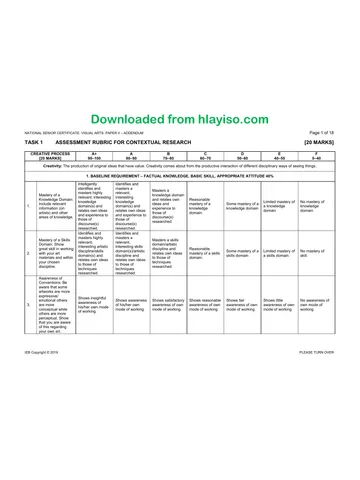
ASSESSMENT CRITERIA – Creative Process in the Visual Journal [20 Marks]
The following notes provide detailed assessment criteria and guidelines for success in this examination. They
are derived from the assessment rubrics in your teacher's possession. You may request access to the rubrics.
Include relevant research information (on artists) and other areas of knowledge.
Show great skill in working with your art materials and within your chosen discipline.
Be aware that some artworks are more expressive/emotional; others are more conceptual; while others are
more perceptual. Show that you are aware of this regarding your own art. Document technical procedures
thoroughly, especially for digital work.
Manage your time effectively.
Don't give up. Keep at it. Don't be discouraged.
Show real interest and involvement.
Generate many ideas around the theme rather than settling on only one.
Experiment with various possibilities by sketching and writing. Combine different categories of ideas,
experiences, feelings and action, e.g. technical, emotional, sensory and intellectual ideas and experiences.
Develop selected ideas by adding relevant details.
Avoid cliché. Find innovative, novel and unusual ideas, methods and actions.
Define the creative problem(s) you, personally, are interested in solving, based on the given theme.
IEB Copyright © 2016 PLEASE TURN OVER
Downloaded from hlayiso.com
NATIONAL SENIOR CERTIFICATE: VISUAL ARTS: PAPER II – GUIDELINE BOOKLET Page 5 of 14
ASSESSMENT CRITERIA – Creative Process in the Visual Journal [continued]
Deal with the unknown by taking chances, experimenting with new ideas or trying new technical challenges
within your chosen discipline. Take chances in your thinking, attempt tasks for which the outcome is
unknown.
Follow your hunches, question alternatives, ponder outcomes and wonder about options:
“What would happen if…?”
Visualise possibilities, build images in your mind and through drawing; picture new objects; reach beyond
the limits of what seems practical.
Having made sketches, selected your sources and expressed ideas in words, look at them, and be critical.
Think about how you might change them and improve them to make them your own and make them
innovative.
Look for novel connections between ideas, artworks, objects and techniques.
When working with sources, don't take them simply at face value. Transform them and make them your own,
rather than simply copying them.
When working with sources, are you simply stealing someone else's idea, or are you being ethical and
responsible and contributing something new to visual culture?
Find visual equivalents for your ideas, feelings, symbols and concepts. Develop a personal style.
Develop your visual language until it becomes elaborate and complex.
The medium you choose can be very significant and meaningful. For example, Joseph Beuys chose to work
with felt and copper. Explain your reasoning behind the media and materials with which you choose to work.
Explain how and why your interpretation of the theme is important to you. Art is about subjectivity.
Reveal your own attitudes, beliefs and feelings.
Explain how and why your interpretation is also relevant to your community and to society. Why would
people want to look at or purchase your art? Imagine the various messages and meanings a range of viewers
might receive when viewing, experiencing and studying your artwork.
Analyse, refine, and select the most valuable and original options. Eliminate the unnecessary.
3. EXAMINATION DRAWING
Drawing Media and Definitions of a Drawing
A drawing is defined broadly as any artwork involving a predominance of line and/or mark-
making. You are encouraged to explore various definitions of 'drawing' and challenge what is
traditionally perceived as drawing. Choose an appropriate medium suitable to your expressive
and conceptual concerns. Justify your choices clearly to convince the examiner/marking panel
of your critical engagement and informed decision-making. If you choose to work in a non-
traditional way, avoid arbitrary choice of medium.
Portfolio of Drawings
Throughout the process of developing ideas for this examination, it is advisable to keep a
separate portfolio for all your drawings and sketches. This may form the basis of the
presentation of a series of process drawings, or as preparation for your end-product
IEB Copyright © 2016 PLEASE TURN OVER
Downloaded from hlayiso.com
NATIONAL SENIOR CERTIFICATE: VISUAL ARTS: PAPER II – GUIDELINE BOOKLET Page 6 of 14
drawing(s). Drawing(s) may be process drawing OR end-product drawing. Carefully
consider the explanation of the difference between these options before making your choice:
• Process drawing
Process drawing is an explorative, experimental series of many drawings. Process
drawings demonstrate the technical and conceptual development process that leads
towards your artwork. The medium chosen for process drawing may communicate
meaning. Consider your choice of medium carefully. Create your process drawings before
creating your artwork; your process drawings should assist you in making decisions about
your artwork. You may choose to start doing process drawings in your Visual Journal.
Make a selection of these drawings for display and assessment purposes of the drawing
task. Any further process drawings in the Visual Journal will not be assessed as part of the
drawing component, but rather as part of the creative process. You will be assessed on
your skill in using any drawing technique of your choice to help you to visualise and
develop your artwork. Challenge yourself to try something new in drawing. Don't just
copy. Experiment. Innovate. Be creative!
• End-product drawing
End-product drawing is at least one larger, technically and conceptually resolved drawing.
You will be assessed on your skill in using any drawing technique of your choice to create
one or more resolved drawings. You may create more than one end-product drawing,
depending on the nature of your work.
Clear and Creative Response to the Examination Theme
Your drawing(s) should not be simply a replica of or a prototype for your artwork. Your
drawing(s) rather should be technical and conceptual explorations of the Examination Theme.
Planning
Use your Visual Journal to plan your drawing(s). Acknowledge your sources and show that
you have transformed them for the drawing, just as you would for the artwork. Your planning
process for the drawing component will not be assessed separately, but will be taken into
account when assessing your entire creative process.
Quantity
You should create enough drawings to sufficiently demonstrate the conceptual and technical
development and visualisation of your artwork. Your drawing(s) should look like two
months' sustained work. This is more important than the number of drawings you produce.
Determine the size and quantity of your drawing(s) by taking into account the concept and
purpose of your drawing(s) (process or end-product drawing) as well as the size of the
available exhibition space. Scale is a potentially meaningful element in the form your
drawing(s) takes. For example, a small drawing is more intimate and personal, whereas a
large one is more public.
Display
Your drawings must be exhibited alongside your artwork. Drawings presented in the
Visual Journal will not be assessed for this component.
IEB Copyright © 2016 PLEASE TURN OVER
Downloaded from hlayiso.com
NATIONAL SENIOR CERTIFICATE: VISUAL ARTS: PAPER II – GUIDELINE BOOKLET Page 7 of 14
ASSESSMENT CRITERIA – Drawing [35 Marks]
The following notes provide detailed criteria and very useful guidelines for success in this examination. They
are derived from the assessment rubrics in your teacher's possession. You may request access to the rubrics.
Show that you understand how to create a successful, effective composition using design elements and
principles.
Your drawing must communicate your ideas and feelings. Use your materials, techniques and design
principles to communicate with the viewer.
The medium you choose can be very significant and meaningful. For example, Joseph Beuys chose to draw
with chemicals on paper. Explain your reasoning behind the media and materials you choose to work with.
Show awareness of conceptual links between: your drawing, the theme and your Final Artwork.
Your sources must be original, transformed and acknowledged. You should generate your own sources.
Attempt something difficult. Challenge yourself.
Show evidence of two months' worth of work.
Be innovative. This applies to your thinking and to the way you choose and use your materials.
For process drawing, your drawings must lead to the Examination Artwork (and not be a random drawing
done for its own sake.)
For end product drawing, your drawing should be a larger, more fully resolved drawing showing the
interesting content you have developed that links to the Examination Artwork. It may be a series of smaller
drawings – a diptych, triptych or poliptych.
Demonstrate great skill in your use of medium whether pencil, charcoal, pastel, watercolour or non-
traditional drawing medium.
Show that you have your own individual way of working: Show that you have developed your own language
of drawing.
4. EXAMINATION ARTWORK
Use the medium/media, discipline and approach of your choice to create an artwork
based on your proposal for the examination. You are strongly advised to work in the
same discipline for the examination as you chose for your SBA portfolio. You must
understand and acknowledge established conventions for these disciplines before attempting
to break boundaries.
Approach, Medium, Technique
You may choose any approach, medium, technique, etc. that is appropriate to your intention
as long as you keep the nature of the learning outcomes, criteria for assessment, and scope of
the required work in mind. You may produce work with a perceptual, expressive, abstract or
conceptual approach. These approaches could also be combined. Investigate the nature and
context of your chosen approach and methods thoroughly in order to make informed
decisions. You may complete your artwork in any discipline appropriate to your intentions.
These disciplines include:
IEB Copyright © 2016 PLEASE TURN OVER
Downloaded from hlayiso.com
NATIONAL SENIOR CERTIFICATE: VISUAL ARTS: PAPER II – GUIDELINE BOOKLET Page 8 of 14
Drawing Film Mixed Media Book Art
Painting Animation Installation Text Art
Sculpture Digital Land Art
Ceramics Photography Puppetry
Printmaking
Continue within the same discipline as explored in your year work showing further extension
and development.
Size and Number of Works
Complete a minimum of one work. You may produce a series of works, or a body of work.
Determine the size of your artwork(s) by taking into account the concept that you wish to
portray, as well as the size of the available exhibition space. The quality of the work and the
evidence of sustained involvement in the creation of the artwork over a period of at least two
months are more important than the size of the work.
ASSESSMENT CRITERIA – Artwork [35 Marks]
The following notes provide detailed criteria and very useful guidelines for success in this examination. They
are derived from the assessment rubrics in your teacher's possession. You may request access to the rubrics.
This practical examination requires you to be able to conceptualise (Learning Outcome 1) and create
(Learning Outcome 2) artworks. Achieve a balance between technical and conceptual aspects (between form
and content). Refer to the criteria below.
Show great skill in working with your art materials.
When you present and display your art, be professional about it. Think about all the ways presentation could
be altered or improved to enhance your intended communication with the viewers.
Show that you understand how to create a successful, effective composition using visual design elements
(line, tone, texture, shape, etc.) and principles (contrast, harmony, balance, emphasis, etc.)
Transform your sources. Make them unique. Use them intelligently as a way of generating your own ideas,
feelings and actions.
Be aware that some artworks are more expressive/emotional; others are more conceptual; while others are
more perceptual. Show that you are aware of this in your rationale.
The way you work with your materials and medium must be suitable to, and enhance your concept.
The medium you choose communicates meaning. Consider your choice of medium carefully.
Make sure your artwork 'speaks'. What is your artwork saying to viewers? Is it saying what you intended it
to say?
An artwork has the power to speak on many levels. Does your piece say something simplistic, basic and
unsophisticated, or does it communicate in subtle, mature, complex ways?
Your artwork is your personal way of speaking. Your art must speak the visual language you invent or use
for it.
Give your artwork a title as a clue to viewers about the meaning of your work and your intentions.
Present a concise rationale (200 words max.) that explains the concept behind your artwork and your
intentions.
IEB Copyright © 2016 PLEASE TURN OVER
Downloaded from hlayiso.com
NATIONAL SENIOR CERTIFICATE: VISUAL ARTS: PAPER II – GUIDELINE BOOKLET Page 9 of 14
5. MINIMUM REQUIREMENTS AND GUIDELINES FOR ART DISCIPLINES
Consider your work critically in order to extend it beyond the minimum requirements as set
out in the examination paper. Check whether the specified quantities serve the purpose of
your work and whether, across the specified number of works, you have convincingly
demonstrated your technical and conceptualising skills. As a broad guideline, your work must
demonstrate evidence of sustained involvement in the creation of your drawing and your
artwork over a period of at least two months for each component.
DRAWING
• One drawing or a series of drawings.
• Drawing is defined as any meaning-making procedure that involves mark-making on a
surface and/or the dominance of the element of line over shape and colour. Drawing is
also usually more spontaneous and immediate than other media. Drawing is "thought
made immediately visible."
• Any creative approach including perceptual, expressive, conceptual and abstract.
• Appropriate choice of technique and media to suit approach and concept of the work.
• Definitions of 'drawing' may be explored and challenged (in keeping with contemporary
art practice), however, the candidate must convince the examiner/marking panel of critical
engagement and informed decision-making.
• Your drawing must be a drawing and not some other art form. If you choose to make an
unconventional or non-traditional drawing, then you must explain your motivation for
doing so and describe how your work counts as drawing in your Visual Journal. If you
choose the Process Drawing option, then your drawings must be displayed professionally
and not left in the journal. A drawing is a series of relatively spontaneous marks on a
surface. An acrylic painting is not a drawing and a photograph is not a drawing – unless
you explain in detail how it could be seen as such. If you present a drawing that is not
traditional, then you must justify how your submission may be understood conceptually as
a drawing. Think carefully about what makes a drawing different from a painting or a
sculpture or a photograph. Consider the reasons why drawing is such an important part of
an artist's creative process.
• Artists: Diane Victor, Julie Mehretu, Raymond Pettibon, Sam Durant, Paul Noble.
PAINTING
• A painting or series of paintings (diptych, triptych, etc.).
• Any creative approach that could include perceptual, expressive, conceptual and abstract
approaches.
• Predominantly two-dimensional quality, however collage is acceptable as part of the
painting process.
• Inclusion of other media and materials, for example printmaking, is acceptable.
• Appropriate techniques used for: oils, acrylic, mixed media, airbrush, fabric paints,
frottage, tempera, gouache, inks, oil pastels, pencil crayons, etc.
• Scale: appropriateness of size to style and content.
• Artists: Gerhard Richter, Penny Siopis, Peter Doig, Marlene Dumas, Gary Hume.
SCULPTURE
• A single sculpture or a series of sculptures.
• Composition in three dimensions that may be perceptual, expressive, conceptual or
abstract in nature.
• Stylistic categories: mobiles, land-art, process art, assemblage, construction, casting,
modelling, carving, installation, etc.
• Work may be in relief or free standing, floating, hanging or part of a larger installation.
IEB Copyright © 2016 PLEASE TURN OVER
Downloaded from hlayiso.com
NATIONAL SENIOR CERTIFICATE: VISUAL ARTS: PAPER II – GUIDELINE BOOKLET Page 10 of 14
• Consideration and manipulation of any suitable medium or combination of media: clay,
wood, metal, stone, plastic, synthetic materials, found objects/materials, etc.
• Techniques: carving (e.g. wood, stone, wax), modelling (e.g. clay, wax, plastic), or
construction/casting (glass, bronze, cement, cement fondue and Plaster of Paris),
assemblage (any found material or combination materials and/or objects).
• Scale: appropriate to medium, technique and concept.
• Artists: Anthony Gormley, Jackson Hlungwane, Walter Oltmann, Louise Bourgeois.
CERAMICS
• A single piece or a set/series that embodies a concept relevant to the examination theme.
• Any creative approach that could include perceptual, expressive, conceptual and abstract
approaches.
• Medium: clay, glaze.
• Decoration: slip work, carving, relief work, embossed textures, etc.
• Technique: hand-built, slabs, coil, thrown, mould or a combination of techniques;
ceramics must be bisque-fired and preferably glaze-fired.
• Consider treatment of the surface, e.g. burnishing, graffito, ceramic paint or any other
suitable technique.
• Scale must be appropriate to ceramic object and/or design.
• Craftsmanship: consideration and manipulation of medium, and quality and suitability of
finish.
• Artists: Bonnie Ntshalintshali, Wilma Cruise, Judy Chicago, Hylton Nel, Grayson Perry.
PRINTMAKING
• Prints could be done as a series or integrated as part of an artwork in keeping with
contemporary art practices.
• A minimum of ONE print (final product) and THREE proofs MUST be created. The
proofs should show the development demonstrating all aspects of the process. It is
important to note that the quality of the work must display evidence of sustained
involvement in the creation of the examination piece over a period of at least two months.
• Observe conventions associated with printmaking, for example, signing and titling the
print in the correct place, and leaving a border around the printed image 1. If you choose to
produce an edition of prints, number them correctly.
• Direct transferring of images from unprocessed sources (photographic reproductions,
Perspex tracings, etc.) must be part of a broader compositional strategy and must be
justified conceptually.
• Artists: John Muafangejo, Philippa Hobbs, Robert Hodgins.
DIGITAL PHOTOGRAPHY
• A series of at least EIGHT black and white or colour digital photographs. At least FOUR
of these must be presented as one serial artwork. The remaining four prints must be
presented in the Visual Journal or may be presented together with the four selected for
display.
• Thoroughly document all technical procedures. Capture screen shots in all software used
to show that your work is authentic and original.
• 'Digital negatives' must be available on a CD in your Visual Journal, documenting all
camera settings and technical choices.
• Candidates selecting this option should familiarise themselves with contemporary
developments in Fine Art digital photography.
• Experiment with interesting ways of capturing and processing your images.
1
These conventions are only applicable to prints presented in a traditional manner. Printmaking as part of more non-
traditional or contemporary approaches (integration of prints on surfaces of artworks or as aspects of an installation,
etc.) need not adhere to these conventions.
IEB Copyright © 2016 PLEASE TURN OVER
Downloaded from hlayiso.com
NATIONAL SENIOR CERTIFICATE: VISUAL ARTS: PAPER II – GUIDELINE BOOKLET Page 11 of 14
• The concept of your work is as important as the technical aspects.
• No two candidates of the same school should use exactly the same approach to their
Artwork.
• Further processing of photographs in an application like Photoshop® is expected.
• Screenshots must be printed, annotated and added to your Visual Journal to document the
digital component of your creative process.
• Contact-sheet prints of all photographs taken must be included in your Visual Journal and
the selected images clearly indicated.
• Justify selected images on a technical and conceptual level in the Visual Journal. Motivate
your choices by thinking about the following questions: Why that particular photograph?
How does it link with the theme? How will processing it further in editing software
enhance the meaning of the photograph? What does the photograph reveal about what you
value as a photographer?
• Artists: Martin Parr, George Rousse, Andreas Gursky.
TRADITIONAL DARKROOM PHOTOGRAPHY
• A series of at least FOUR black and white photographs, which should be conceptualised
and presented as one artwork;
OR
• At least FOUR images combined and/or processed further, in keeping with contemporary
developments in Fine Art photography.
• Test strips, contact prints, negatives and other technical data, as well as written
documentation, must accompany the photographs to explain all technical processes.
• You must print your own photographs using the darkroom at school. You may not
outsource your printing.
• Experiment with interesting ways of capturing and processing your images.
• The concept of your work is equally important. Document concept development in the
Visual Journal, using sketches, images, mind maps, etc. to demonstrate what has
influenced your idea(s) and how you have resolved your concepts in relation to the theme.
• No two candidates of the same school should use exactly the same approach to their
artwork.
• Artists: Jo Ratcliffe, Thomas Struth.
MULTIMEDIA, NEW MEDIA, ANIMATION
• A series of at least FOUR prints (end products or stills from a multi-media production)
which should be conceptualised and presented as one artwork;
OR
• A short film spanning a duration of 5–10 minutes;
OR
• An animation in length of choice, but not longer than 7 minutes.
• Balance the conceptual and technical aspects of creating a digital artwork. The
conceptualising part should not be neglected in favour of a technical focus.
• The Visual Journal must show evidence of relevant source material, documentation of
software and processes used, scriptwriting directions, storyboards and three-dimensional
models or sets (where applicable).
• The bulk of your sources should be your own original creations (own artworks,
photographs, digital creations, etc.) without relying on existing source material from
photographic websites, stock photography, clipart, etc. However, should existing visual
sources be integral to the meaning of your work, e.g. a war scene, it must be
acknowledged and justified in the Visual Journal.
• The Visual Journal must show exactly how your work has developed by including
extensive visual evidence of your process (annotated thumbnail prints, 'screenshots',
storyboards, etc.).
IEB Copyright © 2016 PLEASE TURN OVER
Downloaded from hlayiso.com
NATIONAL SENIOR CERTIFICATE: VISUAL ARTS: PAPER II – GUIDELINE BOOKLET Page 12 of 14
• See Digital Procedures in the Creative Process on page 3.
• Candidates are responsible for setting up their work and must ensure that it is in working
order by 8:00 a.m. on the day of the practical examiner's assessment at your school – and
provide the teacher or examiner with the login password in case the computer goes to
'standby'.
• Preferred video formats: MPEG-4, AVI, WMV, flv.
• Artists: Nam June Paik, Golan Levin, Phil Hansen, William Kentridge.
VIDEO
• A video of no longer than 7 Minutes in duration.
• As far as possible, every element of video art must be the candidate's original work:
shooting, editing, sound and post-production.
• If a candidate uses found footage and/or sound, the material must be acknowledged and
altered in some way: Use montage, sound overlays, cutting, fading, etc. to make the
sound/found footage your own rather simply using it in its raw state.
• Consider presentation: projection, screen, context, projection surface.
• Document all technical procedures by capturing screenshots in software used to verify the
work as your own. Explain how you composed the piece. See 'Multimedia, New Media
and Animation' above.
• Candidates are responsible for setting up their work and must ensure that it is in working
order by 8:00 a.m. on the day of the practical examiner's assessment at your school – and
provide the teacher or examiner with the login password in case the computer goes to
'standby'.
• Preferred video formats: MPEG-4, AVI, WMV, flv, MP4.
• Artists: Bill Viola, Candice Breitz.
INSTALLATION
• Installation artworks must be resolved fully on both technical and conceptual levels.
• Adequate contextual research is necessary to respond convincingly to contemporary
trends in art.
• Investigate the definition and nature of contemporary installation art critically, in order to
contextualise your art-making processes and to inform your decision-making.
• Critically consider the use of found objects as a contemporary art form.
• Context and placement are very important when making an installation. Critically engage
with the space in a site-specific way.
• Artists: Joseph Beuys, Rebecca Horn, Felix Gonzales-Torres.
MIXED MEDIA
• Show that you are familiar with contemporary developments in Fine Art mixed-media
practices.
• Mixed media may entail two-dimensional or three-dimensional work.
• Integrate visual arts disciplines using any suitable material that will support the concept.
• Choice of materials should contribute to the meaning or content of the work.
• Innovative and non-traditional use of materials is encouraged.
• Artists: Max Ernst, Anselm Kiefer.
PUPPETRY
• Create marionettes/a marionette that links with a narrative concept: mythological/political/
personal/religious.
• Marionettes may have realistic, figurative, expressionist, caricature, or fantastical stylistic
characteristics.
• Demonstrate awareness of performance contexts – public space, theatre, gallery, etc.
IEB Copyright © 2016 PLEASE TURN OVER
Downloaded from hlayiso.com
NATIONAL SENIOR CERTIFICATE: VISUAL ARTS: PAPER II – GUIDELINE BOOKLET Page 13 of 14
• Reference to narrative/character role should be included and motivated in relation to the
candidate's concept.
• Techniques should be applied for effective functioning and movement. Consider moving
parts, fixed parts, string operation, modelled/cast aspects, use of materials, fabrics,
dowels, hinges, spring construction.
• Artists: Handspring Puppet Company, Snuff Puppets, Dennis Oppenheim, Rirkrit
Tiravanija.
LAND ART AND ENVIRONMENTAL ART
• Land artists use the natural and built environment as their medium.
• Land art is often a transient intervention.
• Show great respect for the natural environment. Do no harm.
• Choose the site carefully, preferably on the school premises.
• Document the work photographically and with drawings and words.
• Artists: Andy Goldsworthy, Strijdom van der Merwe, Richard Long.
PERFORMANCE ART
• Performance pieces must be planned, documented and rehearsed thoroughly.
• Consider the following carefully:
− Who is the intended audience for the performance?
− What is the intended context/site for the performance?
− How will the performance be recorded and documented?
• Make drawings throughout the process of conceptualising your performance.
• Document performance rehearsals photographically, using video, with drawings and
words.
• Pay careful attention to the subtle differences between Performance Art as Visual Art and
Performance as Dramatic Art. If you are a Dramatic Art candidate, you may not submit
work for assessment in both Visual Art and Dramatic Art.
• Artists: Johan Thom, Anthea Moys, Nadine Hutton, Marina Abramovic.
ARTIST'S BOOK
• An Artist's Book is a book, created by the candidate and presented as an artwork.
• The Visual Journal is a form of Artist's Book but is not Book Art per se: In a visual
journal, text is not used as image and the Visual Journal is not handcrafted by the artist.
• A Visual Journal is a record of ideas and experiments whereas Book Art is the end result
of previous experiments and documented ideas.
• A separate Visual Journal must accompany any Artist's Book/Book Artwork presented for
assessment.
• Craft each page creatively. Present the book as an artwork object.
• Consider use of text very carefully: Text must function both as written communication
and as visual image.
• Artists: Willem Boshoff, Stephan Erasmus, Ed Ruscha.
IEB Copyright © 2016 PLEASE TURN OVER
Downloaded from hlayiso.com
NATIONAL SENIOR CERTIFICATE: VISUAL ARTS: PAPER II – GUIDELINE BOOKLET Page 14 of 14
6. CHECKLIST
It is your responsibility to ensure that all the requirements are met for each of
the examination tasks. Yes No
1. I have read through the examination paper and the criteria for
assessment for my chosen Artwork discipline, as set out in the rubrics.
2. My Visual Journal contains contextual research that substantiates my
ideas.
3. I have included all reference material in my Visual Journal as part of my
preparatory work, for both my drawing(s) and artwork, and I have
acknowledged my sources.
4. My Visual Journal is logically organised, i.e. I am taking the assessor/
examiner on an organised journey through my thought processes and
development of my artwork.
5. My Visual Journal has a clearly marked tab/bookmark for each of the
examination tasks.
6. My Visual Journal is displayed with my Examination Artwork.
7. My drawings clearly demonstrate my sustained involvement over a time
period of four to six weeks, and reflect my personal interpretation of the
examination theme.
8. My Final Artwork is displayed alongside my drawing(s).
9. My Final Examination Artwork clearly demonstrates my sustained
involvement over a time period of two months and reflects my personal
interpretation of the examination theme.
10. I have typed my titles and rationales for my Drawing and for my
Artwork not exceeding 200 words each, and displayed them alongside my
work.
11. I have checked my work against all the requirements and produced the
correct number of works according to Minimum Requirements for
Disciplines as set out in the guideline document.
12. MY FINAL EXAMINATION ARTWORK WAS CREATED AT
SCHOOL, UNDER THE SUPERVISION OF A TEACHER.
13. I HAVE MET THE DEADLINE: 10 OCTOBER 2016.
IEB Copyright © 2016
Study this subject
Revise the topics in this paper, then practise them question by question.
- Grade 12 Visual Arts notes
CAPS revision notes with worked examples.
- Visual Arts questions by topic
Past exam questions sorted by CAPS topic, with memos where available.
- All Grade 12 Visual Arts past papers
Past papers by year, with memos where available.
- Grade 12 IEB past papers
More Visual Arts and other subjects in this collection.
Recommended for this subject
More papers and memos for this grade and subject.
Question paperIEB
Visual Arts Grade 12 IEB Paper 2 2019 Question Paper
Question paperIEB
Visual Arts Grade 12 IEB Paper 2 2019 Question Paper (Afrikaans)
Question paperIEB
Visual Arts Grade 12 IEB Paper 1 2019 Question Paper
Question paperIEB
Visual Arts Grade 12 IEB Paper 1 2019 Question Paper (Afrikaans)
Question paperIEB
Visual Arts Grade 12 IEB Paper 2 2019 Question Paper
Question paperIEB
Visual Arts Grade 12 IEB Paper 2 2019 Question Paper (Afrikaans)
Related documents
Question paperIEB
Visual Arts Grade 12 IEB Paper 2 2016 Question Paper
Question paperIEB
Visual Arts Grade 12 IEB Paper 1 2016 Question Paper
Question paperIEB
Visual Arts Grade 12 IEB Paper 2 2018 Question Paper
Question paperIEB
Visual Arts Grade 12 IEB Paper 2 2018 Question Paper
AddendumIEB
Visual Arts Grade 12 IEB Paper 1 2016 Addendum
MemorandumIEB
Visual Arts Grade 12 IEB Paper 1 2016 Memo
More from Grade 12 Visual Arts
AddendumIEB
Visual Arts Grade 12 IEB Paper 1 2019 Addendum
AddendumIEB
Visual Arts Grade 12 IEB Paper 1 2019 Addendum (Afrikaans)
AddendumIEB
Visual Arts Grade 12 IEB Paper 2 2019 Addendum
AddendumIEB
Visual Arts Grade 12 IEB Paper 2 2019 Addendum (Afrikaans)
MemorandumIEB
Visual Arts Grade 12 IEB Paper 1 2019 Memo
MemorandumIEB