
Downloaded from hlayiso.com
NATIONAL SENIOR CERTIFICATE EXAMINATION
NOVEMBER 2016
VISUAL CULTURE STUDIES: PAPER I
Time: 3 hours 100 marks
READ THE FOLLOWING INSTRUCTIONS CAREFULLY
1. This paper consists of 10 pages and a colour insert of 3 pages (i – iii). Remove the insert
from the middle of the question paper and place it next to the corresponding black and
white prints.
2. Number your answers exactly as they have been numbered in the paper.
3. Read each question carefully before constructing your response.
4. ANSWER ALL 5 QUESTIONS.
5. Refer to the given visual literacy images only in Question 1.
6. For shorter answers, use clear sentences or paragraphs. For essays, use well-structured
paragraphs which each deal with a specific point of discussion.
7. A glossary of selected words (indicated by *) has been included to clarify your
understanding of certain terms used.
8. No marks will be allocated for lists of facts or diagrams.
9. Do not repeat the same information in different answers. No marks are awarded for a
discussion of the same artists, artworks, facts or arguments.
10. Underline the names of movements/modes of working, artists and works, architects and
buildings/designs.
11. It is in your own interest to write legibly and to present your work neatly.
12. Answers must be completed in the Answer Book provided.
IEB Copyright © 2016 PLEASE TURN OVER
Skip to contentQuestion paper 
View all
Visual Arts Grade 12 IEB Paper 1 2016 Question Paper
IEB Grade 12 Visual Arts Paper 1 question paper from the 2016, 10 pages. Read online or get the free PDF download, memo linked when available.
Publisher: IEB
Visual Arts · Grade 12 · 2016. Question paper, 10 pages. Read online or download the PDF.
- Subject
- Visual Arts
- Grade
- Grade 12
- Document type
- Question paper
- Year
- 2016
- Paper
- 1
- Publisher
- IEB
- Curriculum
- IEB
- Pages
- 10
- File size
- 740.1 KB
Loading document…
Loading document…
1 of 10
Document textSearch extracted text and jump to a page.
Downloaded from hlayiso.com
NATIONAL SENIOR CERTIFICATE: VISUAL CULTURE STUDIES: PAPER I Page 2 of 10
GLOSSARY
Use the glossary of words to define and clarify your understanding of specific terms.
Allude: indirectly suggests or hints at.
Analyse: examine methodically and in detail, in order to explain and interpret.
Assess: to make a judgement, to determine or to weigh up.
Awe: an overwhelming feeling of wonder and admiration.
Envelops: to wrap or surround entirely.
Enthralled: to be so fascinated by or interested in something that you give it all your attention.
Ignited: to set alight or on fire.
Mundane: ordinary, everyday
IEB Copyright © 2016
Downloaded from hlayiso.com
NATIONAL SENIOR CERTIFICATE: VISUAL CULTURE STUDIES: PAPER I Page 3 of 10
SECTION A ISSUES THAT ART ADDRESSES IN INTERNATIONAL ART
QUESTION 1 VISUAL LITERACY
Study Images A and B, read the text and then answer the questions that follow.
Use Images A and B for QUESTION 1 ONLY.
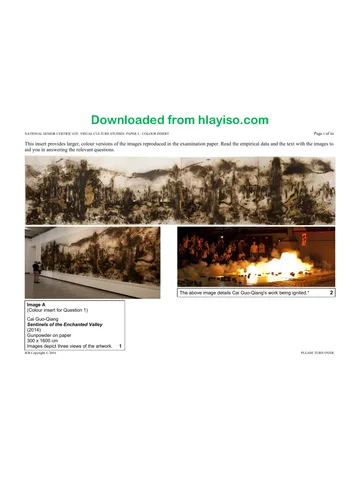
Image A
Cai Guo-Qiang
Sentinels of the
Enchanted Valley
(2014)
Gunpowder on paper
300 x 1 600 cm
Images depict three
views of the artwork 1
The above image details Cai Guo-Qiang's work being ignited.* 2
Text for Image A: Cai's drawings, made by exploding gunpowder laid on paper, demonstrate a
new medium of contemporary artistic expression. His gunpowder drawings convey his idea of
using natural energy forces to create artworks. Cai is interested in the relationship of matter and
energy: matter (gunpowder) explodes into energy and reverts to matter in another state (the
charred drawing). In this way these works are charts of time, process and transformation.
As a teenager growing up in Quanzhou, China, Cai witnessed the social effects of the Cultural
Revolution first-hand, personally participating in demonstrations and parades himself. He grew
up in a setting where explosions were common, whether they were the result of cannon blasts or
celebratory fireworks. He also "saw gunpowder used in both good ways and bad, in destruction
and reconstruction". 2
IEB Copyright © 2016 PLEASE TURN OVER
Downloaded from hlayiso.com
NATIONAL SENIOR CERTIFICATE: VISUAL CULTURE STUDIES: PAPER I Page 4 of 10
Image B:
Tomás Saraceno
On Time Space Foam
(2012)
Three levels of thin clear film raised
at a height of 20 meters off the
ground.
Images depict three views of the
artwork. 3
Text for Image B: Tomás Saraceno is known for his sculptural work and installations that merge
art, architecture, and science. Saraceno is concerned with our living environments. His works are
largely experimental, and he seeks alternative artistic imagery to re-frame our awareness of the
world.
On Space Time Foam is composed of three levels of thin clear film and suspended at a height of
20 metres above the floor of the gallery. The artwork is accessible to visitors who are drawn into
extraordinary spatial experiences: the large soft and floating film welcomes visitors who will thus
find themselves moving mid-air between the floor and the ceiling, earth and sky. 3
IEB Copyright © 2016
Downloaded from hlayiso.com
NATIONAL SENIOR CERTIFICATE: VISUAL CULTURE STUDIES: PAPER I Page 5 of 10
1.1 The choice of the artist's medium in both Image A and Image B is somewhat
unusual. Analyse* how the artists' choice of medium creates the metaphorical
meaning of each of their respective works. (6)
1.2 Assess* whether Cia Gou-Qiang's artwork in Image A is a performance piece?
Provide reasons for your answer. (3)
1.3 At a glance Image A appears abstract, yet Cia Gou-Qiang maintains it is a
landscape. Suggest what aspects in the work allude* to landscape. (2)
1.4 Due to the unconventional nature of Image B, it could possibly be difficult to write
a formal analysis in the same way one would write a formal analysis for a
traditional oil painting. However, some formal elements are still relevant and
contribute to the visual experience of the work.
Identify and describe TWO formal elements that could be used in analysing this
artwork. Explain what effect your selected elements have on the artwork's formal
appearance. (4)
[15]
IEB Copyright © 2016 PLEASE TURN OVER
Downloaded from hlayiso.com
NATIONAL SENIOR CERTIFICATE: VISUAL CULTURE STUDIES: PAPER I Page 6 of 10
QUESTION 2 ESSAY: CONCEPTUAL AND INTERNATIONAL CURRENT
ART AND ARCHITECTURE
Read the following text then write an essay of approximately 4 pages in response.
Contemporary art critic Ossian Ward says: "So much of contemporary art is
spectacular: it lights up, it sounds, it envelops,* it sucks us in or awards us. We expect
to be seduced, enthralled* and even overwhelmed by creations of ever-greater size ...
We stand in awe* but barely see …" 4
Would you agree or disagree that multi-sensory aspects of current and conceptual art have
become too entertaining, to the point that the viewer stands in awe* but barely sees?
Present an essay in which you select 3 examples of artworks by 3 different artists and/or
architects from Conceptual Art of the 1970s and current non-traditional artworks to
substantiate your answer.
Mark allocation for Question 2
3 artworks (with brief description) by 3 different artists and/or architects 3 marks
Relevant selection of artwork 3 marks
Relevant factual content 12 marks
Development of argument 12 marks
[30]
IEB Copyright © 2016
Downloaded from hlayiso.com
NATIONAL SENIOR CERTIFICATE: VISUAL CULTURE STUDIES: PAPER I Page 7 of 10
QUESTION 3 SHORTER ESSAY/PARAGRAPHS
Read the statement below and in approximately 1½ pages answer the questions that follow.
Image C
Image C
Claes Oldenburg
Clothes Pin
(1976)
Rusted Corten steel & stainless steel
13.7 × 3.7 × 1.4 m 5
Oldenburg is known for his large-scale
outdoor sculptures of mundane or
everyday objects, and his commitment to
making a democratic art, accessible to all.
Oldenburg created his artworks by scaling
up the original object many times and
places his artworks in public spaces. His
work has generated much public
controversy. 5
Statement: Like Claes Oldenburg, many artists in the first half of the twentieth
century used mundane* subject matter to make art accessible to a larger audience.
3.1 Select ONE relevant artwork from the Dada movement and ONE relevant artwork
from the Surrealist movement that made use of mundane* subject matter.
For each artwork selected, provide the name of the artist and the title of the artwork
with a brief description. (4)
3.2 Describe how mundane* objects were used in the selected artworks. (4)
3.3 Oldenburg exhibited his artworks in public spaces in an attempt to make his work
accessible to a larger audience. His works were often criticised at the time as being
'artistic eyesores'. Argue whether your selected examples use mundane objects to
make art more accessible or repulsive to viewers. (7)
[15]
60 marks
IEB Copyright © 2016 PLEASE TURN OVER
Downloaded from hlayiso.com
NATIONAL SENIOR CERTIFICATE: VISUAL CULTURE STUDIES: PAPER I Page 8 of 10
SECTION B ISSUES THAT ART ADDRESSES IN SOUTH AFRICAN ART
QUESTION 4 PARAGRAPHS
RESISTANCE ART IN SOUTH AFRICA (1976 –1994)
Image D
Khaya Witbooi
Guns are Roses
(2012)
Oil and spray paint on canvas
150 cm × 120 cm 6
Guns are Roses was inspired by the unfortunate events that took place in September
2012 at the Lonmin Marikana platinum mine in South Africa, where police shot and
killed 34 protesters who were on strike to demand a better basic wage.
What made this event so shocking was the fact that it went against everything that
South Africa is supposed to stand for today. After centuries of colonialism and decades
of active struggle against the apartheid government, South Africa was supposed to
have achieved democracy, equal rights for all and an end to the exploitation of poor
people. At Marikana, people who stood up for these principles were harshly reminded
that perhaps not so much has changed. 6
In approximately 2 pages, answer the questions below, numbering your answers according
to the questions.
4.1 Select ONE resistance artwork from the period 1976 –1994 by ONE resistance artist
that you have studied that confronts the viewer with the conflict and violence
associated with the apartheid era.
Provide the name of the artist and the title of the artwork with a brief description. (2)
4.2 Explain some of the ways in which your selected artist's experience of living under
the apartheid regime are reflected in the artworks. (6)
4.3 Interpret how your selected artist strengthened the message of the artwork through
their choice and manipulation of formal elements. (4)
4.4 By using your knowledge of resistance art, analyse how Witbooi's artwork as seen
in Image D is a form of contemporary resistance art. (8)
[20]
IEB Copyright © 2016
Downloaded from hlayiso.com
NATIONAL SENIOR CERTIFICATE: VISUAL CULTURE STUDIES: PAPER I Page 9 of 10
QUESTION 5 PARAGRAPHS
POST-APARTHEID (POST-APRIL 1994) SOUTH AFRICAN ART
Study the following text, then answer the questions that follow.
The human body is central to how we understand facets of identity such as gender,
sexuality, race, and ethnicity. People alter their bodies, hair, and clothing to align with or
rebel against social conventions and to express messages to others around them. Many
artists explore identity through representations of the body and by using their own
bodies in their creative process. 7
Select TWO current South African artists who use representations of the body in their
artwork to explore issues of identity. These representations could include, amongst
others, literal, metaphoric, figurative and non-figurative approaches to representing the
human form.
Write approximately 2 pages and number your paragraphs according to the questions
below.
5.1 For each artwork selected, name the artist, give the title of the artwork and provide
a brief description. (4)
5.2 Describe how and explain why each selected artist portrays the human body. (8)
5.3 Assess* whether each artist reinforces or challenges social stereotypes through their
representation of the human body. (8)
[20]
40 marks
Total: 100 marks
IEB Copyright © 2016 PLEASE TURN OVER
Downloaded from hlayiso.com
NATIONAL SENIOR CERTIFICATE: VISUAL CULTURE STUDIES: PAPER I Page 10 of 10
Reference List
1 Image A: Cai Guo-Quiang. (2014). Sentinels of the Enchanted Valley.
Available: <http://www.caiguoqiang.com/projects/sentinels-enchanted-valley>.
Last accessed 21 February 2016.
2 Text for Image A: The Solomon R. Guggenheim Foundation. (2016). Cai Gou Qiang- I want to believe.
Available: <http://www.guggenheim.org/new-york/education/school-educator-programs/teacher-resources/
arts-curriculum-online?view=category&id=727>.
Last accessed 21 February 2016.
3 Image B and text: Furuto, A. (2012). On Time Space Foam.
Available: <http://www.archdaily.com/292447/on-space-time-foam-exhibition-studio-tomas-saraceno/>.
Last accessed 21 February 2016.
4 Text and quote for Question 2: Ward O (2014). Ways of Looking: How to Experience Contemporary Art.
London: Laurence King Publishing Ltd, page 127.
5 Image C: Parker, C. (2007). Claes Oldenburg.
Available: <http://linesandcolors.com/2007/07/30/claes-oldenburg/>.
Last accessed 5 March 2016.
6 Text and quote for Question 4: Unknown. (2012). News and Events: a Painting about what happened at
Marikana.
Available: <http://www.worldart.co.za/news/article.asp?ID=137>.
Last accessed 21 February 2016.
7 Quote for Question 5: Investigating Identity.
Available: <http://www.moma.org/learn/moma_learning/themes/investigating-identity/the-body-in-art>.
Last accessed 21 February 2016.
IEB Copyright © 2016
Study this subject
Revise the topics in this paper, then practise them question by question.
- Grade 12 Visual Arts notes
CAPS revision notes with worked examples.
- Visual Arts questions by topic
Past exam questions sorted by CAPS topic, with memos where available.
- All Grade 12 Visual Arts past papers
Past papers by year, with memos where available.
- Grade 12 IEB past papers
More Visual Arts and other subjects in this collection.
Recommended for this subject
More papers and memos for this grade and subject.
Question paperIEB
Visual Arts Grade 12 IEB Paper 2 2019 Question Paper
Question paperIEB
Visual Arts Grade 12 IEB Paper 2 2019 Question Paper (Afrikaans)
Question paperIEB
Visual Arts Grade 12 IEB Paper 1 2019 Question Paper
Question paperIEB
Visual Arts Grade 12 IEB Paper 1 2019 Question Paper (Afrikaans)
Question paperIEB
Visual Arts Grade 12 IEB Paper 2 2019 Question Paper
Question paperIEB
Visual Arts Grade 12 IEB Paper 2 2019 Question Paper (Afrikaans)
Related documents
AddendumIEB
Visual Arts Grade 12 IEB Paper 1 2016 Addendum
MemorandumIEB
Visual Arts Grade 12 IEB Paper 1 2016 Memo
Question paperIEB
Visual Arts Grade 12 IEB Paper 2 2016 Question Paper
Question paperIEB
Visual Arts Grade 12 IEB Paper 2 2016 Question Paper
Question paperIEB
Visual Arts Grade 12 IEB Paper 1 2018 Question Paper
AddendumIEB
Visual Arts Grade 12 IEB Paper 1 2019 Addendum
More from Grade 12 Visual Arts
AddendumIEB
Visual Arts Grade 12 IEB Paper 1 2019 Addendum (Afrikaans)
AddendumIEB
Visual Arts Grade 12 IEB Paper 2 2019 Addendum
AddendumIEB
Visual Arts Grade 12 IEB Paper 2 2019 Addendum (Afrikaans)
MemorandumIEB
Visual Arts Grade 12 IEB Paper 1 2019 Memo
MemorandumIEB
Visual Arts Grade 12 IEB Paper 1 2019 Memo (Afrikaans)
AddendumIEB