
Downloaded from hlayiso.com
NATIONAL SENIOR CERTIFICATE EXAMINATION
NOVEMBER 2016
VISUAL ARTS: PAPER II
Time allocation: According to candidate's needs 100 marks
DEADLINE: 10 October 2016
CONTENTS PAGE
Summary of Tasks and Marks 1
The Examination Theme 2–8
Examination Tasks 9–11
Source Reference List 12
SUMMARY OF TASKS AND MARKS
• Creative Process: Visual Journal [20 marks]
• Contextual Research: Visual Journal [10 marks]
• Drawing [35 marks]
• Artwork [35 marks]
These should not necessarily be seen as unrelated, separate tasks, but rather as actions
performed simultaneously as part of a coherent, comprehensive examination project.
IEB Copyright © 2016 PLEASE TURN OVER
Skip to contentQuestion paper 
View all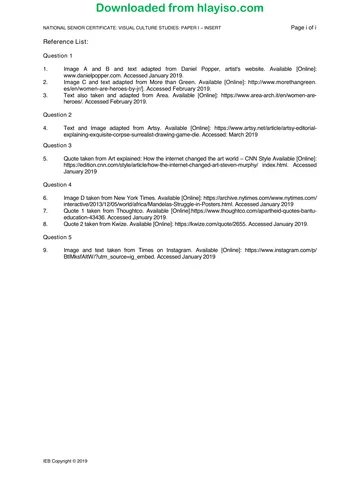
Visual Arts Grade 12 IEB Paper 2 2016 Question Paper
IEB Grade 12 Visual Arts Paper 2 question paper from the 2016, 12 pages. Read online or get the free PDF download, memo linked when available.
Publisher: IEB
Visual Arts · Grade 12 · 2016. Question paper, 12 pages. Read online or download the PDF.
- Subject
- Visual Arts
- Grade
- Grade 12
- Document type
- Question paper
- Year
- 2016
- Paper
- 2
- Publisher
- IEB
- Curriculum
- IEB
- Pages
- 12
- File size
- 2.2 MB
Loading document…
Loading document…
1 of 12
Document textSearch extracted text and jump to a page.
Downloaded from hlayiso.com
NATIONAL SENIOR CERTIFICATE: VISUAL ARTS: PAPER II Page 2 of 12
THE EXAMINATION THEME
(E)
(IM)
MIGRATE
1.
This map shows the possible routes of migration out of Africa that humans
may have taken to populate other areas of the globe.
2.
Walter Oltmann
World Map (2006)
Wire, metal
Dimensions variable
In Walter Oltmann’s installation World
Map, he interprets the continents into fluid
sculptural forms, shifting and interacting.
The work is permanently displayed at the
Origins Centre in Johannesburg, and
provides an artistic interpretation of the
story of human origins, which scientists
must piece together from fossils and
archaeological discoveries.
IEB Copyright © 2016
Downloaded from hlayiso.com
NATIONAL SENIOR CERTIFICATE: VISUAL ARTS: PAPER II Page 3 of 12
3.
"The photograph that has become known as
Migrant Mother is one of a series of photographs
that Dorothea Lange made of Florence Owens
Thompson and her children in February or March of
1936 in Nipomo, California. Lange was concluding a
month's trip photographing migratory farm labor
around the state for what was then the
Resettlement Administration. In 1960, Lange gave
this account of the experience:
'I saw and approached the hungry and desperate
mother, as if drawn by a magnet. I do not remember
how I explained my presence or my camera to her,
but I do remember she asked me no questions. I
made five exposures, working closer and closer
from the same direction. I did not ask her name or
her history. She told me her age, that she was
thirty-two. She said that they had been living on
frozen vegetables from the surrounding fields, and
birds that the children killed. She had just sold the
tires from her car to buy food. There she sat in that
lean-to tent with her children huddled around her,
Dorothea Lange and seemed to know that my pictures might help
Migrant Mother (1936) her, and so she helped me. There was a sort of
Photographic print equality about it.'"
- American Library of Congress
4.
Installation shot
"Drawn on the surfaces of stacked wooden crates,
Nitegeka's portraits and landscapes set up a narrative
of crossing borders and boundaries, and suggest a
fragile relationship between the body and its physical
surroundings" – Stevenson Gallery
"The drawings attempt to restore personal memories of
particular occurrences that were oppressive in nature.
These restorations of memory situate themselves
within a collective history of a people, all people
indeed, who struggle to grapple with the idea of
Serge Alain Nitegeka
'inherited ethnic violence'." – Serge Alain Nitegeka
Untitled (Self-portrait) 2009
Charcoal and paint on wood
IEB Copyright © 2016 PLEASE TURN OVER
Downloaded from hlayiso.com
NATIONAL SENIOR CERTIFICATE: VISUAL ARTS: PAPER II Page 4 of 12
5.
Karin Daymond
Unseen (2016)
oil on canvas
120 × 170 cm
"Somewhere I saw footage from a flight over a refugee camp in the desert and it has stayed with
me.
Makeshift dwellings interspersed with organised structures as far as the eye could see. This has
worked its way into my painting. I have never been to a refugee camp in the desert, but I often
try to wrap my head around the broad concept of being homeless and anonymous, and so I
project myself into these situations. In the midst of the bigger picture, some things must happen
for life to continue; washing is done, trading happens and children play.
I asked myself what I would take if I had to leave, and I saw that African women take fabric. I
scattered my collection of African fabrics on the floor and painted them as if lost at sea. Every
cloth is regional and has meaning. With it around her, a woman can seem regal and even
happy. She might even feel these things. These flashes of colour push back despair; they
conceal and express at the same time" - Karin Daymond
6.
"Alvand, 18, from Syria takes a selfie with
his friends as they walk along a railway
track after crossing into Hungary from the
border with Serbia last week. Cell phones
are widely available in Syria for relatively
little money."
- CBC News
IEB Copyright © 2016
Downloaded from hlayiso.com
NATIONAL SENIOR CERTIFICATE: VISUAL ARTS: PAPER II Page 5 of 12
7.
Banksy
Untitled (Steve Jobs)
(2015)
Mural on wall surface
Notorious street artist Banksy painted an image of Steve Jobs on a wall of a refugee camp in
Calais, France in 2015. CNN's website said the following: "Banksy's latest works have
appeared in a refugee camp in Calais, France. One depicts the late Apple co-founder and
CEO Steve Jobs, carrying a sack over his shoulder and a Macintosh computer.
Photographs of the new works are featured on the street artist's website. The photo of Jobs
is captioned, 'the son of a migrant from Syria'."
IEB Copyright © 2016 PLEASE TURN OVER
Downloaded from hlayiso.com
NATIONAL SENIOR CERTIFICATE: VISUAL ARTS: PAPER II Page 6 of 12
8.
Faith47
Estamos Todos Los Que
Cabemos (2015)
Mural in Harlem, New York City
"Estamos Todos Los Que Cabemos was painted as part of the Monument Art NYC project,
which is focusing on the issue of immigration. Estamos Todos Los Que Cabemos speaks of the
migratory patterns of birds, observing that nature ignores human borders on a map.
We forget that the dividing lines specifying countries were merely drawn by politically hungry
men. In reality the earth is open. There are no countries, no borders. It belongs to no one. We are
transient visitors and should travel as we please." – Faith47
9.
Lawrence Weiner
Residue of a Flare Ignited
on a Boundary (1969)
Photograph of performance
In 1969, for an exhibition in
The Netherlands, Weiner
ignited a flare on the
boundary of the city of
Amsterdam.
IEB Copyright © 2016
Downloaded from hlayiso.com
NATIONAL SENIOR CERTIFICATE: VISUAL ARTS: PAPER II Page 7 of 12
APPROACHING THIS EXAMINATION AND MANAGING YOUR CREATIVITY
The sources given in this examination paper consider the concept of migration, of people's
movement around the globe for a variety of reasons.
In these images and artworks, the artist becomes an agent for considering the reasons for and
ramifications of movement away from one's place of origin.
Inspired by any aspect of these image and artworks that has personal resonance with you, you will
be required to produce the following:
• a visual journal
• a drawing
• an artwork
• a title and rationale for both drawing and artwork
Engaging with Art and Visual Culture
By the end of the examination project, you will have researched and referred to the work of at least
six other artists whose work reflects similar or related concerns to yours, and who work in a similar
discipline to what you have chosen. This research must be shown in your Visual Journal. You must
explore how these artists have sparked something in your own thinking, and how their work has
helped you gain greater clarity of thought in the making of your drawing and artwork.
Thinking as Doing: using your Creative Process to develop and refine your ideas
Also in your Visual Journal, you will document all the steps in your Creative Process leading up to
the presentation of your drawing as well as your artwork. Your research and Creative Process
should commence immediately upon receipt of this Examination Paper, and should continue until
you submit your work on the deadline date.
These tasks, outlined on the following pages, are compulsory. However, the order in which you
approach them must be informed by your own ideas and thinking process. You may start with
research of artists' work and then proceed to drawing your ideas, perceptions and experiences in
your Visual Journal afterwards. You may start drawing immediately and allow your artwork and
research to emerge out of the process of drawing. Creativity is a cyclical as much as it is a linear
process. You will need to go back and forth, considering what you have done thus far and re-
evaluating your processes and products along the way, in order to develop your response to the
examination to a convincing level of depth.
Your teacher has detailed assessment rubrics with all the criteria for success in this examination.
You are advised to familiarise yourself with these rubrics. Your response to the examination will be
assessed on the following three, broad, yet inter-related criteria:
1. Your ability to work skilfully with your chosen materials and composition principles, i.e.
form: do your drawing and your art work show a mastery of the chosen discipline/s, and
take the viewer on an aesthetic journey?
2. Your original and creative thinking, concepts and the intentional meanings explored by
your work, i.e. content: does your work explore an interesting, relevant interpretation of
the theme at a sophisticated level?
IEB Copyright © 2016 PLEASE TURN OVER
Downloaded from hlayiso.com
NATIONAL SENIOR CERTIFICATE: VISUAL ARTS: PAPER II Page 8 of 12
3. The evidence of task-intensity, curiosity, perseverance, and commitment in your response,
as well as your ability to cope with the constraints of time and space, i.e. context: does
your work rise above the limitations of space and circumstances in a sophisticated
manner? Your Drawing should take 4-6 weeks to produce, and this amount of effort
should be visible. Therefore, you cannot make a purely conceptual work that neglects skill
or materiality.
Remember: You may work on your Visual Journal and drawing tasks outside of the school in your
own time, but the artwork task or "Final Artwork" may not be removed from the school premises. It
must be completed under teacher supervision.
It is your responsibility to read this Examination Paper and the Guideline Booklet thoroughly
before commencing with the project. Discuss the examination paper with your teacher and your
peers and take it home with you. Tasks 1 to 3 may be worked on away from the school premises,
but not the artwork task. The artwork (Task 4) must be worked on entirely under teacher
supervision.
NOTE: The above tasks are compulsory but need not necessarily be carried out in strict
numerical order. The process of creativity is organic and cyclical rather than sequential and
linear. You will need to go back and forth, considering and reconsidering the various stages to
develop and deepen your creative involvement in the Examination assignment.
IEB Copyright © 2016
Downloaded from hlayiso.com
NATIONAL SENIOR CERTIFICATE: VISUAL ARTS: PAPER II Page 9 of 12
EXAMINATION TASKS
TASK 1 CREATIVE PROCESS [20 marks]
This is preparation for your drawing and artwork. It is a record of your responses to the theme.
Document your Creative Process fully in your Visual Journal.
Creative Exploration
• Use the images, texts and ideas presented on the previous pages as starting points and stimuli
as you document all your ideas, feelings, sketches and images in your Visual Journal.
• State your interests and intentions for this Examination – but keep an open, flexible mind. Your
intentions may shift and change as your Creative Process develops.
• Include initial sketches and source material.
• Provide ideas written in your own words that explain your reasoning for portraying the
subject/s you choose in the way you choose.
• Show that you are fluent in the ability to generate various ideas and possibilities, not just one
final idea.
• Carefully consider how you will represent your interpretation of this theme.
− Will your approach be intimate and personal, or public and bold?
− Will your drawing/s and artwork/s be naturalistic, stylised or abstract?
− Does a symbolic work communicate a deeper and more profound truth than a naturalistic/
photographic work? Or are the two even mutually exclusive?
− Your approach may be literal, it may be naturalistic, or it may be more symbolic or poetic.
What makes your artwork an artwork?
• Review, develop and elaborate your own visual language by engaging further in a cyclical
Creative Process in preparation for your drawing and artwork.
• Be flexible: your ideas may well have changed and are different to your initial intentions, plans
and goals.
• Use words, sketches, visualisations, technical experiments to develop your artwork visually.
Explore possibilities!
• Which medium are you engaging with? What techniques and subject matter best suit your
intentions and interpretation of the theme?
• What signs and symbols from broader visual culture are you engaging with in order to make
your work meaningful?
• For detailed guidelines concerning the Creative Process, refer to the appropriate sections in the
detailed guideline document.
Link to year-work portfolio
• As part of your Creative Process, consider the artworks you have already completed in your
School Based Assessment (SBA) practical portfolio.
• You are strongly advised to work with the same art discipline for this examination project as
you did in the SBA practical portfolio. (If you did sculpture in your SBA portfolio, then this
Examination work should also be a sculpture).
• Explain the connection between your SBA portfolio and your intentions for the examination
project in terms of your formal and conceptual concerns. This is an important part of
developing a personal visual language.
• For detailed guidelines regarding the Creative Process, refer to the relevant section in the
detailed guideline document.
IEB Copyright © 2016 PLEASE TURN OVER
Downloaded from hlayiso.com
NATIONAL SENIOR CERTIFICATE: VISUAL ARTS: PAPER II Page 10 of 12
TASK 2 RESEARCH [10 marks]
Research is an important part of the process of making a successful artwork
• As part of your Creative Process, select and research at least six other visual artists' work that
you find inspiring for your artistic practice for each task (research approximately three artists
for your drawing and approximately three others for your artwork).
• You may research the work of the artists featured in the sources provided or research other
artists' work.
• While researching, refine and adapt your ideas to fit your own intentions and goals for this
Examination project.
• Produce at least one detailed visual analysis of at least one work by the artist/s you have
chosen. In your analysis you must refer to the theme. The analysis must be in your own
words. Stay away from the Ctrl-C/Ctrl-V scourge! Simply copying and pasting text from
an authoritative source does not constitute adequate research. You should show evidence
of internalisation of your research.
• Acknowledge all your source material using the Harvard Technique of referencing.
• Explain why the artworks you research are relevant to your own intentions and plans for the
Examination drawing and artwork tasks.
• For detailed guidelines concerning contextual research, refer to the appropriate section in the
detailed guidelines document.
• Document any further artworks that are inspiring you in your Creative Process.
• You may find that you need to research other area/s of visual culture and/or knowledge.
• Have any of the artists, artworks or areas of knowledge you researched for your SBA Art
projects recurred in your Visual Journal for this Examination? If so, acknowledge this. It is an
important aspect of developing your personal visual language.
TASK 3 DRAWING [35 marks]
• Produce a series of Process Drawings for display.
OR
• Produce at least one End-Product Drawing for display.
• For detailed guidelines regarding your drawing as well as a detailed explanation of the
differences between process drawing and end-product drawing, refer to the appropriate sections
in the guideline booklet.
• Your Drawing should take 4–6 weeks to complete.
• Work on your Visual Journal and your drawing concurrently.
• If you choose the Process Drawing option, then your drawings must be displayed professionally
and not left in the journal.
NB: Your drawing must be a drawing and not some other art form. If you choose to make an
unconventional or non-traditional drawing, then you must explain your motivation for doing
so and describe how your work counts as drawing in your Visual Journal. A drawing is a series
of relatively spontaneous marks on a surface. An acrylic painting is not a drawing and a photograph
is not a drawing – unless you explain in detail how it could be seen as such. If you present a
drawing that is not traditional, you must justify how your submission may be understood
conceptually as a drawing. Sixteenth century art historian and painter Giorgio Vasari called
drawing "the father of our three arts: architecture, sculpture, and painting." Think carefully about
what makes a drawing different from a painting or a sculpture or a photograph. Consider the
reasons why drawing is such an important part of an artist's Creative Process.
IEB Copyright © 2016
Downloaded from hlayiso.com
NATIONAL SENIOR CERTIFICATE: VISUAL ARTS: PAPER II Page 11 of 12
TASK 4 ARTWORK [35 marks]
• Having selected your art discipline for the examination, produce your artwork for display.
• For detailed guidelines regarding your artwork, refer to the appropriate sections in the guideline
booklet.
• You may not work on your artwork without teacher supervision.
NB: Photography candidates: all photographic shoots must be carried out by you, the
candidate, and not by somebody else. If you are the subject of your own photographs, then you
must show that you have composed your own photographs and not somebody else. If an
assistant is used to actually shoot photographs of you, then this must be acknowledged in the
Visual Journal. Use a substitute model to take your place posing for your shoot, while you
compose each shot and decide on camera settings. You must show the additional planning
shots that you have taken beforehand in your Visual Journal to prove that the technical
composition and shooting are your decision-making and work and not that of the person taking
the shot or anybody else. No professional photographer or any other person is allowed to
compose and shoot the photographs on your behalf.
TASK 5 TITLES AND RATIONALES
• Create an appropriate and interesting Title for both your drawing/s AND your artwork/s.
• Type and print out two separate Rationales of no more than 150-200 words each.
• Display your Rationales, Titles and examination number alongside your drawing and your
artwork.
TASK 6 PRESENTATION
Your drawing and your artwork must be displayed as professionally as possible. Label your
drawing/s and your artwork as follows:
Name
Examination Number
Title
Examination Drawing/
Examination Artwork
SEE THE ACCOMPANYING BOOKLET FOR DETAILED GUIDELINES ON SPECIFIC
DISCIPLINES.
IEB Copyright © 2016 PLEASE TURN OVER
Downloaded from hlayiso.com
NATIONAL SENIOR CERTIFICATE: VISUAL ARTS: PAPER II Page 12 of 12
SOURCE REFERENCE LIST
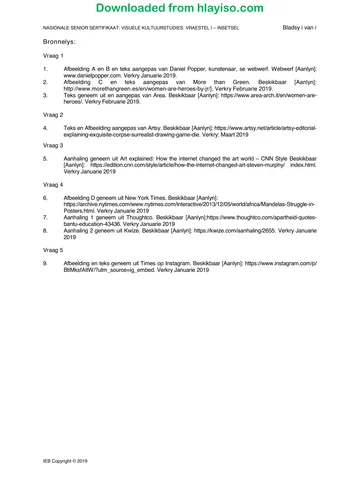
1. 26271801.jpg (1911 × 1422) picture on VisualizeUs. 2016. 26271801.jpg (1911 × 1422) picture on VisualizeUs.
[ONLINE] Available at: http://vi.sualize.us/the_migration_of_anatomically_modern_humans_newscientist_
evolution_infographics_anthropology_picture_5im9.html. [Accessed 31 January 2016].
2. The Origins Journey | Origins Museum. 2016. The Origins Journey | Origins Museum. [ONLINE] Available at:
http://www.origins.org.za/?page_id=199. [Accessed 31 January 2016].
3. Dorothea Lange's "Migrant Mother" Photographs in the Farm Security Administration Collection: An Overview
(Library of Congress). 2016. Dorothea Lange's "Migrant Mother" Photographs in the Farm Security
Administration Collection: An Overview (Library of Congress). [ONLINE] Available at: https://www.loc.gov/
rr/print/list/128_migm.html. [Accessed 31 January 2016].
4. Michael Stevenson – Serge Alain Nitegeka. 2016. Michael Stevenson – Serge Alain Nitegeka. [ONLINE]
Available at: http://stevenson.info/exhibitions/nitegeka/index.htm. [Accessed 31 January 2016].
5. Work sourced directly, but visit http://www.karindaymond.co.za/ for more information on Daymond's work
and process.
6. For Syrian refugees, smartphones are a lifeline — not a toy – World – CBC News. 2016. For Syrian refugees,
smartphones are a lifeline — not a toy – World – CBC News. [ONLINE] Available at: http://www.cbc.ca/news/
world/for-syrian-refugees-smartphones-are-a-lifeline-not-a-toy-1.3221349. [Accessed 31 January 2016].
7. Pay-Per-View Banksy: Calais Migrants Share Steve Jobs Mural for a Charge. 2016. Pay-Per-View Banksy:
Calais Migrants Share Steve Jobs Mural for a Charge. [ONLINE] Available at: http://sputniknews.com/europe/
20151217/1031919031/calais-camp-migrants-charging-for-banksy-steve-jobs-mural.html. [Accessed 31 January
2016].
8. 'Estamos Todos Los Que Cabemos' Faith47 street art. 2016. 'Estamos Todos Los Que Cabemos' Faith47 street
art. [ONLINE] Available at: http://faith47.com/estamos-todos-los-que-cabemos/. [Accessed 31 January 2016].
9. Collection Online | Lawrence Weiner. THE RESIDUE OF A FLARE IGNITED UPON A BOUNDARY. 1969 –
Guggenheim Museum. 2016. Collection Online | Lawrence Weiner. THE RESIDUE OF A FLARE IGNITED
UPON A BOUNDARY. 1969 – Guggenheim Museum. [ONLINE] Available at: http://www.guggenheim.org/new-
york/collections/collection-online/artwork/4189. [Accessed 31 January 2016].
QR Codes
You may choose to access the above sources. To make it easier, you may utilise these QR codes.
This is not compulsory, but it may assist your process if using a smartphone or a tablet.
(Reminder: no QR code was available for Karin Daymond's image, number 5, at time of going to
print.)
1 2 3
4 6 7
8 9
IEB Copyright © 2016
Study this subject
Revise the topics in this paper, then practise them question by question.
- Grade 12 Visual Arts notes
CAPS revision notes with worked examples.
- Visual Arts questions by topic
Past exam questions sorted by CAPS topic, with memos where available.
- All Grade 12 Visual Arts past papers
Past papers by year, with memos where available.
- Grade 12 IEB past papers
More Visual Arts and other subjects in this collection.
Recommended for this subject
More papers and memos for this grade and subject.
Question paperIEB
Visual Arts Grade 12 IEB Paper 2 2019 Question Paper
Question paperIEB
Visual Arts Grade 12 IEB Paper 2 2019 Question Paper (Afrikaans)
Question paperIEB
Visual Arts Grade 12 IEB Paper 1 2019 Question Paper
Question paperIEB
Visual Arts Grade 12 IEB Paper 1 2019 Question Paper (Afrikaans)
Question paperIEB
Visual Arts Grade 12 IEB Paper 2 2019 Question Paper
Question paperIEB
Visual Arts Grade 12 IEB Paper 2 2019 Question Paper (Afrikaans)
Related documents
Question paperIEB
Visual Arts Grade 12 IEB Paper 2 2016 Question Paper
Question paperIEB
Visual Arts Grade 12 IEB Paper 1 2016 Question Paper
Question paperIEB
Visual Arts Grade 12 IEB Paper 2 2018 Question Paper
Question paperIEB
Visual Arts Grade 12 IEB Paper 2 2018 Question Paper
AddendumIEB
Visual Arts Grade 12 IEB Paper 1 2016 Addendum
MemorandumIEB
Visual Arts Grade 12 IEB Paper 1 2016 Memo
More from Grade 12 Visual Arts
AddendumIEB
Visual Arts Grade 12 IEB Paper 1 2019 Addendum
AddendumIEB
Visual Arts Grade 12 IEB Paper 1 2019 Addendum (Afrikaans)
AddendumIEB
Visual Arts Grade 12 IEB Paper 2 2019 Addendum
AddendumIEB
Visual Arts Grade 12 IEB Paper 2 2019 Addendum (Afrikaans)
MemorandumIEB
Visual Arts Grade 12 IEB Paper 1 2019 Memo
MemorandumIEB