
Downloaded from hlayiso.com
NATIONAL SENIOR CERTIFICATE EXAMINATION
NOVEMBER 2016
VISUAL CULTURE STUDIES: PAPER I
MARKING GUIDELINES
Time: 3 hours 100 marks
These marking guidelines are prepared for use by examiners and sub-examiners,
all of whom are required to attend a standardisation meeting to ensure that the
guidelines are consistently interpreted and applied in the marking of learners'
scripts.
The IEB will not enter into any discussions or correspondence about any marking
guidelines. It is acknowledged that there may be different views about some
matters of emphasis or detail in the guidelines. It is also recognised that,
without the benefit of attendance at a standardisation meeting, there may be
different interpretations of the application of the marking guidelines.
Skip to contentMemorandum 
View all
Visual Arts Grade 12 IEB Paper 1 2016 Memo
IEB Grade 12 Visual Arts Paper 1 memorandum from the 2016, 9 pages. Read online or get the free PDF download, question paper linked when available.
Publisher: IEB
Visual Arts · Grade 12 · 2016. Memorandum. Read online or download the PDF.
- Subject
- Visual Arts
- Grade
- Grade 12
- Document type
- Memorandum
- Year
- 2016
- Paper
- 1
- Publisher
- IEB
- Curriculum
- IEB
- Pages
- 9
- File size
- 204.3 KB
Loading document…
Loading document…
1 of 9
Document textSearch extracted text and jump to a page.
Downloaded from hlayiso.com
NATIONAL SENIOR CERTIFICATE: VISUAL CULTURE STUDIES: PAPER I – MARKING GUIDELINES Page 2 of 8
Credit may be given to any of the points given below or any other relevant and valid
argument that the candidate has raised.
SECTION A ISSUES THAT ART ADDRESSES IN INTERNATIONAL ART
QUESTION 1 VISUAL LITERACY
1.1 Analysis: Explain (Level 4) Mark Split 3/3 or 2/4
Any well-substantiated answer will be accepted, for example:
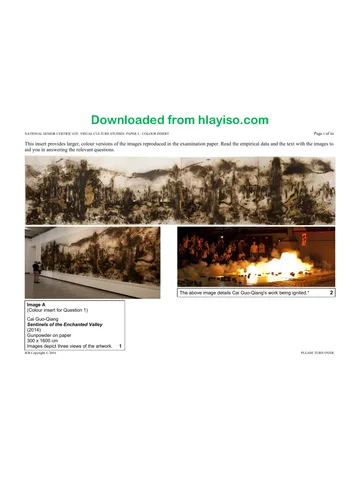
There needs to be a strong reference to the use of gunpowder: Image A, Cai has used
gunpowder, which has been ignited, to make marks on paper, which he calls
drawings. Gunpowder is a very unusual art material, and Cai takes the gunpowder
one step further by lighting it, allowing the chance element and fire to leave flashings
on the page. Cai's choice of medium has personal relevance to him growing up in
China where he witnessed the use of gunpowder both as a revolutionary force and in
celebration. The gunpowder could act as an agent of transformation.
Image B is made from plastic, which is translucent and raised/suspended above
ground. The translucency enables the viewer to interact with the artwork and the
space surrounding it, creating a new and unusual experience for the viewer. This
forces the viewer to re-consider their perceptions of art and of their interactions
with art and space, thus extending possibilities of the artwork which is very much
in keeping with the artist's intention.
1.2 Understanding: Explain (Level 2)
Any well-substantiated answer will be accepted, for example:
Yes. Performance art usually involves the creation of an artwork in the presence of
an audience. Very often the process and end product are less important than the
happening. In the case of Cai's work, the audience spectates and is enthralled by the
ignition of the artwork and it is an important part of the creative process.
No. A performance piece involves planning, selection of a space for the
performance to take place in, and it is usually performed at a given time. It is more
a ritual experience than a spectacle and it appears that when Cai ignites his work it
is in front of a selected audience who watch the spectacle.
1.3 Understanding: Recognise, interpret (Level 2)
The enormous size/scale of the artwork and the long horizontal panoramic format
give a sense of landscape. Also the imagery, which is slightly abstract, alludes to
mountains, mist clouds and trees.
Words such as horizon line, vastness of space, atmospheric are also pertinent to the
answer. Candidates may also refer to the fact that the title Enchanted Valley is
suggested of a valley, part of a landscape.
1.4 2 marks: Identify: Naming (Level 1);
2 marks: Application: Relate (Level 3)
Any relevant visual element will be accepted, for example:
Colour: The subtle transparent blue-green colour of the plastic material that
Image B is made from adds to the weightlessness of the work, and makes the space
appear endless.
Tone: The slight variation in the thickness of the layers of plastic, creates spherical
form in the artwork.
Texture: The texture is smooth and creates uniformity in the artwork.
(1 mark for naming and describing; 1 mark for explaining the effect.)
IEB Copyright © 2016 PLEASE TURN OVER
Downloaded from hlayiso.com
NATIONAL SENIOR CERTIFICATE: VISUAL CULTURE STUDIES: PAPER I – MARKING GUIDELINES Page 3 of 8
QUESTION 2 ESSAY: CONCEPTUAL AND INTERNATIONAL CURRENT
ART AND ARCHITECTURE
Any well-substantiated answer will be accepted, for example:
Yes. The spectacular nature of current conceptual art can be a distraction to the viewer and
obscure the aesthetic appreciation of the artwork. DA
Damien Hirst's For the Love of God, (a human skull recreated in platinum and adorned
with 8 601 diamonds) AW RS
Hirst modelled his diamond encrusted skull off a real human skull and inserted real human
teeth. RF Over 8 000 diamonds were used, the work remains jewel-like and precious. RF
The sheer number of diamonds and the precious material from which the artwork was made,
bedazzle the viewer. RF In many cases the viewer is more fascinated by the materials and
the monetary value of the artwork, overlooking the message being communicated by the
artist. DA Hirst combined the imagery of classic memento mori RF with inspiration drawn
from Aztec skulls and the Mexican love of decoration and attitude towards death. RF The
memento mori should act as a reminder to the viewer of our mortality RF but the viewer
may overlook the warning, rather focusing on the jewel-like nature of the work. DA
OR
No. The spectacular nature of some current and conceptual art adds to the effect, meaning
or reading of the artwork. DA
For the same artwork the candidate could argue that For the Love of God Hirst modelled his
diamond encrusted skull off a real human skull and inserted real human teeth. RF Over 8 000
diamonds were used, the work remains jewel-like and precious. RF While the sheer number of
diamonds and the precious material from which the art work was made can bedazzle the
viewer RF, the skull acts as a reminder that our existence on earth is transient. RF Hirst
combined the imagery of classic memento mori RF with inspiration drawn from Aztec skulls
and the Mexican love of decoration and attitude towards death. RF The memento mori acts as a
reminder to the viewer of our morality. RF He explains death: "You don't like it, so you
disguise it or you decorate it to make it look like something bearable – to such an extent that it
becomes something else." RF He goes on to explain that death is such a heavy subject, it
would be good to make something that laughed in the face of it. RF This idea of laughing in
the face of death resonates with the artist's belief in the value of art collecting: when you die
you cannot take your art collection with you. Ironically the diamonds used in this sculpture are
indestructible and permanent, unlike our mortality so while we place so much value on this
treasured object, which will last forever, we will die, leaving the objects behind. DA So the
dazzling diamonds could re-inforce the idea of twenty-first century obsession with material
wealth and greed as well as bring a certain light-heartedness to our fear of death. DA In using
the diamonds, Hirst creates something beautiful out of something dreaded and feared. DA
OR
Candidates may argue both sides, that in some cases the artwork the spectacular nature of
the artwork can aid the reading of the artwork, but another case it can distract.
Candidates may also discuss the kind of viewer: an educated viewer (who has insights into
conceptual art) could respond differently to a work than that of an uneducated viewer.
Mark allocation for Question 2
3 artworks (with brief description) by 3 different artists 3 marks Remembering: Select
and/or architects. AW (Level 2)
Relevant selection. RS 3 marks
Relevant factual content. RF 12 marks Application: Examine
4 marks can be awarded per artwork, as per the attached (Level 4)
marking rubric.
Development of argument. DA 12 marks Evaluating: Assess/defend/argue
Marks are awarded as outlined by the marking rubric. (Level 6)
IEB Copyright © 2016 PLEASE TURN OVER
Downloaded from hlayiso.com
NATIONAL SENIOR CERTIFICATE: VISUAL CULTURE STUDIES: PAPER I – MARKING GUIDELINES Page 4 of 8
Rubric for Question 2: Essay
SUMMARY OF MARK ALLOCATION: SELECTION AND FACTUAL CONTENT (Levels 1–4)
• 18 MARKS
• 3 ARTISTS AND ARTWORKS AND 3 RELEVANT SELECTIONS
• MAXIMUM OF 4 FACT MARKS PER ARTWORK
• Circle below the correct number for marks allocated for artist and artworks, and facts per artwork
Relevant 1 mark for correctly selecting and naming an artist, artwork and description. Symbol for
selection in marking
relation to topic Zero marks if all three of these components are not present. protocol: AW
of:
3 2 1 0
• artists 1 mark for relevance of artwork. Symbol for
• artwork Zero marks for inappropriate selection. marking
with protocol: RS
description If need be, allocate this mark at the end as it could depend on the candidate's
argument. 3 2 1 0
Relevant Selection of Correct factual Factual evidence Factual evidence No factual
factual content: correct factual knowledge is is flawed; there is severely content.
knowledge provided, but are significant limited; with
Symbol for excellent; factual with some gaps. gaps and serious errors or
marking evidence is omissions. is incorrect.
protocol: RF outstanding.
6 or more 4–5 facts 2–3 facts 1 fact 0 facts
relevant facts
4 4 4 3 3 3 2 2 2 1 1 1 0 0 0
SUMMARY OF MARK ALLOCATION: DEVELOPMENT OF ARGUMENT (Levels 5–7)
• 12 MARKS
• THE ARGUMENT MUST BE ASSESSED BY EXAMINING THE ENTIRE ESSAY.
• THE LEVEL 6 DESCRIPTOR IS FOR THE AVERAGE LEARNER OR AVERAGE ESSAY.
• Symbol for marking protocol:
• Introduction: I
• Development of argument: DA
LEVELS SKILLS MARKS
The excellent response:
• Opening statements are erudite and show a clear understanding of the topic.
• The argument is complete and detailed, making unusual connections to more than one
argument point to each of the selected artworks.
• It is well structured, addressing all aspects of the question and drawing them together 12–11
7+
accurately and with insight.
(100–92%)
• The candidate makes insightful links between facts and argument.
• The candidate addresses all the complexities of the question weighing up,
constructing, juxtaposing, hypothesising, etc. – this is the discriminator between
11-12
The very good response:
• Opening statements show insight and a clear understanding of the topic.
• The candidate is able to make reference to more than one argument point to each of
the selected artworks. 10
7 • The answer is well structured and complete, addressing all aspects of the question and
drawing them together accurately. (83%)
• The candidate makes informed links between facts and argument.
• The candidate grapples with the complexities of the question but may not be fully
eloquent.
The good response:
• Opening statements show an understanding of the topic.
• The candidate puts across valid arguments, making specific reference to more than 9
6 one argument point to each of the selected artwork.
• The candidate makes clear links between facts and arguments in the body of the essay (75%)
in most instances.
• The argument is well structured.
IEB Copyright © 2016 PLEASE TURN OVER
Downloaded from hlayiso.com
NATIONAL SENIOR CERTIFICATE: VISUAL CULTURE STUDIES: PAPER I – MARKING GUIDELINES Page 5 of 8
The average response:
• The argument shows a general understanding of the theme argument in the opening
statements.
• The candidate puts across the argument in a valid, but general way without addressing 8*
5 all aspects.
• Interesting arguments could be present, but could be without supporting facts. (67%)
• Inconsistent argument/ argument sustained for only 2 works.
• The essay relates to aspects of the topic but the argument is not developed.
• There is a good attempt at structuring the essay.
The struggling response:
• Shows a limited understanding of the question topic and responds to it in a one-
dimensional way in the opening statements.
• Attempts to put across the argument, but in a vague way without addressing all 7–6
4
aspects.
(58–50%)
• Makes simple, underdeveloped links between fact and argument.
• Muddled arguments could be present, and usually without supporting facts.
• Shows an attempt to structure the essay but not entirely successful.
The weak response:
• Shows flawed and very incomplete responses to the topic.
• Opening statements are vague and unfocussed or non-existent.
• Not enough artworks are discussed to build an argument.
• Presents opening statements that may be reworded from the given text. 5–4
3 • Unfocused with many sweeping statements and generalisations.
• Inconsistent argument/argument sustained for only 1 work. (42–33%)
• Muddled arguments could be present, but without supporting facts.
• Omits or misunderstands key concepts of content that are important in building the
argument.
• No structure to support the argument.
The very weak response:
• Presents opening statements that may be reworded from the given text or unfocused.
• Not enough artworks are discussed to build an argument. 3–2
2 • Is inaccurate or simplistic.
• No attempt at an argument. (25–16%)
• Argument unrelated to the topic.
• No structure to support the argument.
The poor response:
• Presents opening statements that may be reworded from the given text or are non-
existent.
• The issues are not addressed because of a lack of understanding. 1–0
1
• Attempts to address aspects of the question, but indicates only partial understanding.
(8–0%)
• Not enough artworks are discussed to build an argument.
• No structure to support the argument.
• No argument present.
IEB Copyright © 2016 PLEASE TURN OVER
Downloaded from hlayiso.com
NATIONAL SENIOR CERTIFICATE: VISUAL CULTURE STUDIES: PAPER I – MARKING GUIDELINES Page 6 of 8
QUESTION 3 SHORTER ESSAY/PARAGRAPHS
3.1 Remembering: Select (Level 1)
2 marks per selected work
E.g: Duchamp's Fontaine: this artwork comprises an upside down urinal that was
signed R. Mutt.
3.2 Understanding: Describe (Level 2)
2 marks per selected work
Any well-substantiated answer will be accepted, for example:
Duchamp chose a mundane object such as a urinal and placed it in an art gallery. It
was part of a series of ready-made artworks that he made and said the act of
creation was in the selection process and not in artistic rending of the artwork. He
signed the work with work R. Mutt and presented the mundane object as an object
of contemplation.
3.3 Argue/make a judgement (Level 6)
3–4 marks awarded per artwork/if only 1 work is given a maximum of
4 marks can be awarded
Any well-substantiated answer will be accepted, for example:
Yes, Duchamp's urinal may have been offensive to an audience who did not
understand the work. He placed a ready-made object, that would normally be seen
in a bathroom, in an art gallery.
However, it appears he deliberately chose an object that would muster reaction
from his audience, believing that choice should not be based on aesthetic appeal,
but rather 'on a reaction of visual indifference with a total absence of good/bad
taste' of the public. He discredits taste, skill, craftsmanship and higher artistic
values which are traditionally associated with art, displaying a total rejection and
revolt against accepted artistic canons.
IEB Copyright © 2016 PLEASE TURN OVER
Downloaded from hlayiso.com
NATIONAL SENIOR CERTIFICATE: VISUAL CULTURE STUDIES: PAPER I – MARKING GUIDELINES Page 7 of 8
SECTION B ISSUES THAT ART ADDRESSES IN SOUTH AFRICAN ART
QUESTION 4: PARAGRAPHS
RESISTANCE ART IN SOUTH AFRICA (1976–1994)
4.1 Selecting, namely and describing – remembering (Level 1)
Any relevant South African resistant artist, e.g. The Integrators by Paul
Stopforth – this triptych is a monochromatic, close-up view of the three men who
interrogated Steve Biko.
4.2 Application: Examine (Level 3)
Any well-substantiated answer will be accepted, for example: Stopforth depicts
injustices of the apartheid system through his work which evidence a particular
kind of witnessing and testimony to apartheid-era interrogation and torture, and the
deaths in detention. The link between form and content must be clearly
demonstrated in the answer.
He elects to tell a story of an actual event that took place – the death of activist
Steve Biko who died in detention. Stopforth presents a close-up view of the three
men who were alleged to have interrogated Biko. The chair in the background
reminds one of a torture chamber and that one seemingly ordinary chair can have
menacing connotations when placed in a torture chamber. Only subtle reference is
made to Biko as he is more absent than present. The conflict and violence of
apartheid are made real/visual through art by exposing the atrocities of apartheid to
the audience.
4.3 Evaluating: Interpret (Level 6)
The answer must show a clear link between form and content
He presents a close-up view of the three men, giving attention to the creases in their
faces yet they appear distant and vague as they are slightly out of focus. They are in
your space/face, which makes them appear intimidating. The faces are pushed to
the front of the picture plane so they appear in your space/face making more
intimidating to the viewer. The monochromatic technique emphasises the cold
starkness and reinforces the idea the cold hard fact of Biko's death.
IEB Copyright © 2016 PLEASE TURN OVER
Downloaded from hlayiso.com
NATIONAL SENIOR CERTIFICATE: VISUAL CULTURE STUDIES: PAPER I – MARKING GUIDELINES Page 8 of 8
4.4 4 marks: Application: Examine (Level 3);
4 marks: Analysis: Compare (Level 4)
The answer must focus the interpretation and message not the naming of
formal elements.
The reference that Witbooi makes to graffiti, historically a genre of protest art,
immediately connects the work as a form of protest. Witbooi depicts a mother
holding her dead son in her arms. He references Michelangelo's iconic sculpture of
the Pieta in which the dead Christ lies in his mother's arms. The association of
Witboois work with the well-known image of Mary and Jesus is easily recognisable
as a theme of sorrow and mourning which makes it accessible to audiences to
reading of Witbooi's work. This reinforces the idea of sacrifice: just as Christ gave
his life for a cause so the miners at Marikana have been sacrificed at the mercy of
the authorities. The work is also reminiscent of the iconic photograph of Hector
Pietersen who was killed during the Soweto Riots of 1976. The inclusion of graffiti
in the background evokes notions of protest art while the red roses are symbolic of
passion and bloodshed.
Candidates may also mention any of the following points:
Chaos in background reminiscent of protest
Weapons and fist in background are iconic symbols of protest
Dripping paint reminiscent of bloodshed
Colour is limited to quite somber dark colours – suggestive of a morbid occasion,
and the palette is fairly limited as in protest posters.
Expressive mark-marking is also suggestive of protest.
The roses on the women's chest look like gun shots.
The chair is the background is suggestive of the chair used in Stopforth's
Interrogators, (which in itself is a protest piece).
In the background, hanging from the top of the composition are legs and feet –also
reminiscent of one of Stopforth's works.
IEB Copyright © 2016 PLEASE TURN OVER
Downloaded from hlayiso.com
NATIONAL SENIOR CERTIFICATE: VISUAL CULTURE STUDIES: PAPER I – MARKING GUIDELINES Page 9 of 8
QUESTION 5 PARAGRAPHS
POST-APARTHEID (POST-APRIL 1994) SOUTH AFRICAN ART
5.1 Selecting, naming and describing – remembering (Level 1)
2 marks per selected artwork
Any relevant artist who makes reference to their body as a means to acknowledge
identity, e.g. Berni Searle Snow White. This is a performance video in which Searle
is filmed kneeling, naked, on her haunches. White flour falls onto her from above,
then water, she gathers up the flour and kneads it into a dough.
5.2 Understanding: Describe/Explain (Level 2)
3–5 marks awarded per artwork
She uses her body as a vessel to communicate her ideas about her identity for the
performance and as point of departure. During the performance, Searle claims her
bodily form back by wiping the flour off, onto the floor and then starts noisily,
ritualistically, to make dough from the flour, now wet with water that we hear
dripping from above. The kneading of the dough, an ancient act of labor, turns into
a ritual of redemption. By dusting off the flour she is claiming the self on her own
terms.
Searle deals with issues relating to women, race, colour, language and specific
questions about South Africa's recent history. Her art becomes an entry into the
complex history of Africa and other regions and she uses her own body to
demonstrate this. Searle's ancestry which spans three continents, metaphorically
takes the audience through a cycle of visibility and elimination – a reminder of
experiences under apartheid ideology. Thus Searle uses the metaphor of a fairy tale
and her body to communicate her ancestry. The title 'Snow White', ironically makes
reference to the fairy tale of the same name.
5.3 Evaluate (Level 6)
Candidates may argue both points of view
No. She uses her body to tell a story, making clever reference through the title of a
fairy tale, to her mixed origins and ancestry. She uses an unconventional approach
– a video installation in which she exposes her nude body to communicate her
message. Her body is not a 'sex-object' that one would see in a movie or magazine,
but rather, it is overweight and challenges the stereotypical notion of the female
nude.
Yes. If someone did not understand the meaning behind her work they may
misinterpret her performance as re-enforcing the notion that a woman's role is to
cook. Her large frame (which vaguely resembles the Venus of Willendorf) may
also place her as a fertility figure. This would reinforce social and gender
stereotypes. She also challenges the notion of 'whiteness' being superficial through
the use of powdery white flour which covers her brown skin making her white.
Total: 100 marks
Study this subject
Revise the topics in this paper, then practise them question by question.
- Grade 12 Visual Arts notes
CAPS revision notes with worked examples.
- Visual Arts questions by topic
Past exam questions sorted by CAPS topic, with memos where available.
- All Grade 12 Visual Arts past papers
Past papers by year, with memos where available.
- Grade 12 IEB past papers
More Visual Arts and other subjects in this collection.
Recommended for this subject
More papers and memos for this grade and subject.
MemorandumIEB
Visual Arts Grade 12 IEB Paper 1 2019 Memo
MemorandumIEB
Visual Arts Grade 12 IEB Paper 1 2019 Memo (Afrikaans)
MemorandumIEB
Visual Arts Grade 12 IEB Paper 1 2018 Memo
MemorandumIEB
Visual Arts Grade 12 IEB Paper 1 2017 Memo
AddendumIEB
Visual Arts Grade 12 IEB Paper 1 2019 Addendum
AddendumIEB
Visual Arts Grade 12 IEB Paper 1 2019 Addendum (Afrikaans)
Related documents
AddendumIEB
Visual Arts Grade 12 IEB Paper 1 2016 Addendum
Question paperIEB
Visual Arts Grade 12 IEB Paper 1 2016 Question Paper
Question paperIEB
Visual Arts Grade 12 IEB Paper 2 2016 Question Paper
Question paperIEB
Visual Arts Grade 12 IEB Paper 2 2016 Question Paper
Question paperIEB
Visual Arts Grade 12 IEB Paper 1 2019 Question Paper
Question paperIEB
Visual Arts Grade 12 IEB Paper 1 2019 Question Paper (Afrikaans)
More from Grade 12 Visual Arts
AddendumIEB
Visual Arts Grade 12 IEB Paper 2 2019 Addendum
AddendumIEB
Visual Arts Grade 12 IEB Paper 2 2019 Addendum (Afrikaans)
Question paperIEB
Visual Arts Grade 12 IEB Paper 2 2019 Question Paper
Question paperIEB
Visual Arts Grade 12 IEB Paper 2 2019 Question Paper (Afrikaans)
Question paperIEB
Visual Arts Grade 12 IEB Paper 2 2019 Question Paper
Question paperIEB