
Downloaded from hlayiso.com
NATIONAL SENIOR CERTIFICATE EXAMINATION
NOVEMBER 2019
VISUAL CULTURE STUDIES: PAPER I
MARKING GUIDELINES
Time: 3 hours 100 marks
These marking guidelines are prepared for use by examiners and sub-examiners,
all of whom are required to attend a standardisation meeting to ensure that the
guidelines are consistently interpreted and applied in the marking of learners'
scripts.
The IEB will not enter into any discussions or correspondence about any marking
guidelines. It is acknowledged that there may be different views about some
matters of emphasis or detail in the guidelines. It is also recognised that,
without the benefit of attendance at a standardisation meeting, there may be
different interpretations of the application of the marking guidelines.
IEB Copyright © 2019 PLEASE TURN OVER
Skip to contentMemorandum 
View all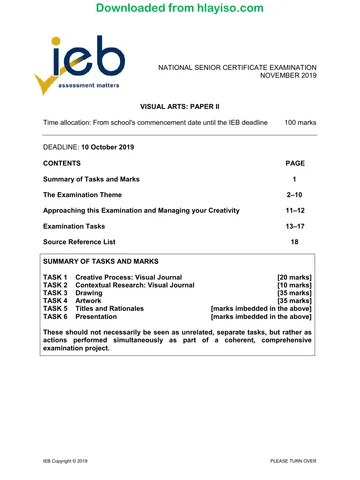
Visual Arts Grade 12 IEB Paper 1 2019 Memo
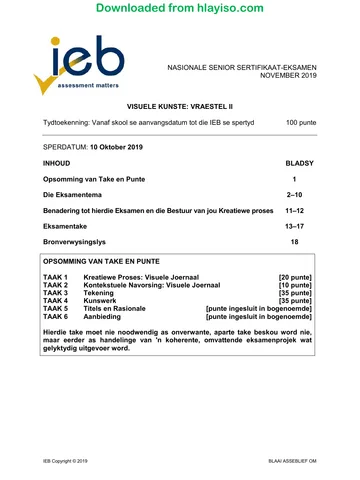
IEB Grade 12 Visual Arts Paper 1 memorandum from the 2019, 15 pages. Read online or get the free PDF download, question paper linked when available.
Publisher: IEB
Visual Arts · Grade 12 · 2019. Memorandum, 15 pages. Read online or download the PDF.
- Subject
- Visual Arts
- Grade
- Grade 12
- Document type
- Memorandum
- Year
- 2019
- Paper
- 1
- Publisher
- IEB
- Curriculum
- IEB
- Pages
- 15
- File size
- 334.4 KB
Loading document…
Loading document…
1 of 15
Document textSearch extracted text and jump to a page.
Downloaded from hlayiso.com
NATIONAL SENIOR CERTIFICATE: VISUAL CULTURE STUDIES: PAPER I – MARKING GUIDELINES Page 2 of 15
QUESTION 1 VISUAL LITERACY
1.1 Bloom's Taxonomy Level 3: interpret, execute, solve, demonstrate.
• Reflections is a massive sculpture and this allows it to tower over the
landscape of the Karoo as well as the people attending AfrikaBurn.
• It makes the work monumental.
• The scale of the work makes it powerful and potentially intimidating for the
viewer.
• Any suitable answer.
1.2 Bloom's Taxonomy Level 5: evaluate, appraise, argue, defend.
• Daniel Popper is the leading artist which means that it is his idea. Under the
banner of Conceptual Art the idea is more important than the creation of
the artwork.
• The fact that his name is the only name connected to the sculpture means
that he owns the idea and therefore the sculpture.
• The community owns the artwork because this is the point of AfrikaBurn. It
is an experience and therefore those who created the artwork and who
were there to experience it, "own" it.
• The idea behind Arikaburn is for the community to create impermanent
artworks. It adds to the experience. The text specifies that nothing is
advertised or commercial therefore it is not a conventional work of art and
the community owns the sculpture.
• Any suitable answer.
1.3 Bloom's Taxonomy Level 5: evaluate, appraise, argue, defend, judge.
Argument for "Craft"
• Reflections is part of a burning festival and this festival is not overtly
advertised.
• The sculptures made by the community are impermanent and therefore
form part of the holistic experience. Images of the artworks don't go into a
gallery space after the event.
• They are made by amateurs and some artists and they are not made for
the purpose/function of being categorised as "High Art".
• The raw element of found materials and the technique of using interwoven
wood could be argued as elements synonymous with "craft".
• The size of the work is bigger than a 'Craft' item.
• The work doesn't have a utilitarian function.
• Craft can be used as a commodity where "art" is not always seen as a
"commodity."
• Any suitable answer.
IEB Copyright © 2019 PLEASE TURN OVER
Downloaded from hlayiso.com
NATIONAL SENIOR CERTIFICATE: VISUAL CULTURE STUDIES: PAPER I – MARKING GUIDELINES Page 3 of 15
Argument for "Art"
• Reflections has a title and although the artwork was made by many
people, Daniel Popper has been named as the leading artist.
• AfrikaBurn is about the collective experience and it involves many other
forms of "Art" like performance art. Therefore the sculpture should be
considered as "Art".
• Even though the information says that these sculptures are not advertised
the artwork can still be found on the internet. The impermanent nature of
this "land art" piece has still been immortalised via the internet and
therefore it should be considered as "Art".
• Please note that candidates may argue that Reflections is both Art and
Craft.
• The artist has taken a risk which adds conceptual value.
• There are no boundaries in the art world anymore.
• The process of the participant building and burning the work is more
important than the final product.
• The learner can define 'art' in relation to 'craft to justify or categorise the
artwork.
• Any suitable answer.
1.4 Bloom's Taxonomy Level 3: interpret, execute, solve, demonstrate.
• Both works existed and were made outside the confines of a
conventional space and/or gallery.
• The works were exhibited but not in a conventional way. The
photographs in Image C were glued onto the ceilings of the rooftops.
• Reflections was built in a landscape by people who had the intention of
destroying the work – the viewers were part of the building and
destruction of the artwork – unconventional and/or unofficial.
• AfrikaBurn prides itself on being a "closed" and non-commercial festival.
• JR is an activist so Image C is seen almost as an act of activism as
opposed to conventional art.
• Both works have specific contexts.
• In both cases the works are experiential in that the viewers have to
experience the artworks.
• These works could arguably be official as there are no boundaries in the
art world anymore.
• The learner could connect both experiential artworks with other
Conceptual Art modes and criteria, i.e. unsaleable, Performance Art,
Happenings, etc.
• Learners must make two valid points pertaining to both artworks.
• Any suitable answer.
IEB Copyright © 2019 PLEASE TURN OVER
Downloaded from hlayiso.com
NATIONAL SENIOR CERTIFICATE: VISUAL CULTURE STUDIES: PAPER I – MARKING GUIDELINES Page 4 of 15
1.5 Bloom's Taxonomy Level 5: appraise, argue, defend, value, critique.
• Successful. The rooftop photographs are large and this helps to
highlight the existence of the women living in the community.
• The nature of the photographs reveals the women in an optimistic and
expressive manner. The women look happy and are smiling.
• The black-and-white photographs are visually contrasted by the rust-
coloured shanty houses that surround them. This contrast creates visual
interest which in turn creates awareness.
• They say the eyes are the window to the soul and when looking at the
pictures, you get a real sense of the hardships these women have to
face daily.
• The photographs make people aware that there are human beings living
in poverty down there.
• The scale of the photographs creates a level of intimacy with the viewer
yet they also protect the women's anonymity.
• Any suitable answer.
• Unsuccessful. The women's identities are obscured and even though
there is visual contrast between the black-and-white photographs and
the rust-coloured houses, the viewer is merely being assaulted with
nameless faces and parts of faces.
• You can only see the photos from a bird's eye view so on ground level
you would not know that they are there.
• This work was created in 2009 and I have become aware of these
women now only because of this exam paper.
• If you consider how much this exhibition must have cost to make, I think
it would have helped the community more to give them the money.
• The women look happy in the photographs and this doesn't make the
viewer realise how bad their lives are.
• This work clearly divides the privileged who can see the work from
inside an aeroplane and those on the ground who experience the
hardships of their reality.
• Learners may argue that the work is both successful and unsuccessful,
• Any suitable answer.
IEB Copyright © 2019 PLEASE TURN OVER
Downloaded from hlayiso.com
NATIONAL SENIOR CERTIFICATE: VISUAL CULTURE STUDIES: PAPER I – MARKING GUIDELINES Page 5 of 15
QUESTION 2 TWENTIETH CENTURY ART FROM DADA UP TO BUT
EXCLUDING THE CONCEPTUAL ART OF THE 1970s
2.1 Bloom's Taxonomy Level 2: understand, describe, discuss.
4 marks for names, titles and descriptions. No marks awarded for title
without a valid description, i.e. 2 marks for each artwork.
Example:
Jackson Pollock (1 mark) created Lavender Mist which is an abstract
painting that consists of a multitude of drips and splatters of lilac-toned and
grey paint. (1 mark)
2.2 Bloom's Taxonomy Level 3: apply, execute, solve.
3 marks per discussion of artist. 6 marks in total.
• Pollock created his works by laying a big piece of canvas on the floor.
He attacked the canvas with paint using unconventional methods of
dripping and splattering paint.
• The rhythmic motion of this painting process captured his subconscious
thoughts and emotions at the time the painting was being created.
• Once this process was complete, he evaluated the piece of canvas and
selected a suitable portion that reminded him of something and/or had
artistic merit.
• This is further evidence of his subconscious at work. In the case of this
artwork the painting he selected reminded him of lavender mist, hence
the title.
• Learners may be awarded 4 marks for one example and 2 marks for the
other example if the discussion justifies it.
2.3 Bloom's Taxonomy Level 5: evaluate, appraise, argue, defend, value
critique.
5 marks in total.
Possible arguments:
• VCS has informed my understanding because without having studied
the artworks I would not have understood the underlying concepts.
• Without knowing what was happening at the time of the artworks'
creation or why the artists did what they did, I would label these artworks
as unskilled and/or deliberately childish.
• Without VCS I might have understood the works on some level but I
would not have been able to verbalise my understanding.
• Without VCS I would have glanced over both these artworks, they would
have had little impact on me because neither is aesthetically pleasing.
• VCS has given me insight and the tools to analyse and appreciate the
artworks. Without VCS I would not have had any real interest as
Lavender Mist has no subject matter and is therefore visually
unstimulating.
• Any suitable answer.
IEB Copyright © 2019 PLEASE TURN OVER
Downloaded from hlayiso.com
NATIONAL SENIOR CERTIFICATE: VISUAL CULTURE STUDIES: PAPER I – MARKING GUIDELINES Page 6 of 15
Possible arguments:
• Uninformed viewers might have a slight understanding of Lavender Mist
because the title alludes to the artist's meaning.
• Uninformed viewers might see this artwork as nothing more than a
layering of drips and splatters of paint. They need to understand the
Abstract Expressionist movement to fully appreciate the artwork.
• In many ways a lack of response by a viewer would be playing into the
artist's hands. The Abstract Expressionists wanted the audience to
interpret the artwork as they saw fit. A lack of response is still a
response.
• Regardless of how educated the audience is, one can never control how
a viewer will interpret an artwork.
• Any suitable answer.
IEB Copyright © 2019 PLEASE TURN OVER
Downloaded from hlayiso.com
NATIONAL SENIOR CERTIFICATE: VISUAL CULTURE STUDIES: PAPER I – MARKING GUIDELINES Page 7 of 15
QUESTION 3 CONCEPTUAL AND CONTEMPORARY INTERNATIONAL
ART
3.1 Bloom's Taxonomy Level 2: understand, describe discuss.
4 marks for names, titles and descriptions. No marks awarded for title
without a valid description. 2 marks for each artwork.
Examples:
First selection:
Marina Abramović's (1 mark) Rhythm O consisted of the artist giving herself
up to an audience for six hours. 72 objects lay on a table in front of her and
the audience was given permission to use these implements to physically
engage with the artist. (1 mark)
Second selection:
Tracey Emin's (1 mark) My Bed consists of the artist's real, wooden bed
with wrinkled sheets, pillows and twisted blankets, but also with tangled
nylon stockings and crumpled towels. Strewn around the bed is a clutter of
personal effects: empty vodka bottles, slippers and underwear, crushed
cigarette packs, a snuffed-out candle, condoms and contraceptives, a
cuddly toy and several Polaroid self-portraits. (1 mark)
3.2 Bloom's Taxonomy Level 3: apply, execute, solve, demonstrate.
4 marks per discussion of artist. 8 marks in total.
First selection:
• To test the limits of the relationship between performer and audience,
Abramović developed one of her most challenging (and best-known)
performances. She assigned a passive role to herself, with the public
being the force that would act on her. Abramović placed 72 objects on a
table that people were allowed to use (a sign informed them) in any way
they chose.
• Some of these were objects that could give pleasure, while others could
inflict pain or harm. Among them were a rose, a feather, honey, a whip,
olive oil, scissors, a scalpel, a gun and a single bullet.
• For six hours the artist allowed the audience members to manipulate her
body and actions. This tested how vulnerable and aggressive the human
subject could be when protected against social consequences.
• By the end of the performance, her body had been stripped, attacked,
and devalued into an image that Abramović described as the "Madonna,
mother, and whore".
• Additionally, markings of aggression were apparent on the artist's body.
There were cuts on her neck made by audience members, and her
clothes had been cut from her body.
IEB Copyright © 2019 PLEASE TURN OVER
Downloaded from hlayiso.com
NATIONAL SENIOR CERTIFICATE: VISUAL CULTURE STUDIES: PAPER I – MARKING GUIDELINES Page 8 of 15
• In her works, Abramović affirms her identity through the perspective of
others, but, more importantly, by changing the roles of each player, the
identity and nature of humanity at large is unravelled and showcased. By
doing so, the individual experience morphs into a collective one and
creates a powerful message about the dark side of human nature.
Second selection:
• Emin presented her bed, in the form of an Installation, exactly as it
looked during a difficult time in her life.
• In an interview Emin elaborated: "I had a kind of mini nervous
breakdown in my very small flat and didn't get out of bed for four days.
And when I did finally get out of bed, I was so thirsty I made my way to
the kitchen crawling along the floor. I pulled myself up on the sink to get
some water, and made my way back to my bedroom, and as I did I
looked at my bedroom and thought, "Oh, my God. What if I'd died and
they found me here? What if I took all of that out of this bedroom and
placed it in a white space? How would it look then?"
• When she put her bed into a white space, some people were shocked.
The artwork is raw and in some ways macabre, which is why it is still
one of the most controversial artworks ever.
• The artist revealed her state of mind in an honest way, and by doing
this, she made a shocking statement regarding her mental health.
• This process of self-reflection had a profound impact on Emin. In her
statement quoted above, she admitted that she was shocked when she
saw her flat. She realised she could have died there.
• By turning this experience into an artwork, she is exposing the truthful
reality of what it is like to have a nervous breakdown.
• It is an issue that many can relate to, but due to societal pressures,
many do not discuss it or make it public.
3.3 Bloom's Taxonomy Level 5: evaluate, appraise, argue, defend, value,
critique.
• Abramović's Rhythm O is a timeless artwork. The manner in which she
created the work and its concept are still valid today and it will still be
relevant in 100 years' time. This said, the world today is bombarded with
all sorts of grotesque imagery because of the internet. As compelling as
the work may be in the abstract, via the internet, one can only in person
truly appreciate the situation she was conveying.
• There are means of capturing the performance via camera and film but
cameras and images can lie. We only know about this artwork through
these historical recordings but what would it have been like to actually
witness such an event?
• The fact that the concept is understandable via digital means is a
testament to the artist's genius; of this, there is no doubt. This said,
however, those who saw this work in "real life" would have been
profoundly moved by the events that took place. They would have been
shocked to the core.
• The recording of the work is shocking enough as it is, but to have been
there in person would have been life-changing.
IEB Copyright © 2019 PLEASE TURN OVER
Downloaded from hlayiso.com
NATIONAL SENIOR CERTIFICATE: VISUAL CULTURE STUDIES: PAPER I – MARKING GUIDELINES Page 9 of 15
3.4 Bloom's Taxonomy Level 5: evaluate, appraise, argue, defend, value,
critique.
• Everyone has seen a messy room and everyone has seen aspects of
what the artist put on display as part of this artwork.
• These everyday objects are therefore not hard to imagine in the
abstract.
• More and more people are subjected to mental health issues as a by-
product of our hectic lives. Thus the concept behind this artwork is not
hard to understand.
• The work is shocking and therefore it will have an impact on the viewer.
This is so for two reasons. Firstly, that this human debris can be viewed
as "art" and secondly, that the artist herself was brave enough to
showcase her issues in such a shocking manner.
• It is a kind of shock that everyone, regardless of gender, colour or creed,
can understand.
QUESTION 4 RESISTANCE ART IN SOUTH AFRICA (1976–1994)
4.1 Bloom's Taxonomy Level 1: remember, define, state.
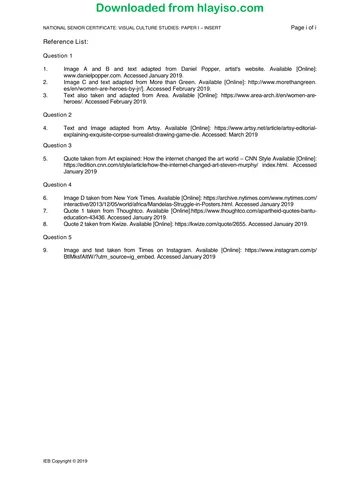
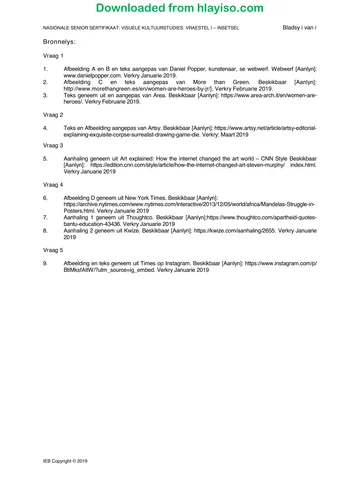
• The image is an artist's interpretation of Sam Nzima's photo of Hector
Pieterson – 1 mark.
• During the Soweto Riots in 1976.
• Any indication of understanding of where the subject matter comes from
should be given at least 1 mark.
• Reference to the Pieta is also acceptable.
4.2 Bloom's Taxonomy Level 2: understand, explain, identify, remember.
• Red symbolises the spilling of blood.
• White refers to purity, innocence or martyrdom.
• Any suitable answer.
4.3 Bloom's Taxonomy Level 2: understand, describe, discuss.
4 marks for names, titles and descriptions. No marks awarded for title
without a valid description. 2 marks for each artwork.
Example:
Helen Sebidi's Mother Africa depicts a crowded scene of mostly human
figures and a goat in the foreground. The work is rendered in an emotional
and gestural manner.
IEB Copyright © 2019 PLEASE TURN OVER
Downloaded from hlayiso.com
NATIONAL SENIOR CERTIFICATE: VISUAL CULTURE STUDIES: PAPER I – MARKING GUIDELINES Page 10 of 15
4.4 Bloom's Taxonomy Level 4: analyse, differentiate, examine, relate.
AND Bloom's Taxonomy Level 5: evaluate, appraise, argue, defend.
10 marks. 5 marks per level. 5 marks for the discussion of each
artwork.
• Sebidi's cramped compositions are said to be reminiscent of the
cramped living conditions in informal settlements.
• Given the intensity of her mark-making, the viewer is definitely left with
an uneasy feeling when viewing her work. She is trying to convey the
uncomfortable and oppressed situations in which her people lived.
• It is no secret that black people were removed from their original
homelands and forced into migrant labour and informal settlements.
• Although not directly about this particular aspect of oppression during
the apartheid regime, Sebidi's work does embody a sense of being
trapped and an absence of relief or indeed opportunities of freedom or
liberty.
• Because of the laws; Bantu Education and general restrictions meant
families were doomed to perpetuate living in poverty from one
generation to the next. Sebidi's work speaks to the aggravation of not
having an opportunity to escape poverty.
4.5 Bloom's Taxonomy Level 5: evaluate, appraise, argue, defend.
2 marks
• Helens Sebidi's artwork is still relevant today because many black South
Africans are still trapped in poverty.
• We still have issues with the lack of education and thus many families
are caught up in the on-going cycle of poverty.
• Not many can afford tertiary education; hence the #FEESMUSTFALL
campaigns in recent years.
• Our government has made many promises but has not lived up to these
and thus people are still forced to live in informal settlements as the
oppressed did in the past.
• It could also be argued that the kind of oppression is in current times
extended beyond the previous demographic borders.
IEB Copyright © 2019 PLEASE TURN OVER
Downloaded from hlayiso.com
NATIONAL SENIOR CERTIFICATE: VISUAL CULTURE STUDIES: PAPER I – MARKING GUIDELINES Page 11 of 15
QUESTION 5 CONTEMPORARY SOUTH AFRICAN ART (POST 1994)
Write an essay of approximately 4 pages in which you critically consider the degree to
which South African Contemporary Art provokes a sense of optimism in the viewer.
Select THREE Contemporary South African artists and ONE artwork by each selected
artist to develop and substantiate your argument.
(Total of three artworks discussed. Please note: candidates may choose to discuss
Nelson Makamo but they may not refer to the artwork referred to in this question.)
Mark allocation for Question 5
3 artists (A)
6 marks
3 titles with brief descriptions (DES) of Bloom's Taxonomy Level 2:
works (W) understand, describe, discuss.
Relevant facts (F)
12 marks
Bloom's Taxonomy Levels 3 and 4:
(Please note: Write 6 facts to achieve 4
apply, execute, solve, demonstrate AND
marks per discussion of each artwork.)
analyse, differentiate, examine, relate.
Development of argument (DA)
12 marks
Bloom's Taxonomy Level 5:
Evaluate, appraise, argue, defend.
Please see rubric.
Possible thoughts on the types of arguments we may encounter:
• It could be argued that all art, whether or not the subject matter or concept is positive
or negative, is positive, because art highlights issues that people weren't previously
aware of. This sparks conversation; and this process of debate is positive, thus
creating optimism and hope.
• Many artists don't deal with the positive or negative issues of society; they merely
reflect their own agendas or aspects of their particular identity. This type of art does
not create hope and/or optimism, e.g. Bernie Searle's Profiles.
• There are so many problems in South Africa/the world at present that there are not
many artists who portray South Africa/the world in a positive light. There is not much to
be positive about and therefore artists don't delve into the positive and they don't
inspire optimism or hope.
• Other artists use their art as a means of creating social awareness amongst the South
African public by portraying negative aspects. This is just a bleak reminder of how bad
things are in our country.
• Many South African artists live and work abroad and thus don't portray South African
subject matter at all.
• It is impossible to speculate on the degree to which feelings of optimism and hope in
the viewer can be provoked by an artwork.
IEB Copyright © 2019 PLEASE TURN OVER
Downloaded from hlayiso.com
NATIONAL SENIOR CERTIFICATE: VISUAL CULTURE STUDIES: PAPER I – MARKING GUIDELINES Page 12 of 15
Argument For:
Simon Max Bannister (A) created Plastikos (W), a large circular disc (amongst other works)
from plastic bags and plastic debris that he collected. (DES)
Plastikos was a unique exhibition where the art was created to raise awareness about
pollution and human waste, particularly plastic and micro plastic and its impact on the
oceans. (F) The works were made from reclaimed polyethylene plastic which Bannister
collected by hand from the shorelines, roadsides and landfills of South Africa. (F)
Situated in the Atlantic Ocean Gallery of the Two Oceans Aquarium, (F) Plastikos included
giant sculptures and micro plastics in suspension. From the entangled mesh of rope and
micro debris, the artworks on display represented the monster of waste that must be
confronted and overcome. (F)
Other elements of Plastikos included a microcosm of a littered beach, illustrating how our
beaches are turning into plastic wastelands as a result of the careless disposal and poor
management of plastic waste. The items on display were all collected from Muizenberg
Beach. (F)
According to Bannister, "I have always hunted waste ... My journey has taken me along
the coastlines of South Africa, the relentless rugged and beautiful headlands driving me
on. I have made it my mission to transform the waste that I find into an art form, giving
these objects new value and meaning and making them the story of my journey." (F)
Bannister's mission to create art from waste gives the viewer a profound sense of hope.
Firstly, the artist is creating beautiful objects from human waste. (DA) These sculptural
objects – part of the Plastikos exhibition – are unique and aesthetically pleasing. Arguably
the viewer is seduced by the beauty he creates from virtually nothing. (DA) The circular
disc that looks like a stained-glass window is fascinating to look at and one would scarcely
believe that this artwork was created out of plastic waste (DA). This work gives us hope
because the artist is making people aware of the environmental issues concerning ocean
pollution. The fact that he is able to transport the viewer to an underwater wonderland
further carries his message across. (DA) Once you learn more about his process and the
hours he spends collecting his material, you gain even more respect for his plight and his
artworks. (DA)
Argument Against:
Bernie Searle's (A) Profiles (W) consist of profile shots of the artist's face. Each profile
shot reveals an object, representing one of the cultures she derives from, pressed into her
cheek. (DES)
Searle's work deals with issues of race and gender, (F) and images of these issues are
convincingly imprinted on her. It involves an elegant combination of photography and
performance. (F) Searle will often include herself in her work, like she did in Profiles, but she
performs only for the camera, producing performative works that explore issues of self-
representation; (F) as well as the relationship between personal and collective identity and
narratives connected to history, memory and place. (F) Her more recent work has a
pervasive and growing sense of dissatisfaction, mirroring the continuous cycle of protests
and strikes across the country. (F)
IEB Copyright © 2019 PLEASE TURN OVER
Downloaded from hlayiso.com
NATIONAL SENIOR CERTIFICATE: VISUAL CULTURE STUDIES: PAPER I – MARKING GUIDELINES Page 13 of 15
While these works are often explored in dialogue with the socio-political legacy of South
Africa and in relation to current-day realities, her use of metaphor and poetic ambiguity
transcend the specifications of context; drawing on universal human emotions associated
with displacement, vulnerability and loss. (F)
There is no doubt that the kinds of subject matter explored by the artist do little in the way
of provoking a sense of optimism or hope in the viewer. (DA) This is a different kind of art.
It certainly evokes discussion and awareness but not necessarily in a manner that is going
to leave the viewer feeling optimistic. (DA) Added to this, it could be argued that her work
is extremely intellectual and that many people who do not understand her process or
conceptual art may not even understand the artwork at all. (DA) The purpose of this work
is to tell a story about the artist's own identity within a South African and global context.
Her intention was never to create a sense of optimism or hope and this is also not an
accidental by-product of the artwork discussed above. (DA)
Rubric for Question 5: Essay for 30 marks
CONTENT:
• 18 MARKS
• 3 ARTISTS AND ARTWORKS
• MAXIMUM OF 4 FACT MARKS PER ARTWORK
Circle below the correct number for marks allocated for artist and artworks, and facts per artwork
Relevant 1 mark for correctly selecting and naming an artist
selection in
relation to topic Symbol for marking protocol: RA 3 2 1 0
of:
1 Mark for correctly selecting and naming artwork – the title must
• artists be followed by a brief description of the artwork
• artwork with 3 2 1 0
description Symbol for marking protocol: RW
(6)
Relevant factual Selection of Correct factual Factual Factual No factual
content: correct knowledge is evidence is evidence is content
factual provided, but flawed; there severely
Symbol for knowledge with some are significant limited; with
marking excellent; gaps gaps and serious errors
protocol: RF factual omissions or incorrect
evidence is facts.
outstanding
6 or more 4–5 facts 2–3 facts 1 facts 0 facts
relevant facts
(12) 4 4 4 3 3 3 2 2 2 1 1 1 0 0 0
IEB Copyright © 2019 PLEASE TURN OVER
Downloaded from hlayiso.com
NATIONAL SENIOR CERTIFICATE: VISUAL CULTURE STUDIES: PAPER I – MARKING GUIDELINES Page 14 of 15
Summary of mark allocation: development of argument (level 5–7)
• The argument should be assessed by judging it throughout the whole essay.
• The level 5 descriptor is for the average learner or average essay.
• When assessing an essay choose descriptors that best/ mostly describe the essay
• Symbol for marking protocol: DA (development of argument)
LEVELS SKILLS MARKS
The excellent response:
• Opening statements are erudite and show a clear understanding of the
topic. 12–11
• The argument is complete and detailed, making unusual connections to
7+ more than one argument point to each of the selected artworks.
• It is well-structured, addressing all aspects of the question and drawing (100–92%)
them together accurately and with insight.
• The candidate makes insightful links between facts and argument.
• The candidate addresses all the complexities of the question weighing
up, constructing, juxtaposing, hypothesising, etc.
The very good response:
• Opening statements show a clear understanding of the topic.
• The candidate is able to make reference to more than one argument point
to each of the selected artworks. 10
7 • The answer is well-structured and complete, addressing some aspects of
(83%)
the question and drawing them together accurately.
• The candidate makes informed links between facts and argument.
• The candidate grapples with some of the complexities of the question but
may not be fully eloquent.
The good response:
• Opening statements show an understanding of the topic.
• The candidate puts across valid arguments, making specific reference to 9
6 more than one argument point to each of the selected artworks.
(75%)
• The candidate makes clear links between facts and arguments in the
body of the essay in most instances.
• The argument is well-structured.
The average response:
• The argument shows an underlying understanding of the theme argument
in the opening statements.
• The candidate puts across the argument in a valid, but general way
without addressing all aspects. 8*
5 • Inconsistent arguments/the argument is not sustained across all 3
artworks. (67%)
• Interesting arguments could be present, but could be without supporting
facts and/or adequate validation.
• The essay relates to aspects of the topic but the argument is not fully
developed.
• There is a good attempt at structuring an argument in the essay.
The fairly struggling response:
• shows a fairly limited understanding of the question topic and responds to
it in a one-dimensional way in the opening statements. 7
4 AND/OR
(58%)
• attempts to put across the argument but in a vague way without
addressing all aspects being asked or alternatively the candidate hasn't
substantiated their argument throughout the essay.
IEB Copyright © 2019 PLEASE TURN OVER
Downloaded from hlayiso.com
NATIONAL SENIOR CERTIFICATE: VISUAL CULTURE STUDIES: PAPER I – MARKING GUIDELINES Page 15 of 15
The struggling response:
• makes simple, underdeveloped links between fact and argument which 6
4 show limited understanding of the question.
• muddles arguments, usually without supporting facts. (50%)
• shows an attempt to structure argument within the essay but is not
entirely successful.
The fairly weak response:
• shows flawed and very incomplete responses to the topic.
AND/OR
• is unfocused with many sweeping statements and generalisations. 5
3 AND/OR
(42%)
• muddles arguments, without supporting facts.
AND/OR
• omits or misunderstands key concepts of content that are important in
building the argument.
The weak response:
• shows flawed and very incomplete responses to the opening statement.
• has vague and unfocussed or non-existent arguments and opening
statements. 4
3 AND/OR
(33%)
• sustains the argument for only one artwork.
• AND/OR
• presents opening statements that may be reworded from the given text
• has no structure to support the argument.
The very weak response:
• presents opening statements that may be reworded from the given text or
are unfocused.
• is inaccurate or simplistic. 3–2
2 • does not discuss enough artworks to build an argument or makes no
(25-17%)
attempt at an argument at all.
• has an argument unrelated to the topic or the candidate has completely
misunderstood the question.
• has no structure to support the argument.
The poor response:
• presents opening statements that may be reworded from the given text or
are non-existent.
• Does not address the issues because of a lack of understanding. 1–0
1 • attempts to address aspects of the question, but indicates only partial
(8-0%)
understanding.
• does not discuss enough artworks to build an argument.
• has no structure to support the argument.
• has no argument present.
Total: 100 marks
IEB Copyright © 2019
Study this subject
Revise the topics in this paper, then practise them question by question.
- Grade 12 Visual Arts notes
CAPS revision notes with worked examples.
- Visual Arts questions by topic
Past exam questions sorted by CAPS topic, with memos where available.
- All Grade 12 Visual Arts past papers
Past papers by year, with memos where available.
- Grade 12 IEB past papers
More Visual Arts and other subjects in this collection.
Recommended for this subject
More papers and memos for this grade and subject.
MemorandumIEB
Visual Arts Grade 12 IEB Paper 1 2019 Memo (Afrikaans)
MemorandumIEB
Visual Arts Grade 12 IEB Paper 1 2018 Memo
MemorandumIEB
Visual Arts Grade 12 IEB Paper 1 2017 Memo
MemorandumIEB
Visual Arts Grade 12 IEB Paper 1 2016 Memo
AddendumIEB
Visual Arts Grade 12 IEB Paper 1 2019 Addendum
AddendumIEB
Visual Arts Grade 12 IEB Paper 1 2019 Addendum (Afrikaans)
Related documents
Question paperIEB
Visual Arts Grade 12 IEB Paper 1 2019 Question Paper
Question paperIEB
Visual Arts Grade 12 IEB Paper 1 2019 Question Paper (Afrikaans)
AddendumIEB
Visual Arts Grade 12 IEB Paper 2 2019 Addendum
AddendumIEB
Visual Arts Grade 12 IEB Paper 2 2019 Addendum (Afrikaans)
Question paperIEB
Visual Arts Grade 12 IEB Paper 2 2019 Question Paper
Question paperIEB
Visual Arts Grade 12 IEB Paper 2 2019 Question Paper (Afrikaans)
More from Grade 12 Visual Arts
Question paperIEB
Visual Arts Grade 12 IEB Paper 2 2019 Question Paper
Question paperIEB
Visual Arts Grade 12 IEB Paper 2 2019 Question Paper (Afrikaans)
AddendumIEB
Visual Arts Grade 12 IEB Paper 2 2018 Addendum
Question paperIEB
Visual Arts Grade 12 IEB Paper 2 2018 Question Paper
Question paperIEB
Visual Arts Grade 12 IEB Paper 1 2018 Question Paper
Question paperIEB