
Downloaded from hlayiso.com
NATIONAL SENIOR CERTIFICATE EXAMINATION
NOVEMBER 2018
VISUAL ARTS: PAPER II
Time allocation: From school's commencement date until the IEB deadline 100 marks
DEADLINE: 16 October 2018
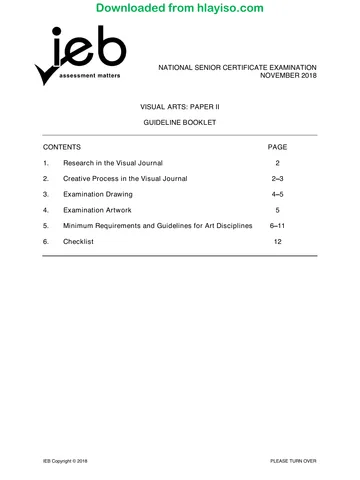
CONTENTS PAGE
Summary of Tasks and Marks 1
The Examination Theme 2–9
Approaching this Examination and Managing your Creative Process 10–11
Examination Tasks 12–16
Source Reference List 17
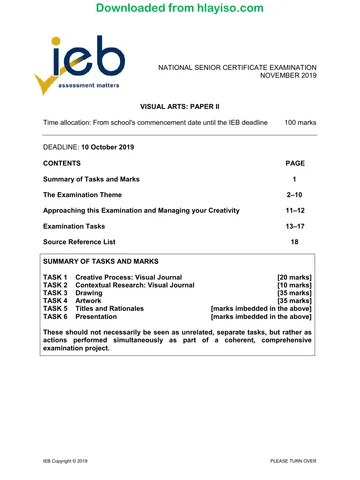
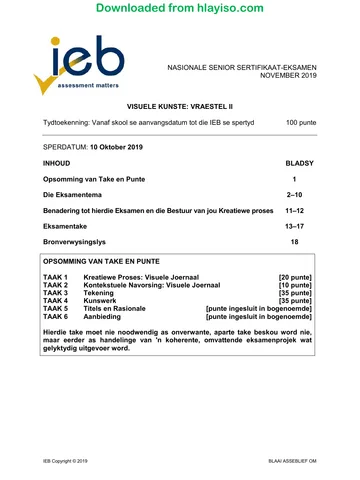
SUMMARY OF TASKS AND MARKS
TASK 1 Creative Process: Visual Journal [20 marks]
TASK 2 Contextual Research: Visual Journal [10 marks]
TASK 3 Drawing [35 marks]
TASK 4 Artwork [35 marks]
TASK 5 Titles and Rationales [marks imbedded in the above]
TASK 6 Presentation [marks imbedded in the above]
These should not necessarily be seen as unrelated, separate tasks, but rather as
actions performed simultaneously as part of a coherent, comprehensive
examination project.
IEB Copyright © 2018 PLEASE TURN OVER
Skip to contentQuestion paper 
View all
Visual Arts Grade 12 IEB Paper 2 2018 Question Paper
IEB Grade 12 Visual Arts Paper 2 question paper from the 2018, 17 pages. Read online or get the free PDF download, memo linked when available.
Publisher: IEB
Visual Arts · Grade 12 · 2018. Question paper, 17 pages. Read online or download the PDF.
- Subject
- Visual Arts
- Grade
- Grade 12
- Document type
- Question paper
- Year
- 2018
- Paper
- 2
- Publisher
- IEB
- Curriculum
- IEB
- Pages
- 17
- File size
- 2.1 MB
Loading document…
Loading document…
1 of 17
Document textSearch extracted text and jump to a page.
Downloaded from hlayiso.com
NATIONAL SENIOR CERTIFICATE: VISUAL ARTS: PAPER II Page 2 of 17
THE EXAMINATION THEME
Some things to consider:
The world is changing. The past your parents grew up in is gone,
and the future is bold, scary and exciting. Cellular phones, the
internet and real-time communication now bridge the gaps
between people as never before; we have become more linked,
more connected. We no longer simply look to the major cities like
New York, London, Tokyo and Johannesburg. Now, the small
town in which you live, or the small community of which you're a
part, are all important. Each smaller centre brings its own
identity, its own world-view and its own culture to the melting
pot of global humankind. There is much outside the 'centre', if
we'd just look.
To get you started, try to answer as many of these questions as possible. Record your
responses in your visual diary, or incorporate your responses in your initial mind-mapping:
1. What things in your own life experience once had a central place, but have since
moved to the outside?
2. What things do you think you should actively move away from your 'centre'?
3. In a broader sense, what things do you think we have moved away from our
'centre' as a country, a culture, a globe?
4. In terms of visual arts, what styles and ways of seeing the world have moved
away from the 'centre'? What came in their place?
IEB Copyright © 2018
Downloaded from hlayiso.com
NATIONAL SENIOR CERTIFICATE: VISUAL ARTS: PAPER II Page 3 of 17
Consider these examples from the fields of art, technology, media and philosophy that
touch on the idea of things 'outside the centre':
1
Kara Walker Scan this QR to
The Jubilant Martyrs of Obsolescence and watch video content
Ruin (2015) about the artist. You
Cut paper on wall could also use this
420 × 1 775 cm code:
bit.ly/ieb_walker
Kara Walker makes artworks about the legacy and history of African Americans. She rejects
the 'official' version of history and retells it from the perspective of slaves, the neglected and
the abused. It is often said that "history is written by the winners": Walker rewrites the
stories through the eyes of history's victims, in terms of both race and gender.
2 Scan this QR code
to go to the source
of this image.
You could also use
this link:
bit.ly/ieb_decenter
Centralised Decentralised Distributed
This diagram shows three ways that systems (computer networks, social systems,
countries) can work. In the first one, things are spread outward from the centre. In the
second, lots of smaller centres have developed, and things are distributed from them. In the
third, there seems to be no centre at all; instead, each dot has its own importance within the
system, and better sharing is enabled. Now imagine these diagrams as describing your
thinking about art: what would happen if you weren't sticking to a central 'style' like realism,
and instead allowed yourself to be influenced by lots of different styles and ideas? Could
you apply these diagrams to other systems in your world?
IEB Copyright © 2018 PLEASE TURN OVER
Downloaded from hlayiso.com
NATIONAL SENIOR CERTIFICATE: VISUAL ARTS: PAPER II Page 4 of 17
3
Scan this QR
code to
watch an
amusing yet
thought-
provoking
video about
this concept;
the clip is a
section from
popular
political
This is a map of the Earth, accurate in every traditional way, drama 'The
except that it is rendered 'upside down'. Who decided that West Wing'.
Europe and America are in the North? How would it change our You could
sense of who we are if the Earth was shown with Africa, South also use this
America and Australia in the Northern Hemisphere? link:
bit.ly/ieb_up
sidedown
IEB Copyright © 2018
Downloaded from hlayiso.com
NATIONAL SENIOR CERTIFICATE: VISUAL ARTS: PAPER II Page 5 of 17
4
Scan the QR code to
view the image in
more detail. You can
also use this link:
bit.ly/ieb_zulu
Sandile Zulu
Galaxy 5 (2005)
Fire, water, air and earth on canvas
150 × 150 cm
South African artist Sandile Zulu asks the question, 'What kind of abstract art
could be made with traditionally "African" materials and natural elements?' He
burns and marks his canvases in a way that reminds the viewer of the burnt veld
in winter, or even the burning of tyres and petrol bombs during the anti-apartheid
struggle. Notice the off-centre circle in this artwork: how do you think it might
relate to the theme of this examination?
Abstract art: art that does not attempt to represent anything from the visible
world.
IEB Copyright © 2018 PLEASE TURN OVER
Downloaded from hlayiso.com
NATIONAL SENIOR CERTIFICATE: VISUAL ARTS: PAPER II Page 6 of 17
5 Scan the QR code
to read an article
about Breitz's
career. You could
also use this link:
bit.ly/ieb_breitz
Candice Breitz
Extra #12, (2011)
Photographic print
56 × 84 cm
In 2011, South African-born artist Candice Breitz returned to SA from her new
home in Germany, to make a body of work about being an outsider. She worked
with the producer of popular local soap opera, Generations, making
photographs where she put herself into the drama on set. The actors were told
to completely ignore her as they continued to act out their scenes. Breitz asks,
what does it mean to be an outsider, from another place, and to be of no
importance to the people around you? How does it feel?
IEB Copyright © 2018
Downloaded from hlayiso.com
NATIONAL SENIOR CERTIFICATE: VISUAL ARTS: PAPER II Page 7 of 17
6
Scan this QR code to
view the image in
greater detail. You can
also use this link:
bit.ly/ieb_shonibare
Yinka Shonibare
Diary of a Victorian Dandy: 14.00 hours (1998)
Chromogenic photograph
Yinka Shonibare is a Nigerian-British artist, famous for placing black characters into
British stories. In this image, we see Shonibare himself, playing the main role of the
wealthy dandy, with white friends, staff members and servants doing as he says and
adoring him. The work parodies British colonialism, and also asks the powerful question,
'Why CAN'T a black person be the centre of power?'
Dandy: a man very concerned with looking stylish and fashionable
IEB Copyright © 2018 PLEASE TURN OVER
Downloaded from hlayiso.com
NATIONAL SENIOR CERTIFICATE: VISUAL ARTS: PAPER II Page 8 of 17
7
Gary Stephens
Gary Stephens
Braid Bun with Palm Fronds
Leticia, Floral Scarf Profile
and Leopard Sunglasses
(2017)
(2017)
Charcoal on folded paper with
Charcoal on folded paper with
string
string
Gary Stephens makes drawings that celebrate contemporary African hair culture.
Resisting the dominance of European and American fashion trends, his people
represent the ways in which contemporary urban African people show themselves to the
world.
Scan this QR code to look at
an online book of Gary
Stephens's work. You can
also use this link:
bit.ly/ieb_stephens
IEB Copyright © 2018
Downloaded from hlayiso.com
NATIONAL SENIOR CERTIFICATE: VISUAL ARTS: PAPER II Page 9 of 17
8
Strijdom van der Merwe
Black Sand Water Ripples in the Karoo (2014)
Intervention in Karoo landscape
Dimensions variable
Strijdom van der Merwe's land art moves the art experience out of the art gallery, in fact
out of the city, to spaces where you wouldn't expect to find it. In this art work, he seems
to be playing with the idea of water ripples, also where you wouldn't expect them: in the
middle of the Karoo desert. Although they have centres, the water ripples are 'outside
the centre' of the urban areas.
Scan this QR code to view
this work and others by
Strijdom van der Merwe. You
can also use this link:
bit.ly/ieb_vandermerwe
IEB Copyright © 2018 PLEASE TURN OVER
Downloaded from hlayiso.com
NATIONAL SENIOR CERTIFICATE: VISUAL ARTS: PAPER II Page 10 of 17
APPROACHING THIS EXAMINATION AND MANAGING YOUR CREATIVE PROCESS
The sources given in this examination paper consider concepts related to the theme,
'Outside the Centre'.
In the examples given, we are confronted with the idea of a decentralised world, one in
which many smaller centres of power, focus and activity start to emerge.
Inspired by any aspect of these images, videos and concepts that has personal resonance
with you, you are required to produce the following:
a visual journal
a drawing
an artwork
a title and rationale for both drawing and artwork
Engaging with Art and Visual Culture
By the end of the examination project, you will have researched and referred to the work
of a minimum of six other artists whose work reflects similar or related concerns to yours,
and who work in a similar discipline to what you have chosen. This research must be
shown in your Visual Journal. You must explore how these artists have sparked
something in your own thinking, and how their work has helped you gain greater
understanding in the making of your drawing and artwork.
Thinking as Doing: using your Creative Process to develop and refine your ideas
In your Visual Journal, you will document all the steps of your Creative Process leading
up to the presentation of your drawing as well as your artwork. Your research and
Creative Process should start immediately upon receipt of this examination paper and
should continue until you submit your work on the deadline date.
All tasks, outlined on the following pages, are compulsory; however, the order in which
you approach them must be informed by your own ideas and thinking process. You may
start with research of artists' work and then proceed to drawing your ideas, perceptions
and experiences in your Visual Journal, or you may start drawing immediately and allow
your artwork and research to emerge out of the process of drawing. Creativity is a cyclical
as much as it is a linear process. You will need to go back and forth, considering what
you have done and re-evaluate your processes and products along the way, in order to
develop your response to the examination to a convincing level of depth.
Guidelines and Requirements
Remember: you may work on your Visual Journal and Drawing tasks outside of the
school in your own time, but the Final Artwork may not be removed from the school
premises. It must be completed under teacher supervision.
It is your responsibility to read this Examination Paper and the Guideline Booklet
thoroughly before commencing with the project. Discuss the examination paper with your
teacher and your peers and take it home with you. Tasks 1 to 3 may be worked on away
from the school premises, but not the artwork task. The artwork (Task 4) must be worked
on entirely under teacher supervision.
IEB Copyright © 2018
Downloaded from hlayiso.com
NATIONAL SENIOR CERTIFICATE: VISUAL ARTS: PAPER II Page 11 of 17
NOTE: the following tasks are compulsory but need not necessarily be carried out
in strict numerical order. The process of creativity is organic and cyclical rather
than sequential and linear. You will need to go back and forth, considering and
reconsidering the various stages to develop and deepen your creative involvement
in the examination assignment.
Assessment
Your teacher has detailed assessment rubrics with all the criteria for success in this
examination. You are advised to familiarise yourself with these rubrics. Your response to
the examination will be assessed on the following three, broad, yet inter-related criteria:
1. Your ability to work skilfully with your chosen materials and composition
principles, i.e. form: do your drawing and your artwork show a mastery of the
chosen discipline(s), and take the viewer on an aesthetic journey?
2. Your original and creative thinking, concepts and the intentional meanings
explored by your work, i.e. content: does your work explore an interesting,
relevant interpretation of the theme at a sophisticated level?
3. The evidence of task-intensity, curiosity, perseverance, and commitment in
your response, as well as your ability to cope with the constraints of time and
space, i.e. context: does your work rise above the limitations of space and
circumstances in a sophisticated manner? Your Drawing and Final Artwork
should each take 4–6 weeks to produce, and this amount of effort should be
visible. Therefore, you cannot make a purely conceptual work that neglects
skill or materiality.
IEB Copyright © 2018 PLEASE TURN OVER
Downloaded from hlayiso.com
NATIONAL SENIOR CERTIFICATE: VISUAL ARTS: PAPER II Page 12 of 17
EXAMINATION TASKS
TASK 1 CREATIVE PROCESS: VISUAL JOURNAL [20 marks]
This is preparation for your drawing and artwork. It is a record of your responses to the
theme. Document your Creative Process fully in your Visual Journal.
Creative Exploration
Use the images, texts and ideas presented on the previous pages as starting points
and stimuli as you document all your ideas, feelings, sketches and images in your
Visual Journal.
State your interests and intentions for this Examination – but keep an open, flexible
mind. Your intentions may shift and change as your Creative Process develops.
Include initial sketches and source material.
Provide ideas written in your own words that explain your reasoning for portraying the
subject(s) you choose in the way you choose.
Show that you are fluent in the ability to generate various ideas and possibilities, not
just one final idea.
Carefully consider how you will represent your interpretation of this theme.
– Will your approach be intimate and personal, or public and bold?
– Will your drawing(s) and artwork(s) be naturalistic, stylised or abstract?
– Does a symbolic work communicate a deeper and more profound truth than a
naturalistic/photographic work? Or are the two even mutually exclusive?
– Your approach may be literal, it may be naturalistic, or it may be more symbolic or
poetic. What makes your artwork an artwork?
Review, develop and elaborate your own visual language by engaging further in a
cyclical Creative Process in preparation for your drawing and artwork.
Be flexible: your ideas may well have changed and are different to your initial
intentions, plans and goals.
Use words, sketches, visualisations and technical experiments to develop your artwork
visually. Explore possibilities!
You must decide which medium you are engaging with, and think about which
techniques and subject matter best suit your intentions and interpretation of the theme.
Decide wisely, and explain your decisions in your Visual Journal.
You must decide what signs and symbols from broader visual culture you will engage
with, in order to make your work meaningful.
As part of your Creative Process, consider the artworks you have already completed in
your School-Based Assessment (SBA) practical portfolio.
You are strongly advised to work with the same art discipline for this examination
project as you did in the SBA practical portfolio. (If you did sculpture in your SBA
portfolio, then this examination work should also be a sculpture.)
Explain the connection between your SBA portfolio and your intentions for the
examination project in terms of your formal and conceptual concerns. This is an
important part of developing a personal visual language.
For detailed guidelines regarding the Creative Process, refer to page 2 in the detailed
guideline document.
IEB Copyright © 2018
Downloaded from hlayiso.com
NATIONAL SENIOR CERTIFICATE: VISUAL ARTS: PAPER II Page 13 of 17
TASK 2 CONTEXTUAL RESEARCH: VISUAL JOURNAL [10 marks]
Research is an important part of the process of making a successful artwork
As part of your Creative Process, select and research a minimum of six other visual
artists' work that you find inspiring for your artistic practice for each task (research
approximately three artists for your drawing and approximately three others for your
artwork). Three of your artists should be African in origin.
You may research the work of the artists featured in the sources provided or research
other artists' work.
While researching, refine and adapt your ideas to fit your own intentions and goals for
this examination project.
Produce one detailed visual analysis of a minimum of one work by the artist(s) you
have chosen. In your analysis you must refer to the theme. The analysis must be in
your own words. Stay away from the scourge of 'copy-paste'! Simply copying and
pasting text from an authoritative source does not constitute adequate research. You
should show evidence of internalisation of your research.
Acknowledge all your source material using the Harvard method of referencing.
Explain why the artworks you research are relevant to your own intentions and plans
for the examination drawing and artwork tasks.
For detailed guidelines concerning contextual research, refer to page 2 in the detailed
guidelines document.
Document any further artworks that are inspiring you in your Creative Process.
You may find that you need to research other area(s) of visual culture and/or
knowledge.
Have any of the artists, artworks or areas of knowledge you researched for your SBA
Art projects recurred in your Visual Journal for this examination? If so, acknowledge
this. It is an important aspect of developing your personal visual language.
IEB Copyright © 2018 PLEASE TURN OVER
Downloaded from hlayiso.com
NATIONAL SENIOR CERTIFICATE: VISUAL ARTS: PAPER II Page 14 of 17
TASK 3 DRAWING [35 marks]
Produce a series of process drawings for display.
OR
Produce a minimum of one end-product drawing for display.
Your drawing should take 4–6 weeks to complete.
Work on your visual journal and your drawing concurrently.
If you choose the Process Drawing option, then your drawings must be displayed
professionally and not left in the journal.
NB: your drawing must be a drawing, developed from some form of marking or
scarifying a surface in a mostly-dry manner and not some other art form. If you
choose to make a drawing that does not conform to this understanding, then you
must explain your motivation for doing so and describe how your work counts as
drawing in your Visual Journal. Omission of such an explanation where required
will inevitably result in penalisation.
How does one understand 'drawing'?
A drawing is a series of relatively spontaneous marks on a surface. If you present a
drawing that is not in a drawing medium, you must justify how your submission may be
understood conceptually as a drawing. Drawing is an important skill to master: abstract
artist Ellsworth Kelly said, 'When I see a white piece of paper, I feel I've got to draw. And
drawing, for me, is the beginning of everything'. Think carefully about what makes a
drawing different from a painting or a sculpture or a photograph. Consider the reasons
why drawing is such an important part of an artist's working process.
For detailed guidelines regarding your drawing as well as a detailed explanation of
the differences between process drawing and end-product drawing, refer to page 4
in the guideline booklet.
IEB Copyright © 2018
Downloaded from hlayiso.com
NATIONAL SENIOR CERTIFICATE: VISUAL ARTS: PAPER II Page 15 of 17
TASK 4 ARTWORK [35 marks]
Having selected your art discipline for the examination, produce your artwork for
display.
You may not work on your artwork without teacher supervision.
NB: photography candidates: all photographic shoots must be carried out by you, the
candidate, and not by somebody else. If you are the subject of your own photographs, you
must show that you have composed your own photographs and not somebody else. If an
assistant is used to actually shoot photographs of you, then this must be acknowledged in
the Visual Journal. Use a substitute model to take your place posing for your shoot, while
you compose each shot and decide on camera settings. You must show the additional
planning shots that you have taken beforehand in your Visual Journal to prove that
the technical composition and shooting are your decision-making and work and not that of
the person taking the shot or anybody else. No professional photographer or any other
person is allowed to compose and shoot the photographs on your behalf.
For detailed guidelines regarding your artwork, refer to page 5 in the guideline
booklet.
IEB Copyright © 2018 PLEASE TURN OVER
Downloaded from hlayiso.com
NATIONAL SENIOR CERTIFICATE: VISUAL ARTS: PAPER II Page 16 of 17
TASK 5 TITLES AND RATIONALES
Create an appropriate and interesting title for both your drawing(s) AND your artwork(s).
Type and print out two separate rationales of no more than 150–200 words each.
Display your rationales, titles and examination number alongside your drawing and
your artwork.
TASK 6 PRESENTATION
Your drawing and your artwork must be displayed as professionally as possible. Label
your drawing(s) and your artwork as follows:
Name
Examination Number
Title
Examination Drawing/
Examination Artwork
SEE THE ACCOMPANYING BOOKLET FOR DETAILED GUIDELINES ON SPECIFIC
DISCIPLINES.
IEB Copyright © 2018
Downloaded from hlayiso.com
NATIONAL SENIOR CERTIFICATE: VISUAL ARTS: PAPER II Page 17 of 17
SOURCE REFERENCE LIST
1. Kara Walker. 2018. Works – Kara Walker. [ONLINE] Available at http://www.karawalkerstudio.com/2015.
[Accessed 26 January 2018].
2. steemit.com. 2018. No page title. [ONLINE] Available at: https://steemit.com/crypto/@jfgrissom/who-
controls-crypto-currencies. [Accessed 26 January 2018].
3. mapworld. 2018. Australia Upside Down World Map, Buy Upside Down World Wall Map – Mapworld.
[ONLINE] Available at: https://www.mapworld.com.au/products/australia-upside-down-world-map-in-
envelope. [Accessed 26 January 2018].
4. Sandile Zulu (South Africa). 2018. Sandile Zulu (South Africa). [ONLINE] Available at:
http://www.octobergallery.co.uk/artists/zulu/index.shtml. [Accessed 27 February 2018].
5. GOODMAN GALLERY: exhibitions | show. 2018. GOODMAN GALLERY: exhibitions | show. [ONLINE]
Available at: http://www.goodman-gallery.com/exhibitions/317. [Accessed 27 February 2018].
6. Yinka Shonibare – Victoria and Albert Museum. 2018. Yinka Shonibare – Victoria and Albert Museum.
[ONLINE] Available at: http://www.vam.ac.uk/content/articles/s/yinka-shonibare/.
[Accessed 6 February 2018].
7. Urban African Style – Gary Stephens' Painting and Drawing. 2018. Urban African Style – Gary Stephens'
Painting and Drawing. [ONLINE] Available at: https://papermine.com/pub/1871#cover. [Accessed
15 March 2018].
8. Strijdom_vdMerwe_land_art047 | Strijdom van der Merwe. 2018. Strijdom_vdMerwe_land_art047 | Strijdom
van der Merwe. [ONLINE] Available at: http://www.strijdom.com/land-art/strijdom_vdmerwe_land_
art047/#main. [Accessed 16 March 2018].
9. P. 2 image reference: [ONLINE] Available at: https://slemma.com/blog/telling-stories-data-intertwining-worlds-
analytics-arts/ https://steemit.com/bitshares/@clains/what-is-a-decentralised-exchange. [Accessed
15 March 2018].
IEB Copyright © 2018
Study this subject
Revise the topics in this paper, then practise them question by question.
- Grade 12 Visual Arts notes
CAPS revision notes with worked examples.
- Visual Arts questions by topic
Past exam questions sorted by CAPS topic, with memos where available.
- All Grade 12 Visual Arts past papers
Past papers by year, with memos where available.
- Grade 12 IEB past papers
More Visual Arts and other subjects in this collection.
Recommended for this subject
More papers and memos for this grade and subject.
Question paperIEB
Visual Arts Grade 12 IEB Paper 2 2019 Question Paper
Question paperIEB
Visual Arts Grade 12 IEB Paper 2 2019 Question Paper (Afrikaans)
Question paperIEB
Visual Arts Grade 12 IEB Paper 1 2019 Question Paper
Question paperIEB
Visual Arts Grade 12 IEB Paper 1 2019 Question Paper (Afrikaans)
Question paperIEB
Visual Arts Grade 12 IEB Paper 2 2019 Question Paper
Question paperIEB
Visual Arts Grade 12 IEB Paper 2 2019 Question Paper (Afrikaans)
Related documents
Question paperIEB
Visual Arts Grade 12 IEB Paper 2 2018 Question Paper
AddendumIEB
Visual Arts Grade 12 IEB Paper 2 2018 Addendum
Question paperIEB
Visual Arts Grade 12 IEB Paper 1 2018 Question Paper
Question paperIEB
Visual Arts Grade 12 IEB Paper 2 2016 Question Paper
Question paperIEB
Visual Arts Grade 12 IEB Paper 2 2016 Question Paper
MemorandumIEB
Visual Arts Grade 12 IEB Paper 1 2018 Memo
More from Grade 12 Visual Arts
AddendumIEB
Visual Arts Grade 12 IEB Paper 1 2019 Addendum
AddendumIEB
Visual Arts Grade 12 IEB Paper 1 2019 Addendum (Afrikaans)
AddendumIEB
Visual Arts Grade 12 IEB Paper 2 2019 Addendum
AddendumIEB
Visual Arts Grade 12 IEB Paper 2 2019 Addendum (Afrikaans)
MemorandumIEB
Visual Arts Grade 12 IEB Paper 1 2019 Memo
MemorandumIEB