
Downloaded from hlayiso.com
GRAAD 12
NATIONAL
SENIOR CERTIFICATE
GRADE 12
VISUAL ARTS P1
FEBRUARY/MARCH 2018
MARKING GUIDELINES
MARKS: 100
These marking guidelines consist of 18 pages.
Copyright reserved Please turn over
Skip to contentAll 2018 papers 
View all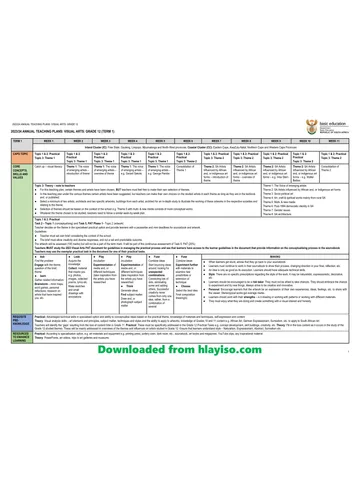
Visual Arts Grade 12 P1 NSC Supplementary 2018 Memo (Eng)
Grade 12 Visual Arts Paper 1 memorandum from the NSC Supplementary Exam 2018 (English), 18 pages. Read online or download the free PDF.
Visual Arts · Grade 12 · NSC Supplementary Exam · 2018. Memorandum, 18 pages. Read online or download the PDF.
- Subject
- Visual Arts
- Grade
- Grade 12
- Document type
- Memorandum
- Year
- 2018
- Exam period
- NSC Supplementary Exam
- Paper
- 1
- Curriculum
- CAPS
- Pages
- 18
- File size
- 336.2 KB
Free to read online, no sign-up needed
Loading document…
Loading document…
1 of 18
This exam
NSC Supplementary Exam 2018
Questions in this paper
- Question 1Visual Literacy and Art Analysis20 marks
- Question 2SA Artists Influenced by African and Indigenous Art Forms20 marks
- Question 3Socio-Political Art20 marks
- Question 4Art Craft and Spiritual Works from Rural South Africa20 marks
- Question 5Multi-Media and New Media Art20 marks
- Question 6Post-1994 Democratic Identity in South African Art20 marks
Show all 7 questions
Document textSearch extracted text and jump to a page.
Downloaded from hlayiso.com
Visual Arts/P1 2 DBE/Feb.–Mar. 2018
NSC – Marking Guidelines
INSTRUCTIONS AND INFORMATION
Read the following instructions carefully before commencing marking:
1. These marking guidelines consist of EIGHT answers. Candidates had to
answer any FIVE questions for a total of 100 marks.
2. It is MOST IMPORTANT that allowance is made for the candidates in many
instances:
Candidates must be given credit for providing their own opinions and
ideas in answers.
Credit must be given for lateral thinking.
Arguments and statements must be well-reasoned and qualified with
reference to specific factors.
3. Questions and subsections must be numbered clearly and correctly.
Bullets usually act as guidelines to help structure candidates' answers.
4. Information and artworks discussed in one answer must not be credited if
repeated in other answers, but artworks may be cross-referenced.
5. Where applicable, candidates must name the artist and title of each artwork.
Only ONE mark is allocated for the correct artist and title of work.
6. Where applicable, candidates may discuss both two- and three-dimensional
artworks in any answer.
7. Remember that many candidates will be discussing these examples,
never having seen them before. Markers therefore cannot expect factual,
academic information. They should draw upon their own experiences,
cultures and interpretations of the artworks, within the context of the
question. Therefore, markers need to be open-minded and flexible in the
marking process.
GENERAL INFORMATION FOR MARKERS
These marking guidelines are to serve as a guideline for markers and a teaching
tool. Therefore, the marking guidelines for certain questions are in greater depth,
so that the information may be used as learning material. Other parts of the
marking guidelines may merely be a suggested guideline.
NOTE: Markers are encouraged to reward candidates for what they know, rather
than penalise them for what they don't know.
Although the information for the questions is given in point form, candidates must
use an essay/paragraph format discussing their information in a holistic manner.
Candidates must answer all the questions in FULL SENTENCES or
PARAGRAPHS, according to the requirements of each question. Answers in point
form cannot receive full marks. Full marks cannot be given if the title or artist is
incorrect.
Markers must refer to the Visual Arts CAPS document page 45 for a guideline to
assess the levels of achievement.
Copyright reserved Please turn over
Downloaded from hlayiso.com
Visual Arts/P1 3 DBE/Feb.–Mar. 2018
NSC – Marking Guidelines
Assessing candidates' ability to analyse and respond to examples of visual culture
ACHIEVEMENT
RATING CODE
TOPIC 3: VISUAL CULTURE STUDIES
7 Demonstrates exceptional ability to respond to and analyse artworks in
Outstanding relation to their cultural, social, political and historical contexts.
80–100% Shows outstanding ability in the use of appropriate Visual Arts
terminology.
Demonstrates extremely well-developed writing and research skills in the
study of art.
Shows exceptional insight and understanding and uses divergent
approaches.
6 Demonstrates a well-developed ability to respond to and analyse artworks
Meritorious in relation to their cultural, social, political and historical contexts.
70–79% Shows excellent ability in the use of appropriate Visual Arts terminology.
Demonstrates highly developed writing and research skills in the study of
art.
Shows excellent insight and understanding.
5 Demonstrates substantial ability to respond to and analyse artworks in
Substantial relation to their cultural, social, political and historical contexts.
60–69% Shows substantial competence in the use of appropriate Visual Arts
terminology.
Demonstrates well-developed writing and research skills in the study of
art.
Shows a good level of insight and understanding.
4 Demonstrates moderate ability to respond to and analyse artworks in
Moderate relation to their cultural, social, political and historical contexts.
50–59% Shows moderate competence in the use of appropriate Visual Arts
terminology.
Demonstrates competent writing and research skills in the study of art.
Shows a fair level of insight and understanding.
3 Demonstrates adequate ability to respond to and analyse artworks in
Adequate relation to their cultural, social, political and historical contexts.
40–49% Shows adequate competence in the use of appropriate Visual Arts
terminology.
Demonstrates adequate writing and research skills in the study of art.
Shows an adequate level of insight and understanding.
2 Demonstrates only basic ability to respond to and analyse artworks in
Elementary relation to their cultural, social, political and historical contexts.
30–39% Shows little ability in the use of appropriate Visual Arts terminology.
Demonstrates basic writing and research skills in the study of art.
Shows an elementary level of insight and understanding.
1 Demonstrates little or no ability to respond to and analyse artworks in
Not achieved relation to their cultural, social, political and historical contexts.
0–29% Shows extremely limited ability in the use of appropriate Visual Arts
terminology.
Demonstrates limited writing and research skills in the study of art.
Shows little or no understanding or insight.
Copyright reserved Please turn over
Downloaded from hlayiso.com
Visual Arts/P1 4 DBE/Feb.–Mar. 2018
NSC – Marking Guidelines
CANDIDATE MUST ANSWER ANY FIVE QUESTIONS.
The following mark allocation must be adhered to when only ONE artwork/artist
has been discussed instead of TWO:
6 marks (max 3)
8 marks (max 5)
10 marks (max 6)
12 marks (max 7)
14 marks (max 8)
20 marks (max 12)
Due to the colour differences of the question papers from the different provinces, the
provinces have to adapt the marking guidelines for interpretation.
QUESTION 1: THE VOICE OF EMERGING ARTISTS
1.1 Candidates must compare the different approaches of the artists by using the
following guidelines in their discussion:
Subject matter:
FIGURE 1a:
This is an everyday township scene portraying a busy street scene. The
township is seen in the background, the curved road divides the foreground
from the background. A large bus is placed in the centre of the artwork.
Different pedestrians are seen crossing the road, standing on the pavement
and at the bus stop.
FIGURE 1b:
This painting portrays the exterior of an exhibition space. The two art
collectors are placed in the composition on the outside of a building. They
appear very static and formal.
Influences:
FIGURE 1a:
Bester uses his surroundings and everyday scenes of the township. He also
collected and recycled debris and junk from junkyards and used it in his art
works. This is a social issue addressed by Bester.
FIGURE 1b:
Influenced by Pop Art, photography and hard-edge painting.
Copyright reserved Please turn over
Downloaded from hlayiso.com
Visual Arts/P1 5 DBE/Feb.–Mar. 2018
NSC – Marking Guidelines
Line, shape and colour:
FIGURE 1a:
This is a bright and colourful painting. Various lines and shapes are seen
throughout the busy composition. The geometric lines of the bus, bus stop,
houses and pedestrian bridge contrasts with the curved line of the tarred
road. The line of the horizon is formed in the background behind the houses.
The picture plane is dominated by the blue colour of the road and the sky. He
uses bright blues and oranges that contrast as well as red and green.
Arbitrary colours are used.
FIGURE 1b:
Simplified, hard-edged shapes are used. Horizontal and vertical lines create
stability in the composition. The shapes of the two human figures contrast
with the formal geometric shapes of the garden and building. The vertical
shapes of the two human figures, tree, totem pole and sculptures contrasts
with the formal geometric shapes of the garden, pavement and building. The
pale saturated blue sky contrasts with the neutral earthy colours of the
foreground. The pink dress of the lady contrasts with the greenish colours of
the sculptures, tree and garden.
Placements of the figures and buildings/structures:
FIGURE 1a:
This is a scene with a pedestrian crossing, pavement, a bus dropping off
people at a bus stop, a pedestrian bridge to the left of the scene, a shelter at
the bus stop, some lorries and houses in the background and several human
figures placed randomly. Some pedestrians are crossing the road; others are
getting off the bus on their way home. Three uniformed figures are under a
roof and facing the road at the bus stop
FIGURE 1b:
The stiff figures are static and formal on a paved area with a flat roofed
building. They are surrounded by their possessions. A profile view of a
middle-aged man is seen in a brown suit standing stiffly with his fists clenched
while a full-figured matron like female in a robe, held closed with one arm,
strikes a sensual pose that is gracious and confrontational. She faces
forward and her eyes staring straight ahead. The façade of the modern
building has two large glass windows. A totem pole and tree are seen to the
right of the composition. Two sculptures are placed in the centre of the
composition. The one in front of the male figure and the second one more to
the back closer to the building.
Style of painting:
FIGURE 1a:
Bester uses an expressive but figurative style of painting.
FIGURE 1b:
Hockney uses a stylised, hard-edged style. Smooth paint is applied in almost
flat areas.
Copyright reserved Please turn over
Downloaded from hlayiso.com
Visual Arts/P1 6 DBE/Feb.–Mar. 2018
NSC – Marking Guidelines
Mood/Atmosphere:
FIGURE 1a:
This is a documentation of a friendly and happy everyday scene in a
township. Bright colours create a busy atmosphere. Everyone is carrying on
with their business of the day.
FIGURE 1b:
This painting is like a portrait study of these art collectors. A serene, static,
quiet and calm atmosphere prevails. A formal and serious feeling is created.
Candidates cannot receive full marks if no comparison is made. Markers
must use the descriptive rubric to guide mark allocation. (8)
1.2 Candidates must write an essay on ONE South-African artist that depicts
his/her surroundings and own experiences from everyday life. They can refer
to the following:
Subject matter
Influences
Art elements
Composition
Style
Possible meanings/messages (12)
[20]
Copyright reserved Please turn over
Downloaded from hlayiso.com
Visual Arts/P1 7 DBE/Feb.–Mar. 2018
NSC – Marking Guidelines
QUESTION 2: SOUTH AFRICAN ARTISTS INFLUENCED BY AFRICAN AND/OR
INDIGENOUS ART FORMS
Karel Appel said that his emotional expressions occupy a middle position between
order and chaos.
2.1 Candidates must discuss the statement above by referring to African and
other influences in FIGURE 2a and FIGURE 2b.
They may include the following:
Shapes and symbols:
FIGURE 2a: Irregular shapes created by colour, become angry faces. Finding
meaning in the expressionistic application of paint, Appel used harsh outlines
to emphasise what he saw in the muddle of colours. These shapes of colours
symbolise faces. Hard outlines, stylisation, naïve symbolic shapes and
distortion, shows clear characteristics of Expressionism.
FIGURE 2b: Squares, and rectangles are put together to form expressive
figures. It symbolises a large figure with a smaller figure on her lap and two
smaller figures on either side of the large figures. Ethnic patterns can be seen
on the clothing of the figures. Walter Battiss was influenced by the simplified
shapes and symbols used by the Khoi-San artists, as can be seen in the tiny
figures in the background. Decorative Ndebele patterns are used on the
figures' clothing. Simplified figures and distortions indicate the influence of
Expressionism. The end result has a Fauvistic feel to it reminding us of the
paintings by Matisse.
Art elements:
FIGURE 2a: The primary colours, red, blue and yellow dominate the picture
plane. Purple, as the complimentary of yellow is used to create a contrasting
background. Green as the complimentary of red is also used to create the
faces. Balance is created through the use of the bright yellow on either side of
the two dominating faces. The use of impasto and arbitrary colours give an
abstracted quality to the painting
FIGURE 2b: The large, green figure in the centre forms the focal point. aïve
lines are used to create the arms and face. Blue and orange, and green and
red are used to form contrasts in the painting. Bright yellow used on the left,
centre and right of the painting, forms a symmetrical balance. Texture is
obtained by the numerous tiny, ant-like figures in the background.
Copyright reserved Please turn over
Downloaded from hlayiso.com
Visual Arts/P1 8 DBE/Feb.–Mar. 2018
NSC – Marking Guidelines
Possible meanings/messages:
FIGURE 2a: The message can be derived from the title, 'Angry Landscape'.
The harsh colours and impasto paint is expressive and angry. The facial
expressions of the two heads also portray anger indicated by bared teeth and
large eyes.
FIGURE 2b: The title of the painting indicates a mother being the head of a
tribe. On her lap is a childlike figure and on either side a female figure and a
small male figure. This makes her the leader. It can also symbolise the fertility
of women in general. The many tiny figures in the background are symbolic of
the tribe. The message of a woman bearing children and being the nurturer of
a nation is universal. (8)
2.2 Candidates must discuss ONE artwork by ONE artist whose works are/were
influenced by Africa.
They must use the following guidelines in their answer:
Subject matter
Influences
Symbols
Style
Possible meanings/messages (12)
[20]
Copyright reserved Please turn over
Downloaded from hlayiso.com
Visual Arts/P1 9 DBE/Feb.–Mar. 2018
NSC – Marking Guidelines
QUESTION 3: SOCIO-POLITICAL ART, INCLUDING RESISTANCE ART OF THE
1970s AND 1980s
As a voice against political and/or social injustices in society, artists use a combination
of media and symbolism to convey a deeper message.
3.1 Candidates must analyse FIGURE 3a and FIGURE 3b to comment on how
these artists conveyed their voices of resistance.
They may use the following guidelines:
Subject matter:
FIGURE 3a: In this artwork the mineworkers of South Africa and their lifestyles
are portrayed. An image of a shanty township is illustrated in the background.
On the left side of the artwork is an image of a steam train. In the centre of the
artwork is the structure of a mine with the wheel of the cage taking the men
down to the underground.
FIGURE 3b: In the centre of the painting is an image of a male figure dressed
in a sleeveless vest and blue pants. He is lying on the lap of a female dressed
in camouflage clothing. She wears glasses and a headscarf. In the
background, composed in a semi-circle, are images of red roses, a fist and the
barrels of 4 guns. In the top right corner of the artwork are the legs of a
person, and just below an outlined image of a human figure. In the centre, on
the right side are blurred images of presumably buildings.
Media and technique
FIGURE 3a: Collage clippings of photographs and sketches were put together
to create a layered composition, creating distorted images. He often paints or
draws over his paper clippings (collẽ). The background is a painted
landscape. A cut-out photograph of a locomotive engine and its carriages can
be seen emerging from the horizon line. Many of the portraits are drawn and
painted in a naïve and simplistic manner.
FIGURE 3b: The artist used oil paint and combined this with spray paint and
stencilling. This is evident in the images of the guns and roses. Interesting
vertical lines create texture in the background.
Symbolism:
FIGURE 3a: The steam train symbolises either the transport of the mine
worker or the transport of the raw materials excavated by the mine. The small
structures in the background could represent the hostels that the mine
workers had to live in, or the low cost housing in squatter camps. All the
figures represent the life of the mine worker.
FIGURE 3b: The two figures symbolise a Pieta. The red roses symbolise
hope, love, forgiveness or sadness. The guns are a symbol of violence and
death.
Copyright reserved Please turn over
Downloaded from hlayiso.com
Visual Arts/P1 10 DBE/Feb.–Mar. 2018
NSC – Marking Guidelines
Possible meanings/messages:
FIGURE 3a: The use of photographs and clippings of drawings becomes a
distorted, dreary scene where people march in and out to the mines to work.
The artwork is a voice against the state of the working conditions of the
labourers at the mines. The composition becomes fragmented scenes of life
on the mines.
FIGURE 3b: The artwork evokes a feeling of sadness as the mother is holding
her son who has died. It reminds one of the PIETA of Michelangelo where
mother Mary holds Jesus on her lap after he has been taken from the cross.
The boy could have been killed in the city during demonstrations or during the
violence between the different gangs of urban squatter camps. (8)
3.2 Candidates must discuss the work of any TWO South African artists who use
their art to convey messages of social and/or political issues.
They must use the following in their answer:
Subject matter
Influences
Art elements
Media and technique
Possible meanings/messages (12)
[20]
Copyright reserved Please turn over
Downloaded from hlayiso.com
Visual Arts/P1 11 DBE/Feb.–Mar. 2018
NSC – Marking Guidelines
QUESTION 4: ART, CRAFT AND SPIRITUAL WORKS MAINLY FROM RURAL
SOUTH AFRICA
The traditional African mask has always been used as a deeply spiritual expression for
cultural and religious ceremonial reasons. Contemporary artists use the mask in many
different ways.
4.1 Candidates must discuss how the traditional mask has been reinterpreted by
referring to FIGURES 4a-d.
They may refer to the following:
Use of recycled materials
FIGURE 4a: A piece of wood is carved to become a mask.
FIGURE 4b: Wooden carved mask with found material for the hair. The artist
has juxtaposed the African mask against modern dress as seen in the
photograph.
FIGURE 4c: He uses recycled materials to create his mask. He uses a
gasoline/petrol canister. The mask also has rope, a woven basket, a key, pipe,
metal clamp and shells for the eyes.
FIGURE 4d: Made from found objects and recycled material sourced from the
streets of Nairobi. Material is recycled and repurposed to form a web like
mask.
Techniques
FIGURE 4a: The mask is carved by a specific person in the community. The
craft is passed down in the family. Colour is applied after the mask had been
shaped and been completed.
FIGURE 4b: Carved mask juxtaposed against modern dress. The photograph
becomes the artwork.
FIGURE 4c: The mask (readymade) has been constructed from a petrol
canister and found objects like a woven basket, keys, pipe, metal clamp, rope
and shells.
FIGURE 4d: The photograph shows the portrait of a man with a mask on.
Both the mask and the portrait become the artwork. The mask is constructed
from found objects i.e. wire, nails, bottle top and metal strips.
Copyright reserved Please turn over
Downloaded from hlayiso.com
Visual Arts/P1 12 DBE/Feb.–Mar. 2018
NSC – Marking Guidelines
Possible meanings/messages
FIGURE 4a: African masks are used in rituals and ceremonies. They
represent spirits of animals, ancestors, mythological heroes, mythological
values or a form of honouring of a person in a symbolic way. The traditional
African mask is worn during celebrations, dances and festivities and ritual
ceremonies commemorating social and religious events. They are more often
than not part of a unified experience, so while we see them as sculptural
forms they can also be considered as a form of performance art, and
understanding their function within this event is essential to appreciate their
cultural, symbolic and aesthetic significance. African masks are high in
demand from art collectors and museums the world over reworking their
archival collections to present masks in a new and vibrant format which focus
on the beauty and variety of form of the sculpture.
FIGURE 4b: There is a combination of Western society as seen in the suit
and the African mask representing old African heritage. It addresses the idea
of colonialisation.
FIGURE 4c: The mask represents the consumer society/ throw-away society
influencing the traditional as seen in the woven head piece.
FIGURE 4d: This construction of found objects has a light and delicate feel to
it. The use of metal parts (wire, bottoms of tins, small metal strips and parts)
that reflect light makes it a modern and fashionable piece. The different
interesting found parts and objects are arranged to form features of a face.
The artist could have been influenced by European art movements for e.g.
Cubism, Expressionism and/or Surrealism. This mask could be worn by a
model on a fashion runway as part of an outfit or worn as an accessory. (8)
4.2 Candidates must analyse the work of TWO South-African artists who
represent rural art, crafts and/or spirituality.
Influences
Art elements
Media and techniques
Possible meanings/ messages (12)
[20]
Copyright reserved Please turn over
Downloaded from hlayiso.com
Visual Arts/P1 13 DBE/Feb.–Mar. 2018
NSC – Marking Guidelines
QUESTION 5: MULTIMEDIA AND NEW MEDIA – ALTERNATIVE
CONTEMPORARY AND POPULAR ART FORMS IN SOUTH
AFRICA
In the Bible, the Tower of Babel was a tower built up to the heavens by rich, corrupt
and materialistic people. God punished their pride by tearing down the tower and
sentencing them all to speak in different languages.
In honour of Buenos Aires, which was named the 2011 World Book Capital, the artist
Marta Minujín created a tower of Babel using 30 000 books donated from all over the
world. Visitors are allowed to walk to the top of this structure.
5.1 Candidates must discuss Minujín 's artwork in FIGURE 5a by referring to the
following guideline:
The significance of using books from around the world
The artist collected 30 000 books from different countries and arranged them
in a spiral tower. Books represent knowledge, education and language. The
books were donated by readers, libraries and over 50 Embassies.
The size of the work
This work is done on a large scale and the tower rises up in the air. The large
scale might represent all languages of the world. It spirals up 25 meters into
the air allowing visitors to view the city from above.
Display of the artwork in a public space
It becomes part of the urban space and is accessible to everyone visiting the
space. It is not isolated in an art gallery or museum.
Use of site
The installation was placed in a public space (San Martin square) in order for
the spectators to walk up the ramp to make them aware of the origins of
different languages.
Interaction of the viewer
The spectator can walk along the spiral form to the top of the tower.
For teachers: When the visitors ascend the tower they hear music composed
by Minujín and the artist repeating the word 'book' in many languages. Once
dismantled the literary enthusiasts will be invited to pick one book to take
home with them and the remaining books will be called the Library of Babel.
Possible messages/meanings
She wants everyone to be part of a whole (unified). Also that we can
communicate through books and spread a message through the written word.
The unification of the written word in one location is reminiscent of the original
Tower of Babel, where everyone spoke the same language. (8)
Copyright reserved Please turn over
Downloaded from hlayiso.com
Visual Arts/P1 14 DBE/Feb.–Mar. 2018
NSC – Marking Guidelines
5.2 Artists often portray their own interpretation of stories and myths and use
different material and techniques to tell a story.
Candidates must discuss ONE artwork from TWO different artists who use
unconventional/ interesting media and techniques to tell a story.
They must use the following guidelines:
Line, shape and colour
Media and techniques
Possible meanings/messages (12)
[20]
Copyright reserved Please turn over
Downloaded from hlayiso.com
Visual Arts/P1 15 DBE/Feb.–Mar. 2018
NSC – Marking Guidelines
QUESTION 6: POST-1994 DEMOCRATIC IDENTITY IN SOUTH AFRICA
Zyma Amien's artwork pays homage to her mother and grandmother who worked in
the textile industry. The textile industry has the reputation that they exploit women by
paying them a minimum wage for long hours' work.
6.1 Candidates must discuss how Zyma Amien has portrayed in this exploitation
in her work by considering the following:
Description of the work
Amien pays homage to her mother and grandmother who worked in the textile
industry. There are three white gauze overalls hanging against a white wall
and three black sewing machines of different sizes are placed at the bottom of
each overall. The sewing machines forcibly 'pin' the overalls to the floor
reminiscent of those worn by female workers.
Colour
The white gauze overalls are juxtaposed against the black sewing machines.
White is symbolic of purity and peace and the black symbolic of the industrial
oppression.
Symbolism
Paying homage to someone is to give honour and respect. The title of the
artwork evokes a feeling of sadness. The white overalls are symbolic of her
mother and grandmother. Usually overalls are not white and made from heavy
durable material whereas these overalls are white and made from a soft and
feminine material. The sewing machine could be a reference to the male
gender and could symbolise oppression seen in the textile industry. (6)
6.2 Like Zyma Amien, many post-1994 democratic artists' work has developed
from their own personal histories.
Candidates must discuss the work of any TWO relevant South African post-
1994 democratic artists who explore their own identities.
They may refer to the following guidelines:
Subject matter
Influences
Art elements
Composition
Style
Possible meanings/messages (14)
[20]
Copyright reserved Please turn over
Downloaded from hlayiso.com
Visual Arts/P1 16 DBE/Feb.–Mar. 2018
NSC – Marking Guidelines
QUESTION 7: GENDER ISSUES: MASCULINITY AND FEMININITY
Contemporary society has a more tolerant approach to gender issues, which has
allowed artists to break with stereotypes.
7.1 Candidates must discuss why they think FIGURE 7a and 7b have broken with
stereotypes.
Candidates can use the following guidelines to aid their response:
Visual appearance/body language
FIGURE 7a: The male is portrayed as a soft, shy young man looking down at
his hand. Introverted and self-absorbed.
FIGURE 7b: The young man is looking at the viewer with self-confidence and
bravado. Standing with his hands on his hips, he shows off his muscular,
tattooed body. He is placed as if on a stage and is prancing and preening for
the adulation of the viewer.
Style and technique
FIGURE 7a: An impressionistic feel is given to the painting by the use of light
and soft colours. The work is gestural, expressive, and painterly. Short
brushstrokes and the use of spray paint reminds one of graffiti. The soft
colours give a feminine image of the young man.
FIGURE 7b: Bold, realistic colours are used. The detail given to the figure
almost reminds one of a photograph. Super realistic, meticulous application of
paint with no visible brushstrokes. The background reminds us of wall paper
which is very decorative and two-dimensional. The motifs of the wallpaper
seem to be repeated in the designs of the tattoos. The realistic use of oil paint
is almost like a photograph.
Mood and atmosphere
FIGURE 7a: A very sad tranquil mood is created. The figure seems very
relaxed and reserved and not aware of the viewer.
FIGURE 7b: Happy, jovial and playful atmosphere is created by the bright
colour and decorative pattern on both the body and the background.
Interpretation of gender issues
Candidates' own interpretation of gender issues and motivation thereof can
be accepted. (10)
Copyright reserved Please turn over
Downloaded from hlayiso.com
Visual Arts/P1 17 DBE/Feb.–Mar. 2018
NSC – Marking Guidelines
7.2 Society has prejudiced ideas on masculinity and femininity.
Candidates must debate their viewpoint of this issue in a discussion of the
work of TWO artists who commented on gender aspects in their work.
They must use the following as a guideline:
Subject matter/Themes
Influences
Media and techniques
Style
Possible meanings/messages (10)
[20]
Copyright reserved Please turn over
Downloaded from hlayiso.com
Visual Arts/P1 18 DBE/Feb.–Mar. 2018
NSC – Marking Guidelines
QUESTION 8: ARCHITECTURE IN SOUTH AFRICA
Francois van der Merwe Architects and PKA International Architects designed an
intelligent green-star-rated government building in Tshwane that combines both the
new and the old. A portion of the Agrivaal building was preserved and the new building
'clips' into the old building, therefore protecting South Africa's heritage.
8.1 Candidates must analyse any TWO buildings they have studied this year, by
answering the following:
Do you think it was a good idea of PKA International Architects to
incorporate part of the old Tshwane building into the new design for
the Agrivaal headquarters? Substantiate your answer by referring to
your own examples.
Yes, because heritage is preserved and it creates a sense of the
history/sense of the past. Old buildings are often built using beautiful
traditional materials such as solid woods, old brick, sandstone, marble,
mosaic work etc. Candidates don't need to agree with the statement as long
as they substantiate their response.
What structures have your chosen architects used in their buildings?
Candidates own information to be given with substantiation.
Do you think that architects should maintain parts of the old building
when building/designing a new structure? Substantiate your answer.
Yes, and only if the maintained part of the building has historical value. Often
a design has to adjust to the original design of the historical building.
Candidates could incorporate old and new building styles/materials etc.
Candidates own information to be given with substantiation.
Does your selected building reflect South Africa's heritage?
Substantiate your answer.
Candidates own information to be given with substantiation.
Materials
Candidates own information to be given with substantiation.
Style
Candidates own information to be given with substantiation.
Possible influences
Candidates own information to be given with substantiation.
[20]
TOTAL: 100
Copyright reserved
Study this subject
Recommended for this subject
Memorandum
Visual Arts Grade 12 P1 NSC Supplementary 2018 Memo (Afr)
Question paper
Visual Arts Grade 12 P1 NSC Supplementary 2018 QP (Afr)
Memorandum
Visual Arts Grade 12 P1 Eastern Cape Mock 2018 Memo (Afr)
Memorandum
Visual Arts Grade 12 P1 Eastern Cape Mock 2018 Memo (Eng)
Memorandum
Visual Arts Grade 12 Paper 1 NSC June 2018 Memo (English)
Memorandum
Visual Arts Grade 12 Paper 1 NSC June 2018 Memo (Afrikaans)
More from Grade 12 Visual Arts
Annual teaching plan
Gr 12 Vis Arts ATP 2023 24
Question paper
Visual Arts Grade 12 P1 NSC June 2025 Question Paper (Eng)
Question paper
Visual Arts Grade 12 P1 NSC November 2025 QP (Afr)
Question paper
Visual Arts Grade 12 P1 NSC November 2025 QP (Eng)
Question paper
Visual Arts Grade 12 P2 NSC November 2025 QP (Afr)
Question paper