
Downloaded from hlayiso.com
GRAAD 12
NATIONAL
SENIOR CERTIFICATE
GRADE 12
VISUAL ARTS P1
NOVEMBER 2022
MARKS: 100
TIME: 3 hours
This question paper consists of 19 pages.
This question paper must be printed in full colour.
Copyright reserved Please turn over
Skip to contentAll 2022 papers 
View all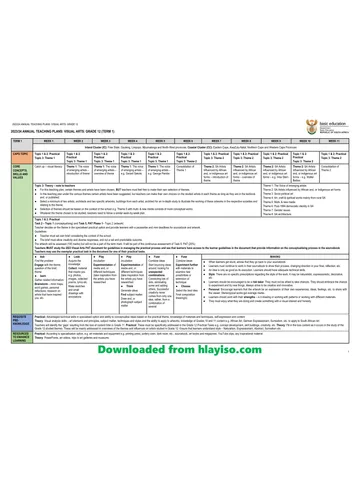
Visual Arts Grade 12 P1 NSC November 2022 QP (Eng)
Grade 12 Visual Arts Paper 1 question paper from the NSC November Exam 2022 (English), 19 pages. Read online or download the free PDF.
Visual Arts · Grade 12 · NSC November Exam · 2022. Question paper, 19 pages. Read online or download the PDF.
- Subject
- Visual Arts
- Grade
- Grade 12
- Document type
- Question paper
- Year
- 2022
- Exam period
- NSC November Exam
- Paper
- 1
- Curriculum
- CAPS
- Pages
- 19
- File size
- 2.0 MB
Free to read online, no sign-up needed
Loading document…
Loading document…
1 of 19
This exam
NSC November Exam 2022
Questions in this paper
- Question 1Visual Literacy and Art Analysis20 marks
- Question 2SA Artists Influenced by African and Indigenous Art Forms20 marks
- Question 3Socio-Political Art20 marks
- Question 4Visual Literacy and Art Analysis20 marks
- Question 5Multi-Media and New Media Art20 marks
- Question 6Post-1994 Democratic Identity in South African Art20 marks
Show all 7 questions
Document textSearch extracted text and jump to a page.
Downloaded from hlayiso.com
Visual Arts/P1 2 DBE/November 2022
NSC
INSTRUCTIONS AND INFORMATION
In this examination you will demonstrate the following skills:
The use of the correct art terminology
The use and implementation of visual analysis and critical thinking
Writing and research skills within a historical and cultural context
The placing of specific examples in a cultural, social, political and historical context
Understanding distinctive creative styles
Read the following instructions before deciding which questions to answer.
1. This question paper consists of EIGHT questions.
2. Answer any FIVE questions for a total of 100 marks.
3. Number the answers correctly according to the numbering system used in this
question paper.
4. Questions appear on the left-hand pages, with visual sources on the right-
hand pages.
5. Ensure that you refer to the visual sources reproduced in colour where
required.
6. Information discussed in one answer will NOT be credited if repeated in other
answers. Cross-referencing of artworks is permissible.
7. Name the artist and title of EACH artwork you discuss in your answers.
Underline the title of an artwork or the name of a building.
8. Candidates may NOT discuss artworks that have already been used in other
questions.
9. Write in a clear, creative and structured manner, using full sentences and
paragraphs according to the instructions of each question. Listing of
facts/tables is NOT acceptable.
10. Use the following as a guideline to the length of your answer. Note the mark
allocation.
6–8 marks: a minimum of ½–¾ page
10–14 marks: a minimum of 1–1½ page(s)
20 marks: a minimum of 2 pages
11. Write neatly and legibly.
Copyright reserved Please turn over
Downloaded from hlayiso.com
Visual Arts/P1 3 DBE/November 2022
NSC
LEAVE THIS PAGE BLANK.
Copyright reserved Please turn over
Downloaded from hlayiso.com
Visual Arts/P1 4 DBE/November 2022
NSC
ANSWER ANY FIVE QUESTIONS.
QUESTION 1: THE VOICE OF EMERGING ARTISTS
Artists do more than just reflect the times. They portray the many different activities of
the community they live in.
1.1 Study FIGURE 1a and FIGURE 1b and discuss the following:
The use of line
The use of space and depth
Both works use yellow and blue. What is the effect of this colour choice in
EACH work?
Style and technique
The interaction between the figures and the mood and atmosphere it
creates (10)
1.2 Discuss the artwork of any TWO South African artists (ONE artwork per artist)
who reflect on the activities of their communities.
Use the following guidelines:
Subject matter
Art elements
Possible influences
Media and technique
Possible meaning/messages (10)
[20]
Copyright reserved Please turn over
Downloaded from hlayiso.com
Visual Arts/P1 5 DBE/November 2022
NSC
FIGURE 1a: Koboka Welcome Mandla, People Collecting Water, oil on board, date unknown.
FIGURE 1b: Ian Mwesiga, People And Chicken, oil on canvas, 2020.
Copyright reserved Please turn over
Downloaded from hlayiso.com
Visual Arts/P1 6 DBE/November 2022
NSC
QUESTION 2: SOUTH AFRICAN ARTISTS INFLUENCED BY AFRICAN AND/OR
INDIGENOUS ART FORMS
Tamar Mason has created a South African landscape showing influences from our
African culture/heritage/environment.
2.1 Discuss the image in FIGURE 2a and the detailed close-ups in FIGURES 2b
and 2c by referring to the following:
Art elements (line, colour and texture)
Composition
Influences:
o Indigenous and/or African art forms and visual images
o Specific materials and techniques used in this work on the style and
the effect on the appearance of the work (8)
2.2 Discuss TWO artworks (ONE artwork per artist) that explores an African
influence.
Use the following guidelines:
Subject matter
Art elements
Media and technique
Influence of African and/or indigenous art forms (12)
[20]
Copyright reserved Please turn over
Downloaded from hlayiso.com
Visual Arts/P1 7 DBE/November 2022
NSC
FIGURE 2a: Tamar Mason, South African Landscape,
embroidery and beadwork on black fabric, 2 x 1,5 m, date unknown.
FIGURE 2b: Tamar Mason, South African FIGURE 2c: Tamar Mason, South African
Landscape (detail). Landscape (detail).
Copyright reserved Please turn over
Downloaded from hlayiso.com
Visual Arts/P1 8 DBE/November 2022
NSC
QUESTION 3: SOCIOPOLITICAL ART, INCLUDING RESISTANCE ART OF THE
1970s AND 1980s
Artists use art as a means of commentary and reflection on sociopolitical issues.
3.1 Discuss the artwork in FIGURE 3a by using the following as a guideline:
Give THREE reasons why the man is the focal point of the composition.
Identify the images/objects that relate to mining.
Discuss the balance in this composition.
Possible meaning/message referring to the work, including the title and
the text 'Under destruction'. (8)
3.2 Discuss the artwork of TWO South African artists (ONE artwork per artist) that
you have studied who comment on social and/or political issues.
Use following guidelines in your essay:
Subject matter
Media and technique
Style
Message/Meaning (12)
[20]
Copyright reserved Please turn over
Downloaded from hlayiso.com
Visual Arts/P1 9 DBE/November 2022
NSC
FIGURE 3a: Loyiso Mkize, The Pooristocrat, oil on canvas, 2013.
Aristocrat: An individual who is part of a selected group of powerful people that are
famous, wealthy, upper class or the highest social class.
Copyright reserved Please turn over
Downloaded from hlayiso.com
Visual Arts/P1 10 DBE/November 2022
NSC
QUESTION 4: ART, CRAFT AND SPIRITUAL WORKS MAINLY FROM RURAL
SOUTH AFRICA
Artworks give us a glimpse into the lives of others.
4.1 Discuss FIGURES 4a and 4b by answering the following:
Give a brief description of EACH artwork.
Identify the dominant visual image in EACH artwork. Give reasons for
your answer by referring to the composition and possible meaning/
message.
What role does colour play in creating the specific mood/atmosphere in
EACH artwork?
Which work do you prefer? Give reasons for your answer. (10)
4.2 Discuss the artwork of any TWO artists (ONE artwork per artist) who creates
art, craft and/or spiritual works.
Use the following guidelines:
Subject matter and/or function
Visual images and symbols
Art elements
Media and technique
Possible meaning and message (10)
[20]
Copyright reserved Please turn over
Downloaded from hlayiso.com
Visual Arts/P1 11 DBE/November 2022
NSC
FIGURE 4a: Marion Boehm, Muinda's Prayer, mixed media collage, 2017.
FIGURE 4b: Trevor Makhoba, Inguyazane (Caucus) (Take It Easy), oil on board, 1995.
Copyright reserved Please turn over
Downloaded from hlayiso.com
Visual Arts/P1 12 DBE/November 2022
NSC
QUESTION 5: MULTIMEDIA AND NEW MEDIA – ALTERNATIVE CONTEMPORARY
AND POPULAR ART FORMS IN SOUTH AFRICA
Art is often evaluated with the use of traditional methods and materials. Contemporary
artists often challenge this by using alternative media and techniques.
5.1 Do you agree or disagree with the statement above? Explain your answer. (2)
5.2 Write a paragraph in which you refer to FIGURES 5a and 5b regarding the
following:
The specific use of found materials and techniques, e.g. collage, stitching
and weaving, in creating these artworks and the function/role in the
artworks
The influence of Picasso/Duchamp or any other 20 th Century artist on
these artworks (6)
5.3 Evaluate which work is more successful in the use of materials. Give reasons
for your answer. (2)
5.4 Discuss TWO artworks that you have studied which show the use of
new/alternative media.
Refer to the following guidelines:
Techniques
Influences
Media/Alternative media
Message and/or meaning of the artwork (10)
[20]
Copyright reserved Please turn over
Downloaded from hlayiso.com
Visual Arts/P1 13 DBE/November 2022
NSC
FIGURE 5a: AdejokeTugbiyele, Homeless Hungry Homo, palm stems, steel, wire, metal,
wood, American dollar bills (money), 2014.
FIGURE 5b: Wangechi Mutu, Mask, mixed media and collage, 2006.
Copyright reserved Please turn over
Downloaded from hlayiso.com
Visual Arts/P1 14 DBE/November 2022
NSC
QUESTION 6: POST-1994 DEMOCRATIC IDENTITY IN SOUTH AFRICA
6.1 Fadiel Hermans makes use of powerful historical and fictional characters.
These characters play a role in shaping a young boy's identity.
Do you agree that toys play a role in creating your identity? Give reasons
by referring to FIGURE 6a.
Refer to figures and objects in the composition and their possible
meaning.
Discuss the use of specific colour and shapes in the background
Discuss the mood created by the posture of the little boy, images and
colour
Would you say the title is relevant? If you were the artist, what would you
name the artwork and why? (10)
6.2 Write an essay on TWO South African artworks which address identity in our
democratic society. (10)
[20]
Custodian: Someone who looks after or preserves things
Copyright reserved Please turn over
Downloaded from hlayiso.com
Visual Arts/P1 15 DBE/November 2022
NSC
FIGURE 6a: Fadiel Hermans, The Little Custodian, oil and charcoal on canvas, 2020.
Copyright reserved Please turn over
Downloaded from hlayiso.com
Visual Arts/P1 16 DBE/November 2022
NSC
QUESTION 7: GENDER ISSUES: MASCULINITY AND FEMININITY
Little boxes on the hillside
Little boxes made of ticky-tacky
Little boxes on the hillside
Little boxes all the same
There's a green one and a pink one
And a blue one and a yellow one
And they're all made out of ticky-tacky
And they all look just the same.
– Song by Malvina Reynolds (1962) and sung by Pete Seeger (1963)
Society tends to categorise people into boxes.
7.1 Do you think people are boxed in according to gender?
Compare FIGURES 7a and 7b and consider the following:
The significance of the wooden crate/box in both artworks
Stereotypical portrayal of the male and female child
Clothing
Symbolism of the objects placed in the crates
Possible meanings of the titles (10)
7.2 Write an essay on TWO artworks (ONE artwork per artist) that comments on
gender issues. (10)
[20]
Copyright reserved Please turn over
Downloaded from hlayiso.com
Visual Arts/P1 17 DBE/November 2022
NSC
FIGURE 7a: Angela Banks, Hidden Dreams, oil on canvas, 2019.
FIGURE 7b: Angela Banks, Deep in the Quiet, oil on canvas, 2019.
Copyright reserved Please turn over
Downloaded from hlayiso.com
Visual Arts/P1 18 DBE/November 2022
NSC
QUESTION 8: ARCHITECTURE IN SOUTH AFRICA
Traditionally homes were built entirely by hand. With the advancement of technology,
homes can now be constructed using 3D printers.
Write an essay by referring to FIGURES 8a to 8d using the following guidelines:
Benefits of sustainable architecture
Construction methods – traditional versus modern
Shape
Light source(s)
Possible influences
Include ONE South African building/structure that you have studied which has
inspired you due to the innovative use of material and building techniques. [20]
Copyright reserved Please turn over
Downloaded from hlayiso.com
Visual Arts/P1 19 DBE/November 2022
NSC
FIGURE 8a: Whitewashed corbelled houses, FIGURE 8b: Interior detail of the corbelled
stone, mud and clay, Stuurmansfontein Farm, houses, Stuurmansfontein Farm, Karoo,
Karoo, 19th Century (built by nomadic farmers) 19th Century.
FIGURE 8c: Mario Cucinella Architects, FIGURE 8d: Mario Cucinella Architects,
TECLA 3D printed house, 2021. The house is TECLA 3D printed house (interior detail),
constructed on site, using a mixture of clay, 2021.
water, fibres from rice husks and a binder.
These reusable, recyclable, carbon-neutral
materials are fed into a large 3D printer that
moves in a circular direction and is adaptable
to any climate.
TOTAL: 100
Copyright reserved
Study this subject
Recommended for this subject
Question paper
Visual Arts Grade 12 P1 NSC June 2022 Question Paper (Eng)
Question paper
Visual Arts Grade 12 P1 NSC June 2022 Question Paper (Afr)
Question paper
Visual Arts Grade 12 P1 NSC November 2023 QP (Eng)
Question paper
Visual Arts Grade 12 P1 NSC November 2023 QP (Afr)
Question paper
Visual Arts Grade 12 P1 NSC November 2021 QP (Eng)
Question paper
Visual Arts Grade 12 P1 NSC November 2021 QP (Afr)
More from Grade 12 Visual Arts
Annual teaching plan
Gr 12 Vis Arts ATP 2023 24
Memorandum
Visual Arts Grade 12 Paper 1 NSC June 2025 Memo (English)
Memorandum
Visual Arts Grade 12 P1 NSC November 2025 Memo (English)
Question paper
Visual Arts Grade 12 P2 November 2024 NSC QP (Eng)
Question paper
Visual Arts Grade 12 P2 November 2024 NSC QP (Afr)
Memorandum