
Downloaded from hlayiso.com
NATIONAL
SENIOR CERTIFICATE
GRADE 11
NOVEMBER 2020
CIVIL TECHNOLOGY: CIVIL SERVICES
(EXEMPLAR)
MARKS: 200
TIME: 3 hours
*ICVLTE1*
This question paper consists of 15 pages, including 1 answer sheet.
Skip to contentAll 2020 papers 
View all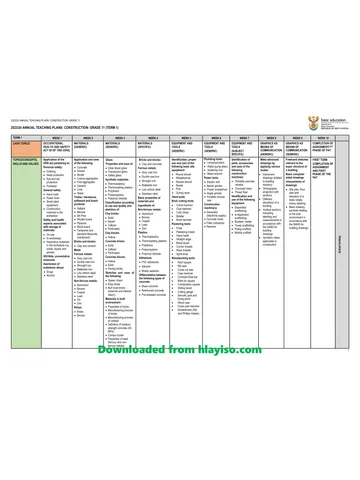
Civil Technology Grade 11 Eastern Cape November 2020 Memo
Grade 11 Civil Technology memorandum from the Eastern Cape November 2020 (English), 32 pages. Read online or download the free PDF.
Civil Technology · Grade 11 · Eastern Cape November · 2020. Memorandum, 32 pages. Read online or download the PDF.
- Subject
- Civil Technology
- Grade
- Grade 11
- Document type
- Memorandum
- Year
- 2020
- Exam period
- Eastern Cape November
- Curriculum
- CAPS
- Pages
- 32
- File size
- 1.1 MB
Free to read online, no sign-up needed
Loading document…
Loading document…
1 of 32
This exam
Document textSearch extracted text and jump to a page.
Downloaded from hlayiso.com
2 CIVIL TECHNOLOGY: CIVIL SERVICES (EC/NOVEMBER 2020)
REQUIREMENTS:
1. ANSWER BOOK
2. Drawing instruments
3. A non-programmable pocket calculator
INSTRUCTIONS AND INFORMATION
1. This question paper consists of SIX questions: THREE questions are generic
and THREE questions are subject specific.
2. Answer ALL the questions.
3. Answer each question as a whole. Do NOT separate subsections of questions.
4. Start the answer to EACH question on a NEW page.
5. Do NOT write in the margins of the ANSWER BOOK.
6. You may use sketches to illustrate your answers.
7. Write ALL calculations and answers in the ANSWER BOOK or on the attached
ANSWER SHEETS.
8. Use the mark allocation as a guide to the length of your answers.
9. Make drawings and sketches in pencil, fully dimensioned and neatly finished
off with descriptive titles and notes to conform to the SANS/SABS Code of
Practice for Building Drawings.
10. For the purpose of this question paper, the size of a brick should be taken as
220 mm x 110 mm x 75 mm.
11. Use your own discretion where dimensions and/or details have been omitted.
12. Answer QUESTIONS 5.1 and 5.2 on the attached ANSWER SHEETS, using
drawing instruments where necessary.
13. Write your NAME on all ANSWER SHEETS and hand them in with your
ANSWER BOOK, whether you have answered the question or not.
14. Drawings in the question paper are NOT to scale.
Copyright reserved Please turn over
Downloaded from hlayiso.com
(EC/NOVEMBER 2020) CIVIL TECHNOLOGY: CIVIL SERVICES 3
QUESTION 1: SAFETY AND MATERIALS (GENERIC)
Start this question on a NEW page.
1.1 What type of personal protective clothing is compulsory to wear on a
building site at all times? (1)
1.2 Why should you remove your tie when you are operating machines with
moving parts? (1)
1.3 Identify the following statements as TRUE or FALSE.
1.3.1 Two operators are allowed to operate a machine at the same time. (1)
1.3.2 Petrol engines may be used inside the workshop. (1)
1.3.3 Carry tools with sharp points facing downwards. (1)
1.3.4 Non-slip footwear is compulsory when you operate machinery. (1)
1.4 Answer the following questions with regard to the storing of materials on
site.
1.4.1 What can materials be placed on if they cannot be stored directly
onto the floor? (1)
1.4.2 Why should heaps of sand and stone be covered with plastic? (1)
1.4.3 Why should there be dividing walls to separate sand and stone? (1)
1.5 Calculate the maximum width of the stacked material if the stack is
1 800 mm high. (Show calculations.) (2)
1.6 What is the difference between unreinforced concrete and reinforced
concrete? (1)
1.7 Name ONE purpose of coarse aggregate in a concrete mixture. (1)
1.8 What type of material increases the plasticity of mortar mixtures? (1)
1.9 What type of material is used as a levelling layer on concrete floors? (1)
1.10 Name the TWO main groups into which wood can be divided. (2 x 1) (2)
1.11 Name ONE use of plywood. (1)
Copyright reserved Please turn over
Downloaded from hlayiso.com
4 CIVIL TECHNOLOGY: CIVIL SERVICES (EC/NOVEMBER 2020)
1.12 Identify the following metals as FERROUS or NON-FERROUS:
1.12.1 Copper (1)
1.12.2 Cast iron (1)
1.13 Name ONE use of lead in the building environment. (1)
1.14 Name ONE use of stainless steel in the building environment. (1)
1.15 Describe in steps how PVC adhesives must be used. (3 x 1) (3)
1.16 What is the minimum thickness of a windowpane? (1)
1.17 Name TWO uses of translucent glass. (2 x 1) (2)
1.18 Name the TWO main groups into which plastic can be divided. (2 x 1) (2)
[30]
Copyright reserved Please turn over
Downloaded from hlayiso.com
(EC/NOVEMBER 2020) CIVIL TECHNOLOGY: CIVIL SERVICES 5
QUESTION 2: EQUIPMENT, TOOLS AND GRAPHICS (GENERIC)
Start this question on a NEW page.
2.1 Why must a spade be oiled lightly when it is not used? (1)
2.2 Briefly explain the difference in the uses of the cold chisel and bolster. (2)
2.3 Name the tools in FIGURES 2.3.1 to 2.3.3 and name ONE use of each.
FIGURE 2.3.1 FIGURE 2.3.2 FIGURE 2.3.3
(3 x 2) (6)
2.4 Answer the following questions with regard to the tool in FIGURE 2.4.
FIGURE 2.4
2.4.1 What is this tool called? (1)
2.4.2 Briefly explain how this tool will be used during the installation of a
doorframe. (2)
2.4.3 Name TWO caring measures of this tool. (2 x 1) (2)
2.5 Answer the following questions with regard to the tool in FIGURE 2.5.
FIGURE 2.5
2.5.1 What is this tool called? (1)
2.5.2 Name TWO uses of this tool. (2 x 1) (2)
Copyright reserved Please turn over
Downloaded from hlayiso.com
6 CIVIL TECHNOLOGY: CIVIL SERVICES (EC/NOVEMBER 2020)
2.6 Answer the following questions with regard to the detail drawing in
FIGURE 2.6.
A
B
E
C
D
FIGURE 2.6
2.6.1 Why are detail drawings drawn on an enlarged scale? (1)
2.6.2 Briefly motivate why descriptive notes are included on detail
drawings. (2)
2.6.3 Which type of eave construction is illustrated in FIGURE 2.6? (1)
2.6.4 Name parts A to E. (5)
2.6.5 What is the purpose of part B? (1)
2.6.6 What is the purpose of part C? (1)
2.7 Explain the purpose of the control test for floor plan dimensions. (2)
2.8 Explain the position, on the drawing sheet for building plans, where the
north arrow must be indicated. (2)
2.9 On which scale are floor plans usually drawn? (1)
2.10 Identify the following abbreviations on elevations of buildings:
2.10.1 NGL (1)
2.10.2 FFL (1)
2.11 Make neat sketches to illustrate the following symbols on floor plans:
2.11.1 Window (2)
2.11.2 Electricity meter (2)
2.11.3 Drain (1)
[40]
Copyright reserved Please turn over
Downloaded from hlayiso.com
(EC/NOVEMBER 2020) CIVIL TECHNOLOGY: CIVIL SERVICES 7
QUESTION 3: JOINING AND GRAPHICS (GENERIC)
Start this question on a NEW page.
3.1 Answer the following questions with regard to the plan elevation in
FIGURE 3.1.
BOSTON STREET
B
A
C
PLOT 123 PLOT 125 PLOT 127
PLOT 134 PLOT 136
FIGURE 3.1
3.1.1 What is the plan elevation called? (1)
3.1.2 What is the plot number of the plot at the west side of plot 125? (1)
3.1.3 What are the lines at A called? (1)
3.1.4 Identify the symbols at B and C. (2 x 1) (2)
Copyright reserved Please turn over
Downloaded from hlayiso.com
8 CIVIL TECHNOLOGY: CIVIL SERVICES (EC/NOVEMBER 2020)
3.2 Name ONE use of PVC glue. (1)
3.3 Which adhesive joining material consists of glue? (1)
3.4 Make neat sketches to illustrate the following symbols on a floor plan:
3.4.1 Gully (2)
3.4.2 Earth (2)
3.4.3 Dressed wood (2)
3.5 Briefly describe the application steps of PVA adhesive. (3 x 1) (3)
3.6 Briefly name THREE precautions when using contact glue. (3 x 1) (3)
3.7 Name any FIVE uses of silicone. (5 x 1) (5)
3.8 State TWO properties of EACH of the following adhesives:
3.8.1 Silicone (2)
3.8.2 Contact glue (2)
3.8.3 PVA glue (2)
[30]
Copyright reserved Please turn over
Downloaded from hlayiso.com
(EC/NOVEMBER 2020) CIVIL TECHNOLOGY: CIVIL SERVICES 9
QUESTION 4: SAFETY, MATERIAL, EQUIPMENT AND JOINING (SPECIFIC)
Start this question on a NEW page.
4.1 Briefly describe how sewage from informal settlements influences the water
quality of dams. (2)
4.2 Briefly explain why sewage is a health risk. (2)
4.3 What is the best method to treat a light burn wound caused by a solder iron? (1)
4.4 Name THREE uses of ceramic products in a home. (3 x 1) (3)
4.5 Which type of metal is used in the manufacturing of the following plumbing
materials?
4.5.1 Manhole covers (1)
4.5.2 Sinks (1)
4.5.3 Pressure control valves (1)
4.5.4 Vacuum breakers (1)
4.5.5 Hot-water pipes (1)
4.6 Choose a tool in COLUMN B that fits the use in COLUMN A. Write only the
letter (A–E) next to the question numbers (4.6.1–4.6.3) in the ANSWER BOOK
for example 4.6.4 F.
COLUMN A COLUMN B
4.6.1 Tightening of bolts A Ball-peen hammer
4.6.2 Clamping work pieces to be sawed B Tin snips
4.6.3 Forming the new head of a rivet C Spanners
D Pliers
E Bench vice
(3 x 1) (3)
4.7 Name TWO maintenance measures applicable to the rolling machine. (2 x 1) (2)
4.8 Name the TWO methods of bending low-pressure polythene pipes. (2 x 1) (2)
Copyright reserved Please turn over
Downloaded from hlayiso.com
10 CIVIL TECHNOLOGY: CIVIL SERVICES (EC/NOVEMBER 2020)
4.9 Answer the following questions with regard to the tool in FIGURE 4.9.
FIGURE 4.9
4.9.1 What is this tool called? (1)
4.9.2 Name the use of this tool. (1)
4.9.3 Describe in point form the method in which this tool must be used. (4)
4.10 Fully motivate why pipes must be secured firmly during the installation
process. (2)
4.11 What is the purpose of teflon tape when pipes are joined? (1)
4.12 What is the purpose of the pre-made weak spot of the pop rivet pin? (1)
[30]
Copyright reserved Please turn over
Downloaded from hlayiso.com
(EC/NOVEMBER 2020) CIVIL TECHNOLOGY: CIVIL SERVICES 11
QUESTION 5: GRAPHICS, CONSTRUCTION AND JOINING (SPECIFIC)
Start this question on a NEW page.
5.1 Use your drawing instruments and divide the line XY on ANSWER SHEET 1
into six equal parts. Show all construction lines. (3)
5.2 FIGURE 5.2 on ANSWER SHEET 1 shows the top and side views of a
250 x 250 mm square pipe with a length of 500 mm. The joint of the pipe is in
the middle of side AD.
Use ANSWER SHEET 1 and develop and draw the development of the pipe
on scale 1 : 10. (11)
5.3 Briefly motivate why the casting of concrete on very cold days must be
avoided. (2)
5.4 What is the minimum thickness of the concrete slab for a manhole? (1)
5.5 Indicate whether the following statements are TRUE or FALSE. Write only the
word ‘true’ or ‘false’ next to the number in the ANSWER BOOK.
5.5.1 The placing of concrete must be started in the corners nearest to the
concrete mixer. (1)
5.5.2 Concrete should be poured 200 mm higher than the correct height to
provide for the settling of the concrete. (1)
5.5.3 Concrete should be left to harden for two days before building on it. (1)
5.6 Briefly explain the procedure of levelling a compacted concrete slab with a
wooden beam. (2)
5.7 Name TWO reasons for floating concrete. (2 x 1) (2)
5.8 When copper pipes are bent by means of sand, the sand must comply with
certain properties. Name TWO properties of this kind of sand. (2 x 1) (2)
5.9 Describe in point form the method of joining polythene pipes with heat fusion. (4)
[30]
Copyright reserved Please turn over
Downloaded from hlayiso.com
12 CIVIL TECHNOLOGY: CIVIL SERVICES (EC/NOVEMBER 2020)
QUESTION 6: COLD- AND HOT WATER SUPPLY, DRAINAGE AND SANITARY
FITMENTS (SPECIFIC)
Start this question on a NEW page.
6.1 Answer the following questions with regard to the water supply system for a
household in FIGURE 6.1.
STREET SITE BOUNDARY
A B
D
C
FIGURE 6.1
6.1.1 Name the installations A and B. (2)
6.1.2 What is the purpose of installation B? (1)
6.1.3 Name the pipelines C and D. (2)
6.1.4 What is the diameter size of the pipe at D? (1)
6.1.5 Motivate why the pipeline at D must be laid at least 450 mm
underground. (2)
6.2 Name THREE disadvantages of the use of galvanised pipe for water supply.
(3 x 1) (3)
6.3 Answer the following questions with regard to the fitting in FIGURE 6.3.
FIGURE 6.3
6.3.1 What is this fitting called? (1)
6.3.2 Which type of pipe is joined with this type of fitting? (1)
6.3.3 Which joining method is used to join this fitting to pipes? (1)
Copyright reserved Please turn over
Downloaded from hlayiso.com
(EC/NOVEMBER 2020) CIVIL TECHNOLOGY: CIVIL SERVICES 13
6.4 Identify the following symbols that are used for cold water systems:
6.4.1
(1)
6.4.2
(1)
6.4.3
(1)
6.5 Briefly motivate why the cold-water inlet pipe is at the bottom side of the
high-pressure geyser. (2)
6.6 Explain the purpose of the thermostat in the high-pressure geyser. (2)
6.7 Explain why the hot-water outlet pipe is at the top of a high-pressure geyser. (2)
6.8 Choose the correct answer from those in brackets and write it next to the
question numbers (6.8.1–6.8.3) in the ANSWER BOOK.
6.8.1 The (anode / element) heats up the water in the geyser. (1)
6.8.2 Vacuum breakers are installed (300 mm / 330 mm) above the
geyser. (1)
6.8.3 A (20 mm / 50 mm) drainpipe is connected to the drip tray. (1)
6.9 Name TWO reasons why hot-water pipes from geysers must be isolated.
(2 x 1) (2)
6.10 When storm water subsoil drainage pipes are installed, holes must be drilled
into both sides of the upper third of the pipes. What is the purpose of these
holes? (1)
6.11 Briefly motivate why storm water must be led away from buildings. (1)
6.12 Describe the regulation which is applicable when soil fixtures are
permanently disconnected. (2)
6.13 Identify the following abbreviations for drainage systems:
6.13.1 RWP (1)
6.13.2 ST (1)
6.13.3 WHB (1)
Copyright reserved Please turn over
Downloaded from hlayiso.com
14 CIVIL TECHNOLOGY: CIVIL SERVICES (EC/NOVEMBER 2020)
6.14 Briefly motivate why the stub-stack system is cheaper than other drainage
systems. (2)
6.15 Identify parts A to C of the cistern in FIGURE 6.15. (3)
A
B
C
FIGURE 6.15
[40]
TOTAL: 200
Copyright reserved Please turn over
Downloaded from hlayiso.com
(EC/NOVEMBER 2020) CIVIL TECHNOLOGY: CIVIL SERVICES 15
CIVIL TECHNOLOGY
ANSWER SHEET 1 CIVIL SERVICES
NAME:
5.1 Use your drawing instruments and divide the line XY on ANSWER SHEET 1
into six equal parts. Show all construction lines. (3)
X Y
5.2 FIGURE 5.2 on ANSWER SHEET 1 shows the top and side views of a 250 x
250 mm square pipe with a length of 500 mm. The joint of the pipe is in the
middle of side AD.
Use ANSWER SHEET 1 and develop and draw the development of the pipe on
scale 1 : 10. (11)
A D
SIDE ELEVATION
ASSESSMENT CRITERIA MARK CANDIDATE’S
MARK
A1 D1 Baseline 2
Corner lines 6
Joint allowance 2
Scale 1
B C
TOTAL 11
PLAN VIEW
Copyright reserved Please turn over
Downloaded from hlayiso.com
Downloaded from hlayiso.com
NATIONAL
SENIOR CERTIFIKATE
GRADE 11
NOVEMBER 2020
CIVIL TECHNOLOGY: CIVIL SERVICES
MARKING GUIDELINE
(EXEMPLAR)
MARKS: 200
This marking guideline consists of 13 pages.
Downloaded from hlayiso.com
2 CIVIL TECHNOLOGY: CIVIL SERVICES (EC/NOVEMBER 2020)
QUESTION 1: SAFETY AND MATERIALS (GENERIC)
1.1 Hard hat (1)
1.2 A tie can get stuck in the moving parts and cause injuries (1)
1.3 1.3.1 False (1)
1.3.2 False (1)
1.3.3 True (1)
1.3.4 True (1)
1.4 Storing of materials on site.
1.4.1 Any ONE area on which materials can be placed:
x Shelves
x Pallets (1 x 1) (1)
1.4.2 Any ONE reason why heaps of sand and stone should be covered
with plastic.
x To keep it clean
x To prevent being washed away during rainfalls
(Similar answer) (1 x 1) (1)
1.4.3 To prevent the materials from mixing (1)
1.5 1 800 mm ÷ 3 (1) = 600 mm (1) (2)
1.6 Reinforced concrete contains steel reinforcement bars (1)
1.7 Any ONE purpose of coarse aggregate in a concrete mixture:
x Provides volume stability to the concrete
x Economical – forms the bulk of the mixture
x Lowers the shrinkage potential of the concrete (1 x 1) (1)
1.8 Lime (1)
1.9 Screed (1)
1.10 Hardwood (1) and softwood (1) (2)
1.11 Any ONE use of plywood:
x Bottoms of drawers
x Wall panelling
x Door panels
x Cupboard panels
x Interior balustrades / railings
x Framing (1 x 1) (1)
Copyright reserved Please turn over
Downloaded from hlayiso.com
(EC/NOVEMBER 2020) CIVIL TECHNOLOGY: CIVIL SERVICES 3
1.12 1.12.1 Non-ferrous metal (1)
1.12.2 Ferrous metal (1)
1.13 Any ONE use of lead in the building environment:
x Batteries
x Cable sheaths
x Lead pipes
(Similar answer) (1 x 1) (1)
1.14 Any ONE use of stainless steel in the building environment:
x Sinks
x Wash tubs / baths
x Water taps
x Water traps
x Extractor fans
(Similar answer) (1 x 1) (1)
1.15 x Dry-fit the parts to make sure the pipes are fitted in the right direction (1)
x Apply a light coat of PVC glue to the fitting and the pipe (1)
x Slightly twist and push parts into position (1) (3)
1.16 3 mm (1)
1.17 Any TWO uses of translucent glass:
x Bathroom / toilet windowpanes
x Glass bricks for walls
x Doors
x Urban furniture and appliances (2 x 1) (2)
1.18 Thermoplastic (1) and thermosetting plastic (1) (2)
[30]
Copyright reserved Please turn over
Downloaded from hlayiso.com
4 CIVIL TECHNOLOGY: CIVIL SERVICES (EC/NOVEMBER 2020)
QUESTION 2: EQUIPMENT, TOOLS AND GRAPHICS (GENERIC)
2.1 Prevent rust (1)
2.2 Cold chisel is used to cut holes / grooves in concrete / brickwork / metal (1)
Bolster is used to cut bricks (1) (2)
2.3 Name the tools in FIGURES 2.3.1 to 2.3.3 and name ONE use of each.
2.3.1 Pick (1)
Any ONE use (1):
• Loosening hard ground during excavations
• Breaking up rock (2)
2.3.2 Block brush (1)
Any ONE use (1):
• Moistening plaster
• Dampening surfaces / concrete (2)
2.3.3 Plane (1)
Any ONE use (1):
• Planing timber
• Smoothing rough surfaces on timber (2)
2.4 2.4.1 Spirit level (1)
2.4.2 Test if the head is horizontal (1) and if the stiles are installed
vertically (1) (2)
2.4.3 Any TWO precautions for the spirit level:
x Wipe clean after use
x Not allow plaster / cement to dry on it
x Store in a dry place (2 x 1) (2)
2.5 2.5.1 Portable circular saw (1)
2.5.2 Any TWO uses:
• Cutting wood
• Cutting other materials with specific blades
• Cutting rebates (2 x 1) (2)
2.6 2.6.1 To include more information (1)
2.6.2 To highlight details (1) that may not be clearly understood (1) (2)
2.6.3 Open eave (1)
Copyright reserved Please turn over
Downloaded from hlayiso.com
(EC/NOVEMBER 2020) CIVIL TECHNOLOGY: CIVIL SERVICES 5
2.6.4 A – DPC (1)
B – Beam filling / half brick wall (1)
C – Facia board / plank (1)
D – Single brick wall (1)
E – Ceiling / cornice (1) (5)
2.6.5 Prevents dust / vermin / etc. from entering underneath the roof (1)
2.6.6 Fixing gutters (1)
2.7 To ensure that the horizontal and vertical external measurements (1)
correspond with the individually internal measurements (1) (2)
2.8 Bottom (1) on the right-hand side of drawing sheet (1) (2)
2.9 1 : 100 (1)
2.10 2.10.1 Natural ground level (1)
2.10.2 Finished floor level (1)
2.11 2.11.1
(2)
2.11.2
W (2)
2.11.3 (1)
[40]
Copyright reserved Please turn over
Downloaded from hlayiso.com
6 CIVIL TECHNOLOGY: CIVIL SERVICES (EC/NOVEMBER 2020)
QUESTION 3: QUANTITIES, JOINING AND GRAPHICS (GENERIC)
3.1 3.1.1 Site plan (1)
3.1.2 123 (1)
3.1.3 Boundary wall (1)
3.1.4 B = Manhole C = Rodding eye (2)
3.2 ONE use of PVC glue:
x To bond PVC pipes (1)
3.3 PVC adhesive (1)
3.4 3.4.1
(2)
3.4.2
(2)
3.4.3
(2)
3.5 The application steps for PVA adhesive:
(1) Dry-fit parts to make sure the pipes are fitted in the right direction
(2) Apply a light coat of PVC glue to the fitting and the pipe
(3) Slightly twist and push parts into position (3)
3.6 Any THREE precautions when using contact glue:
x Be careful not to allow the adhesive to dry fully before assembly
x Do not wait too long before assembling the parts
x The glue should not be applied too quickly (3 x 1) (3)
3.7 Any FIVE uses of silicone:
x Basic sealant against air and water leakage
x Textile uses
x Enhances materials
x Used in aviation
x Construction repairs
x Electronics (5 x 1) (5)
Copyright reserved Please turn over
Downloaded from hlayiso.com
(EC/NOVEMBER 2020) CIVIL TECHNOLOGY: CIVIL SERVICES 7
3.8 Any TWO properties of EACH of the following adhesives
3.8.1 Silicone
x Heat resistant
x Conductive or insulating
x Rubbery
x Low heat conductivity
x Resist chemicals / low chemical reaction
x Low toxicity
x Waterproof / repels water (2 x 1) (2)
3.8.2 Contact glue
x Adheres well to most materials (plastics, rubber, paper, wood, etc.)
x Sticks to most non-porous materials
x Rubbery and has a creamy colour
x Flammable
x Water-resistant
x Dries quickly and adheres / sticks immediately (2 x 1) (2)
3.8.3 PVA glue
x Water-based
x For interior and exterior use
x White or yellowish colour before it dries, clear when dry
x Yellow PVA is not completely clear on drying
x Super strong when used on wood
x Dries quickly
x Inexpensive (2 x 1) (2)
[30]
Copyright reserved Please turn over
Downloaded from hlayiso.com
8 CIVIL TECHNOLOGY: CIVIL SERVICES (EC/NOVEMBER 2020)
QUESTION 4: SAFETY, MATERIAL, EQUIPMENT AND JOINING (SPECIFIC)
4.1 (1) Sewerage seeps into the ground and (1) flows / seeps through ground
water to rivers and dams (2)
4.2 (1) It contains untreated / waste matter / human waste which (1) contains
harmful micro-organisms / bacteria / viruses / parasites (2)
4.3 Rinse the wound with cold water. (1)
4.4 Any THREE uses of ceramic products in a house:
x Floor tiles
x Wall ties
x Baths, washbasins, water closets
x Materials that are resistant to high temperatures (3 x 1) (3)
4.5 4.5.1 Manhole covers – Cast iron (1)
4.5.2 Sinks – Stainless steel (1)
4.5.3 Pressure control valves – Bronze (1)
4.5.4 Vacuum breakers – Bronze (1)
4.5.5 Hot-water pipes – Copper (1)
4.6 4.6.1 Tightening of bolts C Spanners
4.6.2 Clamping work pieces to be sawed E Bench vice
4.6.3 Forming the new head of a rivet A Ball-peen hammer (3 x 1) (3)
4.7 Any TWO maintenance measures:
x Oil moving parts
x Service regularly
x Not overloading the machine
x Rollers kept some distance apart when not in use (2 x 1) (2)
4.8 Name the TWO methods of bending low-pressure polythene pipes:
x Fill pipe with sand, heat and bend
x Pipe-bending spring (2 x 1) (2)
Copyright reserved Please turn over
Downloaded from hlayiso.com
(EC/NOVEMBER 2020) CIVIL TECHNOLOGY: CIVIL SERVICES 9
4.9 4.9.1 Pipe cutter (1)
4.9.2 Cut copper pipes/galvanised pipes (1)
4.9.3 (1) Cutter wheel on cutting line
(2) Rotate clockwise and (3) anticlockwise
(4) Tighten the cutter until the pipe is cut (4)
4.10 (1) Prevents rattling (2) when water passes through the pipes / Movement
causes stress on joints and can spring leaks (2)
4.11 Provides watertight joints (1)
4.12 Allows it to break when the rivet is installed (1)
[30]
Copyright reserved Please turn over
Downloaded from hlayiso.com
10 CIVIL TECHNOLOGY: CIVIL SERVICES (EC/NOVEMBER 2020)
QUESTION 5: GRAPHICS, CONSTRUCTION AND JOINING (SPECIFIC)
5.1 Use your drawing instruments and divide the line XY on ANSWER SHEET 1
into six equal parts. Show all construction lines. (3)
5.2 FIGURE 5.2 on ANSWER SHEET 1 shows the top and side views of a
250 x 250 mm square pipe with a length of 500 mm. The joint of the pipe is
in the middle of side AD.
Use ANSWER SHEET 1 and develop and draw the development of the pipe
on scale 1 : 10. (11)
5.3 Similar answer:
(1) The hardening of concrete is retarded (2) when the temperature is below
5°. (2)
5.4 150 mm (1)
5.5 5.5.1 False (1)
5.5.2 False (1)
5.5.3 False (1)
5.6 (1) First make use of a chopping action and (2) then a sawing motion (2)
5.7 Name TWO reasons for floating concrete:
x Creates a smooth surface
x Removes marks
x Helps with the compacting
x Forces pieces of gravel below the surface (2 x 1) (2)
5.8 Name TWO properties of this kind of sand:
x Dry
x Fine
x Compacted (2 x 1) (2)
5.9 (1) The ends of the pipes must be clean and square.
(2) Heat the ends by using a temperature-controlled apparatus.
(3) Press the melted ends together and
(4) apply the pressure while the pipes are cooling down. (4)
[30]
Copyright reserved Please turn over
Downloaded from hlayiso.com
(EC/NOVEMBER 2020) CIVIL TECHNOLOGY: CIVIL SERVICES 11
QUESTION 6: COLD- AND HOT WATER SUPPLY, DRAINAGE AND
SANITARY FITMENTS (SPECIFIC)
6.1 6.1.1 A – Stopcock
B – Water meter (2)
6.1.2 Measures the volume of water used (1)
6.1.3 C – Main water supply
D – Water supply pipe (2)
6.1.4 15 mm (1)
6.1.5 Prevents freezing and direct loads on the pipe (2)
6.2 Any THREE disadvantages of galvanised pipe for water supply:
x Difficult to bend
x Contains lead, inevitable to corrosion
x Sediment can collect in the pipes
x Difficult to get rid of rust (3 x 1) (3)
6.3 6.3.1 45-elbow (1)
6.3.2 Copper pipe (1)
6.3.3 Soldering or brazing (1)
6.4 6.4.1 Pipe joint – Butt-welded (1)
6.4.2 Pipe joint – Flanched and bolted (1)
6.4.3 Water-level control valve (1)
6.5 Similar answer.
(1) As the cold water heats up, it rises (2) therefore the cold water must
enter from the bottom (2)
6.6 (1) It senses the water temperature and switches on the element when the
water is too cold and (2) switches off again when the water is too hot (2)
6.7 (1) Hot water rises to the top (2) letting the cold water in from the bottom (2)
6.8 6.8.1 Element (1)
6.8.2 300 mm (1)
6.8.3 50 mm (1)
Copyright reserved Please turn over
Downloaded from hlayiso.com
12 CIVIL TECHNOLOGY: CIVIL SERVICES (EC/NOVEMBER 2020)
6.9 Any TWO reasons why hot water pipes from geysers must be isolated:
x Prevents heat loss
x Prevents freezing during winter months (2 x 1) (2)
6.10 Allow storm water to seep through (1)
6.11 Any similar answer.
x Prevents structural damage
x May lead to cracks
x May lead to foundation damage (1)
6.12 (1) It must be done in such a manner that the disconnection (2) will not be a
danger to health. (2)
6.13 6.13.1 Rainwater pipe (1)
6.13.2 Septic tank (1)
6.13.3 Hand wash basin (1)
6.14 (1) Because less piping is used, less labour and (2) material is needed. (2)
6.15 A – Siphon pipe
B – Diaphragm
C – Plunger piston (3)
[40]
TOTAL: 200
Copyright reserved Please turn over
Downloaded from hlayiso.com
(EC/NOVEMBER 2020) CIVIL TECHNOLOGY: CIVIL SERVICES 13
CIVIL TECHNOLOGY
ANSWER SHEET 1 CIVIL SERVICES
NAME:
5.1 Use your drawing instruments and divide the line XY on ANSWER SHEET 1
into six equal parts. Show all construction lines. (3)
X Y
5.2 FIGURE 5.2 on ANSWER SHEET 1 shows the top and side views of a 250 x
250 mm square pipe with a length of 500 mm. The joint of the pipe is in the
middle of side AD.
Use ANSWER SHEET 1 and develop and draw the development of the pipe on
scale 1 : 10. (11)
A D A1 A B C D D1
SIDE ELEVATION
A1 D1 Baseline 2
Corner lines 6
Joint allowance 2
Scale 1
B C TOTAL 11
PLAN VIEW
Copyright reserved Please turn over
Downloaded from hlayiso.com
Downloaded from hlayiso.com
Downloaded from hlayiso.com
Study this subject
Recommended for this subject
Memorandum
Civil Technology Grade 11 Eastern Cape November 2020 Memo
Memorandum
Civil Technology Grade 11 Eastern Cape November 2020 Memo
Memorandum
Civil Technology Grade 11 Eastern Cape November 2020 Memo
Memorandum
Civil Technology Grade 11 Eastern Cape November 2020 Memo
Memorandum
Civil Technology Grade 11 Eastern Cape November 2020 Memo
Memorandum
Civil Technology Grade 11 Eastern Cape November 2020 Memo
More from Grade 11 Civil Technology
Annual teaching plan
Gr 11 Cons ATP 2023 24
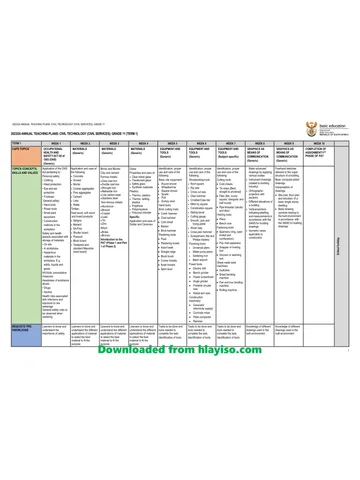
Annual teaching plan
Gr 11 Civil Ser ATP 2023 24
Question paper
Civil Technology Grade 11 2022 QP (Afr)
Question paper
Civil Technology Grade 11 2022 QP (Eng)
Question paper
Civil Technology Grade 11 2022 QP (Eng)
Question paper