
Downloaded from hlayiso.com
NATIONAL
SENIOR CERTIFICATE
GRADE 12
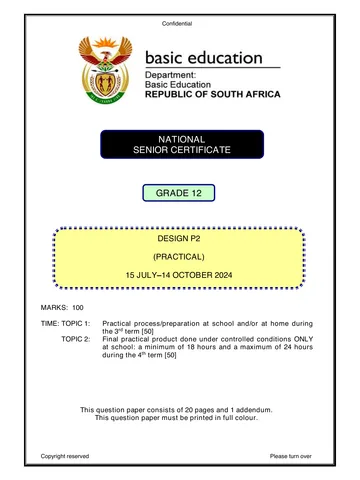
DESIGN P2
(PRACTICAL)
26 JULY–22 OCTOBER 2021
MARKS: 100
TIME: TOPIC 1: Practical process/preparation at school and/or at home during
the 3rd term [50]
TOPIC 2: Final practical product done under controlled conditions ONLY
at school: a maximum of 24 hours during the 4th term [50]
This question paper consists of 18 pages and 1 addendum.
This question paper must be printed in full colour.
Copyright reserved Please turn over
Skip to contentAll 2021 papers 
View all
Design Grade 12 P2 NSC November 2021 Question Paper (Eng)
Grade 12 Design Paper 2 question paper from the NSC November Exam 2021 (English), 19 pages. Read online or download the free PDF.
Design · Grade 12 · NSC November Exam · 2021. Question paper, 19 pages. Read online or download the PDF.
- Subject
- Design
- Grade
- Grade 12
- Document type
- Question paper
- Year
- 2021
- Exam period
- NSC November Exam
- Paper
- 2
- Curriculum
- CAPS
- Pages
- 19
- File size
- 2.7 MB
Free to read online, no sign-up needed
Loading document…
Loading document…
1 of 19
This exam
NSC November Exam 2021
Document textSearch extracted text and jump to a page.
Downloaded from hlayiso.com
Design/P2 2 DBE/November 2021
NSC
INSTRUCTIONS AND INFORMATION
1. This question paper consists of TWO sections:
TOPIC 1: The examination sourcebook/workbook (50 marks)
TOPIC 2: The final practical examination product (50 marks)
TOTAL: 100 marks
2. The question paper has TWO briefs/themes. Choose ONE of the two options.
Copyright reserved Please turn over
Downloaded from hlayiso.com
Design/P2 3 DBE/November 2021
NSC
BRIEF/THEME 1: AFROFUTURISM
THE BRIEF:
Afrofuturism aims to celebrate African culture and technology in bold and innovative,
21st century expressions. Afrofuturism is also described as a movement in literature,
music and art featuring futuristic or science fiction imagery that incorporates elements
of black cultural mythology and history. It is a powerful creative force that merges
technology and creativity, providing a positive account of Africa and its future, with the
aim to counteract negative perceptions of Africa.
Afrofuturism sees Africa as a powerful, technologically advanced and well-resourced
continent. Important Afrofuturist works include, Jay-Z and Beyonce's 'Family Feud'
music video, set in 2444 and directed by UCLA's Ava DuVernay, as well as the movie
Black Panther (2018) directed by Ryan Coogler.
Create an innovative design solution inspired by Afrofuturism for a futuristic
post-Covid South Africa, in a bid to restore hope and positivity for South
Africans.
Create a Visual Communication/Information Design and/or Digital Design solution
fusing science fiction and fantasy with African art, history or mythology to re-envisage a
post-Covid South Africa through, e.g. a campaign or corporate identity that includes a
logo, letterhead, business card, packaging, car branding, a short video advertisement,
an emotive poster or a T-shirt or sweater design.
Create a Surface Design or Two-dimensional Craft Design solution that promotes
South African resilience and quirkiness in an Afrofuturist style in, e.g. wallpapers,
textile fabric, or any other surface pattern solution.
Create a Product Design or Three-dimensional Craft Design solution that can be
purchased to promote economic recovery post-Covid-19, e.g. an ultramodern costume,
helmet, jewellery and ceramics. Here designers can use African traditional craft
techniques in a high-tech way to suit a futuristic society.
Create an Environmental Design solution that can be seen in examples such as
futuristic signage, bus stop shelters and supermarket interiors.
You are required to research the concept of Afrofuturism and the various designs that
it can inspire and incorporate by reading newspapers articles, watching the news,
reading magazine articles and doing image searches on the internet. This research
must be presented as part of your sourcebook/workbook of Topic 1. Refer to the
criteria for the design process and final product together with the assessment
guidelines.
Copyright reserved Please turn over
Downloaded from hlayiso.com
Design/P2 4 DBE/November 2021
NSC
GLOSSARY: AFROFUTURISM
Futuristic: having or involving a very modern machine or technological aesthetic.
Forms become jagged and geometric, lines are straight and clean, and textures are
smooth creating a sense of speed and dynamism. A fantasy, surreal world is created
where the future is dominated by robotic machines.
Science fiction: an imagined world is created based on possible future scientific or
technological advances, as well as major social or environmental changes. This
frequently involves portraying space or time travel and life on other planets.
Mythology: a collection of myths, legends or folklore belonging to a particular religious
and/or cultural tradition or group.
Fantastical: the strange, weird or fanciful appearance of something or someone based
on a particular design concept.
Emotive: able to arouse or indicate intense feelings.
Quirkiness: a strange humorous attitude, habit or oddity particular to someone or
something.
Resilience: the capacity to recover quickly from difficulties or challenges.
The following images are examples of Afrofuturistic designs in different design
categories.
Do NOT copy the examples given.
Copyright reserved Please turn over
Downloaded from hlayiso.com
Design/P2 5 DBE/November 2021
NSC
VISUAL COMMUNICATION/INFORMATION DESIGN AND/OR DIGITAL DESIGN
Copyright reserved Please turn over
Downloaded from hlayiso.com
Design/P2 6 DBE/November 2021
NSC
SURFACE DESIGN AND TWO-DIMENSIONAL CRAFT DESIGN
Copyright reserved Please turn over
Downloaded from hlayiso.com
Design/P2 7 DBE/November 2021
NSC
PRODUCT DESIGN AND THREE-DIMENSIONAL CRAFT DESIGN
Copyright reserved Please turn over
Downloaded from hlayiso.com
Design/P2 8 DBE/November 2021
NSC
ENVIRONMENTAL DESIGN
Copyright reserved Please turn over
Downloaded from hlayiso.com
Design/P2 9 DBE/November 2021
NSC
BRIEF/THEME 2: DESIGN SAVES THE WORLD
THE BRIEF:
Design can alter, transform and improve the quality of human lives by creating
awareness and solutions to specific socio-cultural problems, such as hunger, disease,
homelessness, housing, pollution or the impact of natural disasters. Socio-cultural
problems include health problems like Covid-19, TB, malaria, diabetes, mental health
and physical disabilities. Other issues that could be addressed are lack of access to
education, electricity and infrastructure, such as clean water or sanitation. By designing
products to solve these problems designers can actively contribute to the improvement
of people's lives and saving the world.
Create an innovative design solution inspired by a socio-cultural or
environmental issue that you have identified in your community.
Create a Visual Communication/Information Design and/or Digital Design solution
that addresses a socio-cultural issue in your community. One example could be
designing for a health campaign focusing on hypertension using only symbols in order
to reach a broader audience. Your campaign could include designs for a logo, poster,
billboard, packaging and a T-shirt. It could also include a mobile UX design or info
graphic, providing tips on how to lower one's blood pressure.
Create a Surface Design or Two-dimensional Craft Design solution that promotes a
change in public perception and handling of a specific environmental and social issue,
e.g. water recycling methods. This could be communicated on a wallpaper/textile or
other surface design that illustrates ways of recycling water.
Create a Product Design or Three-dimensional Craft Design solution that can be
purchased to promote awareness of a sociocultural issue you have identified in your
community or South Africa at large. For example the high rate of unemployment in the
country is addressed by design entrepreneurs, such as Mielie, who are creating
products, such as bags and cushions, with social groups and selling them online in
order to initiate economic recovery. Other examples of products that can be created
include industrial products, ceramics and furniture design.
Create an Environmental Design solution that solves or creates awareness of a
sociocultural problem. One example could be a mural design for the interior of a
paediatric/children's hospital that contributes to a friendly and playful environment
which promotes physical and emotional recovery. The mural design would help
alleviate children's fear of going to hospital.
You are required to research the concept 'Design Saves the World' and the various
designs that it can inspire by reading newspaper articles, watching the news, reading
magazine articles and doing image searches on the internet. This research must be
presented as part of your sourcebook/workbook of Topic 1. Refer to the criteria for the
design process and final product together with the assessment guidelines.
Copyright reserved Please turn over
Downloaded from hlayiso.com
Design/P2 10 DBE/November 2021
NSC
GLOSSARY: DESIGN SAVES THE WORLD
Perception: the way in which something is regarded, understood or interpreted.
Infrastructure: the basic physical and organisational structures and facilities, such as
buildings, roads, power supplies, bridges, water supply and sanitation, that are needed
for the operation of a society.
Mobile UX design: the design of applications (apps), like Uber Eats, for hand-held and
wearable devices, such as cellphones, cameras and tablets.
The following images are examples of designs that save lives in different design
categories.
Do NOT copy the examples given.
Copyright reserved Please turn over
Downloaded from hlayiso.com
Design/P2 11 DBE/November 2021
NSC
VISUAL COMMUNICATION/INFORMATION DESIGN AND/OR DIGITAL DESIGN
Copyright reserved Please turn over
Downloaded from hlayiso.com
Design/P2 12 DBE/November 2021
NSC
SURFACE DESIGN AND TWO-DIMENSIONAL CRAFT DESIGN
Copyright reserved Please turn over
Downloaded from hlayiso.com
Design/P2 13 DBE/November 2021
NSC
PRODUCT DESIGN AND THREE-DIMENSIONAL CRAFT DESIGN
Copyright reserved Please turn over
Downloaded from hlayiso.com
Design/P2 14 DBE/November 2021
NSC
ENVIRONMENTAL DESIGN
Copyright reserved Please turn over
Downloaded from hlayiso.com
Design/P2 15 DBE/November 2021
NSC
REQUIREMENTS
SECTION A
TOPIC 1: THE DESIGN PROCESS [50]
1. All processIpreparatory work for your design must be shown in a sourcebook/
workbook.
2. This will involve the processes from conceptualisation to realisation.
3. Thorough investigation of problems posed by the design brief should be
shown.
4. The sourcebook/workbook must be presented in the form of an album (that is
in book form).
5. It must open easily and have pages that turn easily.
6. The sourcebook/workbook must be made of light material to facilitate
transport where work is moderated at a central venue.
7. Ensure that the sourcebook/workbook is presented professionally.
NOTE:
As TOPIC 1 (process/preparation) has the same mark allocation as TOPIC 2
(the final product), it should be given enough time to acknowledge its importance.
Your teacher may be involved in this preliminary preparatory session (TOPIC 1
only).
You may work at home.
CRITERIA FOR THE DESIGN PROCESS (TOPIC 1)
You should present the following (refer to the NSC Design Examination Guidelines):
Expression of intention and rationale (10)
Evidence of research, experimentation (10)
Evidence of detailed planning (10)
Evidence of development and reflection (10)
Presentation related to the final concept (10)
[50]
Copyright reserved Please turn over
Downloaded from hlayiso.com
Design/P2 16 DBE/November 2021
NSC
SECTION B
TOPIC 2: THE FINAL PRODUCT [50]
Although it is recommended that a two-dimensional design should NOT be larger than
A2 in size, candidates' work is not restricted regarding size.
The size of a three-dimensional design will depend on the function of the object being
made. Take into account that the final product might have to be transported to a central
marking venue, and you should therefore be mindful of possible problems during
transportation.
NOTE:
Your teacher may NOT assist you in any way during the final production of the
design.
ALL work must be done under the teacher's and/or appointed invigilator's
supervision at your school.
Any form of direct copying/plagiarism or of work that is not your original work will
be strictly penalised.
A declaration of authenticity (ADDENDUM A) must be completed by yourself and
the chief invigilator/teacher.
Work must be done on a continuous basis, e.g. during three consecutive days
under controlled circumstances.
CRITERIA FOR THE DESIGN PRODUCT (TOPIC 2)
You should use the following criteria (refer to the NSC Design Examination
Guidelines):
Creativity/Originality/Interpretation in terms of the concept and solutions that are
relevant to the brief (10)
Evidence of design involvement: the appropriate use of design elements and
principles (10)
Technique/Craftsmanship/Method (10)
The design solution with evidence of a maximum of 24 hours' work under
controlled circumstances (10)
Professional presentation and functionality of the design solution (10)
[50]
TOTAL: TOPIC 1 (50) + TOPIC 2 (50) 100
Copyright reserved Please turn over
Downloaded from hlayiso.com
Design/P2 17 DBE/November 2021
NSC
INSTRUCTIONS TO THE TEACHER
PRACTICAL EXAMINATION: TOPIC 1 (50 MARKS) AND TOPIC 2 (50 MARKS) –
TASK 7
1. This practical examination consists of ONE question paper. This question paper
comprises TWO parts, TOPIC 1 (the examination sourcebookIworkbook and
TOPIC 2 (the final practical examination product).
2. This practical question paper should be given to the candidates on Monday
26 July 2021. The final submission date will be Friday 22 October 2021.
3. TOPIC 1 (design process) has the same weighting as TOPIC 2 (the final
product) and it should therefore be given enough time to acknowledge its
importance.
4. Consequently, candidates should have enough time to do their TOPIC 1
(preparation/design process). The teacher may only be involved in this
preliminary preparatory session and NOT in TOPIC 2. Due to the preparatory
nature of TOPIC 1, candidates are allowed to work at home.
5. Candidates must use the TOPIC 1 sourcebookIworkbook as a point of reference
during their TOPIC 2 examination. Both TOPIC 1 and TOPIC 2 examination
work must be submitted to the teacher/invigilator immediately after the TOPIC 2
examination has been completed.
6. The teacher may NOT assist the candidate in any way during the final
production of the design product (TOPIC 2).
7. Any form of direct copying/plagiarism or work that is not the candidate's
original work will be strictly penalised.
8. TOPIC 2 must be done on a continuous basis during contact time, e.g. during
three consecutive days under controlled circumstances.
9. TOPIC 2 must be done at the candidate's examination centre, under the
supervision of the teacher/invigilator. TOPIC 2 must NOT be done at home.
10. TOPIC 2 must NOT be removed from the examination centre under any
circumstances.
11. Each province will determine the marking process of TOPIC 1 (sourcebookI
workbook) and TOPIC 2 (final product). Schools will be notified by the provinces
regarding the date, time and venue for the submission of work to the
examination centres, where applicable.
12. The examination TOPIC 1 should be professionally presented in a
sourcebookIworkbook in an album format.
13. The sourcebook/workbook and final product must be labelled neatly and clearly.
14. ADDENDUM A must be completed in full and the school stamp should appear in
the appropriate space. Attach ADDENDUM A securely to the final examination
work (sourcebook/workbook and/or final product).
Copyright reserved Please turn over
Downloaded from hlayiso.com
Design/P2 18 DBE/November 2021
NSC
ASSESSMENT RUBRIC
OUTCOMES WEIGHTING %
AGREED
MARKER 1 MARKER 2
TOTAL
REQUIREMENTS CANDIDATE'S
MARK
MARK
Expression of intention and rationale:
Brainstorm or do a mind map of ideas to explore the theme of
the brief. Develop a concept. A rationale should be provided
10
to validate the solution found.
Evidence of research, experimentation:
SOURCEBOOK/WORKBOOK
Research the brief and find relevant source materials (visual
references). Show evidence of research by completing
TOPIC 1
thumbnail sketches of ideas. Design a few different solutions
10
that explore the brief. Evidence of experimentation,
e.g. a mood board should be visible.
Detailed planning:
Generative drawings should explore a variety of solutions to
50
DESIGN PROCESS
the brief (different techniques and materials).
10
Drawing skill development should be evident.
Evidence of development and reflection:
Shows evidence of the final design solution in the form of a
detailed, annotated drawing/collage/maquette/prototype, etc. 10
Exploration of different materials and techniques should be
encouraged. Reflection of process must be evident.
Presentation:
Careful consideration is given to presentation of the 10
sourcebook. This process should be creatively presented.
SOURCEBOOK/WORKBOOK TOTAL 50
Creativity/Originality/Interpretation in terms of the
concept and solutions that are relevant to the brief:
Is the work unique, original, and relevant to the brief?
10
Does the product solve the problem?
Evidence of design involvement: the appropriate use of
TOPIC 2
THE FINAL PRODUCT
design elements and principles:
Overall impression. How have the elements and principles
10
been used to create a unique design solution?
Technique/Craftsmanship/Method:
How technically competent is the final product? 10 50
How adequate and professional is the craftsmanship?
DESIGN PRODUCTION
Evidence of 24 hours of work:
Evidence of and utilisation of available time to complete the
product. Does the design solution show legitimate
10
involvement in the making of the design product?
Professional presentation and functionality
of the design solution:
Does the product fulfil its function? 10
Is the product presented professionally and neatly?
Does the product work in relation to the brief?
FINAL PRODUCT TOTAL 50
GRAND TOTAL 100
Copyright reserved
Downloaded from hlayiso.com
Design/P2 DBE/November 2021
NSC
ADDENDUM A
This addendum must be detached, copied, completed, signed and attached to
the final examination work (workbook/sourcebook and/or final product).
NOVEMBER 2021 SOURCEBOOK/WORKBOOK
1. Name of subject DESIGN
2. Code of subject DSGN
DECLARATION OF AUTHENTICITY Register
This work was done under supervision and without any help. This is to
certify that all work submitted is the original and own work of the candidate. NO.____
Centre number
Examination number
District/Circuit
Signatures and date School stamp
Candidate
Principal
Chief Invigilator/Teacher
NOVEMBER 2021 FINAL PRODUCT
1. Name of subject DESIGN
2. Code of subject DSGN
DECLARATION OF AUTHENTICITY Register
This work was done under supervision and without any help. This is to
certify that all work submitted is the original and own work of the candidate. NO.____
Centre number
Examination number
District/Circuit
Signatures and date School stamp
Candidate
Principal
Chief Invigilator/Teacher
Copyright reserved
Study this subject
Recommended for this subject
Question paper
Design Grade 12 P2 NSC November 2021 Question Paper (Afr)
Question paper
Design Grade 12 P1 NSC November 2021 Question Paper (Afr)
Question paper
Design Grade 12 P1 NSC November 2021 Question Paper (Eng)
Question paper
Design Grade 12 P2 NSC November 2023 Question Paper (Afr)
Question paper
Design Grade 12 P2 NSC November 2023 Question Paper (Eng)
Question paper
Design Grade 12 P2 NSC November 2019 Question Paper (Eng)
More from Grade 12 Design
Annual teaching plan
Gr 12 Des ATP 2023 24
Memorandum
Design Grade 12 Paper 1 NSC June 2025 Memo (Afrikaans)
Memorandum
Design Grade 12 Paper 1 NSC November 2025 Memo (English)
Memorandum
Design Grade 12 Paper 1 NSC November 2025 Memo (Afrikaans)
Memorandum
Design Grade 12 Paper 1 NSC November 2025 Memo (Afrikaans)
Question paper