
Downloaded from hlayiso.com
NATIONAL
SENIOR CERTIFICATE
GRADE 12
DESIGN P2
(PRACTICAL)
21 JULY–23 OCTOBER 2023
MARKS: 100
TIME: TOPIC 1: Practical process/preparation at school and/or at home during
the 3rd term [50]
TOPIC 2: Final practical product done under controlled conditions ONLY
at school: a maximum of 24 hours during the 4th term [50]
This question paper consists of 23 pages and 1 addendum.
This question paper must be printed in full colour.
Copyright reserved Please turn over
Skip to contentAll 2023 papers 
View all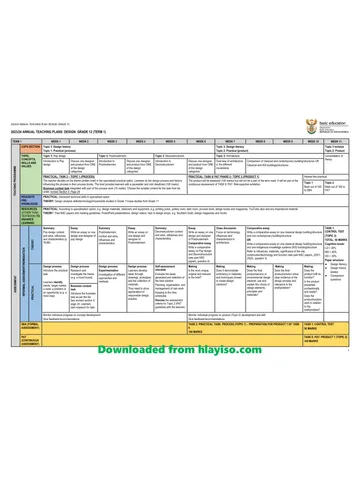
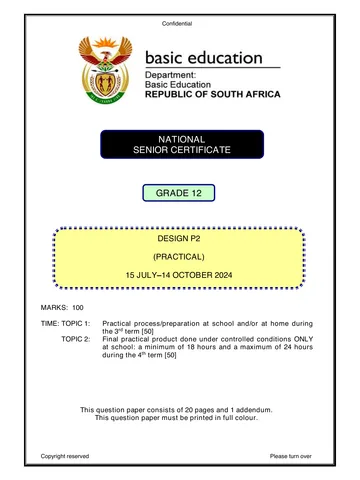
Design Grade 12 P2 NSC November 2023 Question Paper (Eng)
Grade 12 Design Paper 2 question paper from the NSC November Exam 2023 (English), 24 pages. Read online or download the free PDF.
Design · Grade 12 · NSC November Exam · 2023. Question paper, 24 pages. Read online or download the PDF.
- Subject
- Design
- Grade
- Grade 12
- Document type
- Question paper
- Year
- 2023
- Exam period
- NSC November Exam
- Paper
- 2
- Curriculum
- CAPS
- Pages
- 24
- File size
- 3.7 MB
Free to read online, no sign-up needed
Loading document…
Loading document…
1 of 24
This exam
NSC November Exam 2023
Document textSearch extracted text and jump to a page.
Downloaded from hlayiso.com
Design/P2 2 DBE/November 2023
NSC
INSTRUCTIONS AND INFORMATION
1. This question paper consists of TWO sections:
TOPIC 1: The examination sourcebook/workbook (50 marks)
TOPIC 2: The final examination design product (50 marks)
TOTAL: 100 marks
2. The question paper has TWO briefs/themes. Choose ONE of the two
options.
Copyright reserved Please turn over
Downloaded from hlayiso.com
Design/P2 3 DBE/November 2023
NSC
BRIEF/THEME 1: DESIGN FOR SOCIAL WELFARE
THE BRIEF:
The Aryan Benevolent Home (ABH), situated in Chatsworth, Durban, is a non-profit
organisation (NPO) and a public benefit organisation (PBO) that was founded in 1921.
ABH is a social welfare organisation that provides sanctuary to vulnerable and
homeless persons. They have eight facilities operating 24-hour services which include
caring for neglected, abused or orphaned children, the elderly, domestic violence
survivors, and differently abled persons. ABH has a theatre, a learning centre, dining
facilities and after-care services for older children. The home also has an accredited
healthcare education programme that empowers caregivers in the community with
skills to care for their elderly and sick.
Unlike other non-profit organisations, the ABH struggles to raise funds to continue
enriching the lives of the residents. Additionally, many of their facilities are in need of
refurbishing and/or restoration. These facilities require innovative design solutions to
re-design various aspects of their existing facilities, while constantly improving the
environment of the ABH. You may also create completely new design solutions that
add value to the work of the ABH.
Based on the existing principles of the mission of the ABH, create (an) inspired
innovative design solution(s) for the ABH. Your design can help to raise funds,
improve the environment of the home and/or rebrand the home.
Alternatively, you may create design solutions that add value to the work of any
other existing NPO/PBO from your province that does similar work to the Aryan
Benevolent Home (ABH).
CASE STUDY: Aryan Benevolent Home (ABH)
You are required to do research on the Aryan Benevolent Home, its purpose,
mission and the history behind its origins and the various designs that it can inspire. Do
searches on the internet to study websites of other organisations similar to the ABH to
guide you with your research. This research must be presented as part of your
sourcebook/workbook of Topic 1. Refer to the criteria for the design process and final
product together with the assessment guidelines.
Create a Visual Communication/Information Design and/or Digital Design
solution, which could include a rebranding of the existing corporate identity of the ABH.
This could consist of a logo, letterhead and business card. You could also design
packaging for food parcels, a promotional short video of the ABH, and a T-shirt or
sweater design for volunteers of the home, etc. Another possibility could involve a
poster campaign (with a series of posters) promoting the various facilities within the
ABH, e.g. the Pattundeen Theatre or ABH Charity Store. Designers may also re-design
the ABH's existing social media pages, such as Facebook and Instagram. You may
also design navigational signage that helps visitors and residents find their way around
the ABH facilities, e.g. indicate where the Educare Centre or dining facilities are
located.
Copyright reserved Please turn over
Downloaded from hlayiso.com
Design/P2 4 DBE/November 2023
NSC
Create a Surface Design or Two-dimensional Craft Design solution that improves
the existing facilities of the ABH, e.g. wallpapers for communal areas and bedrooms,
textile fabric to be used for curtains, duvet covers, chairs and children's beds, apron
designs for kitchen staff or caregivers' uniforms. This could also be a surface pattern
solution that assists elderly patients with dementia to remember where to locate
objects within their rooms or teaches Educare Centre learners how to read.
Create a Product Design or Three-dimensional Craft Design solution that can be
purchased at the ABH Charity or curio store that are part of the ABH's fundraising
initiatives and specific events, such as the annual Radiothon or fundraising gala dinner.
You could also design a product that can be used within the facility, e.g. a name badge
for caregivers or create an innovative multifunctional crocheted blanket for wheelchair-
bound residents using the corporate identity colours of the ABH or jewellery promoting
the ABH Centenary. Designers can also design cutlery and crockery to be used within
the dining facilities, bedroom lamps for residents and playroom items. Chandeliers for
the dining area or other innovative lighting solutions for the ABH Computer Centre can
also be created. Designers can use traditional African craft techniques or influences to
create these products.
Create an Environmental Design solution such as a play area for the Educare Centre
or a socialising area for the elderly residents. Design or revamp a theatre space or
landscape to add value to the NPO/PBO. These facilities help create a sense of
belonging and safety for residents.
GLOSSARY: DESIGN FOR SOCIAL WELFARE
Non-profit organisation: A non-profit organisation is a group organised for purposes
other than generating profit and in which no part of the organisation's income is
distributed to its members, directors or officers.
Public benefit organisation: The difference between an NPO and a PBO is that the
latter stands for a public benefit organisation.
Sanctuary: Protection or a safe place, especially for someone or something being
chased or hunted.
Differently abled person: Differently abled is often described in terms of a lack of
normal functioning of physical, mental or psychological processes. It is also defined as
learning difficulties or difficulties in adjusting socially, which interfaces with a person's
normal growth and development.
Do NOT copy the examples given.
Copyright reserved Please turn over
Downloaded from hlayiso.com
Design/P2 5 DBE/November 2023
NSC
VISUAL COMMUNICATION/INFORMATION DESIGN AND/OR DIGITAL DESIGN
Copyright reserved Please turn over
Downloaded from hlayiso.com
Design/P2 6 DBE/November 2023
NSC
SURFACE DESIGN AND TWO-DIMENSIONAL CRAFT DESIGN
Copyright reserved Please turn over
Downloaded from hlayiso.com
Design/P2 7 DBE/November 2023
NSC
PRODUCT DESIGN AND THREE-DIMENSIONAL CRAFT DESIGN
Copyright reserved Please turn over
Downloaded from hlayiso.com
Design/P2 8 DBE/November 2023
NSC
ENVIRONMENTAL DESIGN
Copyright reserved Please turn over
Downloaded from hlayiso.com
Design/P2 9 DBE/November 2023
NSC
Copyright reserved Please turn over
Downloaded from hlayiso.com
Design/P2 10 DBE/November 2023
NSC
BRIEF/THEME 2: DESIGN FOR AN ECO-LODGE
THE BRIEF:
Eco-lodges (environmentally sustainable accommodation) are rapidly gaining
popularity as travellers look to help preserve the environment and contribute to
growing local economies. Unlike eco-lodges, traditional hotels, hostels and game
lodges have a negative impact on the environment. The creation of eco-lodges
together with green travel gives travellers the option to positively improve their
environments while experiencing the beauty of nature and ensuring sustainability of
the Earth's resources. Eco-tourism is more than installing solar systems and reducing
waste; it has grown to also include community development and the protection of
indigenous cultural traditions. Local communities are exposed to improved
employment opportunities, infrastructure development and better community
resources and facilities.
Create an innovative design/design product for an eco-lodge which addresses
the impact it has on the environment and the community.
Do research on eco-lodges in South Africa and abroad. Refer to eco-conscious travel
blogs and articles that discuss the impact of tourism on the environment. What makes
them different from the usual holiday lodge? How are you going to encourage or sell
your eco-lodge concepts/designs to tourists? This research must be presented as part
of your sourcebook/workbook of TOPIC 1. Refer to the criteria for the design process
and final product together with the assessment guidelines.
TIP: Define the type of eco-lodge you are going to design for. Use a spider
diagram and be specific about where it is situated, who the clientele will be, and
what the mission of the eco-lodge will be.
Create a Visual Communication/Information Design and/or Digital Design solution
that could be used by an eco-lodge OR promote eco-travel. For example, create or
consider a bespoke, environmentally friendly corporate identity for an eco-lodge which
could include a logo, letterhead, business card, packaging, brochure, a short video
advertisement promoting the ethics of the eco-lodge OR environmentally friendly
signage for an eco-lodge.
Create a Surface Design or Two-dimensional Craft Design solution that is eco-
friendly, promotes eco-tourism and can be used by an eco-lodge of your choice. For
example, wallpapers that specifically interpret the mission/ethos of your chosen type of
eco-lodge, textile fabric, or any other surface pattern solutions that address the
problems created by tourism or promote eco-tourism.
Create a Product Design or Three-dimensional Craft Design solution for use by an
eco-lodge that will consider the problems of sustainability by educating guests about
the importance of eco-living, e.g. a biodegradable sling bag with the eco-lodge's
corporate identity. You could also design furniture or crockery using sustainable
materials or that promote local cultural style and techniques, etc.
Copyright reserved Please turn over
Downloaded from hlayiso.com
Design/P2 11 DBE/November 2023
NSC
Create an Environmental Design solution that can be integrated into an eco-lodge
which will draw attention to eco-tourism, e.g. a 'green' bathroom with a calm and
serene ambience, built with sustainable materials and with water restrictions in mind.
The water from the bathroom may be harvested for use in the garden. You could
design and create a bespoke architectural model of an eco-lodge or a window display
advertising your eco-lodge.
Refer to the criteria for the design process and final product together with the
assessment guidelines.
GLOSSARY: DESIGNING FOR AN ECO-LODGE
Eco-lodge: Accommodation that consciously makes an effort to preserve the
environment and contribute to local economies, while minimising the impact on natural
environments and local populations
Eco-tourism: A tourism sector that promotes environmentally and socially responsible
travel
Green travel: A means of travel that positively contributes to the environment while
simultaneously experiencing the richness and beauty of nature
Infrastructure: The built environment
Solar system: An alternative means of generating electricity with sun power
Unethical tourism: Tourism that intentionally disregards maintaining the environment
and societies it interacts with
The following images are examples that show products designed for eco-lodges
in the different design categories.
Do NOT copy the examples given.
Copyright reserved Please turn over
Downloaded from hlayiso.com
Design/P2 12 DBE/November 2023
NSC
VISUAL COMMUNICATION/INFORMATION DESIGN AND/OR DIGITAL DESIGN
Copyright reserved Please turn over
Downloaded from hlayiso.com
Design/P2 13 DBE/November 2023
NSC
SURFACE DESIGN AND TWO-DIMENSIONAL CRAFT DESIGN
Copyright reserved Please turn over
Downloaded from hlayiso.com
Design/P2 14 DBE/November 2023
NSC
Copyright reserved Please turn over
Downloaded from hlayiso.com
Design/P2 15 DBE/November 2023
NSC
PRODUCT DESIGN AND THREE-DIMENSIONAL CRAFT DESIGN
Copyright reserved Please turn over
Downloaded from hlayiso.com
Design/P2 16 DBE/November 2023
NSC
Copyright reserved Please turn over
Downloaded from hlayiso.com
Design/P2 17 DBE/November 2023
NSC
Copyright reserved Please turn over
Downloaded from hlayiso.com
Design/P2 18 DBE/November 2023
NSC
ENVIRONMENTAL DESIGN
Copyright reserved Please turn over
Downloaded from hlayiso.com
Design/P2 19 DBE/November 2023
NSC
Copyright reserved Please turn over
Downloaded from hlayiso.com
Design/P2 20 DBE/November 2023
NSC
REQUIREMENTS
SECTION A
TOPIC 1: THE DESIGN PROCESS [50]
1. All process/preparatory work for your design must be shown in a sourcebook/
workbook.
2. This will involve the processes from conceptualisation to realisation.
3. Thorough investigation of problems posed by the design brief should be shown.
4. The sourcebook/workbook must be presented in the form of an album (i.e. in
book form).
5. It must open easily and have pages that turn easily.
6. The sourcebook/workbook must be made of light material to facilitate
transportation where work is moderated at a central venue.
7. Ensure that the sourcebook/workbook is presented professionally.
NOTE:
As TOPIC 1 (process/preparation) has the same mark allocation as TOPIC 2 (the
final product), it should be given enough time to acknowledge its importance.
Your teacher may be involved in this preliminary preparatory session (TOPIC 1 only).
You may work at home (TOPIC 1 only).
CRITERIA FOR THE DESIGN PROCESS (TOPIC 1)
You should present the following (refer to the NSC Design Examination Guidelines):
Expression of intention and rationale (10)
Evidence of research, experimentation (10)
Evidence of detailed planning (10)
Evidence of development and reflection (10)
Presentation related to the final concept (10)
[50]
Copyright reserved Please turn over
Downloaded from hlayiso.com
Design/P2 21 DBE/November 2023
NSC
SECTION B
TOPIC 2: THE FINAL PRODUCT [50]
Although it is recommended that a two-dimensional design should NOT be larger than
A2 in size, candidates' work is not restricted regarding size.
The size of a three-dimensional design will depend on the function of the object being
made. Take into account that the final product might have to be transported to a central
marking venue, and you should therefore be mindful of possible problems that can be
encountered during transportation.
NOTE:
Your teacher may NOT assist you in any way during the final production of the
design.
ALL work must be done under the teacher's and/or appointed invigilator's
supervision at your school.
Any form of direct copying/plagiarism or work that is not your original work will be
strictly penalised.
A declaration of authenticity (ADDENDUM A) must be completed by yourself and
the chief invigilator/teacher.
Work must be done on a continuous basis, e.g. during three consecutive days
under controlled circumstances.
CRITERIA FOR THE DESIGN PRODUCT (TOPIC 2)
You should use the following criteria (refer to the NSC Design Examination
Guidelines):
Creativity/Originality/Interpretation in terms of the concept and solutions that are
relevant to the brief (10)
Evidence of design involvement: the appropriate use of design elements and
principles (10)
Technique/Craftsmanship/Method (10)
The design solution with evidence of a maximum of 24 hours' work under
controlled circumstances (10)
Professional presentation and functionality of the design solution (10)
[50]
TOTAL: TOPIC 1 (50) + TOPIC 2 (50): 100
Copyright reserved Please turn over
Downloaded from hlayiso.com
Design/P2 22 DBE/November 2023
NSC
INSTRUCTIONS TO THE TEACHER
PRACTICAL EXAMINATION: TOPIC 1 (50 MARKS) AND TOPIC 2 (50 MARKS) –
TASK 7
1. This practical examination consists of TWO parts, TOPIC 1 (sourcebook/
workbook and TOPIC 2 (final product).
2. This practical question paper should be given to the candidates on Friday
21 July 2023. The final submission date will be Friday 20 October 2023.
3. TOPIC 1 (design process) has the same weighting as TOPIC 2 (final product)
and it should therefore be given enough time to acknowledge its importance.
4. Consequently, candidates should have enough time to do their TOPIC 1
(preparation/design process). Due to the preparatory nature of TOPIC 1,
candidates are allowed to work at home. The teacher may be involved in the
preliminary preparatory session for TOPIC 1 only. The preparatory work for
TOPIC 1 should commence in Term 3.
5. The teacher may NOT assist the candidate in any way during the final
production of the design product (TOPIC 2).
6. Candidates must use the TOPIC 1 sourcebook/workbook as a point of reference
during their TOPIC 2 examination. Both TOPIC 1 and TOPIC 2 examination
work must be submitted to the teacher/invigilator immediately after the TOPIC 2
examination has been completed.
7. Any form of direct copying/plagiarism or work that is not the candidate's
original work will be strictly penalised.
8. TOPIC 2 must be done on a continuous basis during contact time, e.g. during
three consecutive days under controlled circumstances.
9. TOPIC 2 must be done at the candidate's examination centre, under the
supervision of the teacher/invigilator. TOPIC 2 must NOT be removed under any
circumstances from the examination centre during the exam.
10. TOPIC 2 must NOT be done at home.
11. Each province will determine the marking process of TOPIC 1 (sourcebook/
workbook) and TOPIC 2 (final product). Schools will be notified by the provinces
regarding the date, time and venue for the submission of work to the
examination centres, where applicable.
12. The examination TOPIC 1 should be professionally presented in a
sourcebook/workbook in album format.
13. The sourcebook/workbook and final product must be labelled neatly and clearly.
14. ADDENDUM A must be completed in full and the school stamp should appear in
the appropriate space. Attach ADDENDUM A securely to the final examination
work (sourcebook/workbook and/or final product).
Copyright reserved Please turn over
Downloaded from hlayiso.com
Design/P2 23 DBE/November 2023
NSC
ASSESSMENT RUBRIC Mark Sheet/Register No.:___________
CENTRE NUMBER:
EXAMINATION NUMBER:
Provincial Education Department: ________________________________________________
OUTCOMES WEIGHTING %
MODERATED
MARKER 1 MARKER 2
MARK
REQUIREMENTS
TOTAL
MARK
Expression of intention and rationale:
Brainstorm or do a mind map of ideas to explore the theme of the brief. Develop a concept 10
plan by providing a rationale to validate/explain the solution planned/found.
SOURCEBOOK/WORKBOOK
Evidence of research:
Research the brief and find relevant source materials (visual references/inspiration). Show
10
TOPIC 1:
evidence of research by creating a mood board and by completing thumbnail sketches of
various ideas.
Detailed planning and experimentation:
Generative ideas and/or drawings should explore a variety of concept solutions to the brief
(different techniques and materials). Drawing skills development should be evident. 10 50
DESIGN PROCESS
Design a few concept solutions that explore the brief showing evidence of
experimentation.
Evidence of development:
Shows evidence of the final design solution in the form of a detailed, annotated
drawing/collage/maquette/prototype, etc. Exploration of different materials and techniques
10
should be encouraged.
Reflection and presentation:
Reflection of process must be evident. Careful consideration is given to presentation of 10
the sourcebook. This process should be creatively presented.
SOURCEBOOK/WORKBOOK TOTAL 50
Creativity/Originality/Interpretation in terms of the concept and solutions that are
relevant to the brief:
Is the work unique, original and relevant to the brief?
10
Does the product solve the problem posed by the brief?
TOPIC 2:
THE FINAL PRODUCT
Evidence of design involvement: the appropriate use of design elements and
principles:
Overall impression. How have the elements and principles been used to create a unique
10
design solution?
Technique/Craftsmanship/Method:
How technically competent is the final product? 10 50
How adequate and professional is the craftsmanship?
DESIGN PRODUCTION
Evidence of 24 hours of work:
Evidence of the use of available time to complete the product.
Does the design solution show legitimate involvement in the making of the design 10
product?
Is attention given to detail?
Professional presentation, functionality and reflection of the design solution:
Is the product presented professionally and neatly? Does the product fulfil its function? 10
Evidence of reflection of the product in relation to the problem posed by the brief.
FINAL PRODUCT TOTAL 50
GRAND TOTAL 100
NAME: SIGNATURE:
DATE: ________________ CM: _____________________ ________________
IM: ___________________ ______________
Copyright reserved
Downloaded from hlayiso.com
Design/P2 DBE/November 2023
NSC
ADDENDUM A
This addendum must be detached, copied, completed, signed and attached to the
final examination work (workbook/sourcebook and/or final product).
OFFICIAL LABEL: NOVEMBER 2023 SOURCEBOOK/WORKBOOK
1. Name of subject DESIGN
2. Code of subject DSGN
DECLARATION OF AUTHENTICITY Register
This is to certify that all work submitted is the original and own work of the
candidate. NO.________
Centre number
Examination number
District/Circuit
Signatures and date School stamp
Candidate
Principal
Chief Invigilator/Teacher
--------------------------------------------------------------------------------------------------------------------------------------------
OFFICIAL LABEL: NOVEMBER 2023 FINAL PRODUCT
1. Name of subject DESIGN
2. Code of subject DSGN
DECLARATION OF AUTHENTICITY Register
This work was done under supervision and without any help. This is to certify
that all work submitted is the original and own work of the candidate. NO._______
Centre number
Examination number
District/Circuit
Signatures and date School stamp
Candidate
Principal
Chief Invigilator/Teacher
Copyright reserved
Study this subject
Recommended for this subject
Question paper
Design Grade 12 P2 NSC November 2023 Question Paper (Afr)
Question paper
Design Grade 12 P1 NSC November 2023 Question Paper (Eng)
Question paper
Design Grade 12 P1 NSC November 2023 Question Paper (Afr)
Question paper
Design Grade 12 P2 NSC November 2021 Question Paper (Afr)
Question paper
Design Grade 12 P2 NSC November 2021 Question Paper (Eng)
Question paper
Design Grade 12 P2 NSC November 2019 Question Paper (Eng)
More from Grade 12 Design
Annual teaching plan
Gr 12 Des ATP 2023 24
Memorandum
Design Grade 12 Paper 1 NSC June 2025 Memo (Afrikaans)
Memorandum
Design Grade 12 Paper 1 NSC November 2025 Memo (English)
Memorandum
Design Grade 12 Paper 1 NSC November 2025 Memo (Afrikaans)
Memorandum
Design Grade 12 Paper 1 NSC November 2025 Memo (Afrikaans)
Question paper