
Downloaded from hlayiso.com
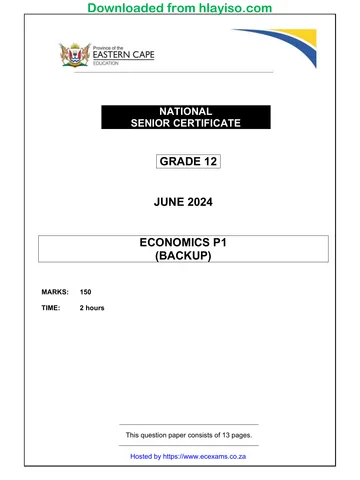
NATIONAL
SENIOR CERTIFICATE
GRADE 12
ECONOMICS P1
NOVEMBER 2021
MARKS: 150
TIME: 2 hours
This question paper consists of 13 pages.
Copyright reserved Please turn over
Skip to contentAll 2021 papers 
View all
Economics Grade 12 P1 NSC November 2021 Question Paper (Eng)
Grade 12 Economics Paper 1 question paper from the NSC November Exam 2021 (English), 13 pages. Read online or download the free PDF.
Economics · Grade 12 · NSC November Exam · 2021. Question paper, 13 pages. Read online or download the PDF.
- Subject
- Economics
- Grade
- Grade 12
- Document type
- Question paper
- Year
- 2021
- Exam period
- NSC November Exam
- Paper
- 1
- Curriculum
- CAPS
- Pages
- 13
- File size
- 458.9 KB
Free to read online, no sign-up needed
Loading document…
Loading document…
1 of 13
This exam
NSC November Exam 2021
Questions in this paper
- Question 1.1The dynamics of perfect markets
- Question 1.2The circular flow model, national account aggregates and the multiplier
- Question 1.3The foreign exchange market and the balance of payments accounts
- Question 2The circular flow model, national account aggregates and the multiplier8 marks
- Question 3South Africa’s industrial policies and their suitability in terms of international best practice8 marks
- Question 4Economic growth and development20 marks
Document textSearch extracted text and jump to a page.
Downloaded from hlayiso.com
Economics/P1 2 DBE/November 2021
NSC
INSTRUCTIONS AND INFORMATION
1. Answer FOUR questions as follows in the ANSWER BOOK:
SECTION A: COMPULSORY
SECTION B: Answer TWO of the three questions.
SECTION C: Answer ONE of the two questions.
2. Answer only the required number of questions. Answers in excess of the
required number will NOT be marked.
3. Number the answers correctly according to the numbering system used in this
question paper.
4. Write the question number above each answer.
5. Read the questions carefully.
6. Start EACH question on a NEW page.
7. Leave 2–3 lines between subsections of questions.
8. Answer the questions in full sentences and ensure that the format, content
and context of your responses comply with the cognitive requirements of the
questions.
9. Use only black or blue ink.
10. You may use a non-programmable pocket calculator.
11. Write neatly and legibly.
Copyright reserved Please turn over
Downloaded from hlayiso.com
Economics/P1 3 DBE/November 2021
NSC
SECTION A (COMPULSORY)
QUESTION 1 30 MARKS – 20 MINUTES
1.1 Various options are provided as possible answers to the following questions.
Choose the answer and write only the letter (A–D) next to the question
numbers (1.1.1 to 1.1.8) in the ANSWER BOOK, e.g. 1.1.9 D.
1.1.1 Long-term financial instruments, such as shares, are traded in
the … market.
A money
B capital
C foreign exchange
D labour
1.1.2 Business cycles that are caused by changes in the construction
industry that last for 15 to 20 years are called … cycles.
A Kuznets
B Kitchin
C Jugler
D Kondratieff
1.1.3 Transfer of ownership of entities from the private sector to the
public sector is called …
A privatisation.
B commercialisation.
C deregulation.
D nationalisation.
1.1.4 Investment contracts that base their value on the underlying
assets, such as currencies and commodities, are known as …
A other investments.
B direct investments.
C financial derivatives.
D portfolio investments.
1.1.5 The international organisation that reduces tariffs and other trade
barriers to liberalise trade is called the …
A World Bank.
B International Monetary Fund.
C World Trade Organisation.
D World Health Organisation.
Copyright reserved Please turn over
Downloaded from hlayiso.com
Economics/P1 4 DBE/November 2021
NSC
1.1.6 The growth and development policy that aims to eliminate poverty
and reduce inequality by 2030, is known as the …
A National Development Plan.
B Reconstruction and Development Programme.
C Growth, Employment and Redistribution Programme.
D Accelerated and Shared Growth Initiative for South Africa.
1.1.7 A cash incentive that aims to provide investment in the training of
the South African labour force to gain new expertise, is called
the …
A Critical Infrastructure Programme.
B Skills Support Programme.
C Custom Free Incentives.
D Small Business Support Programme.
1.1.8 The percentage of the population living in poverty in a country is
indicated by …
A the Gini coefficient.
B life expectancy.
C per capita gross domestic product.
D the headcount index. (8 x 2) (16)
Copyright reserved Please turn over
Downloaded from hlayiso.com
Economics/P1 5 DBE/November 2021
NSC
1.2 Choose a description from COLUMN B that matches the item in COLUMN A.
Write only the letter (A–I) next to the question numbers (1.2.1–1.2.8) in the
ANSWER BOOK, e.g. 1.2.9 J.
COLUMN A COLUMN B
1.2.1 Transfer payment A combination of international trade
policies suitable for the prevailing
1.2.2 Investment conditions in an economy
1.2.3 Cash reserve B monitors identifiable and definable
requirements issues related to human well-being
1.2.4 Price discrimination C nationwide government intervention to
create employment using labour
1.2.5 Social indicator intensive methods
1.2.6 Desirable mix D money received without any productive
service rendered
1.2.7 Industrial development
zones E charging different customers, different
prices for the same product
1.2.8 Expanded Public
Works Programme F spending by businesses on capital
goods
G used to control money supply through
buying and selling of government
securities
H purpose-built industrial estates that are
physically enclosed and link to
international ports
I the minimum amount of money that the
South African Reserve Bank requires
banks to maintain in order to manipulate
money creation activities
(8 x 1) (8)
Copyright reserved Please turn over
Downloaded from hlayiso.com
Economics/P1 6 DBE/November 2021
NSC
1.3 Give ONE term for each of the following descriptions. Write only the term next
to the question numbers (1.3.1 to 1.3.6) in the ANSWER BOOK.
Abbreviations, acronyms and examples will NOT be accepted.
1.3.1 When a country involved in international trade, produces more
output than other countries given the same input
1.3.2 A document that details expected revenue and projected
expenditure for the next fiscal year
1.3.3 Tax systems where low-income earners pay higher tax rates while
high-income earners pay lower tax rates
1.3.4 The provision of incentives to encourage local businesses to
produce goods to sell to other countries
1.3.5 The process that focuses on the improvement of people's standard
of living
1.3.6 The industrial development strategy that focuses on improving the
competitiveness in manufacturing by considering input prices and
technology. (6 x 1) (6)
TOTAL SECTION A: 30
Copyright reserved Please turn over
Downloaded from hlayiso.com
Economics/P1 7 DBE/November 2021
NSC
SECTION B
Answer any TWO of the three questions in this section in the ANSWER BOOK.
QUESTION 2: MACROECONOMICS 40 MARKS – 30 MINUTES
2.1 Answer the following questions.
2.1.1 Name any TWO participants of the circular-flow model. (2 x 1) (2)
2.1.2 Why does public sector failure lead to social instability? (1 x 2) (2)
2.2 Study the table below and answer the questions that follow.
GROSS VALUE ADDED BY KIND OF ECONOMIC ACTIVITY
2021 figures
At constant At current prices
2015 prices
Primary sector 295 203 472 082
Secondary sector 552 601 943 771
Tertiary sector 2 017 745 3 107 747
Gross value added at basic prices 2 865 548 4 523 600
[Adapted from SARB Quarterly Bulletin, March 2021]
2.2.1 Identify the base year that the South African Reserve Bank uses to
compile national accounts aggregates. (1)
2.2.2 Give the alternative term used for gross value added in national
accounts. (1)
2.2.3 Briefly describe the term gross value added. (2)
2.2.4 How are basic prices converted to market prices? (2)
2.2.5 Why would economists prefer constant prices to current prices
when measuring economic growth? (2 x 2) (4)
Copyright reserved Please turn over
Downloaded from hlayiso.com
Economics/P1 8 DBE/November 2021
NSC
2.3 Study the extract below and answer the questions that follow.
PUBLIC DEBT ON THE INCREASE
High government debt levels increase the cost of borrowing across the
economy. The rising debt leads to higher future taxation and uncertainty.
Servicing this rising debt takes away resources that could have been invested
in infrastructure. Our borrowing requirement will remain well above
R500 billion in each year of the medium term despite the modest
improvements in our fiscal position.
This 2021 budget framework puts South Africa on course to achieve a primary
surplus. By doing this, government debt will stabilise at 88,9 per cent of gross
domestic product in 2025/26.
[Adapted from 2021/22 Annual Budget Statement]
2.3.1 Name the government department responsible for the formulation and
implementation of fiscal policy. (1)
2.3.2 Give the benchmark percentage of public debt in relation to gross
domestic product. (1)
2.3.3 Briefly describe the term medium-term expenditure framework. (2)
2.3.4 Why is there a need for government to spend more on social
development? (2)
2.3.5 How can income tax brackets influence taxpayers? (2 x 2) (4)
2.4 With the aid of a correctly labelled graph, explain the multiplier concept. (8)
2.5 How can changes in terms of trade influence the South African economy? (8)
[40]
Copyright reserved Please turn over
Downloaded from hlayiso.com
Economics/P1 9 DBE/November 2021
NSC
QUESTION 3: ECONOMIC PURSUITS 40 MARKS – 30 MINUTES
3.1 Answer the following questions.
3.1.1 Name any TWO methods of import substitution. (2 x 1) (2)
3.1.2 How can the government use land restitution to achieve its
development and redress objectives? (1 x 2) (2)
3.2 Study the information below and answer the questions that follow.
SOUTH AFRICA'S 2030 ENERGY PLAN
As part of the 2030 plan, the Department of Mineral Resources and Energy
effectively unlocked R56 billion that will be invested in renewable energy
projects across the country. Municipalities are required to select suitable off-
grid energy sources and to provide access to poor households.
[Adapted from Department of Mineral Resources and Energy Statement, 2021]
3.2.1 Identify the energy source that relates to the burning of fossil fuels. (1)
3.2.2 Give the index that is used to measure society's level of
development. (1)
3.2.3 Briefly describe the term economic indicator. (2)
3.2.4 Explain the negative impact of rural-urban migration on the supply
of services in urban areas. (2)
3.2.5 How will renewable sources of energy affect poor households in
rural areas positively? (2 x 2) (4)
Copyright reserved Please turn over
Downloaded from hlayiso.com
Economics/P1 10 DBE/November 2021
NSC
3.3 Study the information below and answer the questions that follow.
Special
Economic
Zones … offers
Duty-free
The SEZ incentives,
programme Foreign
attracted Investment
234 Grant and
investors, Skills Support
Programme.
creating
15 000
Tax incentives
direct jobs
[Adapted from Google, SEZ latest development, March 2021]
3.3.1 Identify the financial incentive that allows for the importing of
intermediate goods without paying any tariffs. (1)
3.3.2 Name any ONE special economic zone in South Africa. (1)
3.3.3 Briefly describe the term corridors. (2)
3.3.4 How is the government using corporate tax to attract investments
into special economic zones? (2)
3.3.5 Explain the importance of public-private partnerships in spatial
development initiatives. (2 x 2) (4)
3.4 Outline the aims of regional development. (4 x 2) (8)
3.5 Analyse the environmental effects of economic activities of countries in the
north. (8)
[40]
Copyright reserved Please turn over
Downloaded from hlayiso.com
Economics/P1 11 DBE/November 2021
NSC
QUESTION 4: MACROECONOMICS AND ECONOMIC PURSUITS
40 MARKS – 30 MINUTES
4.1 Answer the following questions.
4.1.1 Name any TWO international benchmark criteria for regional
development. (2 x 1) (2)
4.1.2 Why are liabilities added when calculating net direct investments in
the financial account of the balance of payments? (2)
(1 x 2)
4.2 Study the extract below and answer the questions that follow.
WHY DO COUNTRIES TRADE?
Today, international trade is at the heart of the global economy and is
responsible for much development and prosperity of the modern industrialised
world. Countries trade with each other when they do not have the resources,
or capacity to satisfy their own needs and wants. By exploiting their domestic
scarce natural resources, countries can produce a surplus and trade this for
the resources they need.
Faced by large global markets, firms may be encouraged to adopt mass
production, and apply new technology.
[Adapted from www.internationalecon.com]
4.2.1 Identify the supply reason for international trade addressed in the
extract above. (1)
4.2.2 Name the product explicitly recorded in the current account, due to
its historic importance. (1)
4.2.3 Briefly describe the term mass production. (2)
4.2.4 Explain the reason for South African consumers importing
products that are available on domestic markets. (2)
4.2.5 How could natural disasters, such as a drought, influence the
South African trade balance? (2 x 2) (4)
Copyright reserved Please turn over
Downloaded from hlayiso.com
Economics/P1 12 DBE/November 2021
NSC
4.3 Study the information below and answer the questions that follow.
SOUTH AFRICA'S ECONOMY HITS LOW
Weak economic
growth
South Africa's gross domestic product (GDP) fell by just over 16,4%
between the first quarter and second quarter of 2020, resulting in an
annualised growth rate of 51%. The demand side of the economy slumped
by 52,3% as a result of lower exports and household spending.
[Adapted from @StatsSA, February 2021]
4.3.1 Identify ONE component of aggregate demand in the information
above. (1)
4.3.2 Name the employment indicator that relates to the size of the
labour force in the country. (1)
4.3.3 Briefly describe the term economic growth. (2)
4.3.4 Explain the impact of an increase in consumer spending on the
production of goods and services. (2)
4.3.5 How can small, medium and microenterprises (SMMEs) contribute
to economic growth and development? (2 x 2) (4)
4.4 Briefly discuss exchange rate stability and price stability as macroeconomic
objectives of the state. (2 x 4) (8)
4.5 Analyse the challenges of the South African government in reducing the
unemployment rate in the economy. (8)
[40]
TOTAL SECTION B: 80
Copyright reserved Please turn over
Downloaded from hlayiso.com
Economics/P1 13 DBE/November 2021
NSC
SECTION C
Answer any ONE of the two questions in this section in the ANSWER BOOK.
Your answer will be assessed as follows:
MARK
STRUCTURE OF ESSAY
ALLOCATION
Introduction
The introduction is a lower-order response. Max. 2
A good starting point would be to define the main concept related to the
question topic.
Do NOT include any part of the question in the introduction.
Do NOT repeat any part of the introduction in the body.
Avoid mentioning in the introduction what you are going to discuss in
the body.
Body
Main part: Discuss in detail/In-depth discussion/Examine/Critically Max. 26
discuss/Analyse/Compare/Evaluate/Distinguish/Differentiate/Explain/Draw a
graph and explain/Use the graph given and explain/Complete the given
graph/Assess/Debate
A maximum of 8 marks may be allocated for headings/examples. Max. 10
Additional part: Critically discuss/Evaluate/Critically evaluate/Debate/
Deduce/Compare/Distinguish/Interpret/How?/Suggest
A maximum of 2 marks may be allocated for mere listing of facts.
Conclusion
Any higher-order conclusion should include: Max. 2
A brief summary of what has been discussed without repeating facts
already mentioned
Any opinion or valued judgement on the facts discussed
Additional support information to strengthen the discussion/analysis
A contradictory viewpoint with motivation, if required
Recommendations
TOTAL 40
QUESTION 5: MACROECONOMICS 40 MARKS – 40 MINUTES
Discuss in detail the new economic paradigm in smoothing-out business cycles.
(26 marks)
Evaluate the South African government's initiatives to reduce the economic
downturn caused by the Covid-19 pandemic. (10 marks) [40]
QUESTION 6: ECONOMIC PURSUITS 40 MARKS – 40 MINUTES
Discuss the arguments in favour of protectionism. (26 marks)
How can South Africa benefit from trading in global markets? (10 marks) [40]
TOTAL SECTION C: 40
GRAND TOTAL: 150
Copyright reserved
Study this subject
Recommended for this subject
Question paper
Economics Grade 12 P1 NSC November 2021 Question Paper (Afr)
Question paper
Economics Grade 12 P1 NSC June 2021 Question Paper (English)
Question paper
Economics Grade 12 P1 NSC June Exemplar 2021 QP (Eng)
Question paper
Economics Grade 12 P1 NSC November 2023 Question Paper (Eng)
Question paper
Economics Grade 12 P1 NSC November 2018 Question Paper (Eng)
Question paper
Economics Grade 12 P1 NSC November 2017 Question Paper (Afr)
More from Grade 12 Economics
Memorandum
Economics Grade 12 P2 Eastern Cape June 2025 Memo (Afr)
Memorandum
Economics Grade 12 Paper 2 Gauteng June 2025 Memo (English)
Memorandum
Economics Grade 12 Paper 1 NSC June 2025 Memo (English)
Memorandum
Economics Grade 12 Paper 2 NSC June 2025 Memo (Afrikaans)
Question paper
Economics Grade 12 P2 NW June 2025 Question Paper (English)
Question paper