
Downloaded from hlayiso.com
GAUTENG DEPARTMENT OF EDUCATION
PROVINCIAL EXAMINATION
NOVEMBER 2018
GRADE 10
ECONOMICS
PAPER 1
MARKING GUIDELINES
17 pages
Skip to contentAll 2018 papers 
View all

Economics Grade 10 P1 Gauteng November 2018 Memo (English)
Grade 10 Economics Paper 1 memorandum from the Gauteng November 2018 (English), 17 pages. Read online or download the free PDF.
Economics · Grade 10 · Gauteng November · 2018 · English. Memorandum, 17 pages. Read online or download the PDF.
- Subject
- Economics
- Grade
- Grade 10
- Language
- English
- Document type
- Memorandum
- Year
- 2018
- Exam period
- Gauteng November
- Paper
- 1
- Curriculum
- CAPS
- Pages
- 17
- File size
- 306.2 KB
Free to read online, no sign-up needed
Loading document…
Loading document…
1 of 17
This exam
Gauteng November 2018
Questions in this paper
- Question 1.1Basic Concepts & Basic Economic Problem8 marks
- Question 1.2Basic Concepts & Basic Economic Problem16 marks
- Question 1.3Circular Flow & Quantitative Elements6 marks
- Question 2Business Cycles40 marks
- Question 3Population & Labour Force40 marks
- Question 4Growth, Development & Globalisation40 marks
Document textSearch extracted text and jump to a page.
Downloaded from hlayiso.com
ECONOMICS
MARKING GUIDELINES
(Paper 1) GRADE 10
GAUTENG DEPARTMENT OF EDUCATION
PROVINCIAL EXAMINATION
ECONOMICS
(Paper 1)
SECTION: (COMPULSORY)
QUESTION 1
1.1 MULTIPLE-CHOICE QUESTIONS
1.1.1 B limited means
1.1.2 A scarcity of resources
1.1.3 D households
1.1.4 C lagging indicator
1.1.5 B modern money
1.1.6 D skilled labour
1.1.7 C manageable
1.1.8 A immigration (8 x 1) (8)
1.2 MATCHING ITEMS
1.2.1 E Exists because we have limited resources with which to satisfy
unlimited needs and wants
1.2.2 F A group of people that live together and make economic decisions
1.2.3 A All people have a basic human right to be free from poverty,
ignorance and ownership by another
1.2.4 G A period in which there is a decline in economic activity with rising
unemployment
1.2.5 D The use of tools and advanced methods to produce goods and
services in the economy
1.2.6 C The combination of two different goods that could be produced
when using all available resources to the full and efficiently
2
Downloaded from hlayiso.com
ECONOMICS
MARKING GUIDELINES
(Paper 1) GRADE 10
1.2.7 I Is the amount of money offered or asked for something that is
bought or sold
1.2.8 B The movement of people across international boundaries from one
country to the other
(8 x 2) (16)
1.3 GIVE ONE TERM
1.3.1 Public Sector Economics
1.3.2 Savings
1.3.3 Barter
1.3.4 Communal property
1.3.5 Banks
1.3.6 Unemployed (6 x 1) (6)
TOTAL FOR SECTION A: 30
3
Downloaded from hlayiso.com
ECONOMICS
MARKING GUIDELINES
(Paper 1) GRADE 10
SECTION B
Answer any TWO of the three questions in this section in the ANSWER BOOK.
QUESTION 2: MACROECONOMICS
2.1 Answer the following questions.
2.1.1 Name any TWO factors of production.
Land
Labour
Capital
Entrepreneurship (Any 2 x 1) (2)
2.1.2 Why do consumers have to make choices about what they buy?
They have scarce resources so they have to choose how to use
these resources to gain maximum satisfaction
(Accept any other correct relevant response.) (1 x 2) (2)
2.2 DATA RESPONSE
2.2.1 Give examples of real flow from the diagram above.
Goods and services
Factors of production (2 x 1) (2)
2.2.2 Briefly describe the term circular flow.
The movement of goods and services, factors of production, and
money (income and expenditure) in an economy (2)
2.2.3 Describe the role of the factor market in the circular flow.
Factor market or resource market is where the services of the
factors of production are traded.
For example labour is hired, capital is borrowed, property is rented
and entrepreneurs offer their services
These factors of production earn wages, interest, rent and
profits.
(Accept any other correct relevant response.) (2)
4
Downloaded from hlayiso.com
ECONOMICS
MARKING GUIDELINES
(Paper 1) GRADE 10
2.2.4 What are the problems with international comparisons?
Some figures need to be estimated because they may be
unavailable
Social wages may be high in some countries compared to others
leading to higher GDP figures in those countries
Climate conditions are different from country to country and that
makes it difficult to compare outputs of countries with different
climates
Unreliability of exchange rates may affect the GDP figures
(Accept any other correct relevant response.) (4)
2.3 DATA RESPONSE
2.3.1 Provide the above diagram with an appropriate heading.
Business cycle (1)
2.3.2 Name the lowest point, C, in the diagram above.
Trough (1)
2.3.3 Briefly describe the term trend line.
This is a line showing the general direction of economic activity
(Accept any other correct relevant response.) (2)
2.3.4 Describe the effect of a depression on employment levels.
During a depression many companies scale down on their
production and ultimately many workers are retrenched causing
massive unemployment
(Accept any other correct relevant response.) (2)
2.3.5 How is the economy affected during the prosperity phase?
The economy is affected due to:
This is a time of general optimism and consumer spending
Output and economic activity increase and entrepreneurs expand
their businesses
Employ more people and buy equipment.
Profits increase as well as wages and prices
Consumer demand rises which stimulates greater production
(Accept any other correct relevant response.) (2 x 2) (4)
5
Downloaded from hlayiso.com
ECONOMICS
MARKING GUIDELINES
(Paper 1) GRADE 10
2.4 Differentiate between economic goods and free goods.
Economic goods Free goods
They are scarce in relation to their They are not scarce, available
demand without limit
People are prepared to pay for People are not prepared to pay for
them, they have a price them, they have no price
They can be sold on markets and They cannot be counted as
accumulated as wealth wealth
(Accept any other correct relevant response) (2 x 4) (8)
2.5 How does the state contribute towards the growth of the economy?
The state contributes towards the growth of the economy because:
The state manages the economy through various policies
Public goods, which consumers do not want to pay for, are provided to
households by the state
Basic infrastructure like roads, electricity supply and bridges necessary for
the growth of the economy is provided by the government
The government provides rules and regulations to protect businesses and
also to protect consumers from unfair practices
National laws that influence the economy such as the national budget are
the responsibility of the state
(Accept any other correct relevant response.) (8)
[40]
QUESTION 3: ECONOMIC PURSUITS
3.1 Answer the following questions.
3.1.1 Give any TWO types of taxes paid to the government.
Value added tax (VAT)
Income tax
Company tax
Wealth tax
Capitalgains-tax (Any 2 x 1) (2)
3.1.2 How does economic growth lead to economic development?
A country that produces more goods and services has a population
that has a better standard of living because they use those goods to
improve their lifestyle
(Accept any other correct relevant response.) (1 x 2) (2)
6
Downloaded from hlayiso.com
ECONOMICS
MARKING GUIDELINES
(Paper 1) GRADE 10
3.2 DATA RESPONSE
3.2.1 Which of the African countries in the table had the lowest level of
urbanisation in 2010?
Uganda (13%) (1)
3.2.2 Who is responsible for the publication of the above information?
The World Factbook (1)
3.2.3 Briefly explain the term urbanisation.
This is the gradual increase in the number of people staying in urban
areas, leading to the growth of towns and cities (2)
3.2.4 What is the relationship between poverty and migration?
When people are poor they are more likely to move to areas where
poverty is low so that they can find ways of reducing their poverty
(Accept any other correct relevant response.) (2)
3.2.5 Why is urbanisation a problem especially to government?
Problem of infrastructure, Migration leads to densely populated
informal settlements or slums necessitating a massive demand for
housing and infrastructure such as land, roads, health clinics
problem of service delivery, problem of electricity
Cities are now unable to absorb labour especially the unskilled
ones
Unemployment is rife in towns and cities leading to crimes, such as
violence, robbery, theft etc
Government is faced with an uncontrollable influx of people leading to
housing, water problems etc.
(Accept any other correct relevant response.) (Any 2 x 2) (4)
7
Downloaded from hlayiso.com
ECONOMICS
MARKING GUIDELINES
(Paper 1) GRADE 10
3.3 DATA RESPONSE
3.3.1 To which part of the labour force does this extract refer?
Unemployed youth (1)
3.3.2 To what proportion of the population does this extract refer?
80% (1)
3.3.3 Briefly explain the term labour force.
The labour force of the country is made up of the economically active
population
Economically active population consists of people between the ages
of 15 and 64 years of age who are unemployed or working for
themselves (2)
3.3.4 Describe any social effect of unemployment.
Unemployed youth can cause possible riots / violence.
The largest group 80% is youth that can cause or engage in crime as
a result of frustration
Youth may become the leaders of violent public protests as they are
still full of energy
(Accept any other correct relevant response.) (1 x 2) (2)
3.3.5 Suggest possible solutions to unemployment.
The solution is to create jobs and training particularly for those who
have fewer than 12 years of schooling
Apprenticeships, learnerships, mentorships, skills development and
training should be offered to the unemployed youths
The government can be involved in job creation programmes like
Expanded Public Works Programmes
(Accept any other correct relevant response.) (2 x 2) (4)
8
Downloaded from hlayiso.com
ECONOMICS
MARKING GUIDELINES
(Paper 1) GRADE 10
3.4 Discuss the main characteristics of money as a means of payment.
Generally accepted by all as a means of payment Source currencies have
more value than the others e.g. US dollar is accepted internationally
rather than the Zimbabwean dollar
Must be durable and not easily counterfeited or easily rust or decay over
time also cannot be easily counterfeited
Money must be scarce and valuable that is why money must not be
printed in large amounts because it will lose value (scarcity) by becoming
too plentiful, thus becoming worthless
Money must be manageable in that it must be easy to carry it around
because of its size and weight
Must be the sameand easy to get change when different payments are
made
(Accept any other correct relevant response.) (4 x 2) (8)
3.5 How did industrialisation lead to the development of transport and
communication?
Transport
Railway lines are built to facilitate transportation of bulk products
Roads were improved
Bulk volumes of goods could be transported and delivered in shorter
times
Harbours were built for sea transportation
Imports and exports possible
Development of shipping (max 4)
Communication
Improved communication networks led to improved distribution of
information
Business and consumers easily contacted for sales
Exports and imports businesses flourished as a result of easy contacts with
international counterparts
Money transfers became easy through internet banking
Insurance and investments improved
(Accept any other correct relevant response.) (max 4)
(2 x 4) (8)
[40]
9
Downloaded from hlayiso.com
ECONOMICS
MARKING GUIDELINES
(Paper 1) GRADE 10
QUESTION 4: MACROECONOMICS AND ECONOMIC PURSUITS
4.1 Answer the following questions.
4.1.1 Name any TWO approaches to studying Economics.
Microeconomics
Macroeconomics (2 x 1) (2)
4.1.2 How were nomadic societies organised?
Societies were organised in small familiy groups, moving from one
area to the other as resources were depleted (1 x 2) (2)
4.2 DATA RESPONSE
4.2.1 Identify the sector that contributed most to the GDP.
Tertiary sector (1)
4.2.2 Comment on the trend of the contribution of the tertiary sector.
The tertiary sector contributes more income to the middle and higher
income earners (1)
4.2.3 Briefly describe the term primary sector.
The sector is involved in the extraction of raw materials, for example
agriculture, mining and fishing
(Accept any other correct relevant response.) (2)
4.2.4 What could be the cause for the decline in the contribution of the
primary sector?
Many South Africans prefer to work in other sectors like the service
sector rather than in the primary sector since more are now skilled
and their skills are not needed much in the primary sector
(Accept any other correct relevant response.) (2)
10
Downloaded from hlayiso.com
ECONOMICS
MARKING GUIDELINES
(Paper 1) GRADE 10
4.2.5 How can economic human rights be addressed in South Africa?
The government has a responsibility to protect consumers from
exploitation by producers
The state could impose heavy penalties on those producers and
businesses who infringe on human rights
Has a responsibility to ensure that consumer rights are enforced
It can be achieved through educating consumers about their rights
and referral to the organisations set up to deal with these issues
Investigate consumer complaints and consumer rights violations
(Accept any other correct relevant response.) (Any 2 x 2) (4)
4.3 DATA RESPONSE
4.3.1 Identify which food items are being produced in the picture above.
Maize
Milk (2 x 1) (2)
4.3.2 Which stage of economic development is depicted in the above
picture? Provide a reason for your response?
Animal husbandry and agriculture commercial crop farming and
dairy farming is evident (2)
4.3.3 Briefly describe the term Secondary Sector.
Manufacturing or processing of raw material from Primary Sector
Deals with the changing of raw material into finished goods and
resources
(Accept any other correct relevant response.) (2)
4.3.4 Which factors promoted the development of mining activities in South
Africa?
Foreign investment in the mining activities increased
Relatively cheap labour was available from neighboring countries
Transport in the country improved
Demand for gold as an international means of payment was high
(Accept any other correct relevant response.) (2 x 2) (4)
11
Downloaded from hlayiso.com
ECONOMICS
MARKING GUIDELINES
(Paper 1) GRADE 10
4.4 Differentiate between Gross Domestic Product and Gross National Income.
Gross Domestic Product Gross National Income
Is a good measure of how well Is a good measure of the material
the economy is doing standard of living enjoyed by the
people of a country
Figures can be used to compare Figures can be used to compare the
one country with another at a material standard of living of citizens in
particular point in time different countries
Determine which economies have Also provides economic activities over
produced the most output time
GDP figures are also used to To measure GNI two adjustments must
construct the business cycle be made to the value of GDP
(max 4) (max 4)
(Accept any other correct relevant response.) (8)
4.5 How do stokvels contribute towards a better form of saving for members?
Stokvels contribute towards a better form of saving because:
Stokvels are sociable, members have common values and understand one
another
They impose self-discipline and commitment on people
No one wants to let their friends down when it comes to paying
There is social prestige in belonging to a stokvel
You must be invited to join
(Accept any other correct relevant response.) (8)
TOTAL FOR SECTION B: 40
12
Downloaded from hlayiso.com
ECONOMICS
MARKING GUIDELINES
(Paper 1) GRADE 10
SECTION C
Answer any ONE of the two questions in this section in the ANSWER BOOK.
QUESTION 5: MACROECONOMICS
Discuss in detail the FOUR participants in an economy and the inter-
relationships between them. (26 marks)
Briefly describe the methods used to determine Gross Domestic Product.
(10 marks) [40]
INTRODUCTION
There are four main participants in an open economy, namely the households,
businesses, the government and the foreign sector that are interlinked and
therefore have a relationship with each other.
The decisions that they take and their interactions with each other.
The influence this has on individuals in the community and the influence on the
level of economic activities.
(Accept any other correct relevant response.) (Max 2)
BODY: MAIN PART
Households
They are also known as consumers because they use goods and services
Households are the primary economic participants because they own, directly
and indirectly, the factors of production (land, labour, capital and
entrepreneurship)
Consumers have needs which are satisfied through the consumption of goods
and services which they purchase from the firms
Consumers demand for goods and services stimulate economic activity by
encouraging firms and the state to produce goods and services
Consumers sell their factors of production to firms in return for remuneration
(wages, rent, interest and profit)
13
Downloaded from hlayiso.com
ECONOMICS
MARKING GUIDELINES
(Paper 1) GRADE 10
Firms
They are also known as businesses or producers
They purchase the factors of production from the households in the factor
market
They use the factors of production to produce goods and services, which they
then sell on the goods market to households
Firms are motivated to produce goods and services by the profit motive
Government
Governments act to provide goods and services, which cannot be provided by
firms
The state also has certain functions and roles to play in the economy. For
example, protection services, social services and economic services
Governments receive revenue from firms and households in the form of taxes
and revenue from state-owned property and state-owned enterprises
Foreign sector
The foreign sector supplies goods and services that are imported by households
and businesses and buys goods and services that are exported
The foreign sector pays for the exports and receives money for the imports our
country makes with the rest of the world
The foreign sector also supplies factors of production that are imported and buys
factors of production that are exported
They receive remuneration for factors that they import to us and pay for the
factors that we export to them
(Accept any other correct relevant response.) (Max 26)
14
Downloaded from hlayiso.com
ECONOMICS
MARKING GUIDELINES
(Paper 1) GRADE 10
ADDITIONAL PART
Briefly describe the methods used to determine Gross Domestic Product.
There are three different ways in which Gross Domestic Product can be
determined. Each way is an indication of the composition of the Gross Domestic
Product
Production method
Using this method, GDP is determined by calculating the sum of the value added at
each stage of the production process (primary, secondary and tertiary stages)
This method yields GDP at basic prices
Income method
Using this method, GDP is determined by calculating the income earned by the
factors of production within the borders of the country
This method yields GDP at factor cost
Expenditure method
Using this method, GDP is determined by calculating the total expenditure on all
final goods and services produced within the borders of the country
(C + I + G + X – M)
This method yields GDP at market prices
(Accept any other correct relevant response.) (Max 10)
CONCLUSION
The economic participants are reliant on each other. An economy cannot function
if one participant does not contribute fully.
(Accept any other correct relevant higher-order response.) (Max 2)
OR
Efficient utilisation of factors of production by producers is important so that there is
an increase in the value of goods and services produced in an economy.
(Accept any other correct relevant higher-order response.) (Max 2)
[40]
15
Downloaded from hlayiso.com
ECONOMICS
MARKING GUIDELINES
(Paper 1) GRADE 10
QUESTION 6: ECONOMIC PURSUITS
Discuss the roles and functions of Commercial Banks in the development of
the economy of South Africa (26 marks)
Critically evaluate the South African Reserve Bank (SARB) as the monetary
authority, controlling all money-related issues of the country. (10 marks) [40]
INTRODUCTION
Modern banking is characterized by the constant improvements in its functions
Banks brought about the present economic development throughout the world
Highly economically developed countries are where they are because of a well
developed banking infrastructure
Banks are the link to all economic activity
(Accept any other correct relevant response.) (Max 2)
BODY: MAIN PART
Banks are the intermediary, bringing together lenders (depositors) and borrowers
of money
Banks are the safe keepers of money
Provide facilities where people can store money in the safe place
Banks accept and store deposits on which interest is paid
They keep foreign currency reserves
Fees can be transferred from one account to the other
Lend money in the form of loans and overdrafts at the risk of the banks
Banks charge interest for loanable funds
Banks make profit from two sources namely: earning interest on loans and
overdrafts
They charge service fees for the services rendered
Banks contribute to the growth of the economy through efficient allocation of
resources
Help with new business ventures by loaning money
They lend money to business who want to expand their businesses
Improves the standard of living of the people by providing loans to the individuals
who want to buy assets such as houses
Address the socio-economic issues of the public by providing financial
education
Banks also grant study loans and enable people to acquire further education and
training
Increase the possibility for better opportunities through bursaries and loans
Banks are involved in community development projects e.g. sport, art etc.
(Accept any other correct relevant response.) (Max 26)
16
Downloaded from hlayiso.com
ECONOMICS
MARKING GUIDELINES
(Paper 1) GRADE 10
ADDITIONAL PART
The South African Reserve Bank is a central bank that controls other banks
It was established in 1920
It has the sole right to issue bank notes and coins
South African Reserve Bank is the bank to other banks, they borrow money from
it
It is also a government bank hence it applies the monetary policies
It is responsible for formulating the monetary policies
The South African Reserve Bank is the custodian of gold and foreign reserves
It oversees the activities of commercial banks
The Financial Service Board oversees the other financial institutions such as
insurance and investment companies
(Accept any other correct relevant response.) (Max 10)
CONCLUSION
Without banking, there would have been no economic development as it is
today
Through activities such as internet banking we have access to globalisation
Countries trade internationally because of the banks bringing together the buyer
and the seller
(Accept any other correct relevant higher order response.) (Max 2)
[40]
TOTAL FOR SECTION C: 40
TOTAL: 150
17
Study this subject
Recommended for this subject
Memorandum
Economics Grade 10 Paper 1 Gauteng June 2018 Memo (English)
Memorandum
Economics Grade 10 P1 Gauteng November 2022 Memo (English)
Memorandum
Economics Grade 10 P1 Gauteng November 2020 Memo (English)
Memorandum
Economics Grade 10 P1 Gauteng November 2017 Memo (English)
Memorandum
Economics Grade 10 P1 Gauteng November 2016 Memo (English)
Question paper
Economics Grade 10 P2 Gauteng November 2018 QP (Eng)
More from Grade 10 Economics
Question paper
Economics Grade 10 P2 November Mock 2026 QP (Eng)
Annual teaching plan
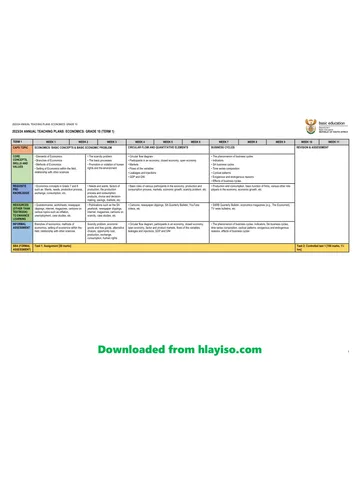
Gr 10 Eco ATP 2023 24
Question paper and memo
Economics Grade 10 Limpopo March Test 2025 Paper & Memo
Question paper
Economics Grade 10 P2 Gauteng June 2024 Question Paper (Eng)
Question paper
Economics Grade 10 P1 North West June 2024 Question Paper
Question paper