
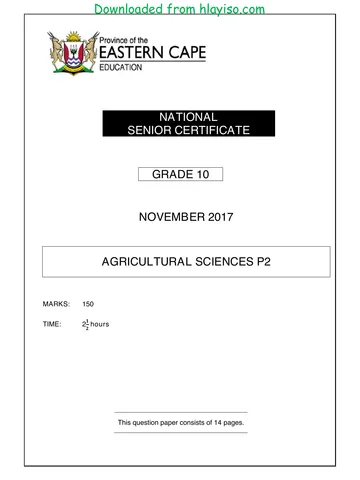
NATIONAL
SENIOR CERTIFICATE
GRADE 10
NOVEMBER 2017
AGRICULTURAL SCIENCES P2
MARKS: 150
𝟏
TIME: 2𝟐 hours
This question paper consists of 14 pages.
You're offline
Skip to contentQuestion paper 




View all
AGRSC P2 GR10 QP NOV2017
Agricultural Sciences · Grade 10 · National November Exam · 2017. Question paper, 14 pages. Read online or download the PDF.
- Subject
- Agricultural Sciences
- Grade
- Grade 10
- Document type
- Question paper
- Year
- 2017
- Exam period
- National November Exam
- Paper
- 2
- Pages
- 14
- File size
- 763.2 KB
Loading document…
Loading document…
1 of 14
Document textSearch extracted text and jump to a page.
2 AGRICULTURAL SCIENCES P2 (EC/NOVEMBER 2017)
INSTRUCTIONS AND INFORMATION
1. This question paper consists of TWO sections, namely SECTION A and
SECTION B.
2. Answer ALL the questions in the ANSWER BOOK.
3. Read ALL the questions correctly and answer what is asked.
4. Number the answers correctly according to the numbering system used in
this question paper.
5. A non-programmable calculator may be used.
6. Show ALL calculations, including formulae, where applicable.
7. Write neatly and legibly.
Copyright reserved Please turn over
(EC/NOVEMBER 2017) AGRICULTURAL SCIENCES P2 3
SECTION A
QUESTION 1
1.1 Various options are provided as possible answers to the following questions.
Choose the correct answer and write only the letter (A-D) next to the question
number (1.1.1 – 1.1.10) in your ANSWER BOOK, for example 1.1.11 D
1.1.1 Vertical layers of soil visible on a soil profile are called…
A soil crusts.
B soil components.
C oil horizons.
D soil forming processes.
1.1.2 Which ONE of the following fruits is an example of a tropical fruit?
A Banana
B Lemon
C Apples
D Grapes
1.1.3 … is a control measure for water logging.
A Cultivation of wetlands
B Use of heavy machinery
C Installation of drainage systems
D Over irrigation
1.1.4 … are groups of cells with similar structures and functions.
A Tissues
B Organs
C Systems
D Cells Nutrients
1.1.5 Vermiculite can be classified as a … mineral.
A secondary
B primary
C tertiary
D precious
1.1.6 Which of the following statements does not describe the properties of
maize?
A Originally came from Mexico in South America
B Summer crop that requires a summer rainfall of between
450 mm and 900 mm per year
C Staple food for most African people
D Is also known as guinea corn
Copyright reserved Please turn over
4 AGRICULTURAL SCIENCES P2 (EC/NOVEMBER 2017)
1.1.7 Identify the type of pollution shown on the diagram below:
A Soil pollution
B Air pollution
C Water pollution
D Land pollution
1.1.8 Bioturbation can be defined as …
A the washing out of soluble substances from the soil.
B the rise of water table.
C the downward movement of dissolved material within the soil.
D mixing of soil by organisms.
1.1.9 A winter cereal that is used to produce cake flour is…
A wheat.
B barley.
C oats.
D rye.
1.1.10 Sedimentary rocks have the following properties:
(i) Can be rough or smooth
(ii) Are translucent
(iii) Have a layered structure
(iv) Are the softest group of rocks
Choose the correct combination:
A (i), (ii) and (iii)
B (ii), (iii) and (iv)
C (i), (ii) and (iv)
D (i), (iii) and (iv)
(10 x 2) (20)
Copyright reserved Please turn over
(EC/NOVEMBER 2017) AGRICULTURAL SCIENCES P2 5
1.2 Choose a word/term/concept/phrase from COLUMN B that best matches a
description in COLUMN A. Write ONLY the letter (A–J) next to question number
(1.2.1 – 1.2.5) in the ANSWER BOOK, for example 1.2.6 K
COLUMN A COLUMN B
1.2.1 Breeding stock A Fodder crop that provides bulk,
energy and roughage
1.2.2 Lucerne B Crops that are usually used as staple
foods
1.2.3 Soil C Needed to prune, plant and pick the
harvest
1.2.4 Grain crops D Provides water to plants, which is
absorbed by the roots
1.2.5 Mitosis E Animals selected for their desirable
characteristics
F Chromosome number remains the
same
G Protein rich legume fodder crop
H Chromosome number is reduced to
half
I Found in the R horizon
J Deciduous crop
(5 x 2) (10)
1.3 Give ONE word/term/concept/phrase for each of the following descriptions. Write
ONLY the term next to the question number (1.3.1–1.3.5) in the ANSWER BOOK.
1.3.1 A double membrane that surrounds the nucleus
1.3.2 Release of minerals during the decomposition process by bacteria and
fungi
1.3.3 Plants that were introduced from other countries
1.3.4 Release of harmful substances into the environment
1.3.5 Medium-sized organisms living in the soil, for example nematodes and
mites (5 x 2) (10)
Copyright reserved Please turn over
6 AGRICULTURAL SCIENCES P2 (EC/NOVEMBER 2017)
1.4 Change the UNDERLINED WORD(S) in each of the following statements to
make them TRUE. Write only the answer next to the question number in the
ANSWER BOOK.
1.4.1 The process whereby rocks are broken down to small particles to form
soil is known as precipitation.
1.4.2 Somatic cells have a haploid number of chromosomes.
1.4.3 Angle is the direction a slope faces.
1.4.4 Vegetables, fruits, flowers and shrubs are classified as forest crops.
1.4.5 Fynbos such as rooibos and honeybush are the small bushes grown
for making tea and medicines.
(5 x 1) (5)
TOTAL SECTION A: 45
Copyright reserved Please turn over
(EC/NOVEMBER 2017) AGRICULTURAL SCIENCES P2 7
SECTION B
QUESTION 2: SOIL SCIENCES
Start this question on a new page.
2.1 A grade 10 learner half-filled a test tube with an air dry soil sample. The learner
then held the test tube over an open flame as shown in the diagram below.
After some time water started to condense against the upper end of the test
tube.
2.1.1 Deduce the type of soil water which accumulates as droplets in the
test tube from the diagram above. (1)
2.1.2 Motivate the answer you gave in QUESTION 2.1.1 above. (2)
2.1.3 Deduce whether the soil water depicted in the diagram above is
accessible to plants. Explain your answer. (2)
2.1.4 Identify a safety precaution taken by the learner which is visible on
the diagram above. (1)
2.1.5 Suggest the other TWO types of soil water that are not depicted in the
diagram above. (2)
Copyright reserved Please turn over
8 AGRICULTURAL SCIENCES P2 (EC/NOVEMBER 2017)
2.2 The following are some of the main characteristics that are used in mineral
identification.
crystaline structure; cleavage; purity; lustre; density; tenacity
2.2.1 Match and select the mineral identification characteristics above with
the following:
A The definite parallel lines along which a mineral splits (1)
B How shiny a mineral appears in light (1)
C Whether a mineral is made up of only one type of a substance (1)
D The resistance a mineral offers to breaking, crushing, bending or
cutting (1)
E An object′s mass relative to its volume (1)
2.2.2 Provide any THREE characteristics of primary minerals. (3)
2.3 Rocks break down to form and release nutrients that are required by plants
for growth. These rocks can either be igneous, sedimentary or metamorphic.
The suitability of a soil for crop cultivation therefore depends on the bedrock
from which it was formed.
2.3.1 Identify a soil forming factor that is mentioned in the passage above. (1)
2.3.2 Classify the following rocks into Igneous, sedimentary and
metamorphic rocks:
A Sandstone (1)
B Marble (1)
C Dolomite (1)
2.3.3 Deduce any THREE cultivation properties of soils formed from
sedimentary rocks. (3)
2.4 Igneous rocks are divided into extrusive, intrusive and plutonic rocks.
2.4.1 Distinguish intrusive rocks from extrusive igneous rocks. (2)
Copyright reserved Please turn over
(EC/NOVEMBER 2017) AGRICULTURAL SCIENCES P2 9
2.5 The diagram below shows various features of a soil forming factor.
A.122 m above sea
level B. North facing
C. Steep
45 m above sea
level
D. Gentle
2.5.1 Identify the soil forming factor that is shown in the diagram above. (1)
2.5.2 Suggest where the soil will be deeper, point C or D. (1)
2.5.3 Briefly explain why there is a difference in soil depth between points C
and D. (2)
2.5.4 Supply the name of each of the features A, B and C of the soil forming
factor shown in the diagram above. (3)
2.5.5 State any THREE human activities that have a direct impact on soil
formation. (3)
[35]
Copyright reserved Please turn over
10 AGRICULTURAL SCIENCES P2 (EC/NOVEMBER 2017)
QUESTION 3: PLANT STUDIES
Start this question on a new page.
3.1 Listed below are different categories of crop plants.
grain crops; oil seed crops; industrial crops; fodder crops; forest crops
3.1.1 Match the crop classes above to EACH of the following descriptions:
A Crops that are grown as commodities or as raw materials for (1)
manufacturing
B Plants that provide grazing for livestock and hay production (1)
C Sunflower, canola and peanuts (1)
D Mainly used for making timber and paper (1)
3.1.2 Crops play a big role in the South African economy. Validate this
statement with THREE reasons. (3)
3.2 The table below shows the volumes of field crops produced in South Africa
from 2005 to 2010.
Volume of crop production (t)
Crop 2005/6 2006/7 2007/8 2008/9 2009/10
Maize 6 000 7 000 12 000 12 050 13 043
Wheat 500 1 000 1 200 2 950 3 637
Sorghum 900 3 000 5 000 6 760 7 220
Sunflower seeds 2 010 1 200 8 325 801 516
Soya beans 5 200 22 700 4 000 516 560
Lucerne 25 000 525 000 3 250 2 260 21 780
Cotton 51 200 419 800 32 060 420 360
3.2.1 Use the table above to draw a line graph showing the volumes of wheat
production from 2005 to 2010. (6)
3.2.2 Deduce the trend of wheat production from 2005 to 2010. (2)
3.2.3 Calculate the total volume of grains produced in the 2005/6 season. (2)
3.2.4 Refer to the table above and identify ONE legume fodder crop that is
rich in proteins. (1)
3.2.5 Briefly explain why legumes are rich in proteins. (2)
Copyright reserved Please turn over
(EC/NOVEMBER 2017) AGRICULTURAL SCIENCES P2 11
3.3 ORANGES
Oranges are fruits that have been used for food and medicine for many years.
These fruits can be used on a sustainable basis to produce income for both
rural communities and commercial farmers.
Orange pulp is an excellent source of vitamin C which enables the body to fight
flu infections. The leaves of orange trees have medicinal value as they can be
used to treat nausea.
Like most citrus fruits, oranges do well under moderate temperatures between
15,5 – 29 ⁰C and require considerable amounts of sunshine and water. They
are sensitive to frost, and as a result, they grow well in the Limpopo,
Mpumalanga and Northern Cape provinces of South Africa. Oranges can be
marketed in their raw form or processed into fruit juice.
3.3.1 Name the vitamin that oranges contain. (1)
3.3.2 Describe any TWO health benefits of oranges given in the passage
above. (2)
3.3.3 Suggest any THREE benefits of processing oranges to fruit juice. (3)
3.4 The Conservation of Agricultural Resources Act of 1983 classifies invader
species into three categories, namely: Category 1, Category 2 and Category 3.
3.4.1 Identify the invader category from the passage above that is relevant to
each of the following descriptions:
A Invaders that are useful as shade and ornamental trees in urban
areas (1)
B Wattle trees can be planted in certain demarcated areas with
permission from the government (1)
C Pose a very high risk and may not be planted or sold anywhere in the
country (1)
3.4.2 Justify the eradication of invader plants with TWO reasons. (2)
3.4.3 Differentiate between softwood and hardwood trees. Give ONE example
of each. (4)
[35]
Copyright reserved Please turn over
12 AGRICULTURAL SCIENCES P2 (EC/NOVEMBER 2017)
QUESTION 4: SUSTAINABLE USE OF NATURAL RESOURCES AND
BIOLOGICAL CONCEPTS
Start this question on a new page.
4.1 The pictures below show examples of the resources that are used by farmers in
agricultural production.
A B
C
4.1.1 Identify ONE example of a non-renewable natural resource from the
pictures above. (1)
4.1.2 Briefly explain why the resource you mentioned in QUESTION 4.1.1 is
regarded as non-renewable. (2)
4.1.3 Choose the soil cultivation method between A and B that is more
environmentally sustainable. (1)
4.1.4 Justify your choice in QUESTION 4.1.3 with THREE reasons. (3)
4.2 South Africa receives an average of 500 mm of rain per year. The limited water
supply makes it a water scarce country. The suitability of the available water for
use by humans, animals and aquatic organisms depends on its quality. Salinity,
pesticide concentration, turbidity and the presence of pathogens are some of the
factors affecting water quality.
4.2.1 Identify ONE physical property of water mentioned in the passage above. (1)
Copyright reserved Please turn over
(EC/NOVEMBER 2017) AGRICULTURAL SCIENCES P2 13
4.2.2 Define the physical property of water mentioned in QUESTION 4.2.1. (1)
4.2.3 Indicate any THREE issues that affect the supply and quality of water in
South Africa. (3)
4.2.4 State ONE published Act that regulates the use, protection and
conservation of water resources in South Africa. (1)
4.2.5 Supply any THREE effects of soil pollution on natural resources. (3)
4.2.6 List any TWO methods that can be used by farmers to dispose of non-
biodegradable waste. (2)
4.3 Below is a diagram of a plant cell. Answer the questions based on it.
A
B
C
D
E
F
G
4.3.1 Identify the names of the parts labelled A, B, D and E. (4)
4.3.2 State any TWO functions of part E. (2)
4.4 Tabulate the differences between plant and animal cells under the following
headings:
4.4.1 Outer protective layer (2)
4.4.2 Vacuole (2)
Copyright reserved Please turn over
14 AGRICULTURAL SCIENCES P2 (EC/NOVEMBER 2017)
4.5 Analyse the phases of mitosis shown below and answer the questions that
follow.
A B
C D
4.5.1 Identify the phases of mitosis that are represented by labels A, B, C
and D. (4)
4.5.2 Outline any THREE roles of mitotic cell division in living organisms. (3)
[35]
TOTAL SECTION B: 105
GRAND TOTAL: 150
Copyright reserved Please turn over
Recommended for this subject
Published documents with matching subject and grade metadata.
Question paper
GR10 AGRICULTURAL SCIENCES QP P1 ENG
Question paper
GR10 AGRICULTURAL SCIENCES QP P2 NW
Question paper
AGR SCIENCES P1 GR10 QP NOV2020 Afrikaans hlayiso.com
Question paper
AGR SCIENCES P1 GR10 QP NOV2020 English hlayiso.com
Question paper
AGRSC P2 GR10 QP NOV2020 Afrikaans hlayiso.com
Question paper
AGRSC P2 GR10 QP NOV2020 English hlayiso.com
Related documents
Matched using subject, grade, language, document type and exam metadata.
Question paper
Agricultural Sciences P2 Grade 10 2017 Afrikaans
Memorandum
AGR SCIENCES P2 GR10 MEMO NOV2017 Afrikaans
Memorandum
Agricultural Sciences P2 Grade 10 2017 MEMO Engl
Question paper
AGRIC SCIENCES P1 GR10 QP NOV2017 Afrikaans
Question paper
AGRSC P2 GR10 QP NOV2017 hlayiso.com
Question paper
Agricultural Sciences P2 Grade 10 2017 Afrikaans hlayiso.com
More from Grade 10 Agricultural Sciences
Explore more published documents in this catalogue.
Study guide
Gr10 Agricultural Sciences SG LR hlayiso.com
Annual teaching plan
Gr 10 Agric Sci ATP 2023 24
Memorandum
AGR SCIENCES P1 GR10 MEMO NOV2020 Afrikaans hlayiso.com
Memorandum
AGR SCIENCES P1 GR10 MEMO NOV2020 English hlayiso.com
Memorandum
AGRSC P2 GR10 MEMO NOV2020 Afrikaans hlayiso.com
Memorandum