
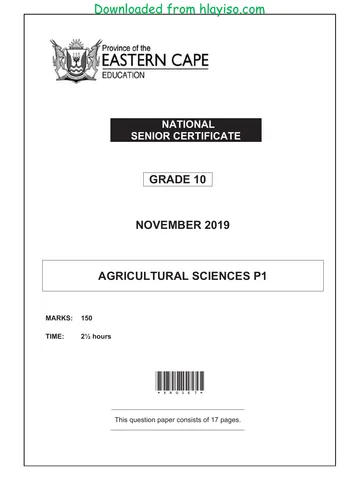
NATIONAL
SENIOR CERTIFICATE
GRADE 10
NOVEMBER 2019
AGRICULTURAL SCIENCES P1
MARKS: 150
TIME: 2½ hours
*XAGSE1*
This question paper consists of 17 pages.
You're offline
Skip to contentQuestion paper 
View all
AGR SCIENCES P1 GR10 QP NOV2019 Eng D
Agricultural Sciences · Grade 10 · National November Exam · 2019. Question paper, 24 pages. Read online or download the PDF.
- Subject
- Agricultural Sciences
- Grade
- Grade 10
- Document type
- Question paper
- Year
- 2019
- Exam period
- National November Exam
- Paper
- 1
- Pages
- 24
- File size
- 707.6 KB
Loading document…
Loading document…
1 of 24
Document textSearch extracted text and jump to a page.
2 AGRICULTURAL SCIENCES P1 (EC/NOVEMBER 2019)
INSTRUCTIONS AND INFORMATION
1. This question paper consists of TWO sections, namely SECTION A and
SECTION B.
2. Answer ALL the questions in the ANSWER BOOK.
3. Start EACH question on a NEW page.
4. Number the answers correctly according to the numbering system used in this
question paper.
5. You may use a non-programmable calculator.
6. Show ALL calculations, including formulae, where applicable.
7. Write neatly and legibly.
Copyright reserved Please turn over
(EC/NOVEMBER 2019) AGRICULTURAL SCIENCES P1 3
SECTION A
QUESTION 1
1.1 Various options are provided as possible answers to the following questions.
Choose the answer and write only the letter (A–D) next to the question number
(1.1.1–1.1.10) in the ANSWER BOOK, for example 1.1.11 A.
1.1.1 A group of individual organisms that is similar in appearance,
behaviour and genetic make-up.
A Ecosystem
B Community
C Population
D Species
1.1.2 Which of the following threats is INCORRECT with regard to the
fynbos biome?
A Alien plants
B Overgrazing
C Climate change
D Agriculture
1.1.3 The picture below is an example of … grazing.
A selective
B zero
C rotational
D non-selective
1.1.4 The production of maize in the Western Cape is 96 tons, in the
Eastern Cape 92 tons and in Gauteng 84 tons. The production
percentage of the Eastern Cape province will be …
A 45,7%.
B 27,1%.
C 33,8%.
D 35,6%.
Copyright reserved Please turn over
4 AGRICULTURAL SCIENCES P1 (EC/NOVEMBER 2019)
1.1.5 The trend shown by the population and number of years on the graph
below, proves that the …
80
Population in millions
70
60
50
40
30
20
10
0
Years
A population increases with years.
B population decreases with years.
C population increases in years.
D number of years is increasing.
1.1.6 One of the following statements about indigenous knowledge is
CORRECT:
A Knowledge of the present
B Stored in books
C Learnt by experience
D Economic sustainability
1.1.7 The following statements are TRUE about the domestication of
animals:
(i) Most animals were domesticated for their products
(ii) Few animals were domesticated to be pets
(iii) Some animals were domesticated for transport and work
(iv) Many animals were domesticated for home protection
Choose the CORRECT combination below:
A (i), (ii) and (iv)
B (i), (iii) and (iv)
C (ii), (iii) and (iv)
D (i), (ii) and (iii)
Copyright reserved Please turn over
(EC/NOVEMBER 2019) AGRICULTURAL SCIENCES P1 5
1.1.8 These animals are known as grazers and are monogastric:
(i) Horses
(ii) Goats
(iii) Donkeys
(iv) Cattle
Choose the CORRECT combination below:
A (i) and (ii)
B (i) and (iii)
C (ii) and (iii)
D (ii) and (iv)
1.1.9 The picture below shows a chicken production system known as
the …
A deep litter system.
B battery cage system.
C back yard system.
D free range system.
1.1.10 One of the animals listed below, does not belong to the game
animals known as The Big Five:
A Lion
B Elephant
C Rhino
D Giraffe (10 x 2) (20)
Copyright reserved Please turn over
6 AGRICULTURAL SCIENCES P1 (EC/NOVEMBER 2019)
1.2 Indicate whether each of the descriptions in COLUMN B applies to A ONLY,
B ONLY, BOTH A AND B or NONE of the items in COLUMN A. Write
A only, B only, both A and B or none next to the question number
(1.2.1–1.2.5) in the ANSWER BOOK, for example 1.2.6 B only.
COLUMN A COLUMN B
1.2.1 A: Producers Organisms that obtain food by
B: Consumers feeding from other organisms
1.2.2 A Sweetveld Found in areas where rainfall is
B: Sour veld high
1.2.3 A: State land Land is owned by a small village
B: Leasehold
1.2.4 A: Commodity organisations Local and provincial agricultural
B: Agricultural Cooperatives organisations
1.2.5 A: Drakensberger It was created by cross breeding
B: Nguni the Afrikaner with the Holstein
(5 x 2) (10)
1.3 Give ONE word/term for each of the following descriptions. Write only the
word/term next to the question number (1.3.1–1.3.5) in the ANSWER BOOK.
1.3.1 The science of applying the concepts of ecology to the design and
management of agricultural or farming systems
1.3.2 Liquid water from the surface of water bodies, soil, animals and
plants changes into a gas
1.3.3 A measure of how available food is, as well as a person’s access to
food
1.3.4 A change made to an Act
1.3.5 An incidental or secondary product made in the manufacture or
synthesis of something else (5 x 2) (10)
Copyright reserved Please turn over
(EC/NOVEMBER 2019) AGRICULTURAL SCIENCES P1 7
1.4 Change the UNDERLINED WORD(S) in each of the following statements to
make them TRUE. Write only the correct word(s) next to the question
number (1.4.1–1.4.5) in the ANSWER BOOK.
1.4.1 Natural pastures have been planted by the farmer for specific
livestock production.
1.4.2 The aim of the Marketing of Agricultural Products Act is to prevent
diseases in livestock animals and meat.
1.4.3 Mutton breeds are used in wool and meat production systems that
combine fine wool production with higher fertility and slaughter
lamb production.
1.4.4 Large-bodied horses with thick skins that are used as draught for
heavy loads, are called hot-blooded horses.
1.4.5 Impala are small omnivore animals and are proficient scavengers.
(5 x 1) (5)
TOTAL SECTION A: 45
Copyright reserved Please turn over
8 AGRICULTURAL SCIENCES P1 (EC/NOVEMBER 2019)
SECTION B
QUESTION 2: AGRO-ECOLOGY
Start this question on a NEW page.
2.1 The table below shows different organisms living in an ecosystem. Analyse the
table and answer the questions that follow.
ORGANISMS NUMBER OF ORGANISM CHANCES OF SURVIVAL (%)
Hyenas 76 84
Lions 42 95
Springboks 150 60
Thatch grass Millions 99
2.1.1 Refer to the organisms in the table above and identify the primary
consumer. (1)
2.1.2 Give a reason for your answer in QUESTION 2.1.1. (1)
2.1.3 Indicate the type of competition that will take place between the lion and
the hyena during hunting. Justify your answer. (2)
2.1.4 Explain why the lion has more chances of survival in this ecosystem. (2)
2.1.5 Use the list of organisms in the table to draw a food chain to show the
FOUR trophic levels of energy flow in the ecosystem. (4)
Copyright reserved Please turn over
(EC/NOVEMBER 2019) AGRICULTURAL SCIENCES P1 9
2.2 The diagram below shows a very important nutrient cycle. Study the diagram
and answer the questions based on it.
2.2.1 Identify the nutrient cycle depicted in the diagram above. (1)
2.2.2 Identify processes A, B and C in the diagram. (3)
2.2.3 Suggest the component of the ecosystem to which water belongs. (1)
2.3 The two pictures below, which show pastures of different farms, were taken by
Grade 10 learners. Analyse the pictures and answer the questions that follow.
FARM A FARM B
2.3.1 Identify the pastural condition of farm A and B. (2)
2.2.2 Suggest TWO farming practices that led to the pastural condition of
farm B. (2)
Copyright reserved Please turn over
10 AGRICULTURAL SCIENCES P1 (EC/NOVEMBER 2019)
2.3.3 State the veld management practice applied to farm A in the following
situations:
(a) Pasture is divided into small camps and animals are moved from
one camp to another during the year (1)
(b) The farmer allows a certain number of animals in one camp (1)
(c) Each camp carries 50 concentrate grazers and 100 bulk grazers (1)
2.3.4 Provide TWO advantages of communal farming. (2)
2.3.5 Name TWO reasons why pasture management is important. (2)
2.4 A biome is a large natural area with a unique set of factors such as climate,
soil and landform. Such factors determine the kind of plants (trees, ferns,
grasses) that grow there and animals (elephants, antelopes) that live in that
biome. One of the South African biomes is dominated by tall trees and another
one is dominated by different types of grasses.
2.4.1 Refer to the scenario above and identify ONE example of fauna found
in South African biomes. (1)
2.4.2 Suggest the names of South African biomes characterised by the
underlined phrases. (2)
2.4.3 Give any other TWO South African biomes not mentioned in the
scenario. (2)
2.4.4 Supply ONE function of the Savannah Biome in agriculture. (1)
2.5 Changes in the climate mean that farmers need to choose farming practices
that will be successful under the increased temperatures, changes in rainfall
and reduced soil fertility.
2.5.1 Name ONE cause of climate change. (1)
2.5.2 Suggest any impact of climate change on agriculture. (1)
2.5.3 Indicate ONE way in which farmers in South Africa can adapt to climate
change. (1)
[35]
Copyright reserved Please turn over
(EC/NOVEMBER 2019) AGRICULTURAL SCIENCES P1 11
QUESTION 3: AGRI-INDUSTRY
Start this question on a NEW page.
3.1 The graph below shows the information about patterns of food use. Study the graph
and answer the questions that follow.
90
82 83 80
80
70 Rural
area (%)
rural/urban (%)
60
52
50
40
Urban
30 24 Area (%)
20 16
10 6
2
0
Maize Chicken Corned meat Fruit
food type and how often used
3.1.1 Refer to the graph above and identify the food that is mostly used in rural
areas. (1)
3.1.2 Give a reason for the answer to QUESTION 3.1.1. (1)
3.1.3 Food products in agriculture are classified into three groups. Suggest the class
to which corned meat and fruit belong. (2)
3.1.4 Calculate the difference in maize use between rural and urban areas. Show all
your calculations. (3)
3.1.5 Translate the data from the graph into a table. (5)
Copyright reserved Please turn over
12 AGRICULTURAL SCIENCES P1 (EC/NOVEMBER 2019)
3.2 The picture below indicates some very important knowledge in the history of
agriculture. Study the picture and answer the questions based on it.
3.2.1 Suggest whether the knowledge in the picture is indigenous or scientific. (1)
3.2.2 Give a reason to support your answer in QUESTION 3.2.1. (1)
3.2.3 Indicate how indigenous knowledge is used in agriculture in the following
situations:
(a) The farmer grows two or more different crops next to each other (1)
(b) Crops are changed regularly on the same piece of land (1)
3.2.4 Deduce any TWO constraints of using indigenous knowledge in agriculture. (2)
Copyright reserved Please turn over
(EC/NOVEMBER 2019) AGRICULTURAL SCIENCES P1 13
3.3 The picture below shows the natural agricultural resources that need to be
protected by South African laws. Analyse the picture and answer the questions
that follow.
3.3.1 Identify the resource from the picture which is protected by the following
laws:
(a) Animal Disease Act (1)
(b) Conservation of Agricultural Resources Act (1)
(c) National Water Act (1)
(d) National Veld and Forest Act (1)
3.3.2 Name TWO aims of agricultural legislation. (2)
3.4 Population growth and urbanisation in South Africa has a big impact on
agricultural production.
3.4.1 Define the term urbanisation. (2)
3.4.2 Outline TWO negative effects of population growth on the agricultural
sector. (2)
Copyright reserved Please turn over
14 AGRICULTURAL SCIENCES P1 (EC/NOVEMBER 2019)
3.5 Land ownership means that the land belongs to whoever owns it, while land
tenure means that a person may have access to the land and can use it.
3.5.1 Deduce the type of land ownership or type of land tenure the
following statements:
(a) The farmer rents a piece of land from the owner (1)
(b) The farmer from another country owns a land to grow livestock (1)
(c) A fenced natural forest and the people from community are not
allowed to fetch wood from the forest (1)
(d) Farm workers are provided with a piece of land for settlement (1)
3.5.2 Explain the difference between land redistribution and land tenure
reform. (2)
3.5.3 Name ONE role of agricultural organisations. (1)
[35]
Copyright reserved Please turn over
(EC/NOVEMBER 2019) AGRICULTURAL SCIENCES P1 15
QUESTION 4: ANIMAL STUDIES
Start this question on a NEW page.
4.1 The flow diagram below shows different types of beef breeds and milk breeds.
Study the diagram and answer questions that follow.
4.1.1 Identify the TWO exotic beef breeds in the diagram above. (2)
4.1.2 Refer to the diagram above and identify the breed with the following
qualities:
(a) Produces high-quality milk with high butter fat content (1)
(b) Produces white milk with low butter fat content (1)
(c) This breed produces both meat and milk of good quality (1)
4.1.3 List THREE beef breeds not mentioned in the diagram. (3)
4.1.4 Distinguish between the exotic and indigenous breeds. (2)
Copyright reserved Please turn over
16 AGRICULTURAL SCIENCES P1 (EC/NOVEMBER 2019)
4.2 The pictures below show a male and female sheep on a farm.
4.2.1 Provide the name for sheep A and B. (2)
4.2.2 Tabulate the visible differences between sheep A and B under the
following headings:
(a) Body size (2)
(b) Neck and head (2)
4.2.3 Name THREE main sheep breeds based on their utilisation and
products derived from each. (3)
Copyright reserved Please turn over
(EC/NOVEMBER 2019) AGRICULTURAL SCIENCES P1 17
4.3 The veld ram auctions of the Angora Ram Breeders’ Society are popular.
According to farmers, these rams are kept on the same veld, where they
receive a lick. They are shorn and dosed as one group. The progress of the
animals is then compared. The Angora producers in the Eastern Cape have
a distinct advantage – they are able to get together and network during
selection days and auctions.
[Adapted from Stock farm, Volume 9, No. 2, 2019]
4.3.1 Refer to the scenario above and suggest a reason why farmers in
the Eastern Cape should continue producing Angora rams. (1)
4.3.2 Give the name of the main product an Angora goat produces. (1)
4.3.3 Name TWO goat breeds a farmer can use to produce dairy products. (2)
4.3.4 Explain why Angora goats must be kept in an area with a moderate
climate. (2)
4.3.5 Suggest the name of a meat goat breed with a red colour and
developed in South Africa. (1)
4.4 When pigs were first domesticated, they were used for their meat and for
their fat. Commercial farmers began to practise intensive pig farming.
Example: a pig for meat or one with more fat for bacon and lard production.
4.4.1 Refer to the passage above and name TWO main products of pigs. (2)
4.4.2 Suggest the purpose for slaughtering pigs with the following mass:
(a) 45 kg (1)
(b) 90 kg (1)
4.4.3 Provide THREE characteristics of improved pig breeds that make
them suitable for commercial farming. (3)
4.5 Chickens are omnivores, which means they eat food from plant origin such
as seeds as well as food from ‘animal’ origin such as insects. Chickens
normally live in a house together in flocks.
Provide TWO facilities a farmer can use to control the temperature in a
house of chickens. (2)
[35]
TOTAL SECTION B: 105
GRAND TOTAL: 150
Copyright reserved
Recommended for this subject
Published documents with matching subject and grade metadata.
Question paper
GR10 AGRICULTURAL SCIENCES QP P1 ENG
Question paper
GR10 AGRICULTURAL SCIENCES QP P2 NW
Question paper
AGR SCIENCES P1 GR10 QP NOV2020 Afrikaans hlayiso.com
Question paper
AGR SCIENCES P1 GR10 QP NOV2020 English hlayiso.com
Question paper
AGRSC P2 GR10 QP NOV2020 Afrikaans hlayiso.com
Question paper
AGRSC P2 GR10 QP NOV2020 English hlayiso.com
Related documents
Matched using subject, grade, language, document type and exam metadata.
Question paper
AGR SCIENCES P1 GR10 QP NOV2019 Afr D
Memorandum
AGR SCIENCES P1 GR10 MEMO NOV2019 Afrikaans
Memorandum
AGR SCIENCES P1 GR10 MEMO NOV2019 English.
Question paper
AGR SCIENCES P2 GR10 QP NOV2019 Eng D
Question paper
AGR SCIENCES P2 GR10 QP NOV2019 Afr D
Question paper
AGR SCIENCES P1 GR10 QP NOV2019 Eng D hlayiso.com
More from Grade 10 Agricultural Sciences
Explore more published documents in this catalogue.
Study guide
Gr10 Agricultural Sciences SG LR hlayiso.com
Annual teaching plan
Gr 10 Agric Sci ATP 2023 24
Memorandum
AGR SCIENCES P1 GR10 MEMO NOV2020 Afrikaans hlayiso.com
Memorandum
AGR SCIENCES P1 GR10 MEMO NOV2020 English hlayiso.com
Memorandum
AGRSC P2 GR10 MEMO NOV2020 Afrikaans hlayiso.com
Memorandum