
hlayiso mock exams
Practice Series:
Grade 10 Exam Preparation
WWW.HLAYISO.COM
NATIONAL
SENIOR CERTIFICATE
GRADE 10
BUSINESS STUDIES P1
NOVEMBER EXAMINATION 2026 (MOCK)
MARKING GUIDELINES
MARKS: 150
These marking guidelines consist of 23 pages.
Copyright reserved Please turn over
Skip to contentAll 2026 papers 
View all
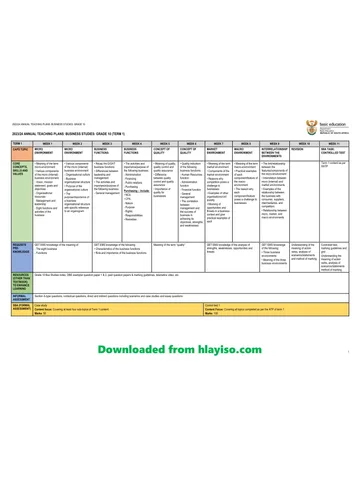
Business Studies Grade 10 P1 November Mock 2026 Memo (Eng)
Grade 10 Business Studies Paper 1 memorandum from the November Mock Exam 2026 (English), 23 pages. Read online or download the free PDF.
Business Studies · Grade 10 · November Mock Exam · 2026 · English. Memorandum, 23 pages. Read online or download the PDF.
- Subject
- Business Studies
- Grade
- Grade 10
- Language
- English
- Document type
- Memorandum
- Year
- 2026
- Exam period
- November Mock Exam
- Paper
- 1
- Publisher
- Hlayiso
- Curriculum
- CAPS
- Pages
- 23
- File size
- 180.4 KB
Free to read online, no sign-up needed
Loading document…
Loading document…
1 of 23
This exam
November Mock Exam 2026
- Paper 1Question paperMemo
- Paper 2Question paperMemo
Document textSearch extracted text and jump to a page.
Business Studies/P1 2 Hlayiso/Mock 2026
NSC – Marking Guidelines
NOTES TO MARKERS
These notes are provided to ensure fair, consistent and reliable marking of this mock
examination.
1. Candidates’ responses must be in full sentences for SECTIONS B and C, depending
on the nature of the question.
2. The marking guidelines are comprehensive but not exhaustive. Give credit to answers
that are correct but use a different expression, come from another credible source, are
original, or use a different approach. There is only ONE correct answer for each item in
SECTION A.
3. Where an answer is unclear or shows some understanding, award part-marks (e.g. one
mark instead of two).
4. The word ’Sub-max’ is used to allocate marks within a question or sub-question. The
word ’Max’ shows the maximum marks for the question; circle the subtotal on the
right-hand side as guided by ’Max’.
5. In an indirect question (scenario-based), the theory and the response must be relevant
and related to the question. Responses that must be quoted from a scenario receive
ONE mark each.
6. Do not give credit for repeated facts. Indicate repetition with an ’R’.
7. Cognitive verbs:
(a) Name, state, give, list, outline, quote, identify, motivate,
√√ recommend, suggest and
advise do not usually require much depth; the marks ( ) appear at the end of each
fact.
(b) Define, describe, explain, discuss, elaborate, distinguish, differentiate, analyse and
evaluate require a greater depth of√understanding; ticks are separated, e.g. ’Product
development is a √ growth strategy , where businesses introduce new products into
existing markets.’
8. Where a specific number of facts is required (e.g. ’any FOUR’), mark only the FIRST
responses up to that number and draw a line through the rest. Mark only the FIRST
answer where a question requires ONE answer.
9. Where the number of facts is specified for describe/discuss/explain questions in
SECTION B: fact (2 marks) and explanation (1 mark). In SECTION C the explanation
earns 2 marks.
Copyright reserved Please turn over
Business Studies/P1 3 Hlayiso/Mock 2026
NSC – Marking Guidelines
10. SECTION C: The breakdown of essay marks is as follows:
Introduction, Content, Conclusion Max 32
Insight 8
TOTAL 40
Insight (LASO) consists of the following components:
Layout/ Is there an introduction, a body with 2
Structure (L) paragraphs/sub-headings and a conclusion? The
words INTRODUCTION and CONCLUSION must be
stated and supported by an explanation.
Analysis and Can the candidate break down the question into 2
interpretation headings/sub-headings and interpret it correctly? All
(A) headings addressed: 1 mark. Interpretation (16 to 32
marks for facts): 1 mark.
Synthesis (S) Are relevant decisions/facts/responses made? Only 2
relevant facts in two or more sub-questions: 2 marks
(no ’-S’). Some irrelevant facts/only one sub-question
with relevant facts: 1 mark (one ’-S’). No relevant facts:
0 marks (two ’-S’).
Originality (O) Is there evidence of examples, based on recent 2
information/current trends and developments (not older
than two years), in any TWO of the four sub-questions?
TOTAL FOR INSIGHT 8
11. Indicate insight in the left-hand margin with a symbol (L, A, -S and/or O).
Mark all relevant facts until the SUB-MAX/MAX in a subsection is reached, write
SUB-MAX/MAX, but continue reading for originality (’O’). At the end of each essay
show the allocation as follows:
CONTENT MARKS
Facts 32 (max.)
L 2
A 2
S 2
O 2
TOTAL 40
12. No marks are awarded for content repeated from the introduction and conclusion.
Award TWO marks for complete sentences and ONE mark for phrases, incomplete
sentences and vague answers.
Copyright reserved Please turn over
Business Studies/P1 4 Hlayiso/Mock 2026
NSC – Marking Guidelines
SECTION A
QUESTION 1
√√
1.1 1.1.1 B
√√
1.1.2 B
√√
1.1.3 B
√√
1.1.4 A
√√
1.1.5 C
(5 x 2) (10)
√√
1.2 1.2.1 informal
√√
1.2.2 micro
√√
1.2.3 fixed capital
√√
1.2.4 purchasing
√√
1.2.5 macro
(5 x 2) (10)
√√
1.3 1.3.1 E
√√
1.3.2 A
√√
1.3.3 D
√√
1.3.4 H
√√
1.3.5 C
(5 x 2) (10)
[30]
BREAKDOWN OF MARKS
QUESTION 1 MARKS
1.1 10
1.2 10
1.3 10
TOTAL 30
TOTAL SECTION A: 30
Copyright reserved Please turn over
Business Studies/P1 5 Hlayiso/Mock 2026
NSC – Marking Guidelines
SECTION B
Mark the answers to the FIRST TWO questions only.
QUESTION 2: BUSINESS ENVIRONMENTS
2.1 Components of the macro environment
√
- Political environment
√
- Economic environment
√
- Social/Cultural/Demographic environment
√
- Technological environment
√
- Legal environment
√
- Physical/Natural environment
√
- International/Global environment
√
- Institutional environment
Any other relevant answer related to the components of the macro environment.
NOTE: Mark the first FOUR (4) only.
(4 x 1) (4)
2.2 Difference between a vision and a mission statement
VISION MISSION STATEMENT
Describes
√ where the√ business sees Describes√the purpose of the
itself in the future. business√ and how it will achieve its
vision.
√
Focuses on the long-term √ Focuses
√ on what the business
√ does
dreams/aspirations of the business. now and for whom.
√
Short, inspiring statement
√ that Explains the products/services,
√
motivates employees. customers√and values of the
business.
Sub-max (2) Sub-max (2)
Any other relevant answer related to the difference between a vision and a mission
statement.
NOTE: 1. The answer does not have to be in tabular format.
2. The difference must be clear.
3. Award a maximum of TWO (2) marks if the difference is not clear/only
one concept is explained.
Max (4)
Copyright reserved Please turn over
Business Studies/P1 6 Hlayiso/Mock 2026
NSC – Marking Guidelines
2.3 Micro environment
2.3.1 Components of the micro environment that apply to MFM
COMPONENTS MOTIVATIONS
√√
1. Vision Mr Mokoena wants MFM to be the leading
manufacturer
√ of school furniture in Gauteng by
2030.
2. Organisational
√√ MFM uses modern woodworking √ machines and
resources employs 25 skilled carpenters.
3. Organisational
√√ The employees of MFM respect one another
culture and share the√belief that every desk must be
made to last.
Sub-max (4) Sub-max (2)
NOTE: 1. Mark the first TWO (2) only.
2. Award marks for the components even if the quotes are
incomplete.
3. Do not award marks for the motivation if the component was
incorrectly identified.
4. Accept ’physical/human resources’ for organisational
resources.
Max (6)
2.3.2 Extent of control over the micro environment
√ √
- Businesses have full/complete control over the micro environment.
√
- Management makes decisions √ about the vision, mission, goals and
strategies of the business.
√
- The business decides how to use its resources, √ e.g. how many
employees to appoint/which machines to buy.
√
- Management
√ can change the organisational structure/culture when
needed.
√
- Challenges in the micro environment√can be solved through internal
decisions, e.g. training/new policies.
Any other relevant answer related to the extent of control over the micro
environment.
Max (4)
Copyright reserved Please turn over
Business Studies/P1 7 Hlayiso/Mock 2026
NSC – Marking Guidelines
2.4 Interrelationship between the micro and the macro environment
√ √
- The micro environment is influenced by changes in the macro environment.
√
- The business√ must adapt its strategies/plans to changes in the macro
environment.
√
- A change in the economy, e.g. √ higher interest rates, may force the business to
cut costs/postpone expansion.
√
- New laws,√e.g. labour legislation, require changes to the policies of the
business.
√
- New technology
√ may require businesses to buy new equipment and train
employees.
√
- Social/demographic
√ changes may require the business to change its
products.
√
- Decisions in the micro environment, e.g.
√ creating jobs/paying taxes, contribute
to the economy/macro environment.
Any other relevant answer related to the interrelationship between the micro and
macro environments.
Max (6)
2.5 Business sectors
2.5.1 Business sectors of the businesses in the scenario
BUSINESS BUSINESS SECTOR
√√
Matlala Farms Primary sector
√√
Juicy Valley Secondary sector
√√
FreshMart Tertiary sector
(3 x 2) (6)
2.5.2 How the three business sectors depend on one another
√
- The primary sector provides
√ raw materials to the secondary sector,
e.g. oranges for juice.
√
- The secondary sector turns raw √ materials into finished products that
are sold by the tertiary sector.
√
- The tertiary sector provides services, e.g. transport/banking/insurance,
√
to both the primary and secondary sectors.
√
- The secondary
√ sector supplies machinery/tools/fertiliser to the primary
sector.
√ √
- If one sector fails, the other sectors are negatively affected.
Any other relevant answer related to how the business sectors depend on
one another.
Max (4)
Copyright reserved Please turn over
Business Studies/P1 8 Hlayiso/Mock 2026
NSC – Marking Guidelines
2.6 Importance of the informal sector for the South African economy
- Creates√√jobs/self-employment for people who cannot find work in the formal
sector.
√√
- Reduces poverty as people earn an income to support their families.
- Provides
√√ goods/services at convenient places/times close to where people
live.
√√
- Offers products at lower prices to low-income consumers.
- Develops entrepreneurial
√√ skills/serves as a starting point for formal
businesses.
√√
- Buys stock from formal businesses, which increases their sales.
√√
- Requires little capital to start a business.
√√
- Contributes to economic growth/the GDP of the country.
Any other relevant answer related to the importance of the informal sector.
Max (6)
[40]
BREAKDOWN OF MARKS
QUESTION 2 MARKS
2.1 4
2.2 4
2.3.1 6
2.3.2 4
2.4 6
2.5.1 6
2.5.2 4
2.6 6
TOTAL 40
Copyright reserved Please turn over
Business Studies/P1 9 Hlayiso/Mock 2026
NSC – Marking Guidelines
QUESTION 3: BUSINESS OPERATIONS
3.1 Tasks of management
√
- Planning
√
- Organising
√
- Leading/Directing
√
- Controlling
NOTE: Mark the first FOUR (4) only.
(4 x 1) (4)
3.2 Activities of the marketing function
√√
- Conduct market research to determine the needs of customers.
√√
- Identify the target market of the business.
√√
- Develop new products/improve existing products.
√√
- Determine the prices of products.
√√
- Advertise/promote the products of the business.
√√
- Distribute products to customers through suitable channels.
√√
- Design the packaging/brand/trademark of products.
√√
- Monitor competitors and market trends.
Any other relevant answer related to the activities of the marketing function.
Max (6)
3.3 Business functions
3.3.1 Business functions that apply to NC
BUSINESS MOTIVATIONS
FUNCTIONS
1. Purchasing
√√ Nandi buys fresh vegetables and meat from √
function local farmers at the best possible prices.
2. Administration
√√ She records all customer bookings on a
function computer√and files the invoices neatly in a
cabinet.
3. Marketing
√√ Nandi advertises her services on social media
function and gives a√10% discount to first-time
customers.
Sub-max (4) Sub-max (2)
NOTE: 1. Mark the first TWO (2) only.
2. Award marks for the functions even if the quotes are
incomplete.
3. Do not award marks for the motivation if the function was
incorrectly identified.
Max (6)
Copyright reserved Please turn over
Business Studies/P1 10 Hlayiso/Mock 2026
NSC – Marking Guidelines
3.3.2 Steps in the purchasing procedure
√
- Identify
√ the need for goods/raw materials, e.g. when stock levels are
low.
√
- Complete a requisition
√ form and send it to the purchasing
department.
√ √
- Identify suitable suppliers and request quotations from them.
√
- Compare the quotations √ and select the best supplier based on
price/quality/delivery.
√ √
- Place an order by sending an official order form to the supplier.
√ √
- Follow up on the order to make sure that it is delivered on time.
√
- Receive
√ and check the goods against the order form and delivery
note.
√ √
- Check the invoice and pay the supplier.
√ √
- Record the transaction/File all documents for future reference.
Any other relevant answer related to the steps in the purchasing procedure.
NOTE: The steps may be in any order.
Max (6)
3.4 Difference between fixed capital and working capital
FIXED CAPITAL WORKING CAPITAL
Money √used to buy fixed/non-current Money used√to pay for the
assets√ that are used for a long day-to-day running/operating
√
time. expenses of the business.
E.g. land, buildings,
√√ vehicles, E.g. buying stock, paying
√√ salaries,
machinery. water and electricity.
√ √
Usually obtained from
√ long-term Usually obtained from√ short-term
sources of finance. sources of finance.
Sub-max (2) Sub-max (2)
Any other relevant answer related to the difference between fixed and working
capital.
NOTE: 1. The answer does not have to be in tabular format.
2. The difference must be clear.
Max (4)
3.5 Purpose of the public relations function
√ √
- Creates and maintains a positive image of the business.
√ √
- Builds good relationships with customers/suppliers/the community/media.
√ √
- Informs the public about the products/activities of the business.
√
- Handles complaints/negative
√ publicity and restores the reputation of the
business.
√ √
- Builds good internal relationships between management and employees.
√ √
- Promotes the social responsibility projects of the business.
Any other relevant answer related to the purpose of the public relations function.
Max (4)
Copyright reserved Please turn over
Business Studies/P1 11 Hlayiso/Mock 2026
NSC – Marking Guidelines
3.6 Activities of the human resources function
√ √
- Recruit suitable candidates to fill vacancies.
√ √
- Select and appoint the best candidates.
√ √
- Place new employees in the correct positions and conduct induction.
√ √
- Train and develop employees to improve their skills.
√ √
- Determine salaries/wages and fringe benefits of employees.
√ √
- Keep records of all employees.
√ √
- Evaluate the performance of employees.
√ √
- Ensure that the business complies with labour legislation.
√ √
- Handle disciplinary matters/grievances of employees.
Any other relevant answer related to the activities of the human resources function.
Max (6)
3.7 Purpose of the administration function
- Collects,√√
processes and stores information so that it is available when
needed.
√√
- Keeps records of all business transactions/documents safely.
√√
- Provides accurate information to management for decision-making.
√√
- Handles communication, e.g. letters/e-mails/reports.
√√
- Manages the information technology/computer systems of the business.
√√
- Ensures that documents required by law, e.g. tax records, are kept.
Any other relevant answer related to the purpose of the administration function.
Max (4)
[40]
BREAKDOWN OF MARKS
QUESTION 3 MARKS
3.1 4
3.2 6
3.3.1 6
3.3.2 6
3.4 4
3.5 4
3.6 6
3.7 4
TOTAL 40
Copyright reserved Please turn over
Business Studies/P1 12 Hlayiso/Mock 2026
NSC – Marking Guidelines
QUESTION 4: MISCELLANEOUS TOPICS
BUSINESS ENVIRONMENTS
4.1 Reasons why socio-economic issues pose a challenge to businesses
√
- Reduce the spending power of consumers/lower sales.
√
- Increase the costs of the business, e.g. security costs.
√
- Reduce the productivity of employees.
√
- Lead to a shortage of skilled employees.
√
- Disrupt business operations, e.g. strikes/political disturbances.
√
- Businesses are expected to spend money on social responsibility programmes.
Any other relevant answer related to reasons why socio-economic issues pose a
challenge.
NOTE: Mark the first TWO (2) only.
(2 x 1) (2)
4.2 Socio-economic issues
4.2.1 Socio-economic issues that affect SSS
√
- Many people in the area lost their jobs when a nearby factory closed.
√
- Last month thieves broke into the shop and stole airtime and stock.
- Some√ customers now spend their money on betting at a new betting
shop.
NOTE: 1. Mark the first TWO (2) only.
2. Only award marks for responses that are quoted from the
scenario.
(2 x 1) (2)
4.2.2 Impact of crime on businesses
√ √
- Businesses lose stock/money/equipment through theft and burglary.
√ √
- Security costs increase, e.g. alarms/guards/CCTV cameras.
√ √
- Insurance premiums increase for businesses in high-crime areas.
√
- Customers may√avoid shopping in areas where crime is high, which
reduces sales.
√
- Employees may √ feel unsafe/traumatised, which reduces
productivity.
√ √
- Investors may not want to invest in areas with high crime.
√ √
- Fraud/theft by employees reduces the profit of the business.
Any other relevant answer related to the impact of crime on businesses.
Max (4)
Copyright reserved Please turn over
Business Studies/P1 13 Hlayiso/Mock 2026
NSC – Marking Guidelines
4.3 Impact of unemployment on businesses
√
- Consumers have√ less money to spend, which reduces the sales of
businesses.
√ √
- Crime may increase , which increases security costs.
√ √
- Government collects less tax and may increase taxes on businesses.
√
- Businesses may be expected √ to create jobs/invest in skills development as
part of social responsibility.
√
- Unemployed people√ may lose skills over time, which leads to a shortage of
skilled workers.
√
- Businesses can √ find workers easily/pay lower wages as many people are
looking for jobs.
Any other relevant answer related to the impact of unemployment on businesses.
Max (4)
4.4 Impact of HIV/AIDS on businesses
√ √
- Absenteeism of sick employees increases, which reduces productivity.
√ √
- Skilled and experienced employees may be lost through illness/death.
√ √
- Costs to recruit and train new employees increase.
√ √
- Medical aid/group life insurance costs for businesses increase.
√ √
- Employee morale may be low when colleagues/family members are ill.
√
- Consumers
√ spend more on medical care, which reduces spending on other
goods.
Any other relevant answer related to the impact of HIV/AIDS on businesses.
Max (4)
4.5 Purpose of inclusivity in the workplace
√
- Ensures that all employees are treated
√ fairly/equally regardless of
race/gender/age/disability/religion.
√
- Gives all employees
√ equal opportunities for employment, training and
promotion.
√
- Employees from different
√ backgrounds bring different ideas/skills , which
improves creativity.
√
- Employees feel√ valued and respected, which improves morale and
productivity.
√ √
- The business complies with legislation , e.g. the Employment Equity Act.
√
- The workforce reflects the
√ diversity of customers , which helps the business to
understand their needs.
√ √
- Improves the image of the business in the community.
Any other relevant answer related to the purpose of inclusivity in the workplace.
Max (4)
Copyright reserved Please turn over
Business Studies/P1 14 Hlayiso/Mock 2026
NSC – Marking Guidelines
BUSINESS OPERATIONS
4.6 Sources of borrowed capital
√
- Bank loans
√
- Bank overdraft
√
- Mortgage loans/bonds
√
- Trade credit from suppliers
√
- Hire purchase
√
- Debentures
√
- Loans from family/friends/government agencies
Any other relevant answer related to sources of borrowed capital.
NOTE: Mark the first TWO (2) only.
(2 x 1) (2)
4.7 Business functions
√√
4.7.1 Production function
(2)
√√
4.7.2 Financial function
(2)
4.8 Difference between cash purchases and credit purchases
CASH PURCHASES CREDIT PURCHASES
√ √
Goods are paid for immediately
√ Goods are paid for at√ a later date ,
when they are bought. e.g. within 30 days.
√ √ √
No interest is charged. Interest√may be charged if payment
is late.
The business
√√ may receive a cash The business can√√
use the goods before
discount. paying for them.
No credit√√
application/credit check is The business must apply for credit and
√√
needed. have a good credit record.
Sub-max (2) Sub-max (2)
Any other relevant answer related to the difference between cash and credit
purchases.
NOTE: 1. The answer does not have to be in tabular format.
2. The difference must be clear.
Max (4)
Copyright reserved Please turn over
Business Studies/P1 15 Hlayiso/Mock 2026
NSC – Marking Guidelines
4.9 Activities of the financial function
√ √
- Obtain capital from the most suitable sources.
√ √
- Draw up budgets to plan income and expenditure.
√ √
- Record all financial transactions accurately.
√ √
- Draw up financial statements , e.g. income statement/balance sheet.
√ √
- Manage cash flow so that the business can pay its debts.
√ √
- Invest surplus funds to earn a return.
√ √
- Control the use of funds/costs to prevent fraud and wastage.
√ √
- Pay taxes to SARS on time.
√ √
- Insure the assets of the business against risks.
Any other relevant answer related to the activities of the financial function.
Max (6)
4.10 Activities of the production function
√√
- Transforms raw materials into finished products/services.
√√
- Plans and controls the production process.
√√
- Determines the production method/system to be used.
√√
- Maintains machinery and equipment.
√√
- Controls the quality of products.
√√
- Ensures that products are completed on time and at the lowest cost.
√√
- Ensures a safe working environment for production workers.
Any other relevant answer related to the activities of the production function.
Max (4)
[40]
BREAKDOWN OF MARKS
QUESTION 4 MARKS
4.1 2
4.2.1 2
4.2.2 4
4.3 4
4.4 4
4.5 4
4.6 2
4.7.1 2
4.7.2 2
4.8 4
4.9 6
4.10 4
TOTAL 40
TOTAL SECTION B: 80
Copyright reserved Please turn over
Business Studies/P1 16 Hlayiso/Mock 2026
NSC – Marking Guidelines
SECTION C
Mark the answer to the FIRST question only.
QUESTION 5: BUSINESS ENVIRONMENTS (MARKET AND MACRO ENVIRONMENTS)
5.1 Introduction
- The market environment consists of √ the components that the business interacts
with directly outside the business.
√
- Consumers, suppliers and competitors can create challenges for businesses.
√
- Businesses have no control over the macro environment.
√
- Businesses must find ways to deal with the challenges in their environments.
Any other relevant answer related to the components of the market
environment/challenges of consumers, suppliers and competitors/macro
environment challenges/dealing with market challenges.
Any (2 x 1) (2)
5.2 Components of the market environment
√√
- Consumers/Customers buy the goods and services of the business.
√√
- Suppliers provide the raw materials/stock/services that the business needs.
- Intermediaries,
√√e.g. wholesalers/retailers/agents, help to distribute products to
consumers.
√√
- Competitors are other businesses that sell the same/similar products.
- Regulators, e.g.
√√ SARS/CIPC, are bodies that control the activities of
businesses.
√√
- Strategic allies are businesses that work together to achieve common goals.
- Civil society/Community
√√ organisations, e.g. NGOs, may influence business
decisions.
√√
- Trade unions represent the interests of workers.
Any other relevant answer related to the components of the market environment.
Max (8)
Copyright reserved Please turn over
Business Studies/P1 17 Hlayiso/Mock 2026
NSC – Marking Guidelines
5.3 Challenges posed by components of the market environment
Consumers
√ √
- Consumers may have low spending power/income, which reduces sales.
√
- The needs/tastes√ of consumers change, so businesses must constantly adapt
their products.
√
- Consumers may switch √ to competitors if they are unhappy with
prices/quality/service.
√ √
- Consumers are protected by law, e.g. they may return faulty goods.
√
- Consumers√may buy on credit and fail to pay their accounts, which leads to
bad debts.
Any other relevant answer related to the challenges posed by consumers.
Sub-max (4)
Suppliers
√
- Suppliers √
may increase their prices, which increases the costs of the
business.
√
- Suppliers may
√ deliver late/fail to deliver, which delays production/causes stock
shortages.
√
- Suppliers√may deliver poor-quality goods , which affects the quality of the final
product.
√ √
- The business may depend on one supplier and struggle to find alternatives.
√ √
- Suppliers may change their credit terms , e.g. shorter payment periods.
Any other relevant answer related to the challenges posed by suppliers.
Sub-max (4)
Competitors
√
- Competitors may sell similar products
√ at lower prices, which reduces the
market share of the business.
√ √
- New competitors may enter the market and attract existing customers.
√
- Competitors
√ may offer better quality/service , which forces the business to
improve.
√
- Competitors may
√ spend more on advertising , which makes their products
better known.
√
- Competitors may √ employ skilled employees from the business by offering
higher salaries.
Any other relevant answer related to the challenges posed by competitors.
Sub-max (4)
Max (12)
Copyright reserved Please turn over
Business Studies/P1 18 Hlayiso/Mock 2026
NSC – Marking Guidelines
5.4 Challenges of the macro environment for businesses
√
- Economic: increases in interest rates/inflation/fuel
√ prices increase business
costs and reduce consumer spending.
√
- Economic: changes
√ in the exchange rate make imported goods more
expensive.
√
- Political: political
√ instability/unrest may disrupt business operations/discourage
investment.
√
- Legal: √businesses must comply with new laws , which may increase their
costs.
√
- Technological: new technology changes√quickly, so businesses must spend
money on new equipment and training.
√
- Social: socio-economic√issues, e.g. crime/HIV/AIDS/unemployment, affect
productivity and sales.
√
- Physical/Natural:
√ droughts/floods/load shedding may damage property or stop
production.
√
- International:
√ global competition/events affect the prices and availability of
products.
Any other relevant answer related to the challenges of the macro environment.
Max (10)
5.5 Ways to deal with the challenges of the market environment
√
- Conduct market
√ research to stay informed about the changing needs of
consumers.
√ √
- Offer quality products/excellent customer service to keep customers loyal.
√
- Use more
√ than one supplier so that the business does not depend on only
one.
√ √
- Negotiate long-term contracts/discounts with reliable suppliers.
√ √
- Improve/differentiate products to be different from those of competitors.
√ √
- Use effective advertising/sales promotions to attract customers.
√ √
- Form strategic alliances with other businesses to share resources/costs.
√ √
- Offer competitive prices by reducing costs.
√ √
- Join business associations/networks to share information and resources.
Any other relevant answer related to ways to deal with the challenges of the market
environment.
Max (10)
Copyright reserved Please turn over
Business Studies/P1 19 Hlayiso/Mock 2026
NSC – Marking Guidelines
5.6 Conclusion
- Businesses that understand the market environment can√√ respond quickly to
challenges from consumers, suppliers and competitors.
- Although businesses cannot√√ control the macro environment, they can adapt their
strategies to its challenges.
- Businesses that deal with challenges effectively remain competitive and
√√
profitable.
Any other relevant answer related to the components of the market
environment/challenges of consumers, suppliers and competitors/macro
environment challenges/dealing with market challenges.
Any (1 x 2) (2)
[40]
QUESTION 5: BREAKDOWN OF MARK ALLOCATION
DETAILS MAXIMUM TOTAL
Introduction 2
Components of the market environment 8
Challenges of consumers, suppliers and 12
Max 32
competitors
Challenges of the macro environment 10
Ways to deal with market environment 10
challenges
Conclusion 2
INSIGHT
Layout 2
Analysis/Interpretation 2
8
Synthesis 2
Originality/Examples 2
TOTAL MARKS 40
LASO – For each component: Allocate 2 marks if all requirements are met. Allocate 1 mark if some
requirements are met. Allocate 0 marks where requirements are not met at all.
Copyright reserved Please turn over
Business Studies/P1 20 Hlayiso/Mock 2026
NSC – Marking Guidelines
QUESTION 6: BUSINESS OPERATIONS (GENERAL MANAGEMENT)
6.1 Introduction
- General management √ co-ordinates all the business functions to achieve the
goals of the business.
√
- Top, middle and lower management have different responsibilities.
√
- Management and leadership are different but both are needed in a business.
- Quality
√ indicators show whether the general management function is performing
well.
Any other relevant answer related to the activities of general management/levels of
management/management and leadership/quality indicators.
Any (2 x 1) (2)
6.2 Activities of the general management function
√√
- Plan the vision, mission, goals and strategies of the business.
√√
- Organise resources and draw up an organisational structure.
√√
- Lead/Direct and motivate employees to achieve the goals.
√√
- Control/Monitor performance and take corrective action.
√√
- Co-ordinate the activities of all the business functions.
√√
- Make decisions and solve problems.
√√
- Delegate tasks and responsibilities to employees.
√√
- Communicate with stakeholders inside and outside the business.
Any other relevant answer related to the activities of the general management
function.
Max (8)
6.3 Responsibilities of the levels of management
Top management
√
- Consists of the board of√directors/CEO/managing director who are responsible
for the whole business.
√ √
- Formulates the vision, mission and long-term goals of the business.
√ √
- Develops strategies/policies for the business as a whole.
√ √
- Makes long-term/strategic decisions, e.g. expanding into new markets.
√
- Accountable
√ to the owners/shareholders for the performance of the
business.
Any other relevant answer related to the responsibilities of top management.
Sub-max (4)
Middle management
√
- Consists of
√ heads of departments/functional managers, e.g. the marketing
manager.
√ √
- Puts the plans/strategies of top management into action in their departments.
√ √
- Makes medium-term/tactical decisions for their departments.
√
- Acts as a link
√ between top and lower management, passing on information
both ways.
√ √
- Allocates resources/tasks to lower management.
Copyright reserved Please turn over
Business Studies/P1 21 Hlayiso/Mock 2026
NSC – Marking Guidelines
Any other relevant answer related to the responsibilities of middle management.
Sub-max (4)
Lower management
√ √
- Consists of supervisors/foremen who manage the workers directly.
√ √
- Supervises the day-to-day tasks of workers.
√ √
- Makes short-term/operational/routine decisions to complete daily tasks.
√
- Ensures that workers
√ meet their targets/deadlines set by middle
management.
√ √
- Reports problems/progress to middle management.
Any other relevant answer related to the responsibilities of lower management.
Sub-max (4)
Max (12)
6.4 Differences between management and leadership
MANAGEMENT LEADERSHIP
Management is the process of Leadership is the√ability to
planning, organising,
√ leading and influence/inspire
√ people to achieve
controlling
√ resources to achieve goals.
goals.
Focuses√√on systems, processes and Focuses on people
√√ and
tasks. relationships.
√
Authority comes from the position
√ of Influence√comes from the√personal
the manager in the business. qualities of the leader.
Managers do things
√√right/follow rules Leaders do the right things/encourage
√√
and procedures. new ideas and change.
√ √
Focuses on short-term √ goals and Focuses on the√ long-term vision of
day-to-day activities. the business.
√ √
Employees follow instructions
√ People follow because
√ they trust and
because they have to. respect the leader.
Sub-max (5) Sub-max (5)
Any other relevant answer related to the differences between management and
leadership.
NOTE: 1. The answer does not have to be in tabular format.
2. The differences must be clear.
Max (10)
Copyright reserved Please turn over
Business Studies/P1 22 Hlayiso/Mock 2026
NSC – Marking Guidelines
6.5 Quality indicators of the general management function
√ √
- Have a clear vision, mission and goals that all employees understand.
√ √
- Develop effective strategic plans to achieve the goals of the business.
√ √
- Co-ordinate the business functions so that they work well together.
√ √
- Set a good example through ethical/professional behaviour.
√ √
- Communicate clearly with employees and other stakeholders.
√ √
- Delegate tasks effectively to suitably skilled employees.
√ √
- Monitor performance regularly and take corrective action when needed.
√ √
- Invest in the training and development of employees.
√ √
- Adapt quickly to changes in the business environment.
Any other relevant answer related to the quality indicators of general management.
Max (10)
6.6 Conclusion
- Effective general management ensures √√that all business functions work together
to achieve the goals of the business.
- Each level√√
of management plays an important role in the success of the
business.
- Businesses √√
need managers who are also good leaders to motivate
employees.
Any other relevant answer related to the activities of general management/levels of
management/management and leadership/quality indicators.
Any (1 x 2) (2)
[40]
Copyright reserved Please turn over
Business Studies/P1 23 Hlayiso/Mock 2026
NSC – Marking Guidelines
QUESTION 6: BREAKDOWN OF MARK ALLOCATION
DETAILS MAXIMUM TOTAL
Introduction 2
Activities of the general management 8
function
Max 32
Responsibilities of the levels of 12
management
Differences between management and 10
leadership
Quality indicators of general management 10
Conclusion 2
INSIGHT
Layout 2
Analysis/Interpretation 2
8
Synthesis 2
Originality/Examples 2
TOTAL MARKS 40
LASO – For each component: Allocate 2 marks if all requirements are met. Allocate 1 mark if some
requirements are met. Allocate 0 marks where requirements are not met at all.
TOTAL SECTION C: 40
GRAND TOTAL: 150
Copyright reserved
Study this subject
Recommended for this subject
Question paper
Business Studies Grade 10 P2 November Mock 2026 QP (Eng)
Question paper
Business Studies Grade 10 P1 November Mock Exam 2 2026 QP
Memorandum
Business Studies Grade 10 P1 National November 2018 Memo
Question paper
Business Studies Grade 10 P2 November Mock Exam 2 2026 QP
Question paper
Business Studies Grade 10 P1 2020 QP (Eng)
Question paper
Business Studies Grade 10 P1 National November 2018 QP (Eng)
More from Grade 10 Business Studies
Study guide
Gr10 Besigheidstudie studyguide LR
Study guide
Gr10 Business Studies studyguide LR
Annual teaching plan
Gr 10 Bus Stu ATP 2023 24
Question paper and memo
Business Studies Grade 10 Gauteng March Test 2025 QP & Memo
Question paper and memo
Business Studies Grade 10 P1 Limpopo June 2025 Paper & Memo
Question paper