
hlayiso mock exams
Practice Series:
Grade 10 Exam Preparation
WWW.HLAYISO.COM
NATIONAL
SENIOR CERTIFICATE
GRADE 10
BUSINESS STUDIES P2
NOVEMBER EXAMINATION 2026 (MOCK)
MARKING GUIDELINES
MARKS: 150
These marking guidelines consist of 23 pages.
Copyright reserved Please turn over
Skip to contentAll 2026 papers 
View all
Business Studies Grade 10 P2 November Mock 2026 Memo (Eng)
Grade 10 Business Studies Paper 2 memorandum from the November Mock Exam 2026 (English), 23 pages. Read online or download the free PDF.
Business Studies · Grade 10 · November Mock Exam · 2026 · English. Memorandum, 23 pages. Read online or download the PDF.
- Subject
- Business Studies
- Grade
- Grade 10
- Language
- English
- Document type
- Memorandum
- Year
- 2026
- Exam period
- November Mock Exam
- Paper
- 2
- Publisher
- Hlayiso
- Curriculum
- CAPS
- Pages
- 23
- File size
- 178.6 KB
Free to read online, no sign-up needed
Loading document…
Loading document…
1 of 23
This exam
November Mock Exam 2026
- Paper 1Question paperMemo
- Paper 2Question paperMemo
Document textSearch extracted text and jump to a page.
Business Studies/P2 2 Hlayiso/Mock 2026
NSC – Marking Guidelines
NOTES TO MARKERS
These notes are provided to ensure fair, consistent and reliable marking of this mock
examination.
1. Candidates’ responses must be in full sentences for SECTIONS B and C, depending
on the nature of the question.
2. The marking guidelines are comprehensive but not exhaustive. Give credit to answers
that are correct but use a different expression, come from another credible source, are
original, or use a different approach. There is only ONE correct answer for each item in
SECTION A.
3. Where an answer is unclear or shows some understanding, award part-marks (e.g. one
mark instead of two).
4. The word ’Sub-max’ is used to allocate marks within a question or sub-question. The
word ’Max’ shows the maximum marks for the question; circle the subtotal on the
right-hand side as guided by ’Max’.
5. In an indirect question (scenario-based), the theory and the response must be relevant
and related to the question. Responses that must be quoted from a scenario receive
ONE mark each.
6. Do not give credit for repeated facts. Indicate repetition with an ’R’.
7. Cognitive verbs:
(a) Name, state, give, list, outline, quote, identify, motivate,
√√ recommend, suggest and
advise do not usually require much depth; the marks ( ) appear at the end of each
fact.
(b) Define, describe, explain, discuss, elaborate, distinguish, differentiate, analyse and
evaluate require a greater depth of√understanding; ticks are separated, e.g. ’Product
development is a √ growth strategy , where businesses introduce new products into
existing markets.’
8. Where a specific number of facts is required (e.g. ’any FOUR’), mark only the FIRST
responses up to that number and draw a line through the rest. Mark only the FIRST
answer where a question requires ONE answer.
9. Where the number of facts is specified for describe/discuss/explain questions in
SECTION B: fact (2 marks) and explanation (1 mark). In SECTION C the explanation
earns 2 marks.
Copyright reserved Please turn over
Business Studies/P2 3 Hlayiso/Mock 2026
NSC – Marking Guidelines
10. SECTION C: The breakdown of essay marks is as follows:
Introduction, Content, Conclusion Max 32
Insight 8
TOTAL 40
Insight (LASO) consists of the following components:
Layout/ Is there an introduction, a body with 2
Structure (L) paragraphs/sub-headings and a conclusion? The
words INTRODUCTION and CONCLUSION must be
stated and supported by an explanation.
Analysis and Can the candidate break down the question into 2
interpretation headings/sub-headings and interpret it correctly? All
(A) headings addressed: 1 mark. Interpretation (16 to 32
marks for facts): 1 mark.
Synthesis (S) Are relevant decisions/facts/responses made? Only 2
relevant facts in two or more sub-questions: 2 marks
(no ’-S’). Some irrelevant facts/only one sub-question
with relevant facts: 1 mark (one ’-S’). No relevant facts:
0 marks (two ’-S’).
Originality (O) Is there evidence of examples, based on recent 2
information/current trends and developments (not older
than two years), in any TWO of the four sub-questions?
TOTAL FOR INSIGHT 8
11. Indicate insight in the left-hand margin with a symbol (L, A, -S and/or O).
Mark all relevant facts until the SUB-MAX/MAX in a subsection is reached, write
SUB-MAX/MAX, but continue reading for originality (’O’). At the end of each essay
show the allocation as follows:
CONTENT MARKS
Facts 32 (max.)
L 2
A 2
S 2
O 2
TOTAL 40
12. No marks are awarded for content repeated from the introduction and conclusion.
Award TWO marks for complete sentences and ONE mark for phrases, incomplete
sentences and vague answers.
Copyright reserved Please turn over
Business Studies/P2 4 Hlayiso/Mock 2026
NSC – Marking Guidelines
SECTION A
QUESTION 1
√√
1.1 1.1.1 B
√√
1.1.2 A
√√
1.1.3 C
√√
1.1.4 A
√√
1.1.5 B
(5 x 2) (10)
√√
1.2 1.2.1 business plan
√√
1.2.2 Delphi
√√
1.2.3 partnership
√√
1.2.4 social responsibility
√√
1.2.5 acceptance
(5 x 2) (10)
√√
1.3 1.3.1 E
√√
1.3.2 B
√√
1.3.3 D
√√
1.3.4 G
√√
1.3.5 I
(5 x 2) (10)
[30]
BREAKDOWN OF MARKS
QUESTION 1 MARKS
1.1 10
1.2 10
1.3 10
TOTAL 30
TOTAL SECTION A: 30
Copyright reserved Please turn over
Business Studies/P2 5 Hlayiso/Mock 2026
NSC – Marking Guidelines
SECTION B
Mark the answers to the FIRST TWO questions only.
QUESTION 2: BUSINESS VENTURES
2.1 Qualities of a successful entrepreneur
√
- Willing to take calculated risks
√
- Creative/Innovative
√
- Passionate/Committed/Dedicated
√
- Self-confident
√
- Persistent/Does not give up easily
√
- Hard-working/Has initiative
√
- Good leadership/management skills
√
- Goal-orientated/Has a vision
√
- Able to identify opportunities
√
- Good communication/networking skills
Any other relevant answer related to the qualities of a successful entrepreneur.
NOTE: Mark the first FOUR (4) only.
(4 x 1) (4)
2.2 Characteristics of a partnership
√√
- Owned by two or more partners.
√√
- Formed by an oral or written partnership agreement.
√√
- Does not have to be registered with the CIPC/easy to establish.
√√
- Has no separate legal personality/no continuity.
√√
- Partners have unlimited liability/are jointly and severally liable for the debts.
√√
- Profits and losses are shared according to the partnership agreement.
√√
- Partners pay personal income tax on their share of the profits.
√√
- Management is shared among the partners.
√√
- Capital is contributed by the partners.
Any other relevant answer related to the characteristics of a partnership.
Max (6)
Copyright reserved Please turn over
Business Studies/P2 6 Hlayiso/Mock 2026
NSC – Marking Guidelines
2.3 Forms of ownership
√√
2.3.1 Private company
(2)
2.3.2 Advantages of a private company
√
- Has a separate
√ legal personality and can enter into contracts in its
own name.
√
- Shareholders
√ have limited liability and can only lose the amount they
invested.
√
- Has continuity
√ ; the company continues to exist when shareholders
change/die.
√ √
- Easier to raise capital than a sole trader/partnership.
√ √
- Not required to publish its financial statements for the public.
√
- Can be formed
√ by only one person who acts as shareholder and
director.
√
- Shares cannot√be traded on the JSE , so control stays with the existing
shareholders.
√
- Directors are appointed
√ for their skills , which may improve
management.
Any other relevant answer related to the advantages of a private company.
NOTE: Award marks for the advantages of a private company even if
QUESTION 2.3.1 was incorrectly identified.
Max (6)
2.4 Factors to consider when choosing a business location
√
- Closeness to √ the market/customers to reduce delivery costs and attract
customers.
√ √
- Availability of raw materials/suppliers close to the business.
√ √
- Availability of labour with the right skills.
√ √
- Infrastructure, e.g. roads/water/electricity/internet, must be available.
√ √
- Cost of buying/renting premises must be affordable.
√ √
- Transport/Accessibility for customers, employees and suppliers.
√ √
- Safety and security of the area/crime levels.
√ √
- Local by-laws/zoning regulations must allow the type of business.
√ √
- Number of competitors in the area.
√ √
- Government incentives , e.g. in special economic zones.
Any other relevant answer related to the factors to consider when choosing a
location.
Max (6)
Copyright reserved Please turn over
Business Studies/P2 7 Hlayiso/Mock 2026
NSC – Marking Guidelines
2.5 Difference between primary and secondary research
PRIMARY RESEARCH SECONDARY RESEARCH
√ √
New/first-hand information is √ Uses existing information
√ that was
collected for a specific purpose. collected by others.
Methods include questionnaires, Sources include the internet,
interviews,
√√observation and newspapers, √√books and government
surveys. statistics.
√ √ √
More expensive
√ and takes longer to Cheaper and quicker to obtain.
collect.
√ √
Information is up√to date and relevant Information may be outdated or not √
to the business. suited to the needs of the business.
Sub-max (2) Sub-max (2)
Any other relevant answer related to the difference between primary and secondary
research.
NOTE: 1. The answer does not have to be in tabular format.
2. The difference must be clear.
Max (4)
2.6 SWOT analysis
2.6.1 Classification of the findings of KDS
FINDING SWOT COMPONENT
√
(a) Strength
√
(b) Weakness
√
(c) Opportunity
√
(d) Threat
(4 x 1) (4)
2.6.2 Meaning of a SWOT analysis
- A SWOT analysis
√ is a tool used to analyse the internal strengths and
weaknesses √ and the external opportunities and threats of a
business.
√
- It helps entrepreneurs to evaluate
√ a business idea/opportunity before
starting/expanding a business.
Any other relevant answer related to the meaning of a SWOT analysis.
Max (2)
Copyright reserved Please turn over
Business Studies/P2 8 Hlayiso/Mock 2026
NSC – Marking Guidelines
2.7 Requirements of a valid contract
√ √
- The parties must agree/have consensus on the terms of the contract.
√ √
- There must be a clear offer and acceptance of the offer.
√
- The parties
√ must have contractual capacity , e.g. be of legal age and of sound
mind.
√ √
- The contract must be legal and not against the law/public interest.
√ √
- It must be physically possible to carry out the contract.
√
- The terms must
√ be clear/certain so that all parties understand their
obligations.
√
- Formalities required√by law must be met, e.g. some contracts must be in
writing and signed.
Any other relevant answer related to the requirements of a valid contract.
Max (6)
[40]
BREAKDOWN OF MARKS
QUESTION 2 MARKS
2.1 4
2.2 6
2.3.1 2
2.3.2 6
2.4 6
2.5 4
2.6.1 4
2.6.2 2
2.7 6
TOTAL 40
Copyright reserved Please turn over
Business Studies/P2 9 Hlayiso/Mock 2026
NSC – Marking Guidelines
QUESTION 3: BUSINESS ROLES
3.1 Criteria for successful team performance
√
- Shared/common goals
√
- Clear roles and responsibilities
√
- Open/effective communication
√
- Mutual trust and respect
√
- Commitment/Co-operation of all members
√
- Good leadership
√
- Members with different/complementary skills
√
- Effective conflict resolution
√
- Regular feedback/review of performance
Any other relevant answer related to the criteria for successful team performance.
NOTE: Mark the first FOUR (4) only.
(4 x 1) (4)
3.2 Benefits of teamwork for businesses
√√
- Tasks are completed faster as the workload is shared.
√√
- Team members share skills, knowledge and ideas.
√√
- Improves creativity/problem solving as more ideas are generated.
√√
- Improves productivity and the quality of work.
√√
- Improves morale/motivation as members support one another.
√√
- Builds good relationships/trust among employees.
√√
- Better decisions are made because different views are considered.
√√
- Goals of the business are achieved more easily.
Any other relevant answer related to the benefits of teamwork.
Max (6)
Copyright reserved Please turn over
Business Studies/P2 10 Hlayiso/Mock 2026
NSC – Marking Guidelines
3.3 Social responsibility
3.3.1 Socio-economic issues addressed by UFP
SOCIO-ECONOMIC MOTIVATIONS
ISSUES
√√
1. Unemployment UFP trains unemployed young people from √ the
nearby township in basic farming skills.
√√
2. HIV/AIDS The business runs HIV/AIDS awareness
workshops and offers free √
testing to employees
and community members.
√√
3. Crime UFP also pays for street lights and supports a
neighbourhood
√ watch to reduce break-ins in the
area.
Sub-max (4) Sub-max (2)
NOTE: 1. Mark the first TWO (2) only.
2. Award marks for the issues even if the quotes are incomplete.
3. Do not award marks for the motivation if the issue was
incorrectly identified.
Max (6)
3.3.2 Benefits of social responsibility for businesses
√ √
- Improves the image/reputation of the business.
√ √
- Attracts customers , which may increase sales.
√
- Attracts skilled employees/investors
√ who want to be associated with a
caring business.
√ √
- Employees feel proud/motivated , which improves productivity.
√
- The business may√ qualify for tax benefits on donations to approved
organisations.
√ √
- Builds good relationships with the community.
√
- A healthier,√skilled and safer community benefits the business in the
long term.
Any other relevant answer related to the benefits of social responsibility.
Max (4)
Copyright reserved Please turn over
Business Studies/P2 11 Hlayiso/Mock 2026
NSC – Marking Guidelines
3.4 Meaning of corporate social responsibility (CSR)
√
- CSR is the way in which a business takes responsibility for the √ impact of its
activities on employees, the community and the environment.
√
- The business voluntarily
√ contributes to the well-being of the
community/society.
√ √
- It is part of the strategy/policy of the business.
Any other relevant answer related to the meaning of CSR.
Meaning (2)
Practical example
√√
- A supermarket donates food to a local soup kitchen.
√√
- A business offers bursaries to learners from poor communities.
√√
- A factory starts a recycling project to protect the environment.
Any other relevant answer related to a practical example of CSR.
Example (2)
Max (4)
3.5 Initiatives to address poverty
√√
- Create jobs for people from local communities.
√√
- Support/Sponsor feeding schemes/soup kitchens.
√√
- Offer bursaries/learnerships to learners from poor families.
√√
- Provide skills development/training programmes for unemployed people.
√√
- Support small local businesses/buy from local suppliers.
√√
- Pay employees fair wages and benefits.
√√
- Donate to/build schools, clinics and community centres.
√√
- Offer financial literacy training to employees and the community.
Any other relevant answer related to initiatives to address poverty.
Max (6)
3.6 Factors that influence relationships in a team
√
- Communication:√ open and honest communication builds understanding among
team members.
√ √
- Trust and respect: members who trust each other work together better.
√ √
- Leadership: a good leader motivates members and handles problems fairly.
√ √
- Shared goals/values: members who share goals co-operate more easily.
√
- Diversity: differences
√ in culture/age/personality may cause misunderstandings
if not managed.
√ √
- Conflict: unresolved conflict damages relationships in the team.
√ √
- Workload: unfair division of tasks may cause resentment.
√
- Recognition: √acknowledging the contributions of members improves
relationships.
Any other relevant answer related to the factors that influence team relationships.
Max (6)
Copyright reserved Please turn over
Business Studies/P2 12 Hlayiso/Mock 2026
NSC – Marking Guidelines
3.7 Importance of good interpersonal relationships in the workplace
√ √
- Employees co-operate better, which improves teamwork.
√ √
- Improves communication among employees and managers.
√ √
- Reduces conflict/stress in the workplace.
√ √
- Employees are more motivated/happy, which increases productivity.
√ √
- Reduces absenteeism and staff turnover as employees enjoy their work.
√
- Creates a√positive working environment where employees support one
another.
Any other relevant answer related to the importance of good interpersonal
relationships.
Max (4)
[40]
BREAKDOWN OF MARKS
QUESTION 3 MARKS
3.1 4
3.2 6
3.3.1 6
3.3.2 4
3.4 4
3.5 6
3.6 6
3.7 4
TOTAL 40
Copyright reserved Please turn over
Business Studies/P2 13 Hlayiso/Mock 2026
NSC – Marking Guidelines
QUESTION 4: MISCELLANEOUS TOPICS
BUSINESS VENTURES
4.1 Types of profit companies
√
- Private company
√
- Personal liability company
√
- Public company
√
- State-owned company
NOTE: Mark the first TWO (2) only.
(2 x 1) (2)
4.2 Forms of ownership
√√
4.2.1 Co-operative
(2)
√√
4.2.2 State-owned company
(2)
4.3 Importance of a business plan
√√
- Helps the entrepreneur to set clear goals for the business.
√√
- Used to obtain finance/loans from banks and investors.
√√
- Helps to determine whether the business idea is viable.
√√
- Serves as a guide/road map for running the business.
√√
- Helps to identify possible risks/problems in advance.
√√
- Used to measure/control the actual performance of the business.
√√
- Helps to determine how much capital and which resources are needed.
Any other relevant answer related to the importance of a business plan.
Max (4)
4.4 Importance of market research when identifying a business opportunity
√ √
- Identifies the needs and wants of potential customers.
√ √
- Determines whether there is enough demand for the product/service.
√ √
- Identifies the target market of the business.
√ √
- Provides information about competitors and their strengths/weaknesses.
√ √
- Helps to determine a suitable price that customers are willing to pay.
√ √
- Reduces the risk of starting a business that will fail.
√ √
- Helps to choose a suitable location for the business.
√ √
- Provides information for the business plan to convince investors/banks.
Any other relevant answer related to the importance of market research.
Max (6)
Copyright reserved Please turn over
Business Studies/P2 14 Hlayiso/Mock 2026
NSC – Marking Guidelines
4.5 Disadvantages of a sole trader
√√
- The owner has unlimited liability for the debts of the business.
√√
- No continuity/the business ends when the owner dies.
√√
- Difficult to raise capital/limited capital.
√√
- The owner carries all the risks alone.
√√
- The owner may lack skills in all areas of management.
√√
- Long working hours/the owner has no one to share the workload with.
√√
- Expansion may be limited because of limited capital.
Any other relevant answer related to the disadvantages of a sole trader.
Max (4)
BUSINESS ROLES
4.6 Types of gambling
√
- Casino games, e.g. slot machines
√
- National Lottery/Lotto
√
- Sports betting
√
- Horse racing betting
√
- Bingo
√
- Online gambling
√
- Scratch cards
Any other relevant answer related to types of gambling.
NOTE: Mark the first TWO (2) only.
(2 x 1) (2)
4.7 Self-management
4.7.1 Ways in which Tebogo applies self-management
√
- Every Monday she sets clear goals for the week.
√
- She makes a daily to-do list
√
- and completes the most important tasks first.
- She also√ registered for an evening course to improve her computer
skills.
NOTE: 1. Mark the first TWO (2) only.
2. Only award marks for responses that are quoted from the
scenario.
(2 x 1) (2)
Copyright reserved Please turn over
Business Studies/P2 15 Hlayiso/Mock 2026
NSC – Marking Guidelines
4.7.2 Importance of self-management for employees
√ √
- Employees use their time effectively and meet deadlines.
√ √
- Helps employees to set and achieve personal and work goals.
√ √
- Reduces stress because work is planned and organised.
√ √
- Improves productivity and the quality of work.
√ √
- Employees take responsibility for their own development/learning.
√ √
- Improves chances of promotion as employees are seen as reliable.
√ √
- Helps employees to balance work and personal life.
Any other relevant answer related to the importance of self-management.
Max (4)
4.8 Ways in which businesses can contribute to the well-being of employees
√ √
- Pay fair wages/salaries and provide benefits, e.g. medical aid/pension.
√ √
- Provide a safe and healthy working environment.
√ √
- Offer wellness programmes , e.g. health screening/counselling/gym facilities.
√
- Provide √training and development opportunities to improve skills and career
growth.
√ √
- Offer flexible working hours to help employees balance work and family life.
√ √
- Provide transport/canteens/child-care facilities for employees.
√ √
- Offer bursaries/study assistance to employees and their children.
√ √
- Recognise and reward good performance to motivate employees.
Any other relevant answer related to ways to contribute to the well-being of
employees.
Max (6)
4.9 Ways in which businesses can promote inclusivity in the workplace
√√
- Employ people regardless of their race/gender/age/religion/disability.
√√
- Adapt the workplace, e.g. ramps/lifts, for people with disabilities.
- Provide diversity
√√ training so that employees respect one another’s
differences.
√√
- Draw up policies that prevent discrimination and deal with complaints fairly.
√√
- Give all employees equal opportunities for training and promotion.
√√
- Pay equal salaries for work of equal value.
√√
- Allow flexible leave for different religious/cultural holidays.
√√
- Involve employees from all groups in decision-making.
Any other relevant answer related to ways to promote inclusivity.
Max (6)
[40]
Copyright reserved Please turn over
Business Studies/P2 16 Hlayiso/Mock 2026
NSC – Marking Guidelines
BREAKDOWN OF MARKS
QUESTION 4 MARKS
4.1 2
4.2.1 2
4.2.2 2
4.3 4
4.4 6
4.5 4
4.6 2
4.7.1 2
4.7.2 4
4.8 6
4.9 6
TOTAL 40
TOTAL SECTION B: 80
Copyright reserved Please turn over
Business Studies/P2 17 Hlayiso/Mock 2026
NSC – Marking Guidelines
SECTION C
Mark the answer to the FIRST question only.
QUESTION 5: BUSINESS VENTURES (PRESENTATION OF BUSINESS INFORMATION)
5.1 Introduction
√
- A presenter must prepare carefully to deliver a successful verbal presentation.
- Visual aids such as handouts,
√ data projectors and flip charts make information
easier to understand.
√
- A well-designed presentation keeps the audience interested.
√
- A presenter must respond to questions and feedback in a professional manner.
Any other relevant answer related to preparing for a presentation/visual
aids/designing a presentation/responding to feedback.
Any (2 x 1) (2)
5.2 Factors to consider when preparing for a verbal presentation
√√
- Know the purpose/objective of the presentation.
√√
- Know the audience, e.g. their age/knowledge/interests.
√√
- Research the topic thoroughly and know the content well.
√√
- Plan the structure: introduction, body and conclusion.
√√
- Prepare suitable visual aids and check that equipment works.
√√
- Rehearse/Practise the presentation to keep to the time limit.
√√
- Check the venue/seating/lighting before the presentation.
√√
- Prepare for possible questions from the audience.
√√
- Prepare cue cards/notes with key points.
Any other relevant answer related to the factors to consider when preparing for a
verbal presentation.
Max (8)
Copyright reserved Please turn over
Business Studies/P2 18 Hlayiso/Mock 2026
NSC – Marking Guidelines
5.3 Advantages of visual aids
Handouts
√ √
- The audience can take the information home for later reference.
√
- The audience√does not have to write notes and can focus on the
presentation.
√ √
- Detailed information/figures can be included that cannot be shown on a slide.
√ √
- Cheap and easy to prepare ; no electricity is needed.
Any other relevant answer related to the advantages of handouts.
Sub-max (4)
Data projectors (slide presentations)
√ √
- Information can be shown to a large audience on a big screen.
√
- Slides can include pictures/graphs/videos/animation
√ , which keeps the
audience interested.
√ √
- Looks professional and gives a good impression of the presenter.
√ √
- Slides are easy to change/update before the presentation.
√
- The presenter can
√ face the audience while using a remote/laptop to move
between slides.
Any other relevant answer related to the advantages of data projectors.
Sub-max (4)
Flip charts
√ √
- Cheap and easy to use.
√ √
- Do not need electricity , so they can be used anywhere.
√
- Ideas/feedback√ from the audience can be written down during the
presentation.
√ √
- Pages can be prepared beforehand and flipped back for revision.
√ √
- Suitable for small groups and interactive sessions.
Any other relevant answer related to the advantages of flip charts.
Sub-max (4)
Max (12)
5.4 Factors to consider when designing a presentation
√ √
- Keep the design simple so that the message is clear.
√ √
- Use a font size that is large enough to be read from the back of the room.
√ √
- Limit the amount of text on each slide/page, e.g. use bullet points.
√ √
- Use colours that contrast well and are easy to read.
√ √
- Use graphs/pictures/diagrams to illustrate important points.
√ √
- Use a consistent layout/style throughout the presentation.
√
- Arrange information
√ in a logical order with an introduction, body and
conclusion.
√ √
- Check spelling and grammar to appear professional.
√ √
- Do not use too many effects/animations that distract the audience.
Any other relevant answer related to the factors to consider when designing a
presentation.
Max (10)
Copyright reserved Please turn over
Business Studies/P2 19 Hlayiso/Mock 2026
NSC – Marking Guidelines
5.5 Ways to respond to questions and feedback in a non-aggressive and
professional manner
√ √
- Listen carefully to the question without interrupting.
√ √
- Thank the person for the question/feedback.
√
- Repeat/Rephrase√ the question to make sure that everyone heard and
understood it.
√ √
- Stay calm and polite , even when the feedback is negative.
√ √
- Answer honestly and briefly and stick to the point.
√ √
- Admit if you do not know the answer and offer to find out later.
√ √
- Do not take criticism personally ; see it as a chance to improve.
√ √
- Keep eye contact and use positive body language.
√ √
- Allow enough time for questions at the end of the presentation.
Any other relevant answer related to ways to respond to questions and feedback.
Max (10)
5.6 Conclusion
- Careful preparation and design
√√ help the presenter to deliver a clear and
professional presentation.
- Suitable visual
√√ aids make business information easier to understand and
remember.
- A presenter√√who handles questions professionally builds trust with the
audience.
Any other relevant answer related to preparing for a presentation/visual
aids/designing a presentation/responding to feedback.
Any (1 x 2) (2)
[40]
Copyright reserved Please turn over
Business Studies/P2 20 Hlayiso/Mock 2026
NSC – Marking Guidelines
QUESTION 5: BREAKDOWN OF MARK ALLOCATION
DETAILS MAXIMUM TOTAL
Introduction 2
Preparing for a verbal presentation 8
Advantages of visual aids 12
Max 32
Designing a presentation 10
Responding to questions and feedback 10
Conclusion 2
INSIGHT
Layout 2
Analysis/Interpretation 2
8
Synthesis 2
Originality/Examples 2
TOTAL MARKS 40
LASO – For each component: Allocate 2 marks if all requirements are met. Allocate 1 mark if some
requirements are met. Allocate 0 marks where requirements are not met at all.
Copyright reserved Please turn over
Business Studies/P2 21 Hlayiso/Mock 2026
NSC – Marking Guidelines
QUESTION 6: BUSINESS ROLES (CREATIVE THINKING AND PROBLEM SOLVING)
6.1 Introduction
- Creative
√ thinking is the ability to look at problems/situations in new and different
ways.
- Problem-solving
√ techniques help businesses to generate and evaluate
solutions.
- The problem-solving
√ cycle provides a step-by-step approach to solving
problems.
- Businesses √can create an environment that encourages employees to think
creatively.
Any other relevant answer related to advantages of creative
thinking/problem-solving techniques/problem-solving cycle/creative environment.
Any (2 x 1) (2)
6.2 Advantages of creative thinking in the workplace
√√
- New/Unique ideas and solutions to problems are generated.
- Leads to new
√√ products/services that give the business a competitive
advantage.
√√
- Helps the business to identify new business opportunities.
√√
- Improves productivity through better/more efficient ways of working.
√√
- Employees feel valued and motivated when their ideas are used.
√√
- Helps the business to adapt to changes in the business environment.
√√
- Can reduce costs by finding cheaper ways of doing things.
√√
- Improves teamwork as employees share ideas.
Any other relevant answer related to the advantages of creative thinking.
Max (8)
Copyright reserved Please turn over
Business Studies/P2 22 Hlayiso/Mock 2026
NSC – Marking Guidelines
6.3 Problem-solving techniques
Brainstorming
√ √
- A group of people generate as many ideas as possible about a problem.
√ √
- Ideas are shared aloud in a relaxed atmosphere.
√ √
- No idea is criticised/judged during the session.
√ √
- All ideas are written down where everyone can see them.
√ √
- Ideas are evaluated afterwards and the best solution is chosen.
Any other relevant answer related to brainstorming.
Sub-max (4)
Delphi technique
√ √
- A panel of experts is asked for their opinions on a problem.
√ √
- The experts do not meet and remain anonymous.
√ √
- Questionnaires are sent to the experts to complete independently.
√ √
- The responses are summarised and sent back to the experts for comment.
√
- The process is repeated√over several rounds until the experts reach
agreement/consensus.
Any other relevant answer related to the Delphi technique.
Sub-max (4)
Force field analysis
√
- Used to analyse
√ a proposed change/decision by looking at the forces for and
against it.
√ √
- The driving forces/forces for the change are listed on one side.
√ √
- The restraining forces/forces against the change are listed on the other side.
√ √
- Each force is given a score according to its strength.
√ √
- The scores are added to decide whether the change should go ahead.
√
- Plans are
√ made to strengthen the driving forces and weaken the restraining
forces.
Any other relevant answer related to force field analysis.
Sub-max (4)
Max (12)
6.4 Steps in the problem-solving cycle
√ √
- Identify the problem and its causes.
√ √
- Define/Analyse the problem to understand it clearly.
√ √
- Generate alternative solutions , e.g. by using brainstorming.
√ √
- Evaluate the alternative solutions and choose the best one.
√ √
- Develop an action plan to implement the solution.
√ √
- Implement the chosen solution according to the action plan.
√ √
- Monitor/Evaluate the results to see whether the problem has been solved.
√ √
- Take corrective action if the problem has not been solved.
Any other relevant answer related to the steps in the problem-solving cycle.
NOTE: The steps may be in any order.
Max (10)
Copyright reserved Please turn over
Business Studies/P2 23 Hlayiso/Mock 2026
NSC – Marking Guidelines
6.5 Ways to create an environment that stimulates creative thinking
√ √
- Encourage employees to share new ideas without fear of criticism.
√ √
- Reward/Recognise creative ideas that are implemented.
√ √
- Provide time for employees to think creatively/work on new ideas.
√ √
- Use suggestion boxes/regular meetings to collect ideas from employees.
√ √
- Train employees in creative-thinking techniques.
√ √
- Create a relaxed/pleasant work space that encourages open discussion.
√ √
- Accept that mistakes may happen when new ideas are tried.
√ √
- Encourage teamwork with people from different backgrounds/departments.
√ √
- Management should set an example by being open to change.
Any other relevant answer related to ways to create a creative environment.
Max (10)
6.6 Conclusion
√√
- Creative thinking helps businesses to find new solutions and opportunities.
- Problem-solving
√√ techniques and the problem-solving cycle lead to better
decisions.
- Businesses that
√√encourage creativity remain competitive in a changing
environment.
Any other relevant answer related to advantages of creative
thinking/problem-solving techniques/problem-solving cycle/creative environment.
Any (1 x 2) (2)
[40]
QUESTION 6: BREAKDOWN OF MARK ALLOCATION
DETAILS MAXIMUM TOTAL
Introduction 2
Advantages of creative thinking 8
Problem-solving techniques 12
Max 32
Steps in the problem-solving cycle 10
Creating a creative environment 10
Conclusion 2
INSIGHT
Layout 2
Analysis/Interpretation 2
8
Synthesis 2
Originality/Examples 2
TOTAL MARKS 40
LASO – For each component: Allocate 2 marks if all requirements are met. Allocate 1 mark if some
requirements are met. Allocate 0 marks where requirements are not met at all.
TOTAL SECTION C: 40
GRAND TOTAL: 150
Copyright reserved
Study this subject
Recommended for this subject
Question paper
Business Studies Grade 10 P1 November Mock 2026 QP (Eng)
Question paper
Business Studies Grade 10 P2 November Mock Exam 2 2026 QP
Memorandum
Business Studies Grade 10 P2 National November 2019 Memo
Question paper
Business Studies Grade 10 P1 November Mock Exam 2 2026 QP
Question paper
Business Studies Grade 10 P2 North West June 2024 QP (Eng)
Question paper
Business Studies Grade 10 P2 2020 QP (Eng)
More from Grade 10 Business Studies
Study guide
Gr10 Besigheidstudie studyguide LR
Study guide
Gr10 Business Studies studyguide LR
Annual teaching plan
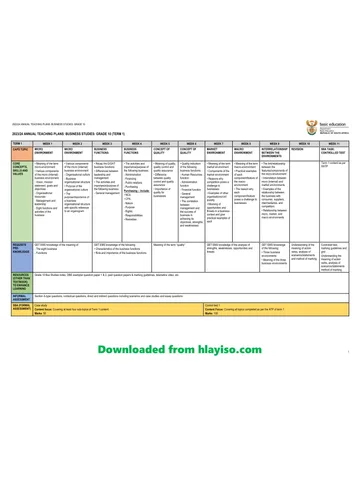
Gr 10 Bus Stu ATP 2023 24
Question paper and memo
Business Studies Grade 10 Gauteng March Test 2025 QP & Memo
Question paper and memo
Business Studies Grade 10 P1 Limpopo June 2025 Paper & Memo
Question paper