
Mock
hlayiso mock exams
Practice Series:
Grade 11 Exam Preparation
WWW.HLAYISO.COM
NATIONAL
SENIOR CERTIFICATE
GRADE 11
HISTORY P1
NOVEMBER EXAMINATION 2026 (MOCK)
MARKS: 150
TIME: 3 hours
This question paper consists of 9 pages and an addendum of 12 pages.
Copyright reserved Please turn over
Skip to contentAll 2026 papers 
View all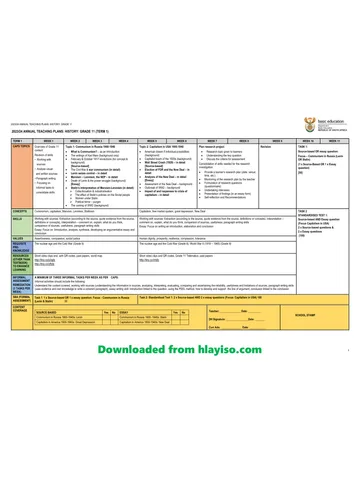

History Grade 11 P1 November Mock Exam 2 2026 QP (Eng)
Grade 11 History Paper 1 question paper from the November Mock Exam 2 2026 (English), 9 pages. Read online or download the free PDF.
History · Grade 11 · November Mock Exam 2 · 2026 · English. Question paper, 9 pages. Read online or download the PDF.
- Subject
- History
- Grade
- Grade 11
- Language
- English
- Document type
- Question paper
- Year
- 2026
- Exam period
- November Mock Exam 2
- Paper
- 1
- Publisher
- Hlayiso
- Curriculum
- CAPS
- Pages
- 9
- File size
- 144.9 KB
Free to read online, no sign-up needed
Loading document…
Loading document…
1 of 9
This exam
November Mock Exam 2 2026
- Paper 1Question paperAddendumMemo
- Paper 2Question paperAddendumMemo
Document textSearch extracted text and jump to a page.
History/P1 2 Hlayiso/Gr 11 Mock 2026
NSC Mock
INSTRUCTIONS AND INFORMATION
1. This question paper consists of SECTION A and SECTION B based on the prescribed
content framework in the CAPS document.
SECTION A: SOURCE-BASED QUESTIONS
QUESTION 1: COMMUNISM IN RUSSIA: 1900–1940
QUESTION 2: CAPITALISM IN THE USA: 1900–1940
QUESTION 3: IDEAS OF RACE IN THE LATE 19TH AND 20TH
CENTURIES
SECTION B: ESSAY QUESTIONS
QUESTION 4: COMMUNISM IN RUSSIA: 1900–1940
QUESTION 5: CAPITALISM IN THE USA: 1900–1940
QUESTION 6: IDEAS OF RACE IN THE LATE 19TH AND 20TH
CENTURIES
2. SECTION A consists of THREE source-based questions. Source material that is
required to answer these questions can be found in the ADDENDUM.
3. SECTION B consists of THREE essay questions.
4. Answer THREE questions as follows:
4.1 At least ONE must be a source-based question and at least ONE
must be an essay question.
4.2 The THIRD question may be either a source-based question or an
essay question.
5. You are advised to spend at least ONE hour per question.
6. When answering the questions, you should apply your knowledge, skills and insight.
7. You will be disadvantaged by merely rewriting the sources as answers.
8. Number the answers correctly according to the numbering system used in this question
paper.
9. Write neatly and legibly.
Copyright reserved Please turn over
History/P1 3 Hlayiso/Gr 11 Mock 2026
NSC Mock
SECTION A: SOURCE-BASED QUESTIONS
Answer at least ONE question, but not more than TWO questions, in this section. The source
material that is required to answer these questions is contained in the ADDENDUM.
QUESTION 1: HOW DID SOVIET ECONOMIC POLICIES CHANGE RUSSIA BETWEEN
1918 AND 1928?
Study Sources 1A, 1B, 1C and 1D and answer the questions that follow.
1.1 Refer to Source 1A.
1.1.1 Define the term War Communism in your own words. (1 x 2) (2)
1.1.2 List THREE measures, from the source, that were introduced under
War Communism. (3 x 1) (3)
1.1.3 Why do you think Lenin regarded these emergency measures as
necessary in 1918? (2 x 2) (4)
1.1.4 Using the information in the source and your own knowledge, explain
why the forced requisitioning of grain led to a fall in agricultural
production. (2 x 2) (4)
1.1.5 Name the leader of the peasant revolt in Tambov province, according
to the source. (1 x 1) (1)
1.2 Read Source 1B.
1.2.1 When, according to the source, did Red Army troops storm the
Kronstadt naval base? (1 x 1) (1)
1.2.2 Quote evidence from the source which shows that the Kronstadt
sailors had supported the Bolsheviks in 1917. (1 x 2) (2)
1.2.3 Comment on why the Kronstadt Rising alarmed Lenin and the
Bolshevik leaders. (2 x 2) (4)
1.2.4 Define the concept commanding heights of the economy in the
context of the New Economic Policy. (1 x 2) (2)
1.2.5 Name TWO ways, according to the source, in which the NEP allowed
a return to private enterprise. (2 x 1) (2)
1.3 Study Source 1C.
1.3.1 How many million tonnes of steel, according to the table, were
produced in 1921? (1 x 1) (1)
1.3.2 Explain what the table reveals about the recovery of the Russian
economy between 1921 and 1926. (1 x 2) (2)
1.3.3 Comment on the limitations of this table for a historian researching
the impact of the NEP on the lives of ordinary Russians. (1 x 2) (2)
1.4 Refer to Sources 1A and 1C. Explain how the information in Source 1C
supports the evidence in Source 1A regarding the impact of War Communism
on the Russian economy. (2 x 2) (4)
Copyright reserved Please turn over
History/P1 4 Hlayiso/Gr 11 Mock 2026
NSC Mock
1.5 Consult Source 1D.
1.5.1 Identify TWO groups, according to the source, who prospered under
the NEP. (2 x 1) (2)
1.5.2 Explain what was meant by the ‘scissors crisis’ of 1923. (1 x 2) (2)
1.5.3 What do you think Bukharin hoped to achieve when he urged the
peasants to ‘enrich yourselves’? (1 x 2) (2)
1.5.4 Using the information in the source and your own knowledge, explain
why Stalin abandoned the NEP in 1928. (2 x 2) (4)
1.6 Using the information in the relevant sources and your own knowledge, write
a paragraph of about SIX lines (about 60 words) explaining how Soviet
economic policies changed Russia between 1918 and 1928. (6)
[50]
Copyright reserved Please turn over
History/P1 5 Hlayiso/Gr 11 Mock 2026
NSC Mock
QUESTION 2: HOW FAR DID ROOSEVELT’S NEW DEAL IMPROVE THE LIVES OF
ORDINARY AMERICANS IN THE 1930s?
Study Sources 2A, 2B, 2C and 2D and answer the questions that follow.
2.1 Read Source 2A.
2.1.1 How many states, according to the source, did Roosevelt win in the
presidential election of 1932? (1 x 1) (1)
2.1.2 Define the term segregation in the context of the USA in the 1930s.
(1 x 2) (2)
2.1.3 List THREE ways, from the source, in which African Americans were
discriminated against under the New Deal. (3 x 1) (3)
2.1.4 Why do you think Roosevelt refused to support a federal law against
lynching? (2 x 2) (4)
2.1.5 Using the information in the source and your own knowledge,
explain why most African American voters supported Roosevelt in
the election of 1936, even though many New Deal programmes
discriminated against them. (2 x 2) (4)
2.2 Study Source 2B.
2.2.1 Explain the messages conveyed by the photograph and the
information below it. (2 x 2) (4)
2.2.2 How much of a CCC worker’s monthly pay, according to the
information below the photograph, was sent home to his family?
(1 x 1) (1)
2.2.3 Explain the usefulness of this photograph to a historian researching
the impact of the New Deal on unemployed young Americans.
(2 x 2) (4)
2.3 Read Source 2C.
2.3.1 Name TWO reform measures, from the source, that were introduced
in 1935. (2 x 1) (2)
2.3.2 Define the term social security in your own words. (1 x 2) (2)
2.3.3 Quote evidence from the source which shows that the AAA harmed
tenant farmers and sharecroppers. (1 x 2) (2)
2.3.4 Explain why many business leaders and wealthy Americans opposed
the New Deal. (2 x 2) (4)
2.3.5 What, do you think, made Huey Long’s ‘Share Our Wealth’
movement popular among poor Americans? (1 x 2) (2)
Copyright reserved Please turn over
History/P1 6 Hlayiso/Gr 11 Mock 2026
NSC Mock
2.4 Consult Source 2D.
2.4.1 In which year, according to the graph, was unemployment the
lowest? (1 x 1) (1)
2.4.2 Explain the trend in unemployment shown in the graph between 1933
and 1937. (1 x 2) (2)
2.4.3 Using Source 2C and your own knowledge, comment on why
unemployment increased in 1938. (1 x 2) (2)
2.5 Refer to Sources 2A and 2C. Explain how the evidence in Source 2A differs
from the information in Source 2C regarding who benefited from the reforms
of the Second New Deal. (2 x 2) (4)
2.6 Using the information in the relevant sources and your own knowledge, write a
paragraph of about SIX lines (about 60 words) explaining how far Roosevelt’s
New Deal improved the lives of ordinary Americans in the 1930s. (6)
[50]
Copyright reserved Please turn over
History/P1 7 Hlayiso/Gr 11 Mock 2026
NSC Mock
QUESTION 3: HOW DID NAZI RACIAL POLICIES EXCLUDE JEWS FROM GERMAN
SOCIETY BETWEEN 1933 AND 1939?
Study Sources 3A, 3B, 3C and 3D and answer the questions that follow.
3.1 Refer to Source 3A.
3.1.1 Define the term Aryan in the context of Nazi racial ideology. (1 x 2) (2)
3.1.2 What proportion of the German population, according to the source,
was Jewish in 1933? (1 x 1) (1)
3.1.3 List THREE measures, from the source, that were taken against
Jews in 1933. (3 x 1) (3)
3.1.4 Explain why the Nazis insisted that the Jews were a race and not a
religious group. (2 x 2) (4)
3.1.5 Why do you think the Nazis taught ‘race science’ to German
schoolchildren? (1 x 2) (2)
3.2 Study Source 3B.
3.2.1 Name the TWO laws, according to the source, that were announced
at Nuremberg on 15 September 1935. (2 x 1) (2)
3.2.2 How, according to the table, was a person with three Jewish
grandparents classified? (1 x 1) (1)
3.2.3 Explain how the Nuremberg Laws took away the rights of German
Jews. (2 x 2) (4)
3.2.4 Comment on why the Nazis used the religion of a person’s
grandparents to decide whether that person was Jewish. (2 x 2) (4)
3.3 Read Source 3C.
3.3.1 Why, according to the source, did Herschel Grynszpan shoot Ernst
vom Rath? (1 x 1) (1)
3.3.2 Quote evidence from the source which suggests that Kristallnacht
was organised by the Nazi state and was not a spontaneous outburst
of public anger. (1 x 2) (2)
3.3.3 List THREE consequences of Kristallnacht, from the source, for the
Jewish community. (3 x 1) (3)
3.3.4 Explain why the Nazi government ordered the Jewish community to
pay a fine of one billion Reichsmarks after Kristallnacht. (2 x 2) (4)
Copyright reserved Please turn over
History/P1 8 Hlayiso/Gr 11 Mock 2026
NSC Mock
3.4 Consult Source 3D.
3.4.1 How many Jews, according to the graph, emigrated from Germany
in 1939? (1 x 1) (1)
3.4.2 Using the information in the graph and the note below it, as well
as your own knowledge, explain why many German Jews did not
emigrate between 1933 and 1937. (2 x 2) (4)
3.4.3 Explain the limitations of this graph for a historian researching the
experiences of German Jews between 1933 and 1939. (1 x 2) (2)
3.5 Refer to Sources 3C and 3D. Explain how the information in Source 3D
supports the evidence in Source 3C regarding the impact of Kristallnacht on
German Jews. (2 x 2) (4)
3.6 Using the information in the relevant sources and your own knowledge, write
a paragraph of about SIX lines (about 60 words) explaining how Nazi racial
policies excluded Jews from German society between 1933 and 1939. (6)
[50]
Copyright reserved Please turn over
History/P1 9 Hlayiso/Gr 11 Mock 2026
NSC Mock
SECTION B: ESSAY QUESTIONS
Answer at least ONE question, but NOT more than TWO questions, in this section.
Your essay should be about THREE pages long.
QUESTION 4: COMMUNISM IN RUSSIA: 1900–1940 – STALIN’S FIVE-YEAR PLANS
‘Stalin’s Five-Year Plans turned the Soviet Union into a major industrial power by 1939, but
the ordinary people of the Soviet Union paid a terrible price for this achievement.’
Do you agree with this statement? Use relevant historical evidence to support your line of
argument.
[50]
QUESTION 5: CAPITALISM IN THE USA: 1900–1940 – THE SOCIAL IMPACT OF THE
GREAT DEPRESSION
‘The Great Depression did not affect all Americans in the same way between 1929 and 1933.’
Critically discuss this statement with reference to the experiences of industrial workers,
farmers, African Americans, Mexican Americans and women.
[50]
QUESTION 6: IDEAS OF RACE IN THE LATE 19TH AND 20TH CENTURIES –
EUGENICS IN NAZI GERMANY
‘The Nazis turned the pseudo-science of eugenics into state policy and persecuted not only
the Jews but every group that they regarded as a threat to the “purity” of the German nation.’
Critically discuss this statement with reference to the treatment of people with disabilities, the
Roma and Sinti, and Black Germans in Nazi Germany between 1933 and 1945.
[50]
TOTAL: 150
Copyright reserved
Study this subject
Recommended for this subject
Memorandum
History Grade 11 Paper 1 November Mock 2026 Memo (English)
Question paper
History Grade 11 P1 Eastern Cape November 2023 QP (Eng)
Question paper
History Grade 11 P1 Eastern Cape November 2022 QP (Eng)
Question paper
History Grade 11 P1 Eastern Cape November 2020 QP (Eng)
Question paper
History Grade 11 P1 Eastern Cape November 2018 QP (Eng)
Memorandum
History Grade 11 P1 Eastern Cape November 2023 Memo (Eng)
More from Grade 11 History
Annual teaching plan
Gr 11 His ATP 2023 24
Question paper and memo
History Grade 11 Paper 2 Eastern Cape June 2025 Paper & Memo
Memorandum
History Grade 11 Paper 1 Eastern Cape November 2025 Memo
Memorandum
History Grade 11 P2 Eastern Cape November 2025 Memo (Eng)
Memorandum
History Grade 11 P2 Eastern Cape November 2024 Memo (Afr)
Question paper