
NATIONAL
SENIOR CERTIFICATE
GRADE 11
NOVEMBER 2024
HISTORY P2
MARKS: 150
TIME: 3 hours
*IHISTE2*
This question paper consists of 9 pages and an addendum of 14 pages.
Hosted by www.ecexams.co.za.
Skip to contentAll 2024 papers 
View all
History Grade 11 P2 Eastern Cape November 2024 QP (Eng)
Grade 11 History Paper 2 question paper from the Eastern Cape November Exam 2024 (English), 16 pages. Read online or download the free PDF.
History · Grade 11 · Eastern Cape November Exam · 2024 · English. Question paper, 16 pages. Read online or download the PDF.
- Subject
- History
- Grade
- Grade 11
- Language
- English
- Document type
- Question paper
- Year
- 2024
- Exam period
- Eastern Cape November Exam
- Paper
- 2
- Curriculum
- CAPS
- Pages
- 16
- File size
- 165.9 KB
Free to read online, no sign-up needed
Loading document…
Loading document…
1 of 16
This exam
Eastern Cape November Exam 2024
Questions in this paper
Document textSearch extracted text and jump to a page.
2 HISTORY P2 (EC/NOVEMBER 2024
INSTRUCTIONS AND INFORMATION
1. This question paper consists of SECTION A and SECTION B based on the
prescribed content framework in the CAPS document.
SECTION A: SOURCE-BASED QUESTIONS
QUESTION 1: NATIONALISM IN SOUTH AFRICA – AFRICAN
NATIONALISM (1902 to 1940s)
QUESTION 2: NATIONALISM IN SOUTH AFRICA – AFRIKANER
NATIONALISM (1900 to 1930s)
QUESTION 3: APARTHEID SOUTH AFRICA – (1940s to 1960s)
SECTION B: ESSAY QUESTIONS
QUESTION 4: NATIONALISM IN SOUTH AFRICA – AFRICAN
NATIONALISM (1940s to 1950s)
QUESTION 5: NATIONALISM IN SOUTH AFRICA – AFRIKANER
NATIONALISM (1930s to 1940s)
QUESTION 6: APARTHEID SOUTH AFRICA – RESISTANCE IN SOUTH
AFRICA – (1940s to 1950s)
2. SECTION A consists of THREE source-based questions. Source material that is
required to answer these questions may be found in the ADDENDUM.
3. SECTION B consists of THREE essay questions.
4. Answer THREE questions as follow:
4.1 At least ONE must be a source-based question and at least ONE must
be an essay question.
4.2 The THIRD question should be a source-based or essay question.
5. You are advised to spend at least ONE hour per question.
6. When answering questions, candidates should apply their knowledge, skills and
insight.
7 You will be disadvantaged by merely rewriting the sources as answers.
8. Number the answers correctly according to the numbering system used in this
question paper.
9. Write neatly and legibly.
Copyright reserved Please turn over
Hosted by www.ecexams.co.za.
(EC/NOVEMBER 2024) HISTORY P2 3
SECTION A: SOURCE-BASED QUESTIONS
Answer at least ONE question in this section. Source material to be used to
answer these questions is contained in the ADDENDUM.
QUESTION 1: HOW DID THE RISE OF AFRICAN NATIONALISM IN SOUTH
AFRICA LEAD TO WORKERS PROTESTS IN THE 1920s?
Study Sources 1A, 1B, 1C and 1D and answer the questions that follow.
1.1 Refer to Source 1A.
1.1.1 What, according to the source, was the purpose of the meeting?
(2 x 1) (2)
1.1.2. Define the term capitalism in your own words. (1 x 2) (2)
1.1.3 Comment on what is implied by the words, “These workers enter the
cities as a conquered people, their lands under imperial authority,
their chiefs colluding (planning) in labour recruitment to the mines”.
(2 x 2) (4)
1.1.4. Identify any THREE challenges that black workers experienced in
the cities. (3 x 1) (3)
1.1.5 What do you think is meant by the Industrial workers of Africa’s
slogan,“Sifuna Zonke”? (We want everything) (2 x 2) (4)
1.2 Consult Source 1B.
1.2.1 Why, according to the source, were the efforts to organise African
workers in Cape Town, successful? (2 x 1) (2)
1.2.2 Comment on what is implied by the words, “stress the necessity of
agitating, educating, and organising the Africans and other non-
European sections of the community if any redress (fixing) of their
grievances was to be obtained.” (2 x 2) (4)
1.2.3. Explain why Africans joined the Industrial and Commercial Workers
Union and became loyal members. (2 x 2) (4)
1.2.4 Explain the usefulness of the information in this source for a
historian researching the contribution made by the Industrial and
Commercial Workers Union (ICU) for the growth of African
Nationalism. (2 x 2) (4)
Copyright reserved Please turn over
Hosted by www.ecexams.co.za.
4 HISTORY P2 (EC/NOVEMBER 2024
1.3 Read Source 1C.
1.3.1 What messages does the poster convey regarding the aims of
the Industrial and Commercial Workers Union? (2 x 2) (4)
1.3.2 Quote evidence from the source that shows that the Industrial
and Commercial Workers Union was well organised. (1 x 2) (2)
1.4 Study Source 1D.
1.4.1 Why, according to the source, did the Cason compound workers
go on strike? (3 x 1) (3)
1.4.2 Comment on what the President of the Chamber of Mines meant
when he said, “the strike had practically paralysed the industry.”
(2 x 2) (4)
1.4.3 Define the term compound in the context of the 1920 strike
organised by the Industrial and Commercial Workers Union.
(1 x 2) (2)
1.5 Using the information in the relevant sources and your own knowledge
and write a paragraph of about SIX lines (about 60 words) explaining
how the rise of African nationalism in South Africa led to workers protests
in the 1920s. (6)
[50]
Copyright reserved Please turn over
Hosted by www.ecexams.co.za.
(EC/NOVEMBER 2024) HISTORY P2 5
QUESTION 2: HOW DID THE RISE OF AFRIKANER NATIONALISM IN
SOUTH AFRICA LEAD TO AFRIKANER UNITY IN THE 1930s
AND 1940s?
Study Sources 2A, 2B, 2C and 2D to answer the following questions.
2.1 Study Source 2A.
2.1.2 Identify THREE ideological blocks in the process of Afrikaner
nationalism. (3 x 1) (3)
2.1.2 Define the term urbanisation in the context of promoting Afrikaner
Nationalism. (1 x 2) (2)
2.1.3 Name any TWO classes that were prominent in the construction
and direction of Afrikaner Nationalism? (2 x 1) (2)
2.1.4. Using the information in the source and your own knowledge,
explain why you think the Afrikaner middle class were determined
to unite Afrikaners. (2 x 2) (4)
2.2 Read Source 2B.
2.2.1 How, according to the source, did the Ossewabrandwag promote
itself? (2 x 1) (2)
2.2.2 Why do you think Dr D F Malan saw a need for the party to be
accessible to grassroot members? (2 x 2) (4)
2.2.3 Name any occasion where Afrikaners could meet in their Trekker
dresses. (1 x 1) (1)
2.3 Consult Source 2C.
2.3.1 What messages are conveyed in the photograph regarding the
aims of the Ossewabrandwag? (2 x 2) (4)
2.3.2 Comment on the significance of the ox-wagon being used in the
Ossewabrandwag badge. (2 x 2) (4)
2.4 Compare Source 2B and Source 2C. Explain how the information in Source
2B supports the evidence in Source 2C regarding the role played by the
Ossewabrandwag in promoting Afrikaner Nationalism.
(2 x 2) (4)
Copyright reserved Please turn over
Hosted by www.ecexams.co.za.
6 HISTORY P2 (EC/NOVEMBER 2024
2.5 Use Source 2D.
2.5.1. What, according to the source, was the concern that was raised by
both Afrikaner Broederbond and Dr D F Malan? (1 x 2) (2)
2.5.2 What, according to the EVK chairman, were the aims of the 1939
Ekonomiese Volkskongres? (2 x 1) (2)
2.5.3 Define the term Afrikaner Nationalism in your own words. (1 x 2) (2)
2.5.4 Explain what is meant by Dr H F Verwoerd’s statement, “that the
taking possession of “state power” was the best weapon available
in the “great struggle” to achieve the Afrikaners’ “legitimate” place
in commerce and industry – that of an employer of labour.” (2 x 2) (4)
2.5.5 Comment on why the Broederbond and Sanlam would sponsor the
Afrikaner economic movement in the 1940s. (2 x 2) (4)
2.6 Using the information in the relevant sources and your own knowledge,
write a paragraph of about SIX lines (about 60 words) explaining how the
rise of Afrikaner Nationalism in South Africa led to Afrikaner unity in the
1930s and 1940s. (6)
[50]
Copyright reserved Please turn over
Hosted by www.ecexams.co.za.
(EC/NOVEMBER 2024) HISTORY P2 7
QUESTION 3: WHAT WAS THE IMPACT OF INTENSIFIED RESISTANCE
AGAINST THE APARTHEID GOVERNMENT IN SOUTH AFRICA
DURING THE 1960s?
Study Sources 3A, 3B, 3C and 3D to answer the following questions.
3.1 Read Source 3A.
3.1.1 What events, according to the source, signalled the beginning of a
brutal and intensive phase of state repression? (2 x 1) (2)
3.1.2. Define the concept armed struggle in the context of resistance against
apartheid. (1 x 2) (2)
3.1.3. Comment on what MK meant by the following statement, “The time
comes in the life of any nation when there remain only two choices:
submit or fight. That time has now come to South Africa.” (2 x 2) (4)
3.1.4 Name any TWO targets that were destroyed by MK. (2 x 1) (2)
3.2 Study Source 3B.
3.2.1 Who, according to the source, purchased Liliesleaf farm? (2 x 1) (2)
3.2.2. Define the concept informant in your own words. (1 x 2) (2)
3.2.3 What do you think ‘Operation Mayibuye’ was about that later would be
used against the accused during the Rivonia Trail? (2 x 2) (4)
3.2.4. Name any TWO activists that were caught during the raid at Liliesleaf
farm. (2 x 1) (2)
3.2.5 Comment on the implications the arrest of these leaders will have on
the liberation struggle in South Africa. (2 x 2) (4)
3.3 Consult Source 3C.
3.3.1. What, according to the source, were the specific charges the accused
faced? (2 x 1) (2)
3.3.2 Comment on what is meant by the following statement, “the trail that
changed South Africa” in the context of the political landscape of South
Africa. (2 x 2) (4)
3.3.3 What do you think Mandela meant when he said, ‘I have dedicated
myself to this struggle. I have fought against white domination, and I
have fought against black domination ... But, if needs be, it is an ideal
for which I am prepared to die for.’ (2 x 2) (4)
3.3.4 How reliable will this source be to a historian studying the role that
Mandela played in the liberation struggle? (2 x 2) (4)
Copyright reserved Please turn over
Hosted by www.ecexams.co.za.
8 HISTORY P2 (EC/NOVEMBER 2024
3.4 Refer to Source 3D.
3.4.1 What messages are portrayed in this photograph regarding the
reasons why people demonstrated outside the court? (2 x 2) (4)
3.4.2 Quote evidence from the photograph that indicates that the
demonstrators supported the leaders on trial. (2 x 1) (2)
3.5 Using the information in the relevant sources and your own knowledge and
write a paragraph of about SIX lines (about 60 words) explaining what the
impact of intensified resistance against the apartheid government in South
Africa was during the 1960s. (6)
[50]
Copyright reserved Please turn over
Hosted by www.ecexams.co.za.
(EC/NOVEMBER 2024) HISTORY P2 9
SECTION B: ESSAY QUESTIONS
Answer at least ONE question, but not more than TWO questions in this section.
QUESTION 4: NATIONALISM IN SOUTH AFRICA – AFRICAN NATIONALISM
Explain to what extent the return of soldiers from World War 2 influenced Black
South Africans to fight for freedom.
Use relevant evidence to support your line of argument. [50]
QUESTION 5: NATIONALISM IN SOUTH AFRICA – AFRIKANER
NATIONALISM
Critically discuss how the idea of the Volk was promoted and became the
cornerstone of Afrikaner Nationalism in the 1930s to 1940s.
Use relevant evidence to support your line of argument. [50]
QUESTION 6: APARTHEID SOUTH AFRICA – RESISTANCE IN SOUTH
AFRICA
The National Party government’s apartheid policies provoked (triggered)
resistance from liberation organisations in the 1950s.
Do you agree with this statement? Substantiate your answer by referring to the
different forms of resistance in the 1950s. [50]
TOTAL: 150
Copyright reserved Please turn over
Hosted by www.ecexams.co.za.
Hosted by www.ecexams.co.za.
Hosted by www.ecexams.co.za.
Hosted by www.ecexams.co.za.
Hosted by www.ecexams.co.za.
Hosted by www.ecexams.co.za.
Hosted by www.ecexams.co.za.
Hosted by www.ecexams.co.za.
Study this subject
Recommended for this subject
Question paper
History Grade 11 P2 North West November 2024 QP (Eng)
Addendum
History Grade 11 P2 Eastern Cape November 2023 Addendum
Memorandum
History Grade 11 P2 Eastern Cape November 2024 Memo (Afr)
Question paper
History Grade 11 P1 Eastern Cape November 2023 QP (Eng)
Question paper
History Grade 11 P2 Eastern Cape November 2022 QP (Eng)
Question paper
History Grade 11 P2 Eastern Cape November 2018 QP (Eng)
More from Grade 11 History
Memorandum
History Grade 11 Paper 1 November Mock 2026 Memo (English)
Annual teaching plan
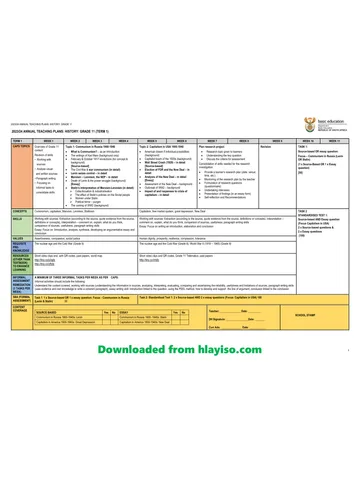
Gr 11 His ATP 2023 24
Question paper and memo
History Grade 11 Paper 2 Eastern Cape June 2025 Paper & Memo
Memorandum
History Grade 11 Paper 1 Eastern Cape November 2025 Memo
Memorandum
History Grade 11 P2 Eastern Cape November 2025 Memo (Eng)
Memorandum