
Study & Master
Support Pack | Grade 11
CAPS
Module 7 Units 1 – 4
Agricultural
Sciences
Optimal resource utilisation
This support pack for the Optimal resource utilisation module in the
Agricultural Sciences Grade 10 CAPS curriculum provides valuable
revision activities. All activities have the answers provided. Learners can
work through these individually at home or these could form the basis
of a catch-up class or online lesson. You have permission to print or
photocopy this document or distribute it electronically
via email or WhatsApp.
For more information on our Study & Master CAPS-approved
textbooks and valuable resource materials, visit
www.cambridge.org
Brighter Thinking | Better Learning
Skip to contentStudy guide 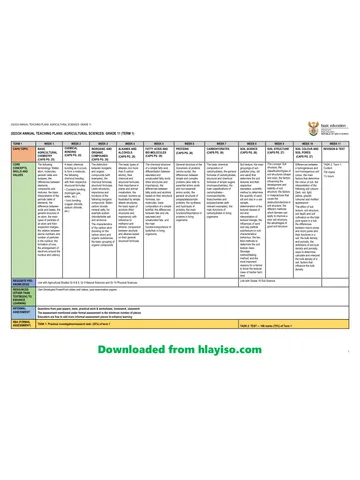




View all

Module 7 Support pack for Optimal resource utilisation GR11
Grade 11 Agricultural Sciences study guide, 6 pages. Read online or get the free PDF download.
Publisher: Study & Master
Agricultural Sciences · Grade 11. Study guide, 6 pages. Read online or download the PDF.
- Subject
- Agricultural Sciences
- Grade
- Grade 11
- Document type
- Study guide
- Publisher
- Study & Master
- Curriculum
- CAPS
- Pages
- 6
- File size
- 118.2 KB
Loading document…
Loading document…
1 of 6
Document textSearch extracted text and jump to a page.
Module 7 – Optimal resource utilisation
Unit 1 Soil surveying and planning
Short questions
1. Various possible answers are provided for the following questions. Write only the correct letter
(A–D) next to the question number.
1.1 A sign of soil erosion is:
A deep fertile soil B thunder storms
C bare ground D wind storms
1.2 An indication of a clay loam soil is that:
A grains of sand cannot be felt B soil can be rolled into a stable sausage
C grains of sand can be felt D grains of sand can be seen and felt
1.3 A reservoir is an artificial:
A dam with treated waste water B river with untreated waste water
C lake with desalinated water D lake or dam used to store water
1.4 An irrigation method that best simulates rainfall is:
A flood irrigation B drip irrigation
C sprinkler irrigation D basin irrigation
1.5 Cut-off drainage systems are used to:
A dry local wet spots B irrigate local dry spots
C protect lower lying areas from water D drain a large area
1.6 An advantage of crop rotation is that it:
A controls pests B needs a greater investment in machinery
D causes a drop in soil fertility C needs greater management skills
1.7 Monoculture is the planting of:
A the same crop every season on the B different crops every season on
same land the same land
C different crops every season on D deep rooted plants every season on
different areas of land different land
1.8 A disadvantage of a greenhouse is that:
A greenhouses are cheap to build B it is an extensive way of providing jobs
C the germination of seeds are lower D glass needs to be cleaned constantly
1.9 Which one of the following is NOT a growth medium in hydroponic systems?
A gravel B clay
C sand D polystyrene
1.10 An example of an open through-flow system for aquaculture in South Africa is:
A raceways for trout farming B on-land abalone farming
C tank systems used in koi-farming D rafts for mussel farming (10 × 2 = 20)
2. Choose the description in column B that best suits each method of soil cultivation in column A.
Column A Column B
2.1 Dissolving A Soil is turned upside down to prepare for planting
2.2 Harrowing B Cultivated soils are covered with different substances
2.3 Mulching C Cutting up of plants that grow in the soil to reintroduce to the soil
2.4 Ploughing D Makes the soil flat and level for replanting
2.5 Bare cultivation E All the remains of the previous crop are ploughed into the soil
(5 × 2 = 10)
S T U DY & M A S T E R S U P P O R T PA C K S 1
Longer questions
3. 3.1 Explain the meaning of soil surveying. (2)
3.2 Discuss the main purpose of doing a soil survey. (2)
4. 4.1 Define the term precision farming. (2)
4.2 Name the FOUR steps in precision farming. (4)
4.3 Name the advantages of precision farming. (2)
Unit 2 Water use/irrigation
1. Define the term irrigation. (2)
2. Name THREE sources of water used for irrigation. (3)
3. Name THREE characteristics of irrigation water of high quality. (3)
4. List THREE types of irrigation systems. (3)
5. Name the THREE instruments used to measure soil moisture content. (3)
Unit 3 Soil drainage, soil cultivation and crop rotation
1. Define the terms:
1.1 Soil drainage system
1.2 Primary cultivation
1.3 Secondary cultivation
1.4 Crop rotation (4 × 2 = 8)
2. Name FOUR factors that will influence the choice of a soil drainage system. (3)
3. List the steps followed and factors to consider to install pipe drains. (5)
4. List THREE soil factors that determine a crop rotation programme. (3)
5. Name THREE disadvantages of crop rotation. (3)
6. Compare monoculture and crop rotation in table form under the following headings:
6.1 Definition(2)
6.2 Level of difficulty (2)
6.3 Pests and diseases (2)
6.4 Quantity of fertiliser used (2)
Unit 4 Greenhouse hydroponics and aquaculture
1. 1.1 Describe what a greenhouse is. (3)
1.2 Explain the purpose of a greenhouse. (4)
1.3 List THREE advantages of greenhouses. (3)
1.4 List THREE environmental factors that determine the choice of site when erecting a greenhouse. (3)
2. 2.1 Define the term hydroponics. (2)
2.2 Name the TWO types of cultures used in hydroponic systems. (2)
2.3 Compare the hydroponic system with an open field system in a table under the following
headings:
a) Woil requirement
b) Irrigation of plants
c) Nutrients
d) Soil-borne diseases
e) Cost (5 × 2 = 10)
2.4 Growth mediums are used in hydroponic systems instead of soil. Name THREE functions
of growth mediums. (3)
2 S T U DY & M A S T E R S U P P O R T PA C K S
3. 3.1 Explain the term raceway in aquaculture. (2)
3.2 Name the THREE types of fish culture systems. (3)
3.3 List FIVE basic requirements for aquaculture. (5)
3.4 Name FIVE factors that restrict choosing a specific species to cultivate. (5)
Memorandum
Unit 1
Short questions
1.1 C 1.2 B 1.3 D
1.4 C 1.5 C 1.6 D
1.7 A 1.8 D 1.9 B
1.10 D (20)
2.1 C 2.2 D 2.3 B
2.4 A 2.5 E (10)
Longer questions
3.1 Soil surveying is the methodical classification, description and mapping of soil. (2)
3.2 Soil surveying is done to help the farmer with decisions on how to best utilise available land. (2)
4.1 Precision farming is a management process whereby a large field is divided into smaller sub-fields
taking the variation in vegetation into account. (2)
4.2 Steps in precision farming:
• Gathering information on the sub-field
• Analysing the data gathered
• Making decisions based on the analysed soil
• Implementing of these decisions (4)
4.3 Advantages of precision farming:
• Saves fertilisers, fuel, time and labour
• Increases crop production (2)
Unit 2
1. Irrigation: the artificial application of water to soil or land (2)
2. Sources of irrigation water:
• ground water
• surface water
• non-conventional water (3)
3. High-quality irrigation water (any three):
• low salinity
• no ion toxicity
• no excessive nutrients
• no scale deposits
• low mineral content (3)
4. Irrigation systems:
• flood irrigation
• sprinkler irrigation
• drip irrigation (3)
5. Instruments used to measure soil moisture content:
• class A evaporation pan
• tensiometer
• neutron moisture meter (3)
S T U DY & M A S T E R S U P P O R T PA C K S 3
Unit 3
1. Definitions:
1.1 Soil drainage system: a method used to get rid of excessive water and salts from the surface of the soil. (2)
1.2 Primary cultivation: a method used to cut and shatter to produce soil with a rough texture. (2)
1.3 Secondary cultivation: a method used to level and firm the top part of the soil to produce a
finer texture. (2)
1.4 Crop rotation: the cultivation of unrelated crops in the same field in consecutive seasons. (2)
2. Soil factors that influence soil drainage system choice:
• Amount of water to be removed
• Topography of the soil
• Characteristics of the soil (3)
3. Steps and factors to consider in installing pipe drains:
• A perforated side branch pipe is placed in permeable soil at a certain angle to the discharge pipe.
• The permeability and depth of the soil above the branch pipe will determine the amount of
water drained.
• A thin layer of small stones is placed around the branch pipe to improve the flow rate of water
entering the pipe.
• The maximum distance that side branches can be placed effectively must be calculated to keep
capital costs low.
• Construct access pits at specific points to allow cleaning and maintenance of the drain pipes. (5)
4. Soil factors that determine crop rotation programme:
• soil type
• soil usage
• soil fertility (3)
5. Disadvantages of crop rotation:
• It may not allow for maximum profitability.
• It needs a greater investment of machinery.
• It requires greater management skills and more knowledge. (3)
6. Differences between monoculture and crop rotation:
Monoculture Crop rotation
6.1 Definition The planting of the same crop over The planting of different crops over
consecutive seasons (often a staple consecutive seasons
crop) (2)
6.2 Level of difficulty Easier to cultivate one type of crop More challenging and time consuming;
because only one type of machinery, need different types of machinery, seed or
seed and pesticide is needed. seedlings and pesticide. (2)
6.3 Pests and Provides the ideal environment for the Breaks or pest and disease life cycles by
diseases spread of pests and diseases different cultivating a crop species every
season (2)
6.4 Fertiliser Uses large quantities of fertiliser and Large quantities of fertiliser are needed but
quantity pesticides to fight disease-causing less pesticides and herbicides are needed
pathogens. in the long run. (2)
Unit 4
1.1
A greenhouse is a structure made up of transparent walls and a roof. The structure is heated up by
the sun to provide the plants with a warm environment and warm the soil.
The warm air is retained inside the house by the enclosed walls and roof. (3)
4 S T U DY & M A S T E R S U P P O R T PA C K S
1.2 Purpose of a greenhouse:
• Create an environment more favourable to plant growth than the outside environment.
• Plants are protected from the sun.
• Humidity around the plant is increased.
• Extreme temperature variations are reduced. (4)
1.3 Advantages of greenhouses:
• Any plant type can be grown anywhere, at any time of the year.
• The seasonal changes are no longer a problem.
• Crop productivity is increased. (3)
1.4 Environmental factors (any three):
• light
• temperature
• water
• nutrition
• plant diseases (3)
2.1
Hydroponics is a production system whereby plants are cultivated in a nutritive solution with or
without artificial growth mediums or mechanical support. (2)
2.2 solution and medium cultures (2)
2.3 Differences between hydroponic systems and open field systems:
Hydroponic system Open field system
a) Soil requirement No soil required Disease-free topsoil required
b) Irrigation Irrigated automatically Regular irrigation
c) Nutrients Balanced nutrient content in Nutrients need to be added to
nutrient medium the soil
d) Soil-borne Can be prevented and eliminated Can accumulate (build up) and
diseases increase
e) Cost Expensive to install Less expensive
(10)
2.4 Functions of growth mediums:
• They provide the roots with oxygen.
• They bring water and dissolved nutrients in contact with the roots.
• They anchor the plant. (3)
3.1
A raceway is a very high density flow-through system. Water flows continuously and passes
through the system only once before discharge. The abundant flow of good-quality water is
essential to remove waste from the system and for the health of the fish. (2)
3.2 Fish culture systems:
• open through-flow system
• semi-closed system
• closed system (3)
3.3 Basic requirements for aquaculture:
• choice of species
• choice of site
• general feasibility
• market analysis
• authorisation of legal matters (5)
3.4 Factors in choosing a species (any five):
• market price and demand
• hardiness and adaptability under high densities
• drought resistance
• temperature resistant
• reproduction of the crop (5)
S T U DY & M A S T E R S U P P O R T PA C K S 5
Study this subject
Notes, quizzes and topic questions for Grade 11 Agricultural Sciences.
- Grade 11 Agricultural Sciences notes
CAPS revision notes with worked examples.
- Agricultural Sciences questions by topic
Past exam questions sorted by CAPS topic, with memos where available.
- Grade 11 Agricultural Sciences quizzes
Short topic quizzes with instant feedback.
- All Grade 11 Agricultural Sciences past papers
Past papers by year, with memos where available.
- Grade 11 Study guides
More Agricultural Sciences and other subjects in this collection.
Recommended for this subject
More papers and memos for this grade and subject.
Annual teaching plan
Gr 11 Agric Sci ATP 2023 24
Memorandum
Agricultural Sciences Grade 11 P1 Eastern Cape November 2025 Memo
Question paper
Agricultural Sciences Grade 11 P2 Eastern Cape November 2025 QP
Memorandum
Agricultural Sciences Grade 11 P2 Eastern Cape November 2024 Memo
Question paper
Agricultural Sciences Grade 11 P1 Eastern Cape November 2024 QP
Question paper
Agricultural Sciences Grade 11 North West November 2024 QP (Afr)
Related documents
Question paper
Agricultural Sciences Grade 11 P1 North West November 2024 QP
Question paper
Agricultural Sciences Grade 11 P2 North West November 2024 QP
Memorandum
Agricultural Sciences Grade 11 P1 Eastern Cape November 2023 Memo
Memorandum
Agricultural Sciences Grade 11 P1 Eastern Cape November 2023 Memo
Memorandum
Agricultural Sciences Grade 11 P1 Eastern Cape November 2023 Memo
Memorandum
Agricultural Sciences Grade 11 P2 Eastern Cape November 2023 Memo
More from Grade 11 Agricultural Sciences
Memorandum
Agricultural Sciences Grade 11 P2 Eastern Cape November 2023 Memo
Memorandum
Agricultural Sciences Grade 11 P2 Eastern Cape November 2023 Memo
Memorandum
Agricultural Sciences Grade 11 P2 Eastern Cape November 2023 Memo
Question paper
Agricultural Sciences Grade 11 P1 Eastern Cape November 2023 QP
Question paper
Agricultural Sciences Grade 11 P1 Eastern Cape November 2023 QP
Question paper