Downloaded from hlayiso.com
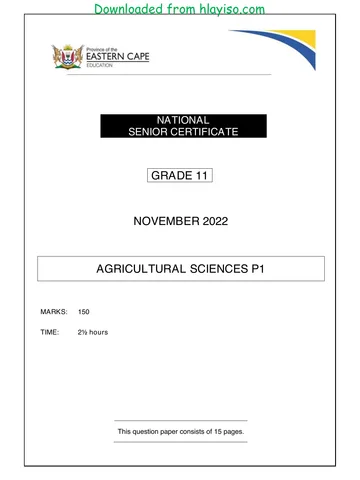
NATIONAL
SENIOR CERTIFICATE
GRADE 11
NOVEMBER 2023
AGRICULTURAL SCIENCES P1
MARKS: 150
TIME: 2½ hours
This question paper consists of 15 pages.
Skip to contentAll 2023 papers 
View all
Agricultural Sciences Grade 11 P1 2023 QP (Eng)
Grade 11 Agricultural Sciences Paper 1 question paper from the Eastern Cape November Exam 2023 (English), 15 pages. Read online or download the free PDF.
Agricultural Sciences · Grade 11 · Eastern Cape November Exam · 2023 · English. Question paper, 15 pages. Read online or download the PDF.
- Subject
- Agricultural Sciences
- Grade
- Grade 11
- Language
- English
- Document type
- Question paper
- Year
- 2023
- Exam period
- Eastern Cape November Exam
- Paper
- 1
- Curriculum
- CAPS
- Pages
- 15
- File size
- 722.8 KB
Free to read online, no sign-up needed
Loading document…
Loading document…
1 of 15
This exam
Eastern Cape November Exam 2023
- Paper 1Question paper · EngQuestion paper · Eng (2)Question paper · Eng (3)Question paper · Eng (4)Question paper · AfrQuestion paper · Afr (2)Question paper · Afr (3)Question paper · Afr (4)Memo · EngMemo · Eng (2)Memo · AfrMemo · Afr (2)
- Paper 2Question paper · EngQuestion paper · Eng (2)Question paper · Eng (3)Question paper · Eng (4)Question paper · AfrQuestion paper · Afr (2)Question paper · Afr (3)Question paper · Afr (4)Memo · EngMemo · Eng (2)Memo · AfrMemo · Afr (2)
Questions in this paper
- Question 1.1Organic chemistry in agriculture20 marks
- Question 1.2Soil physics10 marks
- Question 1.3Soil physics20 marks
- Question 1.4Soil chemistry and organic matter10 marks
- Question 2.1Bio-molecules10 marks
- Question 2.2Soil chemistry and organic matter7 marks
Show all 21 questions
- Question 2.3Bio-molecules8 marks
- Question 2.4Organic chemistry in agriculture6 marks
- Question 2.5Bio-molecules6 marks
- Question 3.1Soil physics7 marks
- Question 3.2Soil physics7 marks
- Question 3.3Soil moisture, air and temperature7 marks
- Question 3.4Soil physics4 marks
- Question 3.5Soil moisture, air and temperature6 marks
- Question 3.6Soil moisture, air and temperature4 marks
- Question 4.1Soil morphology and classification8 marks
- Question 4.2Soil morphology and classification3 marks
- Question 4.3Soil chemistry and organic matter10 marks
- Question 4.4Soil chemistry and organic matter7 marks
- Question 4.5Soil chemistry and organic matter5 marks
- Question 4.6Soil chemistry and organic matter2 marks
Document textSearch extracted text and jump to a page.
Downloaded from hlayiso.com
2 AGRICULTURAL SCIENCES P1 (EC/NOVEMBER 2023)
INSTRUCTIONS AND INFORMATION
1. This question paper consists of TWO sections, namely SECTION A and
SECTION B.
2. Answer ALL the questions in the ANSWER BOOK.
3. Start EACH question on a NEW page.
4. Number the answers correctly according to the numbering system used in this
question paper.
5. You may use a non-programmable calculator.
6. Show ALL calculations, including formulae, where applicable.
7. Write neatly and legibly.
Copyright reserved Please turn over
Downloaded from hlayiso.com
(EC/NOVEMBER 2023) AGRICULTURAL SCIENCES P1 3
SECTION A
QUESTION 1
1.1 Various options are provided as possible answers to the following questions.
Choose the answer and write only the letter (A–D) next to the question numbers
(1.1.1 to 1.1.10) in the ANSWER BOOK, for example 1.1.11 A.
1.1.1 Which ONE of the following is an example of organic compounds? .
A Carbon dioxide
B Lipids
C Ammonia
D Water
1.1.2 The valence electron of an element with a mass number of 27 and an
atomic number of 13 will be …
A 2.
B 4.
C 1.
D 3.
1.1.3 The following statements are TRUE with regard to methane:
(i) Is the simplest alkane and the main component of natural gas
(ii) It produces O2 and H2O when it burns in excess of CO2
(iii) It is used as a source of energy in rural homes
(iv) Has one carbon and four hydrogens
Choose the correct combination:
A (i), (iii) and (iv)
B (ii), (iii) and (iv)
C (i), (ii) and (iv)
D (i), (ii) and (iii)
1.1.4 The monomers of starch and glycogen are connected by … bonds.
A peptide
B ester
C dative
D glycosidic
1.1.5 The following is NOT the factor influencing the development of soil
structure.
A Presence of organic matter
B Activity of earthworm
C Unchanged soil moisture condition
D High clay content
Copyright reserved Please turn over
Downloaded from hlayiso.com
4 AGRICULTURAL SCIENCES P1 (EC/NOVEMBER 2023)
1.1.6 The mottled appearance in soil is an indication of the following:
(i) The reduction of red ferric ion to bluish-grey ferrous ion
(ii) Many flecks in the subsoil
(iii) Patches of rust, yellow and grey colours
(iv) Waterlogging for part of the day
Choose the correct combination:
A (i), (iii), and (iv)
B (ii), (iii) and (iv)
C (i), (ii) and (iv)
D (i), (ii) and (iii)
1.1.7 A loss of water through transpiration can be controlled by …
A reducing excessive use of nitrogen fertilisers.
B applying ammonium phosphate.
C choosing a cultivar with a high transpiration ratio.
D allowing weeds to cover the soil.
1.1.8 The schematic representation below demonstrates the …
Na + CaSO4 Ca2+ + NaSO4
A reclamation of neutral soil.
B reclamation of soil fertility.
C reclamation of brackish soil.
D reclamation of soil acidity.
1.1.9 The following is NOT the procedure followed when classifying the soil.
A Identification of master horizons
B Improving diagnostic horizons
C Determining soil series characteristics
D Determining soil family
1.1.10 The soil micro-organisms responsible for the decomposition of plant
and animal residues.
A Bacteria and earthworms
B Nematodes and actinomycetes
C Mice and moles
D Fungi and millipedes (10 x 2) (20)
Copyright reserved Please turn over
Downloaded from hlayiso.com
(EC/NOVEMBER 2023) AGRICULTURAL SCIENCES P1 5
1.2 Indicate whether each of the descriptions in COLUMN B applies to A ONLY,
B ONLY, BOTH A AND B or NONE of the items in COLUMN A. Write A only,
B only, both A and B or none, next to the question numbers (1.2.1 to 1.2.5) in
the ANSWER BOOK, for example 1.2.6 B only.
COLUMN A COLUMN B
A: Anion
1.2.1 Positively charged ion
B: Cation
A: Compound A substance consisting of two or more
1.2.2 B: Mixture different elements combined in a fixed
ratio
A: Soil compaction Arrangement of soil particles to form
1.2.3
B: Soil texture aggregates
A: Fine texture High degree of cohesive forces and
1.2.4
B: Coarse texture plasticity
A: Humic A Diagnostic horizon characterised by high
1.2.5
B: Melanic A organic matter content
(5 x 2) (10)
1.3 Give ONE word/term for each of the following descriptions. Write only the
word/term next to the question numbers (1.3.1 to 1.3.5) in the ANSWER BOOK.
1.3.1 The smallest particle of a substance which can exist independently and
still retain the properties of that substance
1.3.2 The structure in which the outer electron(s) of an atom is/are
represented by dots or crosses
1.3.3 A texture that has a diameter of less than 0,002 mm
1.3.4 The degree of bulk volume of soil that is not solid units
1.3.5 Very small negatively charged particles that can be suspended in water
(5 x 2) (10)
1.4 Change the UNDERLINED WORD(S) in EACH of the following statements to
make them TRUE. Write only the answer next to the question numbers
(1.4.1 to 1.4.5) in the ANSWER BOOK.
1.4.1 A complex protein yields only amino acids when hydrolysed.
1.4.2 Wilting point is the maximum moisture holding capacity of soil where all
pore spaces are filled with water.
1.4.3 Cation exchange capacity is the bonding of cations on the surface of the
colloid soil.
1.4.4 Nitrogen mineralisation is the absorption and fixation of available
nitrogen compounds by soil micro-organisms.
1.4.5 Eluviation is the process whereby material from A-horizon is deposited
to a B-horizon. (5 x 1) (5)
TOTAL SECTION A: 45
Copyright reserved Please turn over
Downloaded from hlayiso.com
6 AGRICULTURAL SCIENCES P1 (EC/NOVEMBER 2023)
SECTION B
QUESTION 2: BASIC AGRICULTURAL CHEMISTRY
Start this question on a NEW page.
2.1 The table below shows substances used in agriculture.
2.1.1 Classify the compound in the table above. (1)
2.1.2 Name the elements labelled A and B. (2)
2.1.3 Describe the type of bond involved in the table above. (2)
2.1.4 Indicate the charge of the elements below after bonding:
(a) Element B (1)
(b) Element A (1)
2.1.5 Name ONE importance of the compound in the table above. (1)
Copyright reserved Please turn over
Downloaded from hlayiso.com
(EC/NOVEMBER 2023) AGRICULTURAL SCIENCES P1 7
2.2 In an experiment, the educator mixed equal quantities of HCℓ and NaOH with the
same concentration.
2.2.1 Predict the pH of the mixture. (1)
2.2.2 Indicate the substance in the mixture that is:
(a) A base (1)
(b) An acid (1)
2.2.3 Tabulate TWO differences between the substances in the mixture. (4)
2.3 Analyse the flow chart below and answer the questions based on it.
2.3.1 Name the compound labelled A. (1)
2.3.2 Identify label B and C. (2)
2.3.3 Indicate the letter of a bio-molecule that matches each of the
characteristics below:
(a) It is of animal origin (1)
(b) Liquid at room temperature (1)
2.3.4 Give TWO functions of the compound named in QUESTION 2.3.1. (2)
2.3.5 Write the chemical formula of the compounds labelled D. (1)
Copyright reserved Please turn over
Downloaded from hlayiso.com
8 AGRICULTURAL SCIENCES P1 (EC/NOVEMBER 2023)
2.4 Sugarcane and maize are grown and processed for their alcohol content
produced by means of fermentation as shown in the equation below:
C6H12O6 2C2H5OH + 2 CO2
2.4.1 Name the alcohol in the equation above. (1)
2.4.2 Draw the structural formula of the alcohol in QUESTION 2.4.1. (3)
2.4.3 State ONE difference between alcohols and alkanes based on their
structural formulae. (2)
2.5 The structure below represents a structural formula of an organic compound.
2.5.1 Identify the structure illustrated above. (1)
2.5.2 Provide the label for A and B in the structure above. (2)
2.5.3 Name the polymer formed when the structures above are joined in a
chain. (1)
2.5.4 Give TWO functions of the polymer stated in QUESTION 2.5.3. (2)
[35]
Copyright reserved Please turn over
Downloaded from hlayiso.com
(EC/NOVEMBER 2023) AGRICULTURAL SCIENCES P1 9
QUESTION 3: SOIL SCIENCE
Start this question on a NEW page.
3.1 The illustration below represents soil samples with different particle sizes.
3.1.1 Indicate the sample that matches each of the characteristics below:
(a) Larger surface area for chemical reactions (1)
(b) Low ability to retain moisture and nutrients (1)
(c) High heat conduction (1)
3.1.2 SOIL SAMPLE B has a mass of 480 g and occupies a volume of
460 cm3.
Calculate the bulk density of SOIL SAMPLE B. (3)
3.1.3 Name ONE reason why farmers need to know the textural class of the
farm soil. (1)
Copyright reserved Please turn over
Downloaded from hlayiso.com
10 AGRICULTURAL SCIENCES P1 (EC/NOVEMBER 2023)
3.2 The diagrams below show different soil structures based on their shape.
A B C
3.2.1 Identify the structures labelled A, B and C. (3)
3.2.2 Indicate the letter representing the structure that is:
(a) Commonly found in clay pan soils (1)
(b) Suitable for crop production (1)
3.2.3 Name TWO factors that contributed to the development of the soil
structure labelled C. (2)
3.3 The diagram below illustrates water movement through the soil.
3.3.1 Indicate the water movement demonstrated above. (1)
3.3.2 Name TWO forces that have an effect on the water movement in
Soil C. (2)
3.3.3 Identify the soils represented by each of the following: (1)
(a) Soil C (1)
(b) Soil A (1)
3.3.4 Suggest a reason for each of the following:
(a) Highest water level in soil C (1)
(b) Lowest water level in soil A (1)
Copyright reserved Please turn over
Downloaded from hlayiso.com
(EC/NOVEMBER 2023) AGRICULTURAL SCIENCES P1 11
3.4 The colour of the soil gives information about soil properties and the condition if it
is correctly interpreted.
Indicate the condition of the soil with regard to moisture and air when the following
colours are predominant:
(a) Red (2)
(b) Grey (2)
3.5 A soil scientist conducted an experiment to test the influence of soil air in plants.
EXPERIMENT NO. EXPERIMENT 1 EXPERIMENT 2
Seeds planted in soil that Seeds planted in crumbled
SOIL CONDITION is waterlogged soil and watered when there
is a need
RESULTS No growth occurred Growth occurred
3.5.1 Name the gas that is deficient in EXPERIMENT 1. (1)
3.5.2 Indicate the role that the gas mentioned in QUESTION 3.5.1 could have
played if it was not deficient. (1)
3.5.3 Compare the atmospheric gases and soil gases in:
(a) Experiment 2 (2)
(b) Experiment 1 (2)
Copyright reserved Please turn over
Downloaded from hlayiso.com
12 AGRICULTURAL SCIENCES P1 (EC/NOVEMBER 2023)
3.6 The graph below shows a factor that has an influence on soil temperature.
3.6.1 Identify the factor influencing the soil temperature as illustrated in the
graph above. (1)
3.6.2 Explain how the factor identified in QUESTION 3.6.1 has an influence
on soil temperature. (2)
3.6.3 Name ONE effect of soil temperature on the chemical processes that
take place in the soil. (1)
[35]
Copyright reserved Please turn over
Downloaded from hlayiso.com
(EC/NOVEMBER 2023) AGRICULTURAL SCIENCES P1 13
QUESTION 4: SOIL SCIENCE
Start this question on a NEW page.
4.1 The schematic representation below shows horizontal layers of soil.
J
4.1.1 Select a letter (A to I) representing a horizon that matches each of the
descriptions below:
(a) Partly weathered material (1)
(b) Consolidated rock (1)
(c) Partly decomposed organic matter (1)
4.1.2 Identify the part labelled J from the schematic representation above. (1)
4.1.3 Sketch the profile of the soil with the horizontal layers illustrated in the
schematic representation in QUESTION 4.1. (2)
4.1.4 Name TWO diagnostic horizons that may be visible in the horizon
labelled F in the above schematic representation. (2)
4.2 Soil classification is the method used by soil scientists to group the soil into
different classes according to particular characteristics.
4.2.1 State TWO reasons why classification of soil is important in agriculture. (2)
4.2.2 Name the soil classification system which is used in South Africa. (1)
Copyright reserved Please turn over
Downloaded from hlayiso.com
14 AGRICULTURAL SCIENCES P1 (EC/NOVEMBER 2023)
4.3 The table below shows the soil pH values and phosphorus availability.
SOIL PH AVAILABILTY OF
PHOSPHORUS (g)
2 0
4 1
6 3
8 4
10 8
12 14
4.3.1 Present the information in the above table, in the form of a line graph. (6)
4.3.2 Deduce the influence of acidity and alkalinity on the availability of
phosphorus. (2)
4.3.3 Indicate the chemical substance a farmer can apply to solve the
following conditions:
(a) Decreased availability of phosphorus in soils with a pH of
between 2 and 4 (1)
(b) Toxic quantities of phosphorus in soil with pH of 14 (1)
4.4 The schematic representation below shows cation in soil solution and soil
colloid.
A
B
4.4.1 Deduce the term that is applicable to the process in B. (1)
4.4.2 Give a reason for the answer in QUESTION 4.4.1. (1)
4.4.3 Indicate the type of acidity in A and B. (2)
4.4.4 Identify the cation illustrated by the colloid above that can cause
sodicity in soil if it is in excess. (1)
4.4.5 State TWO effects of the presence of the cation in QUESTION 4.4.4
on plant growth. (2)
Copyright reserved Please turn over
Downloaded from hlayiso.com
(EC/NOVEMBER 2023) AGRICULTURAL SCIENCES P1 15
4.5 The diagram below represents soil organisms found in soil.
4.5.1 Classify the soil organisms in the diagram above. (1)
4.5.2 State TWO importance of soil organisms in QUESTION 4.5.1. (2)
4.5.3 Name TWO requirements for the effective functioning of the soil
organisms in the diagram above. (2)
4.6 Plants and animals play an important role in the development of soil through the
addition of organic matter.
Indicate TWO factors that lower the organic matter content in soil. (2)
[35]
TOTAL SECTION B: 105
GRAND TOTAL: 150
Copyright reserved Please turn over
Study this subject
Recommended for this subject
Question paper
Agricultural Sciences Grade 11 P1 2023 QP (Eng)
Question paper
Agricultural Sciences Grade 11 P2 2023 QP (Eng)
Question paper
Agricultural Sciences Grade 11 P2 2023 QP (Eng)
Question paper
Agricultural Sciences Grade 11 P2 2023 QP (Eng)
Question paper
Agricultural Sciences Grade 11 P2 2023 QP (Eng)
Memorandum