
Downloaded from hlayiso.com
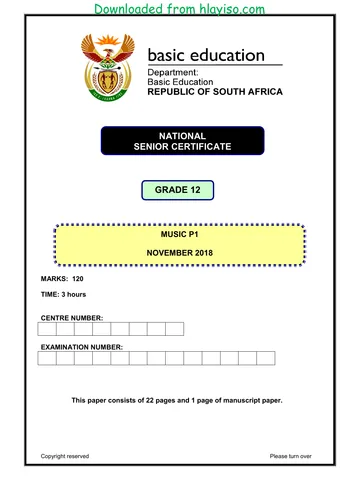
SENIOR CERTIFICATE EXAMINATIONS
MUSIC P1
2018
MARKS: 120
TIME: 3 hours
CENTRE NUMBER:
EXAMINATION NUMBER:
This question paper consists of 23 pages and 1 page of manuscript paper.
Copyright reserved Please turn over
Skip to contentAll 2018 papers 
View all
Music Grade 12 P1 NSC June 2018 Question Paper (English)
Grade 12 Music Paper 1 question paper from the NSC June Exam 2018 (English), 24 pages. Read online or get the free PDF download, memo linked when available.
Music · Grade 12 · NSC June Exam · 2018. Question paper, 24 pages. Read online or download the PDF.
- Subject
- Music
- Grade
- Grade 12
- Document type
- Question paper
- Year
- 2018
- Exam period
- NSC June Exam
- Paper
- 1
- Curriculum
- CAPS
- Pages
- 24
- File size
- 631.2 KB
Free to read online, no sign-up needed
Loading document…
Loading document…
1 of 24
This exam
Questions in this paper
- Question 1Scales, Keys, Modes & Intervals20 marks
- Question 2Harmony, Chords & Composition30 marks
- Question 3Harmony, Chords & Composition20 marks
- Question 4Harmony, Chords & Composition30 marks
- Question 5Notation, Rhythm & Metre20 marks
- Question 6Western Art Music (WAM) — General Knowledge & Set Works [WAM]10 marks
Document textSearch extracted text and jump to a page.
Downloaded from hlayiso.com
Music/P1 2 DBE/2018
SCE
INSTRUCTIONS AND INFORMATION
1. This question paper consists of FIVE sections, namely SECTIONS A, B, C, D
and E.
2. SECTIONS A and B are COMPULSORY.
3. SECTION C: WESTERN ART MUSIC (WAM), SECTION D: JAZZ and
SECTION E: INDIGENOUS AFRICAN MUSIC (IAM) are choice questions.
Answer only ONE of these sections (SECTION C or D or E).
4. Write all music notations in SECTION A in pencil and all written text in blue or
black ink on this question paper.
5. Answer SECTION B and SECTION C or D or E in blue or black ink in the
ANSWER BOOK provided.
6. Number the answers correctly according to the numbering system used in this
question paper.
7. The last page of this question paper is manuscript paper intended for rough
work. Candidates may remove this page.
8. Candidates may NOT have access to any musical instrument for the duration
of this examination.
9. Candidates must take note of the mark allocation for each question to provide
enough information in their answers.
10. Write neatly and legibly.
Copyright reserved Please turn over
Downloaded from hlayiso.com
Music/P1 3 DBE/2018
SCE
MARKING GRID
SECTION QUESTION MARKS MARKER MODERATOR
A: THEORY OF MUSIC 1 20
(COMPULSORY)
2 15
3 10
4 15
SUBTOTAL 60
AND
B: GENERAL MUSIC
KNOWLEDGE 5 20
(COMPULSORY)
SUBTOTAL 20
AND
C: WAM 6 10
7 5
8 5
9 5
10 15
SUBTOTAL 40
OR
D: JAZZ 11 10
12 5
13 5
14 5
15 15
SUBTOTAL 40
OR
E: IAM 16 10
17 5
18 5
19 5
20 15
SUBTOTAL 40
GRAND TOTAL 120
\
Copyright reserved Please turn over
Downloaded from hlayiso.com
Music/P1 4 DBE/2018
SCE
SECTION A: THEORY OF MUSIC (COMPULSORY) (90 minutes)
Answer QUESTION 1
AND QUESTION 2.1 OR 2.2
AND QUESTION 3.1 OR 3.2
AND QUESTION 4.1 OR 4.2.
Answer the questions in the spaces provided on this question paper.
QUESTION 1 (25 minutes)
Study the extract from Beethoven's Violin Sonata Op. 34 and answer the questions
that follow.
Copyright reserved Please turn over
Downloaded from hlayiso.com
Music/P1 5 DBE/2018
SCE
1.1 Name the main key of this piece.
__________________________________ (1)
1.2 Name the intervals at (a) and (b) according to type and distance.
(a) __________________________________
(b) __________________________________ (2)
1.3 Transpose the treble clef part of the piano accompaniment of bars 2 to 31 at X
a minor 3rd higher. Insert the new key signature.
(3)
1.4 Rewrite the treble clef part of the piano accompaniment of bars 2 to 31 at X
an octave lower to be played by a viola. Insert the correct clef and key
signature.
(3)
1.5 Name the triads at (c) and (d) according to type and position. Consider only the
notes in the block.
(c) __________________________________
(d) __________________________________ (2)
1.6 Add accidentals to certain ascending notes in bar 7 at Y to form a chromatic
passage.
(2)
Copyright reserved Please turn over
Downloaded from hlayiso.com
Music/P1 6 DBE/2018
SCE
1.7 Name the key to which the music modulates in bars 8 to 10.
__________________________________ (1)
1.8 Circle the enharmonic equivalent of Eb on the score. (1)
1.9 Complete the melodic fragment below by adding TWO ascending sequences in the
space provided.
Motif/Motief
(2)
1.10 Name the type of scale on which the passage below is based.
__________________________________ (1)
1.11 Complete the following whole-tone scale by adding semibreves at the asterisks (*).
(2)
[20]
Copyright reserved Please turn over
Downloaded from hlayiso.com
Music/P1 7 DBE/2018
SCE
QUESTION 2 (25 minutes)
Answer EITHER QUESTION 2.1 OR QUESTION 2.2.
2.1 Complete the opening motif below to form a twelve-bar melody in ternary form
for any single-line melodic instrument of your choice. Name the instrument for
which you are writing. Indicate the tempo and add dynamic and articulation
indications.
Instrument: ____________________ Tempo: ________________
The melody will be marked according to the following criteria:
MARK CANDIDATE'S
DESCRIPTION
ALLOCATION MARKS
Form and cadential points 3
Correctness
2
Note stems, beats per bar, accidentals, spacing, layout
Quality
10
Suitability, musicality, dynamics, articulation, tempo
TOTAL 15
[15]
OR
Copyright reserved Please turn over
Downloaded from hlayiso.com
Music/P1 8 DBE/2018
SCE
2.2 Complete the opening motif below to form a twelve-bar melody in ternary form
for any single-line melodic instrument of your choice. Name the instrument for
which you are writing. Indicate the tempo and add dynamic and articulation
indications.
Instrument: ______________________ Tempo:________________________
The melody will be marked according to the following criteria:
MARK CANDIDATE'S
DESCRIPTION
ALLOCATION MARKS
Form and cadential points 3
Correctness
2
Note stems, beats per bar, accidentals, spacing, layout
Quality
10
Suitability, musicality, dynamics, articulation, tempo
TOTAL 15 [15]
Copyright reserved Please turn over
Downloaded from hlayiso.com
Music/P1 9 DBE/2018
SCE
BLANK PAGE
Copyright reserved Please turn over
Downloaded from hlayiso.com
Music/P1 10 DBE/2018
SCE
QUESTION 3 (10 minutes)
Answer EITHER QUESTION 3.1 OR QUESTION 3.2.
3.1 Study the extract from the chorale Es ist gewisslich an der Zeit by JS Bach
and answer the questions that follow.
3.1.1 Name the key of this extract.
___________________________________________________ (1)
3.1.2 Identify chords (a) to (d) and figure them on the score. Use Roman
numerals, e.g. IV. (4)
3.1.3 Figure and name the cadence at (e) in bar 4.
Cadence____________________________________________ (2)
Copyright reserved Please turn over
Downloaded from hlayiso.com
Music/P1 11 DBE/2018
SCE
3.1.4 Name the type of non-chordal note at (i) and (ii).
(i) ___________________________________________________
(ii) ___________________________________________________ (2)
3.1.5 With which cadence does this extract end?
_____________________________________________________ (1)
[10]
OR
Copyright reserved Please turn over
Downloaded from hlayiso.com
Music/P1 12 DBE/2018
SCE
3.2 Study the extract below from Smoke Gets In Your Eyes by Jerome Kern and
answer the questions that follow.
Copyright reserved Please turn over
Downloaded from hlayiso.com
Music/P1 13 DBE/2018
SCE
3.2.1 The main key of this work is C major. Which ONE of the keys
below is the submediant minor of this key? Make a cross (X) in the
appropriate block.
Ab minor E minor C minor A minor (1)
3.2.2 Identify chords (a) to (e) and figure them on the score. Use chord
symbols above the score, e.g. Bb/D. (5)
3.2.3 Name the type of non-chordal notes at (i), (ii) and (iii).
(i) _____________________________________________
(ii) _____________________________________________
(iii) _____________________________________________ (3)
3.2.4 Name the cadence at X in bars 8 and 9.
________________________________________________ (1)
[10]
Copyright reserved Please turn over
Downloaded from hlayiso.com
Music/P1 14 DBE/2018
SCE
QUESTION 4 (30 minutes)
Answer EITHER QUESTION 4.1 OR QUESTION 4.2.
4.1 Complete the four-part vocal harmonisation below by adding the alto, tenor
and bass parts.
The harmonisation will be marked according to the following criteria:
CANDIDATE'S
DESCRIPTION MARK ALLOCATION
MARKS
Chord progression
12
Choice of chords, correct use of cadence
Correctness
14
Notation, doubling, spacing, voice leading
Quality
Musicality, non-chordal notes, awareness of style, 4
creativity
30 ÷ 2
TOTAL 15
[15]
OR
Copyright reserved Please turn over
Downloaded from hlayiso.com
Music/P1 15 DBE/2018
SCE
4.2 Complete the piece below by adding a suitable bass line and harmonic
material in the incomplete bars. Continue in the style suggested by the given
material in bars 1 and 2.
The harmonisation will be marked according to the following criteria:
CANDIDATE'S
DESCRIPTION MARK ALLOCATION
MARKS
Chord progression
14
Choice of chords, correct use of cadence
Correctness
12
Notation, doubling, spacing, voice leading
Quality
Musicality, non-chordal notes, awareness of style, 4
creativity
30 ÷ 2
TOTAL 15
[15]
TOTAL SECTION A: 60
Copyright reserved Please turn over
Downloaded from hlayiso.com
Music/P1 16 DBE/2018
SCE
SECTIONS B, C, D, E: GENERAL MUSIC KNOWLEDGE (90 minutes)
Answer SECTION B
AND SECTION C (Western Art Music)
OR SECTION D (Jazz)
OR SECTION E (Indigenous African Music).
Answer these questions in the ANSWER BOOK provided.
SECTION B: GENERAL (COMPULSORY)
QUESTION 5
5.1 Various options are provided as possible answers to the following
questions/statements. Choose the answer and write only the letter (A to D)
next to the question numbers (5.1.1 to 5.1.10) in the ANSWER BOOK,
e.g. 5.1.11 D.
5.1.1 Meaning of polyphonic:
A Music with more than one melody or voice
B Two or more simultaneous lines of independent melody
C Two or more instruments playing together
D All of the above-mentioned
5.1.2 Syncopation is a term ...
A used only in pop music.
B referring to a passage with sharp accents.
C describing accents on the normally weak beats.
D All of the above-mentioned
5.1.3 An accordion is typically used in …
A boeremusiek.
B Baroque music.
C isicathamiya.
D Romantic music.
5.1.4 Tonal music …
A is based on major and minor scales.
B uses related keys in a single piece or movement.
C includes music from the Baroque and Romantic eras.
D All of the above-mentioned
5.1.5 Timbre is the …
A specific quality of a musical sound.
B type of sound a specific instrument makes, e.g. the clarinet.
C tone colour of a group of instruments, e.g. the strings.
D All of the above-mentioned
Copyright reserved Please turn over
Downloaded from hlayiso.com
Music/P1 17 DBE/2018
SCE
5.1.6 A very soft, dynamic level in music:
A Piano
B Mezzo piano
C Pianissimo
D All of the above-mentioned
5.1.7 ABA structure of a music work is also called …
A ternary form.
B binary form.
C verse and chorus.
D call and response.
5.1.8 Which of the following is a typical African instrument?
A Clarinet
B Mbira
C Sitar
D Koto
5.1.9 Which of the following instruments is an idiophone?
A Cowbell
B Djembe
C Banjo
D Saxophone
5.1.10 The term a cappella refers to a …
A chapel choir.
B solo.
C work without accompaniment.
D muted performance. (10 x 1) (10)
5.2 Answer the questions that follow.
5.2.1 Define the term texture with reference to music. (1)
5.2.2 Name and describe any TWO types of texture. (4)
5.3 Apart from being a performer, name FOUR other careers that you can follow
in the music industry. (4)
5.4 Define the term mechanical rights. (1)
TOTAL SECTION B: 20
Copyright reserved Please turn over
Downloaded from hlayiso.com
Music/P1 18 DBE/2018
SCE
Answer SECTION C (WAM)
OR SECTION D (JAZZ)
OR SECTION E (IAM).
SECTION C: WESTERN ART MUSIC (WAM)
QUESTION 6
6.1 Describe THREE of the following:
6.1.1 Symphonic poem
6.1.2 Opera seria
6.1.3 Overture
6.1.4 Aria (3 x 2) (6)
6.2 Give ONE word/term for FOUR of the following descriptions:
6.2.1 The woodwind instrument that was played in the Classical
orchestra but not in the Baroque orchestra
6.2.2 A non-transposing instrument in an orchestra's brass section
6.2.3 A double-reed instrument found in the standard Classical orchestra
6.2.4 A plucked sound played by the string players
6.2.5 An Italian tempo indication which means slowly (4)
[10]
QUESTION 7
Write a paragraph in which you briefly comment on the comic nature of Mozart's opera,
Die Zauberflöte by referring to the character of Papageno and his aria,
Der Vogelfänger bin ich ja. [5]
Copyright reserved Please turn over
Downloaded from hlayiso.com
Music/P1 19 DBE/2018
SCE
QUESTION 8
Complete the comparison below of the first movement of Symphony No. 6 in F major,
Op. 68 by Beethoven and the Overture to Die Zauberflöte by Mozart. Write only the
answers next to the question numbers (8.1 to 8.5) in the ANSWER BOOK,
e.g. 8.6 Ternary form.
BEETHOVEN MOZART
First Movement Overture to
Symphony No. 6 Die Zauberflöte
Tempo Allegro ma non troppo 8.1
Form 8.2 8.3
Instrumentation 8.4 8.5
Standard Classical orchestra plus … [5]
QUESTION 9
Although Mendelssohn's Hebrides Overture was written during the Romantic style
period, it was still heavily influenced by typical characteristics of the Classical period.
Write a paragraph in which you describe these Classical influences. [5]
QUESTION 10
Beethoven's Symphony No. 6 in F major, Op. 68 has a subtitle, A recollection of
country life.
Refer to the statement above and write an essay in which you discuss the different
expressions of country life in the FOURTH and FIFTH movements. Refer to the title
and tone painting in these movements of the symphony.
You will be credited for the logical presentation of facts and the structure of your essay.
The essay will be marked according to the following criteria:
CRITERIA MARK ALLOCATION
Fourth movement: Title 1
Tone painting 5
Fifth movement: Title 1
Tone painting 5
Logical presentation and structure of the essay 3
TOTAL 15 [15]
TOTAL SECTION C: 40
OR
Copyright reserved Please turn over
Downloaded from hlayiso.com
Music/P1 20 DBE/2018
SCE
SECTION D: JAZZ
QUESTION 11
11.1 Describe the following terms:
11.1.1 Swing rhythm
11.1.2 Scatting
11.1.3 Ghoema
11.1.4 Malombo (4 x 2) (8)
11.2 Give a term for the following statements:
11.2.1 An early American piano style that influenced marabi (1)
11.2.2 A short repeated phrase in jazz typically used as an introduction (1)
[10]
QUESTION 12
Choose ONE of the performers and state which music characteristics you would
expect to hear if you attend a concert by either Dolly Rathebe, Thandi Klaasen or
Miriam Makeba. [5]
QUESTION 13
Compare the kwela, mbaqanga and marabi music styles with one another. Write only
the answers next to the question numbers (13.1 to 13.5) in the ANSWER BOOK,
e.g. 13.6 Brenda Fassie.
KWELA MBAQANGA MARABI
Artist/band 13.1 13.2 The Manhattan
Brothers
Harmonic I-IV-V-I I-IV-V-I 13.4
progression
Instrumentation 13.3 Backing band 13.5
and vocals [5]
QUESTION 14
Write a paragraph in which you describe the typical characteristics of the music of ONE
of the artists/bands below:
• Zim Nqawana
• Spirits Rejoice
• Sakhile [5]
Copyright reserved Please turn over
Downloaded from hlayiso.com
Music/P1 21 DBE/2018
SCE
QUESTION 15
Write an essay on the music of ONE of the following South African jazz artists:
• Abdullah Ibrahim
• Robbie Jansen
• Winston Mankunku Ngozi
Discuss the artist's music by referring to influences, rhythm, harmony, melody, texture
and instrumentation. Name at least TWO albums/songs to substantiate your answer.
You will be credited for the logical presentation of facts and the structure of your essay.
The essay will be marked according to the following criteria:
CRITERIA MARK ALLOCATION
Music characteristics 10
Albums/Songs 2
Logical presentation and structure of the essay 3
TOTAL 15 [15]
TOTAL SECTION D: 40
OR
Copyright reserved Please turn over
Downloaded from hlayiso.com
Music/P1 22 DBE/2018
SCE
SECTION E: INDIGENOUS AFRICAN MUSIC (IAM)
QUESTION 16
16.1 Describe the following terms:
16.1.1 Isihlabo (2)
16.1.2 Malombo (2)
16.1.3 Kiba (2)
16.1.4 Amahubo (2)
16.2 With which instrument do you associate TWO of the following statements?
16.2.1 The smallest drum used in Kiba music
16.2.2 The chordophone that influenced the tuning style of the maskandi
guitar
16.2.3 The drum used to accompany songs that call the ancestral spirits
in vhaVenda culture (2)
[10]
QUESTION 17
Izibongo is an integral feature of a maskandi song.
Expand on this statement by referring to the role of izibongo in maskandi. [5]
QUESTION 18
Complete the comparison below of the malombo, mbaqanga and maskandi music
styles. Write only the answers next to the question numbers (18.1 to 18.5) in the
ANSWER BOOK, e.g. 18.6 Miriam Makeba.
MALOMBO MBAQANGA MASKANDI
Artist/band Malombo Jazz 18.1 Shwi Nomthekala
Makers
Chord 18.2 I-IV-V-I 18.3
progression
Instrumentation 18.4 18.5 Backing band + guitar +
Backing band + concertina and vocals
guitar + … [5]
Copyright reserved Please turn over
Downloaded from hlayiso.com
Music/P1 23 DBE/2018
SCE
QUESTION 19
Describe the importance of rhythm in African music. [5]
QUESTION 20
Zulu indigenous beliefs have influenced the music and performance practices of
isicathamiya.
Discuss the statement above by referring to the following:
• Relevance of animals
• Zulu family residence
• Stick fighting competitions (ukuqatha)
• Umuntu ngumuntu ngabantu
You will be credited for the logical presentation of facts and the structure of your essay.
The essay will be marked according to the following criteria:
CRITERIA MARK ALLOCATION
The relevance of animals 3
Zulu family residence 4
Stick fighting competitions (ukuqatha) 3
Umuntu ngumuntu ngabantu 2
Logical presentation and structure of the essay 3
TOTAL 15 [15]
TOTAL SECTION E: 40
GRAND TOTAL: 120
Copyright reserved Please turn over
Downloaded from hlayiso.com
Music/P1 DBE/2018
SCE
Copyright reserved
Study this subject
Recommended for this subject
Question paper
Music Grade 12 P1 NSC June 2018 Question Paper (Afrikaans)
Memorandum
Music Grade 12 Paper 1 NSC June 2018 Memo (Afrikaans)
Question paper
Music Grade 12 P2 NSC June 2018 Question Paper (Afrikaans)
Question paper
Music Grade 12 P1 NSC November 2018 Question Paper (English)
Question paper
Music Grade 12 P1 NSC November 2018 Question Paper (Afr)
Question paper
Music Grade 12 P1 NSC Supplementary 2018 QP (Eng)
More from Grade 12 Music
Memorandum
Music Grade 12 Paper 1 NSC June 2025 Memo (Afrikaans)
Memorandum
Music Grade 12 Paper 2 NSC June 2025 Memo (Afrikaans)
Memorandum
Music Grade 12 Paper 2 NSC November 2025 Memo (English)
Memorandum
Music Grade 12 Paper 1 November 2024 NSC Memo (English)
Memorandum
Music Grade 12 Paper 1 NSC June 2024 Memo (English)
Question paper