
Downloaded from hlayiso.com
PROVINCIAL ASSESSMENT
GRADE 10
GEOGRAPHY P1
NOVEMBER 2019
MARKING GUIDELINE
FEBRUARY 2019
MARKS: 225
This marking guideline consists of 13 pages.
Copyright reserved Please turn over
Skip to contentAll 2019 papers 
View all
Geography Grade 10 P1 North West November 2019 Memo (Eng)
Grade 10 Geography Paper 1 memorandum from the North West November 2019 (English), 13 pages. Read online or download the free PDF.
Geography · Grade 10 · North West November · 2019. Memorandum, 13 pages. Read online or download the PDF.
- Subject
- Geography
- Grade
- Grade 10
- Document type
- Memorandum
- Year
- 2019
- Exam period
- North West November
- Paper
- 1
- Curriculum
- CAPS
- Pages
- 13
- File size
- 266.4 KB
Free to read online, no sign-up needed
Loading document…
Loading document…
1 of 13
This exam
North West November 2019
Questions in this paper
- Question 1.1The atmosphere8 marks
- Question 1.2The atmosphere7 marks
- Question 1.3The atmosphere15 marks
- Question 1.4Geomorphology15 marks
- Question 1.5The atmosphere15 marks
- Question 1.6The atmosphere15 marks
Show all 24 questions
- Question 2.1The atmosphere8 marks
- Question 2.2Geomorphology7 marks
- Question 2.3The atmosphere15 marks
- Question 2.4Geomorphology15 marks
- Question 2.5The atmosphere15 marks
- Question 2.6Geomorphology15 marks
- Question 3.1Population8 marks
- Question 3.2Population7 marks
- Question 3.3Population15 marks
- Question 3.4Water resources15 marks
- Question 3.5Population15 marks
- Question 3.6Water resources15 marks
- Question 4.1Population8 marks
- Question 4.2Water resources7 marks
- Question 4.3Water resources15 marks
- Question 4.4Water resources15 marks
- Question 4.5Population15 marks
- Question 4.6Water resources15 marks
Document textSearch extracted text and jump to a page.
Downloaded from hlayiso.com
Geography/P1 2 NW/November 2019
NSC – Grade 10 – Marking Guideline
QUESTION 1:
1.1.1 B
1.1.2 D
1.1.3 C
1.1.4 C
1.1.5 A
1.1.6 D
1.1.7 A
1.1.8 C (8 x 1) (8)
1.2.1 Conduction
1.2.2 Dew point temperature
1.2.3 Leeward side
1.2.4 Magma
1.2.5 Exosphere/Thermosphere
1.2.6 Sedimentary
1.2.7 Syncline (7 x 1) (7)
1.3.1 2,5 km (1 x 1) (1)
1.3.2 The more humid the air the higher the condensation level (1 x 1) (1)
1.3.3 8°C (1 x 1) (1)
1.3.4 Cirrus (1 x 1) (1)
1.3.5 Convectional rain (1 x 2) (2)
1.3.6 Climate conditions: Areas with high temperatures and moist air
Area: Interior of South Africa /
Summer rainfall regions in South Africa (2 x 2) (4)
1.3.7 A – Cirrus
B – Cumulus
C – Stratus
D – Stratocumulus
E - Altocumulus (5 x 1) (5)
Copyright reserved Please turn over
Downloaded from hlayiso.com
Geography/P1 3 NW/November 2019
NSC – Grade 10 – Marking Guideline
1.4.1 The area on the surface of the earth immediately above the focus is called the
epicenter. (1 x 1) (1)
1.4.2 7.1 magnitude (1 x 1) (1)
1.4.3 Richter scale (1 x 1) (1)
1.4.4 Locate active fault zones
Identify high risk areas
Predict where earthquakes might strike
Make sure emergency services are in place
Build dams along fault lines to absorb the shocks
Strengthen existing infrastructure and houses
Build strong breakwaters to protect coastal areas
Built earthquake resistant buildings
Early warning systems for tsunami’s (any two) (2 x 2) (4)
1.4.5 A lot of people died
Buildings collapsed
Debris injured people and landed in the streets
Fires could have broken out
People are homeless
Water pipes and infrastructure broken
Broken gas and fuel lines cause danger
Collapsed bridges and highways made emergency services difficult
Windows shattered and injured people (any four) (4 x 2) (8)
1.5.1 Insolation is incoming short-wave radiation from the sun. (1 x 1) (1)
1.5.2 Reflection (1 x 1) (1)
1.5.3 Upward (1 x 1) (1)
1.5.4 Absorption Scattering Reflection (3 x 1) (3)
Copyright reserved Please turn over
Downloaded from hlayiso.com
Geography/P1 4 NW/November 2019
NSC – Grade 10 – Marking Guideline
1.5.5 Carbon dioxide;
methane;
CFCs;
nitrous oxide;
water vapour (Any two) (2 x 2) (4)
1.5.6 Increasing occurrence of skin cancer
Leather-like skin
Eye diseases such as cataracts
Weakened immune systems (Any two) (2 x 2) (4)
1.6.1 South Atlantic High Pressure cell (1 x 1) (1)
1.6.2 1032 hPa (1 x 1) (1)
1.6.3 Cold front (1 x 1) (1)
1.6.4 Winter (1 x 2) (2)
1.6.5 a) 16 ° C
b) South West
c) Fully overcast/ 8/8
d) 20 knots (kt)
e) none (5 x 2) (10)
[75]
Copyright reserved Please turn over
Downloaded from hlayiso.com
Geography/P1 5 NW/November 2019
NSC – Grade 10 – Marking Guideline
QUESTION 2:
2.1.1 Troposphere
2.1.2 Stratosphere
2.1.3 Mesosphere
2.1.4 Water vapour
2.1.5 Ultra violet
2.1.6 Stratosphere
2.1.7 Temperature inversion
2.1.8 Albedo (8 x 1) (8)
2.2.1 Mantle
2.2.2 Iron
2.2.3 Humans live on the surface of the earth and grow food in the soil.
2.2.4 Mohorovicic discontinuity/Moho-level
2.2.5 Plates
2.2.6 5 000 ° C
2.2.7 Mantle (7 x 1) (7)
2.3.1 The gradual warming of the earth’s atmosphere by the addition of
greenhouse gasses. (1 x 1) (1)
2.3.2 Livestock/cattle (1 x 2) (2)
2.3.3 “warms the world 20 times faster than carbon dioxide” (1 x 2) (2)
2.3.4 They indirectly cause acid rain,
alien species,
desertification,
dead zones in oceans
poisonous water. (any one) (1 x 2) (2)
Copyright reserved Please turn over
Downloaded from hlayiso.com
Geography/P1 6 NW/November 2019
NSC – Grade 10 – Marking Guideline
2.3.5 Save electricity
Use higher standard of electrical appliences
Carbon tax
Energy tax
Expand transport system
Set carbon emission limits
Set speed limits on roads
Use electric vehicles
Reduce the use of fertilisers
Expand methane extraction
Reduce CFC production (Any four) (4 x 2) (8)
2.4.1 Alfred Wegener (1 x 1) (1)
2.4.2 A move away from one another
B move toward one another (2 x 1) (2)
2.4.3 A Divergent boundary
B Convergent boundary (2 x 2) (4)
2.4.4 The plates float on the molten mantle
The crust of the earth is broken in several large pieces that constantly move in
different directions.
The crust of the earth had broken into seven plates which move around on the
molten outer mantle.
The different plates can move away and towards one another on the molten mantle
of the earth.
The plates are not fixed and can move because it slides around on the liquid and
molten outer mantle of the earth. (Any two) (2 x 2) (4)
2.4.5 Plant and animal life are similar
Glacial deposits in Brazil and West Africa match
Fossil remains are the same
Rock formations line up on the two continents (any two) (2 x 2) (4)
Copyright reserved Please turn over
Downloaded from hlayiso.com
Geography/P1 7 NW/November 2019
NSC – Grade 10 – Marking Guideline
2.5.1 When changes in the earth’s climate system result in new weather patterns that
last for a few decades. (1 x 1) (1)
2.5.2 Global warming (1 x 2) (2)
2.5.3 Fish species might die because of the temperature change in the water.
Marine life might become extinct when their habitat changes and they do not have
enough food.
The fish will not be able to live in warmer water.
The change of temperature in the marine ecosystem will lead to species to
become extinct. (Any one) (1 x 2) (2)
2.5.4 3 000 years (1 x 2) (2)
2.5.5 Expanding oceans lead to the rising of sea level which may lead to flooding of
coastlines.
Changing of precipitation patterns
Change in weather patterns leads to an increase of extreme weather
Changes in soil quality and vegetation
Changes in ecosystems and loss in biodiversity. (any four) (4 x 2) (8)
2.6.1 3 500 people (1 x 1) (1)
2.6.2 The blanket of ash left thousands of animals without pasture and water. (1 x 2) (2)
2.6.3 Composite (1 x 2) (2)
2.6.4 Active – still erupts constantly
Dormant – shows no sign of activity, but can still erupt again. (1 x 2) (2)
2.6.5 South America and Australia (2 x 2) (4)
2.6.6 A Pipe/central vent
C Dyke
D Sill
E Magma chamber/Batholith (4 x 1) (4)
[75]
Copyright reserved Please turn over
Downloaded from hlayiso.com
Geography/P1 8 NW/November 2019
NSC – Grade 10 – Marking Guideline
QUESTION 3:
3.1.1 Life expectancy
3.1.2 Emigration
3.1.3 Marti culture
3.1.4 Pull factors
3.1.5 Population density
3.1.6 Literacy rate
3.1.7 Depopulation
3.1.8 Population distribution (8 x 1) (8)
3.2.1 I
3.2.2 J
3.2.3 E
3.2.4 D
3.2.5 C
3.2.6 G
3.2.7 F (7 x 1) (7)
3.3.1 A bar chart, arranged vertically, that shows the distribution of a population by a
category such as age/sex. (1 x 1) (1)
3.3.2 5 years (1 x 1) (1)
3.3.3 Concave profile (1 x 1) (1)
3.3.4 wide (1 x 2) (2)
3.3.5 Very large young population/
high birth rate
Very few elderly/
High death rate (2 x 2) (4)
Copyright reserved Please turn over
Downloaded from hlayiso.com
Geography/P1 9 NW/November 2019
NSC – Grade 10 – Marking Guideline
3.3.6 A – Dependents/youth
B – Economically active/ adult
C – Dependents/elderly (3 x 2) (6)
3.4.1 Water demand is outstripping supply. (1 x 1) (1)
3.4.2 Tugela-Vaal
Orange river project
Berg river scheme
Lesotho highlands water project
uThukela-uMahlatuze Scheme
Mooi-Umgeni scheme (any two) (2 x 1) (2)
3.4.3 It reduces water for downstream users.
Rotting vegetation in the dams releases greenhouse gasses.
Dam wall blocks fish migration
Disturbs ecosystems (any two) (2 x 2) (4)
3.4.4 Make sure that research is conducted into alternative water supplies
Encourage recycling of water
Enforce laws that prevent pollution of water sources
Restore wetlands
Remove alien vegetation
Educate people about conservation of water (any four) (4 x 2) (8)
3.5.1 Decreasing birth rates. (1 x 1) (1)
3.5.2 The population becomes less. (1 x 2) (2)
3.5.3 The foreigners immigrating into Norway make up for the low birth rate. (1 x 2) (2)
3.5.4 A low to negative birth rate
A low death rate (any one) (1 x 2) (2)
3.5.5 There will be less people in the economically active age group
The economy might suffer as a result of fewer people in the work force. (2 x 2) (4)
Copyright reserved Please turn over
Downloaded from hlayiso.com
Geography/P1 10 NW/November 2019
NSC – Grade 10 – Marking Guideline
3.5.6 Negative Cultural differences might cause strain.
Xenophobia might be a problem.
Positive Foreigners bring new knowledge with them.
Foreigners might have new skills
(one positive and one negative) (2 x 2) (4)
3.6.1 57 percent (1 x 1) (1)
3.6.2 57 percent (1 x 2) (2)
3.6.3 Piped water is safe to drink
Piped water is easy to come by.
Piped water is available most of the time.
People could contract water borne diseases if they drink unimproved water (2 x 2) (4)
3.6.4 People cloud contract diarrhea
People could get other water borne diseases and could die as a result. (2 x 2) (4)
3.6.5 Strict regulations and fines for industries that pollute the rivers.
Restricting access to the dams
Making sure that people do not dump rubbish in the water.
Make more money available for research (any two) (2 x 2) (4)
[75]
Copyright reserved Please turn over
Downloaded from hlayiso.com
Geography/P1 11 NW/November 2019
NSC – Grade 10 – Marking Guideline
QUESTION 4:
4.1.1 A
4.1.2 C
4.1.3 B
4.1.4 A
4.1.5 D
4.1.6 C
4.1.7 B
4.1.8 C (8 x 1) (8)
4.2.1 Evapotranspiration
4.2.2 Condensation
4.2.3 Precipitation
4.2.4 Infiltration
4.2.5 Run off/sheet wash
4.2.6 Groundwater
4.2.7 Evaporation (7 x 1) (7)
4.3.1 A person who moves from one place to another, especially to find work and better
living conditions. (1 x 1) (1)
4.3.2 Brain drain is when skilled and educated people leave a country to live elsewhere. (1 x 1) (1)
4.3.3 When skilled people leave the country, they leave the job market or close their
businesses down leading to their unskilled workers being unemployed. (1 x 1) (1)
4.3.4 Lack of skilled people to educate others; job losses as result of companies closing
down. (1 x 2) (2)
4.3.5 The drop in standard of living
Drop in standard of education
Drop in standard of health services,
The high crime rate
The falling value of the rand. (any two) (2 x 2) (4)
Copyright reserved Please turn over
Downloaded from hlayiso.com
Geography/P1 12 NW/November 2019
NSC – Grade 10 – Marking Guideline
4.3.6 (a) The seasonal movement of people with their livestock over a short
distance to higher pastures in Summer and lower valleys in winter. (2 x 2) (4)
(b) India
Scotland
Switzerland
Greece
Lesotho (any one) (1 x 2) (2)
4.4.1 Seawater can be processed to remove the salt from it and turn it into fresh water
that humans can drink and use. (1 x 1) (1)
4.4.2 Israel (1 x 1) (1)
4.4.3 It is very expensive
Uses a lot of electricity (any one) (1 x 1) (1)
4.4.4 The extreme drought in the Western Cape (1 x 2) (2)
4.4.5 Reverse osmosis (1 x 2) (2)
4.4.6 Orange river (1 x 2) (2)
4.4.7 The demand in Gauteng exceeds the availability. (1 x 2) (2)
4.4.8 South Africa is a dry country with little rainfall.
South Africa has few perennial rivers
People do not use water sparingly in South Africa (any two) (2 x 2) (4)
4.5.1 a) Human Immunodeficiency Virus
b) Acquired Immune Deficiency Syndrome (2 x 1) (2)
4.5.2 Negatively (1 x 1) (1)
4.5.3 3,2 (1 x 2) (2)
4.5.4 Swaziland (1 x 2) (2)
4.5.5 Destabilisation of families
Health facilities struggle to cope with the volume of patients
Insurance companies suffer
Production and labour supply are less
People are more often absent from work.
Economy suffers as result of people being sick/die. (any four) (4 x 2) (8)
Copyright reserved Please turn over
Downloaded from hlayiso.com
Geography/P1 13 NW/November 2019
NSC – Grade 10 – Marking Guideline
4.6.1 The amount of fish people are allowed to catch by law. (1 x 1) (1)
4.6.2 24 percent (1 x 1) (1)
4.6.3 Fish stocks in the ocean are very low and people who depend on income from
fishing will have no income. (1 x 2) (2)
4.6.4 a) South African Sustainable Seafood Initiative (1 x 2) (2)
b) They have made a pocket size card telling people which fish species have
good stock levels.
They educate people about stock levels of fish. (2 x 2) (4)
4.6.5 a) 15 mm
b) 15h30 to 16h00
c) 100 cumegs
d) 18h00 to 18h30
e) 15h30 to 18h00 = 2 and a half hours (5 x 1) (5)
[75]
GRAND TOTAL: 225
Copyright reserved Please turn over
Study this subject
Recommended for this subject
Memorandum
Geography Grade 10 P1 North West November 2019 Memo (Afr)
Addendum
Geography Grade 10 P1 North West November 2019 Addendum
Question paper
Geography Grade 10 P1 North West November 2019 QP (Eng)
Question paper
Geography Grade 10 P1 North West November 2019 QP (Afr)
Question paper
Geography Grade 10 P1 North West November 2019 QP (Afr)
Memorandum
Geography Grade 10 P1 National November 2019 Memo (Afr)
More from Grade 10 Geography
Study guide
Gr10 Geografie OG studyguide LR
Annual teaching plan
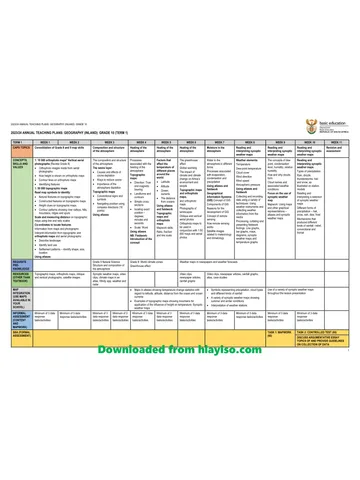
Gr 10 Geo ATP 2023 24
Question paper and memo
Geography Grade 10 Free State March Test 2025 Paper & Memo
Question paper and memo
Geography Grade 10 Paper 1 Limpopo June 2025 Paper & Memo
Question paper and memo
Geography Grade 10 Eastern Cape June 2024 Paper & Memo
Question paper