
Downloaded from hlayiso.com
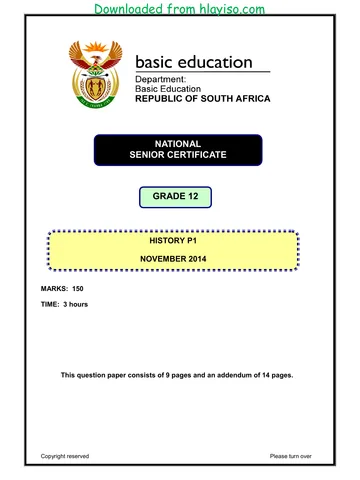
NATIONAL
SENIOR CERTIFICATE
GRADE 12
SEPTEMBER 2014
HISTORY P1
MARKS: 150
TIME: 3 hours
*HISTE1*
This question paper consists of 9 pages, and an addendum of 11 pages.
Skip to contentAll 2014 papers 
View all





History Grade 12 P1 Eastern Cape Mock 2014 QP (Eng)
Grade 12 History Paper 1 question paper from the Eastern Cape Mock Exam 2014 (English), 9 pages. Read online or download the free PDF.
History · Grade 12 · Eastern Cape Mock Exam · 2014. Question paper, 9 pages. Read online or download the PDF.
- Subject
- History
- Grade
- Grade 12
- Document type
- Question paper
- Year
- 2014
- Exam period
- Eastern Cape Mock Exam
- Paper
- 1
- Curriculum
- CAPS
- Pages
- 9
- File size
- 232.8 KB
Free to read online, no sign-up needed
Loading document…
Loading document…
1 of 9
This exam
Eastern Cape Mock Exam 2014
Questions in this paper
Document textSearch extracted text and jump to a page.
Downloaded from hlayiso.com
2 HISTORY P1 (SEPTEMBER 2014)
INSTRUCTIONS AND INFORMATION
1. This question paper consists of SECTION A and SECTION B based on the
prescribed content framework in the CAPS document.
SECTION A: SOURCE-BASED QUESTIONS
QUESTION 1: THE COLD WAR: THE ORIGINS OF THE COLD WAR
QUESTION 2: INDEPENDENT AFRICA: CASE STUDY – ANGOLA
QUESTION 3: CIVIL SOCIETY PROTESTS FROM THE 1950s TO THE
1970s – CIVIL RIGHTS MOVEMENT
SECTION B: ESSAY QUESTIONS
QUESTION 4: EXTENSION OF THE COLD WAR: CASE STUDY –
VIETNAM
QUESTION 5: INDEPENDENT AFRICA: COMPARATIVE CASE STUDY –
THE CONGO AND TANZANIA
QUESTION 6: CIVIL SOCIETY PROTESTS FROM THE 1950s TO THE
1970s: THE BLACK POWER MOVEMENT
2. SECTION A consists of THREE source-based questions. Source material that
is required to answer these questions will be found in the accompanying
ADDENDUM.
3. SECTION B consists of THREE essay questions.
4. Answer THREE questions as follows:
4.1 At least ONE (1) must be a source-based question and at least ONE
(1) must be an essay question.
4.2 The THIRD question can either be a source-based question or an
essay question.
5. Learners may answer two questions on the same topic/theme.
6. When candidates answer questions, they are required to demonstrate
application of knowledge, skills and insight.
7. Merely rewriting of the sources as answers will be to the disadvantage of
candidates.
8. Questions and subsections of questions must be numbered clearly and
correctly using the same numbering system used in the question paper.
9. Write neatly and legibly.
10. Start EACH question on a NEW page.
Copyright reserved Please turn over
Downloaded from hlayiso.com
(SEPTEMBER 2014) HISTORY P1 3
SECTION A: SOURCE-BASED QUESTIONS
Answer at least ONE question from this section.
QUESTION 1: HOW DID THE CONSTRUCTION OF THE BERLIN WALL
IMPACT ON EAST-WEST RELATIONS DURING THE COLD
WAR?
Study Sources 1A, 1B and 1C to answer the following questions.
1.1 Refer to Source 1A.
1.1.1 Using the source and your own knowledge, define the following
concepts in your own words.
(a) Cold War
(b) Communism (2 x 2) (4)
1.1.2 Why, according to the source, did people want to leave Eastern
Europe? (2 x 1) (2)
1.1.3 List THREE reasons why East Berliners were eager to move to West
Berlin. (3 x 1) (3)
1.1.4 Use the source and your own knowledge and explain why
Khrushchev ordered the building of the Berlin Wall. (2 x 2) (4)
1.1.5 How does the visual source support the written source regarding the
impact of the construction of the Berlin Wall? (1 x 3) (3)
1.1.6 Why, do you think, this photograph was taken? (2 x 2) (4)
1.2 Consider Source 1B.
1.2.1 What reasons does Viewpoint 1 provide for the building of the Berlin
Wall? (2 x 1) (2)
1.2.2 Using the source and your own knowledge, explain how the human
rights of the citizens of Berlin were violated by the building of the
Berlin Wall. Refer to both Viewpoints 1 and 2. (2 x 2) (4)
1.2.3 Explain the reliability of Source 1B to historians studying the reasons
for the building of the Berlin Wall. (2 x 2) (4)
1.3 Study Source 1C.
1.3.1 Quote evidence from the source which suggests that the movement
of East Germans to West Germany, affected East Germany. (1 x 2) (2)
Downloaded from hlayiso.com
4 HISTORY P1 (SEPTEMBER 2014)
1.3.2 Why, according to the source, could the economy of East Germany
not develop? (1 x 2) (2)
1.3.3 Using the source, explain what is meant by, “the East Germans
voted with their feet”. (1 x 2) (2)
1.3.4 Using the source and your own knowledge, explain the negative
effect that the defection of young, skilled and professional people
would have on the East German economy. (1 x 2) (2)
1.3.5 Use the source and your own knowledge and explain how Berlin
became the focal point of the Cold War tensions in Germany. (2 x 2) (4)
1.4 Write a paragraph of about EIGHT lines (80 words) in which you explain why
a historian would find both Source 1A and Source 1C useful in
understanding how the construction of the Berlin Wall impacted on (affected)
East-West tensions. (8)
[50]
Copyright reserved Please turn over
Downloaded from hlayiso.com
(SEPTEMBER 2014) HISTORY P1 5
QUESTION 2: WHY DID ANGOLA BECOME THE FOCAL POINT OF THE
COLD WAR IN AFRICA DURING THE 1970s AND 1980s?
Study Source 2A, 2B, 2C and 2D to answer the following questions.
2.1 Study Source 2A.
2.1.1 Which country, according to the source, colonised Angola before
1975? (1 x 2) (2)
2.1.2 Using the source and your own knowledge, mention TWO other
countries that had colonies in Africa. (2 x 1) (2)
2.1.3 What, according to the source, were the factors responsible for the
conflict in Angola? (2 x 1) (2)
2.1.4 Explain why you think that in the three Portuguese colonies,
“independence followed an armed liberation struggle.” (2 x 2) (4)
2.1.5 How, do you think, did Portugal’s withdrawal lead to the conflict in
Angola? (1 x 2) (2)
2.1.6 Using the source and your own knowledge, explain the concept civil
war. (1 x 2) (2)
2.1.7 Comment on the reliability of Source 2A to a historian researching the
civil war in Angola. (1 x 3) (3)
2.2 Refer to Source 2B.
2.2.1 Using the source, mention which liberation movements were
supported by the USSR, USA and China during the conflict in
Angola. (3 x 1) (3)
2.2.2 Using the source and your own knowledge, explain why the source
refers to the various movements in Angola as “clients” of the
superpowers. (1 x 2) (2)
2.2.3 Using your own knowledge and the source, give reasons why South
Africa became involved in Angola. (2 x 2) (4)
2.3 Consider Source 2C.
2.3.1 What are the limitations of this source to a historian studying the
Angolan Civil War? (2 x 2) (4)
2.3.2 How does Source 2C support Source 2B, regarding the involvement
of South Africa in the Angolan Civil War? (2 x 2) (4)
Downloaded from hlayiso.com
6 HISTORY P1 (SEPTEMBER 2014)
2.4 Use Source 2D.
2.4.1 How does Source 2D contradict (go against) the argument that the
USA entered the Angolan crisis as a result of Cuban intervention?
(1 x 2) (2)
2.4.2 How, according to the source, did the USA help to fuel/propel the
conflict in Angola? (2 x 1) (2)
2.4.3 How did the conflict between MPLA and UNITA cause instability in
the Southern African region? (2 x 2) (4)
2.5 Using the sources and your own knowledge write a paragraph of about
EIGHT lines (80 words) in which you explain the usefulness of Sources 2B,
2C and 2D to a historian researching how Angola became a focal point in the
Cold War. (8)
[50]
Copyright reserved Please turn over
Downloaded from hlayiso.com
(SEPTEMBER 2014) HISTORY P1 7
QUESTION 3: TO WHAT EXTENT WAS DESEGREGATION IN SCHOOLS
ACHIEVED IN USA DURING THE 1950s?
Study Sources 3A, 3B and 3C to answer the following questions.
3.1 Refer to Source 3A.
3.1.1 What, according to the source, was the decision of the US Supreme
Court in Brown versus Board of Education? (1 x 2) (2)
3.1.2 Why do you think that Governor Orval Faubus’ actions in calling for
the National Guard to prevent the students from entering the school,
be regarded as a violation of the students’ human rights? (2 x 2) (4)
3.1.3 What, according to the source, was Martin Luther King Jr’s appeal to
the US President in the light of the action taken by Governor Faubus?
(1 x 2) (2)
3.1.4 How did Eisenhower’s intervention benefit the government of the
USA? (2 x 2) (4)
3.1.5 Which groups of people, according to the source, stood firmly in
support of the actions of the US President? (3 x 1) (3)
3.2 Consider Source 3B.
3.2.1 How, according to the photograph, did the parents and the members
of the National Guard react towards Elizabeth Eckford? (1 x 2) (2)
3.2.2 Why, do you think, did the white parents, and the National Guard
members react in such a manner? (1 x 3) (3)
3.3 Use Sources 3A and 3B.
3.3.1 How does Source 3B support Source 3A regarding the treatment of
the black students when they arrived at Central High School? (2 x 2) (4)
3.3.2 Using Sources 3A and 3B explain whether you support Martin Luther
King Jr’s action of writing to the US President. (2 x 2) (4)
3.4 Consider Source 3C.
3.4.1 How, according to the source, were the Little Rock Nine treated by
white students at Central High? (3 x 1) (3)
3.4.2 Why did the majority of the Little Rock Nine not retaliate when
subjected to racial abuse? (2 x 2) (4)
Downloaded from hlayiso.com
8 HISTORY P1 (SEPTEMBER 2014)
3.4.3 Why, according to the source, did Minniejean Brown react in the way
she did to the two boys which landed her in trouble? (1 x 2) (2)
3.4.4 How, according to the source was Minniejean Brown punished by the
school? (1 x 1) (1)
3.4.5 Explain how Central High School contributed towards racism by
expelling Minniejean Brown. (2 x 2) (4)
3.5 Using the information from the relevant sources and your own knowledge
from the relevant sources, write a paragraph of about EIGHT lines (80 words)
explaining whether desegregation of schools in the USA was successful. (8)
[50]
Copyright reserved Please turn over
Downloaded from hlayiso.com
(SEPTEMBER 2014) HISTORY P1 9
SECTION B: ESSAY QUESTIONS
Answer at least ONE question from this section.
QUESTION 4: THE COLD WAR
Discuss to what extent Vietnam was successful in preventing the USA from
imposing a capitalist system in the 1960s and 1970s. [50]
QUESTION 5: INDEPENDENT AFRICA – TANZANIA
“After gaining independence many African countries were faced with varied
possibilities and constraints with regard to their own development.”
Do you agree with the above statement? Critically discuss this statement by
focusing on the economic successes and challenges that both Tanzania and the
Congo faced. [50]
QUESTION 6: CIVIL SOCIETY PROTESTS IN USA, 1950s TO 1960s
“The Black Power movement was based on the philosophy that African Americans
should shape their own destiny and culture. In pursuing this goal they were
prepared to use violence as a means to an end.”
Critically discuss this statement by making specific reference to the key role that
Malcolm X and Stokely Carmichael played in the Black Power Movement in the
1960s. [50]
TOTAL SECTION B: 50
GRAND TOTAL: 150
Study this subject
Recommended for this subject
Question paper
History Grade 12 P1 Eastern Cape Mock 2014 QP (Afr)
Question paper
History Grade 12 P2 Eastern Cape Mock 2014 QP (Afr)
Question paper
History Grade 12 P1 NSC June 2014 Question Paper (English)
Question paper
History Grade 12 P1 NSC November 2014 Question Paper (Eng)
Question paper
History Grade 12 P1 NSC November 2014 Question Paper (Afr)
Question paper
History Grade 12 P1 NSC Supplementary 2014 QP (Eng)
More from Grade 12 History
Study guide
Workguide Case Study Strategies
Memorandum
History Grade 12 Paper 2 North West Mock 2025 Memo
Memorandum
History Grade 12 Paper 1 NSC June 2025 Memo (English)
Memorandum
History Grade 12 P1 Eastern Cape June 2024 Memo (Afrikaans)
Addendum
History Grade 12 P1 Eastern Cape Prelim 2024 Addendum (Afr)
Addendum