
Downloaded from hlayiso.com
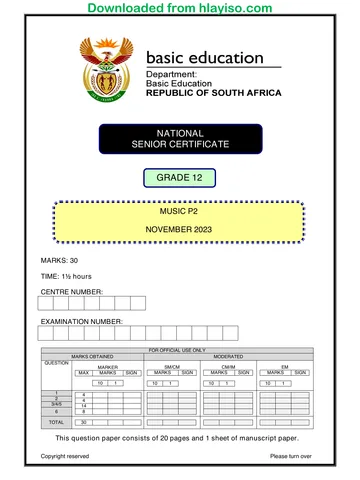
SENIOR CERTIFICATE EXAMINATIONS/
NATIONAL SENIOR CERTIFICATE EXAMINATIONS
MUSIC P2
2023
MARKS: 30
TIME: 1½ hours
CENTRE NUMBER:
EXAMINATION NUMBER:
FOR OFFICIAL USE ONLY
MARKS OBTAINED MODERATED
QUESTION
MARKER SM/CM CM/IM EM
MAX MARKS SIGN MARKS SIGN MARKS SIGN MARKS SIGN
10 1 10 1 10 1 10 1
1 4
2 4
3/4/5 14
6 8
TOTAL 30
This question paper consists of 21 pages and 1 sheet of manuscript paper.
Copyright reserved Please turn over
Skip to contentAll 2023 papers 
View all
Music Grade 12 P2 NSC June 2023 Question Paper (English)
Grade 12 Music Paper 2 question paper from the NSC June Exam 2023 (English), 22 pages. Read online or get the free PDF download, memo linked when available.
Music · Grade 12 · NSC June Exam · 2023. Question paper, 22 pages. Read online or download the PDF.
- Subject
- Music
- Grade
- Grade 12
- Document type
- Question paper
- Year
- 2023
- Exam period
- NSC June Exam
- Paper
- 2
- Curriculum
- CAPS
- Pages
- 22
- File size
- 1.1 MB
Free to read online, no sign-up needed
Loading document…
Loading document…
1 of 22
This exam
NSC June Exam 2023
Questions in this paper
- Question 1Notation, Rhythm & Metre4 marks
- Question 2Notation, Rhythm & Metre4 marks
- Question 3Indigenous African Music (IAM) — General Knowledge & Set Works [IAM]53 marks
- Question 4Western Art Music (WAM) — General Knowledge & Set Works [WAM]14 marks
- Question 5Western Art Music (WAM) — General Knowledge & Set Works [WAM]40 marks
- Question 6Harmony, Chords & Composition17 marks
Document textSearch extracted text and jump to a page.
Downloaded from hlayiso.com
Music/P2 2 DBE/2023
SC/NSC
INSTRUCTIONS AND INFORMATION
1. This question paper consists of THREE sections:
SECTION A: Aural (8)
SECTION B: Recognition of Music Concepts (14)
SECTION C: Form Analysis (8)
2. QUESTION 1, QUESTION 2 and QUESTION 6 are COMPULSORY.
3. In addition also answer QUESTION 3 (Indigenous African Music (IAM)) OR
QUESTION 4 (Jazz) OR QUESTION 5 (Western Art Music (WAM)).
4. Write ALL your answers on this question paper. Use a pencil for music notation
and blue or black ink for the other answers.
5. This examination will be done while candidates are listening to a CD.
6. The music teacher of the centre must conduct the examination in the presence
of the invigilator.
7. The last page of this question paper is manuscript paper intended for rough
work. Candidates must NOT remove this page.
8. Candidates may NOT have access to any musical instrument for the duration of
this examination.
9. Candidates must take note of the mark allocation of each question to provide
enough information in their answers.
10. Write neatly and legibly.
Copyright reserved Please turn over
Downloaded from hlayiso.com
Music/P2 3 DBE/2023
SC/NSC
INSTRUCTIONS FOR THE PERSON OPERATING THE SOUND EQUIPMENT
1. Allow the candidates to first read each question and then play the relevant track.
2. The number of the track must be announced clearly each time before it is played.
3. Each music extract (track) must be played the number of times specified in each
frame.
4. Allow adequate time between tracks to give candidates time to think and write their
answers before playing the next track.
5. If a school offers more than one stream (Indigenous African Music (IAM), Jazz or
Western Art Music (WAM)), the following guidelines must be followed:
Each stream must do the examination in a separate venue.
Each venue must be equipped with suitable sound equipment.
Each venue must have its own CD with music extracts.
An invigilator must be present in each venue.
6. The tracks have to be played as follows:
IAM candidates: Tracks 1 to 20 and Track 44
JAZZ candidates: Tracks 1 to 9, Tracks 21 to 31 and Track 44
WAM candidates: Tracks 1 to 9 and Tracks 32 to 44
7. A battery-powered CD player must be available in case of a power failure.
Copyright reserved Please turn over
Downloaded from hlayiso.com
Music/P2 4 DBE/2023
SC/NSC
SECTION A: AURAL (COMPULSORY)
QUESTION 1
Play Track 1 TWICE in succession.
1.1 Notate the rhythm of the missing notes in bars 2 and 3 below.
(3)
Play Track 1 TWICE again.
Play Track 2 TWICE in succession.
1.2 Notate the missing notes of the melodic line at (A) and (B).
(1)
Play Track 2 again.
[4]
Copyright reserved Please turn over
Downloaded from hlayiso.com
Music/P2 5 DBE/2023
SC/NSC
QUESTION 2
Answer the following questions by making a cross (X) in the appropriate block.
Play Tracks 3 and 4 THREE times in succession.
2.1 Identify the cadences at the end of each of the following TWO extracts.
Track 3 – THREE times
2.1.1 Perfect Interrupted Plagal Imperfect (1)
Track 4 – THREE times
2.1.2 Perfect Interrupted Plagal Imperfect (1)
Play Tracks 5 to 9 TWICE in succession.
2.2 Which ONE of the following describes the time signature?
Track 5 – TWICE
Irregular Duple Triple Quadruple (1)
2.3 Identify the change in texture.
Track 6 – TWICE
Monophonic to Monophonic to Homophonic to Polyphonic to
homophonic polyphonic polyphonic monophonic (1)
2.4 Which feature in this performance drives the music?
Track 7 – TWICE
Overtone singing Solo voice Body percussion Chord cycle (1)
2.5 Which term best describes the movement of the melody?
Track 8 – TWICE
Ascending Sequential Stepwise Chromatic (1)
Copyright reserved Please turn over
Downloaded from hlayiso.com
Music/P2 6 DBE/2023
SC/NSC
Track 9 – TWICE
2.6 Identify the tempo of this extract and describe how it changes.
(2)
(8 ÷ 2) [4]
TOTAL SECTION A: 8
Copyright reserved Please turn over
Downloaded from hlayiso.com
Music/P2 7 DBE/2023
SC/NSC
SECTION B: RECOGNITION OF MUSIC CONCEPTS
Answer QUESTION 3 (IAM)
OR QUESTION 4 (JAZZ)
OR QUESTION 5 (WAM).
QUESTION 3: INDIGENOUS AFRICAN MUSIC (IAM)
Listen to the following tracks and answer the questions that follow.
Play Tracks 10 to 20 TWICE in succession.
Track 10 – TWICE
3.1 Indicate THREE items in COLUMN A that relate to the music in Track 10.
Make a cross (X) in THREE appropriate blocks.
COLUMN A ANSWER
Polyrhythm
Djembe and mbira ensemble
Melodic material over marimba accompaniment
Improvisation on marimba
Multiple whistles creating layering
Call and response
Mbaqanga
Izihlabo (3)
Track 11 – TWICE
3.2 Indicate THREE items in COLUMN A that relate to the music in Track 11.
Make a cross (X) in THREE appropriate blocks.
COLUMN A ANSWER
Quadruple time
Triple time
Bass guitar ostinato
Skiffle rhythm
Bass guitar introduction
Chordophones and aerophones
Chordophones and membranophones
Syncopation (3)
Copyright reserved Please turn over
Downloaded from hlayiso.com
Music/P2 8 DBE/2023
SC/NSC
Track 12 – TWICE
3.3 Describe the accompaniment and the melody in this extract.
Accompaniment:
(2)
Melody:
(1)
Play Tracks 13, 14 and 15 TWICE in succession.
3.4 With which ONE of the following indigenous styles in COLUMN A do you
associate EACH track? Make a cross (X) in the appropriate block for each
track.
COLUMN A Track 13 Track 14 Track 15
Malombo
Kwela
Isicathamiya
Mbaqanga (3)
Track 16 – TWICE
3.5 Choose the term that describes the compositional technique heard in the vocal
part. Make a cross (X) in the appropriate block.
Sequence Melorhythm Repetition Improvisation (1)
Copyright reserved Please turn over
Downloaded from hlayiso.com
Music/P2 9 DBE/2023
SC/NSC
Track 17 – TWICE
3.6 3.6.1 Name the instrument playing the melody in this extract.
(1)
3.6.2 Briefly describe the accompaniment provided by the double bass,
drum kit and guitar/banjo.
Double bass:
Drum kit:
Guitar/banjo:
(3)
Track 18 – TWICE
3.7 3.7.1 Identify the band in this extract.
(1)
3.7.2 Choose the correct time signature for this extract.
Compound Simple Simple Compound
duple triple quadruple quadruple (1)
3.7.3 Give a brief description of the mood created by the music and
lyrics.
(1)
Copyright reserved Please turn over
Downloaded from hlayiso.com
Music/P2 10 DBE/2023
SC/NSC
Track 19 – TWICE
3.8 Give THREE reasons for this extract being a good example of mbaqanga.
Refer to instrumentation, harmony and melody.
(3)
Track 20 – TWICE
3.9 3.9.1 Identify the indigenous style in this extract.
(1)
3.9.2 With which THREE of the following statements in COLUMN A do
you associate this extract? Make a cross (X) in THREE appropriate
blocks.
COLUMN A ANSWER
Xhosa melody
Guitar introduction
Kwela influences
Inkunz' emnyama
Concertina
Male leader and female backing vocals
Guitar comping
Compound quadruple time
Idiophones (3)
3.9.3 Give the term for the introduction.
(1)
(28 ÷ 2) [14]
OR
Copyright reserved Please turn over
Downloaded from hlayiso.com
Music/P2 11 DBE/2023
SC/NSC
QUESTION 4: JAZZ
Listen to the following tracks and answer the questions that follow.
Play Tracks 20 to 31 TWICE in succession.
Track 21 – TWICE
4.1 Indicate THREE items in COLUMN A that relate to the music in Track 21.
Make a cross (X) in THREE appropriate blocks.
COLUMN A ANSWER
Chord ostinato
Polyphonic introduction
Clarinet melody
Syncopation in the melody
Regular rhythm and skiffle-like beat
Marabi and mbaqanga influences
African jazz
Two-chord cycle (3)
Track 22 – TWICE
4.2 Indicate THREE items in COLUMN A that relate to the music in Track 22.
Make a cross (X) in THREE appropriate blocks.
COLUMN A ANSWER
Chordal outline played on tuba
Ragtime
Violin soloist
Legato melody first played by trumpet
Glissandi
Comping on guitar
Double bass
Ascending chromatic passages
Trombone (3)
Copyright reserved Please turn over
Downloaded from hlayiso.com
Music/P2 12 DBE/2023
SC/NSC
Track 23 – TWICE
4.3 Describe the accompaniment and the melody in this extract.
Accompaniment:
(2)
Melody:
(1)
Play Tracks 24, 25 and 26 TWICE in succession
4.4 With which ONE of the following music styles in COLUMN A do you associate
EACH track? Make a cross (X) in the appropriate block for each track.
COLUMN A Track 24 Track 25 Track 26
Cape jazz
Kwela
New jazz
Marabi (3)
Track 27 – TWICE
4.5 Choose the term that describes the compositional technique heard in the
vocal part. Make a cross (X) in the appropriate block.
Sequence Polyrhythm Repetition Improvisation (1)
Copyright reserved Please turn over
Downloaded from hlayiso.com
Music/P2 13 DBE/2023
SC/NSC
Track 28 – TWICE
4.6 4.6.1 Name the instrument playing the melody in this extract.
(1)
4.6.2 Briefly describe the accompaniment provided by the double bass,
drum kit and guitar/banjo.
Double bass:
Drum kit:
Guitar/banjo:
(3)
Track 29 – TWICE
4.7 4.7.1 Identify the solo artist in this extract.
(1)
4.7.2 Identify the chord cycle used in this extract.
Single Four-chord Two-chord Three-chord
chord cycle cycle cycle (1)
Copyright reserved Please turn over
Downloaded from hlayiso.com
Music/P2 14 DBE/2023
SC/NSC
4.7.3 Explain the opening lyrics and the mood of the music.
(2)
Track 30 – TWICE
4.8 4.8.1 Which jazz style does the music in this extract represent?
(1)
4.8.2 Write brief notes on the saxophone improvisation.
(2)
Track 31 – TWICE
4.9 4.9.1 Identify the indigenous style in this extract.
(1)
4.9.2 With which THREE of the following statements in COLUMN A do
you associate this extract? Make a cross (X) in THREE appropriate
blocks.
COLUMN A ANSWER
Remix of a traditional Xhosa melody
Saxophone introduction
Mbaqanga influences
Manhattan Queens
Clarinet counter-melodies and improvisation
Male leader and female backing vocals
Male vocals
Quadruple time
Organ tremolo chords (3)
(28 ÷ 2) [14]
OR
Copyright reserved Please turn over
Downloaded from hlayiso.com
Music/P2 15 DBE/2023
SC/NSC
QUESTION 5: WESTERN ART MUSIC (WAM)
Listen to the following tracks and answer the questions that follow.
Play Tracks 32 to 43 TWICE in succession.
Track 32 – TWICE
5.1 Indicate THREE items in COLUMN A that relate to the music in Track 32.
Make a cross (X) in THREE appropriate blocks.
COLUMN A ANSWER
Langsam
Symphony orchestra
Baroque style
Syncopation in the brass section
Smorzando
Concerto
Percussive drive
Complex harmony and melodic fragments (3)
Track 33 – TWICE
5.2 Indicate THREE items in COLUMN A that relate to the music in Track 33.
Make a cross (X) in THREE appropriate blocks.
COLUMN A ANSWER
Rubato
Impressionistic Period
French horn soloist
Lyrical melody played on trumpet
Chromatic material in melodic line
Acciaccatura
Saxophone and piano
Ascending and descending scale passages
Accelerando (3)
Copyright reserved Please turn over
Downloaded from hlayiso.com
Music/P2 16 DBE/2023
SC/NSC
Track 34 – TWICE
5.3 Briefly describe the role of the organ, double bass and string orchestra as
accompaniment to the melody.
Organ:
Double bass:
String orchestra:
(3)
Play Tracks 35, 36 and 37 TWICE in succession.
5.4 With which ONE of the following characters in COLUMN A do you associate
EACH track? Make a cross (X) in the appropriate block for each track.
COLUMN A Track 35 Track 36 Track 37
Papageno
Pamina
Sarastro
Tamino (3)
Copyright reserved Please turn over
Downloaded from hlayiso.com
Music/P2 17 DBE/2023
SC/NSC
Track 38 – TWICE
5.5 Identify the combination of vocal participants that you hear in this extract.
Make a cross (X) in the appropriate block.
Baritone and Tenor and Bass and Baritone and
chorus quartet chorus quartet (1)
Track 39 – TWICE
5.6 Choose a term that describes the compositional technique in the vocal part.
Make a cross (X) in the appropriate block.
Ascending Vocal
Imitation Melisma
melodic contour decoration (1)
Track 40 – TWICE
5.7 5.7.1 Choose TWO terms in COLUMN A that best describe the mood of
this extract. Make a cross (X) in the TWO appropriate blocks.
COLUMN A ANSWER
Agitato
Giocoso
Parlando
Con fuoco
Piacevole
Con anima (2)
5.7.2 Why is this extract a good example of the genre aria?
(1)
Track 41 – TWICE
5.8 5.8.1 Name the instrument playing the melody in this extract.
(1)
Copyright reserved Please turn over
Downloaded from hlayiso.com
Music/P2 18 DBE/2023
SC/NSC
5.8.2 Describe the role of the bassoon, string section and full orchestra
in the accompaniment.
Bassoon:
String section:
Full orchestra:
(3)
Track 42 – TWICE
5.9 5.9.1 Identify from which movement(s) of Beethoven's Symphony No. 6
this extract is taken.
(1)
5.9.2 Describe the composer's intention within this extract.
(1)
Copyright reserved Please turn over
Downloaded from hlayiso.com
Music/P2 19 DBE/2023
SC/NSC
Track 43 – TWICE
5.10 5.10.1 Identify the genre of the work from which this extract is taken.
(1)
5.10.2 With which FOUR of the following statements in COLUMN A do
you associate this extract? Make a cross (X) in FOUR appropriate
blocks.
COLUMN A ANSWER
Thematic material for the whole work
Codetta
Pedal point and diminution
Inverted pedal point and sequences
Allegro assai
Repetition and augmentation
Opening motivic pattern
Overture
Quadruple time
Melody initially played by cellos and bassoons
Melody played by clarinets and oboes (4)
(28 ÷ 2) [14]
TOTAL SECTION B: 14
Copyright reserved Please turn over
Downloaded from hlayiso.com
Music/P2 20 DBE/2023
SC/NSC
SECTION C: FORM ANALYSIS
QUESTION 6
Read and study the questions for ONE minute.
Play Track 44 ONCE to provide an overview.
Listen to the piece below while you study the score.
Copyright reserved Please turn over
Downloaded from hlayiso.com
Music/P2 21 DBE/2023
SC/NSC
Play Track 44 again
6.1 Give a schematic layout of the form. Create rows in the table below and
indicate EACH section with its corresponding bar numbers.
SECTIONS BAR NUMBERS
(3)
6.2 Name the overall form type of this piece.
(1)
6.3 Name the compositional techniques in the bars specified:
6.3.1 Bars 43 to 61 (in the upper voice part)
(1)
6.3.2 Bars 21 and 22 (in the lower voice part)
(1)
6.4 Name the key and cadence at bars 73 to 8.
Key: (1)
Cadence: (1)
Play Track 44 for a final overview.
TOTAL SECTION C: 8
GRAND TOTAL: 30
Copyright reserved
Downloaded from hlayiso.com
Music/P2 DBE/2023
SC/NSC
Copyright reserved
Study this subject
Recommended for this subject
Question paper
Music Grade 12 P1 NSC June 2023 Question Paper (Afrikaans)
Question paper
Music Grade 12 P2 NSC November 2023 Question Paper (English)
Question paper
Music Grade 12 P2 NSC June 2024 Question Paper (English)
Question paper
Music Grade 12 P2 NSC June 2022 Question Paper (English)
Question paper
Music Grade 12 P2 NSC June 2021 Question Paper (English)
Question paper
Music Grade 12 P2 NSC June 2019 Question Paper (English)
More from Grade 12 Music
Memorandum
Music Grade 12 Paper 1 NSC June 2025 Memo (Afrikaans)
Memorandum
Music Grade 12 Paper 2 NSC June 2025 Memo (Afrikaans)
Memorandum
Music Grade 12 Paper 2 NSC November 2025 Memo (English)
Memorandum
Music Grade 12 Paper 1 November 2024 NSC Memo (English)
Memorandum
Music Grade 12 Paper 1 NSC June 2024 Memo (English)
Memorandum